If my manuscript were a song…
Posted: April 21, 2014 Filed under: On the Lucid Dreaming duology | Tags: Lucid Dreaming, music, pitches 1 CommentYesterday I entered Lucid Dreaming in Pitch Slam. The theme is one of those musical talent shows, like Australian/American/Armenian Idol. You audition (send your pitch) and if Simon Cowell doesn’t hate you, you move on to the next round. The agents, if they make requests, do so as record executives.
I know, right? How cute is that? 🙂
Anyway, as well as providing details like genre and word count, I had to name a song that sums up my manuscript.
For Lucid Dreaming, that was easy. (For Isla, I’d have a lot more trouble.) It’s Enter Sandman by Metallica. But it has to be an orchestral version, because violins. VIOLINS!
Ahem. What song would you choose for your manuscript/s or WIP/s?
Limiting your superpowers
Posted: February 21, 2014 Filed under: On the Isla's Inheritance trilogy, On the Lucid Dreaming duology | Tags: protagonists, urban fantasy 2 CommentsI’m a huge fan of superpowers—special abilities beyond the norm—having downsides or weaknesses. There’s nothing more boring (IMO YMMV ETC) than Captain Cheesecake, the speculative fiction superhero main character who can do anything. I’m looking at you, Superman—although he had kryptonite, his day-to-day abilities are over the top compared to other superheroes.
The contemporary equivalent of Captain Cheesecake is, of course, Ms Mary Sue (or Mr Mary Stu), the beautiful, talented and charming main character who seems to get whatever she wants and has men falling all over her. You particularly see her in fan fiction—and that’s where the term Mary Sue came from—but she crops up in traditional publishing from time to time as well.
Forgive me for saying it, Twilight fans, but Bella is a good example of a Mary Sue.
If a main character is going to have a supernatural ability, it’s important to me as a reader that it have clearly articulated limitations. It’s important as a writer too, because it’s hard to convolute your character’s life if he or she can just wave a magical doodad and unkink the twists in your plot.
And life is always more fun with a little kink.

Did she just say…?
Vampires become weak from lack of blood, and usually can’t go in the sun. Mages burn their own internal reserves, an act that limits their magical capacity. Wizards have wands, which can be lost or broken, or need special ingredients that are hard to find. Werewolves have issues with silver and hairy palms. Physically enhanced characters have limitations on how much damage they can take or how far they can push themselves before they keel over (except Captain Cheesecake Superman).
I’m a big fan of an energy limitation because it can be applied in so many different ways—vampires’ requirement for blood is a good example. I’ve used these types of limitations with the main characters in both my novels/series to date: Isla (of Isla’s Inheritance, funnily enough) and Melaina (from Lucid Dreaming).
In Isla’s case particularly, I also wanted to show the consequences of misusing special powers: what happens when they get out of control. It’s hard to give examples—because hello, spoilers—but think Mickey Mouse in The Sorcerer’s Apprentice. Or Renfield in Dracula.
(It’s really like neither of those things except only peripherally, but that’s the best I can think of.)
Also, another thing to consider is this: moral dilemmas are fun. Just because you can do a thing, should you? This subject could be a whole other blog post (and probably will be one day)—but a character’s morals can impose as much of a limitation on the use of a power or talent as any other, more-physical impediment to their use. (I guess this is where Superman redeems himself. Ok, fine, you can come out of the naughty corner, Clark.)
If you’re a speculative fiction writer, how have you stopped your main characters or bad guys from using their special abilities to wreak complete havoc with your plot and the world around them? And for the readers, what are your favourite examples of a writer putting the breaks on a power?
If you want to do something right…
Posted: January 26, 2014 Filed under: On the Isla's Inheritance trilogy, On the Lucid Dreaming duology, On writing | Tags: aussie-owned, Australia, blog hop, contests 6 Comments
(Okay, that may not be the most inspirational title for an Australia Day blog post, but I think it sums up what I am about to say pretty well.)
I love urban fantasy. Love it! I’ve felt that way since I didn’t know what the genre was called—back when Interview With the Vampire was filed in the sci-fi and fantasy section of the bookstore and the paranormal shelves didn’t exist. (Say what you will about it, we have Twilight to thank for their creation.) I thoroughly enjoyed Anita Blake’s early adventures, and loved Sookie Stackhouse when she came along too.
When I started thinking about the sort of novel I might write, I toyed with fantasy, but urban fantasy drew me back like a lodestone.
Then I’d think about where to set the book, and come unstuck. Because all the urban fantasy novels I read were set in America or, less usually, England. Wouldn’t Americans (who, lets be honest, are the biggest market of English-speaking readers in the world) prefer to read books set in their own country? The streets of New Orleans, Chicago, New York—those were the places haunted and hunted by the supernatural. Not sunny Australia.
I could’ve tried to write a book set in the States—I did think about it—but I felt like a fraud. I knew my Australian slang would reveal the lie. I’ve never even been to America. How could I pull that off?
So I didn’t write the book. Because “write what you know”, right?
Over the past few years, urban fantasies—and their kissing cousin, the paranormal romance—have started to appear, set in Australia. Maybe they’ve been around for longer and I only just began to notice them through the blanket coverage of foreign authors in Australian chain bookstores.
Okay, I thought, I can do this. Only… those books were all set in Sydney or Melbourne. Could Canberra, with its population of 360,000, be a viable setting for an urban fantasy? It may be the nation’s capital, but almost no one outside Australia has heard of it. Two out of three tourists think Sydney is the capital. (I just made that stat up, but I’d bet it’s true!)
And then it hit me like a boomerang in the face: if someone needs to do it to test the water, to see whether it’s a viable location for an urban fantasy, why shouldn’t that be me? I’ve lived here all my life so it definitely ticks the “write what you know” box. I love this city, with its wide open spaces, bush corridors, national monuments and occasionally dubious public art*.
Of course my books are set here.
*If you want to see what I’m talking about, do a Google image search for “Belconnen owl” and tell me what you think it looks like from behind. Then search for “Skywhale”, because LOL.
This post is part of Aussie Owned and Read’s Australia Day/Blogaversary blog hop. You can find other participating blogs or register your own here. And there is a GIANT GIVEAWAY too, which you can enter here.
New year’s resolutions: 2014 edition
Posted: December 31, 2013 Filed under: On the Isla's Inheritance trilogy, On the Lucid Dreaming duology | Tags: new year's resolutions, writing 8 Comments
I did alright with my 2013 resolutions. They were all successes except for the “get more exercise” one — because in the course of attempting that, I tore my Achilles tendon at the gym in May. As it turns out they take FOREVER to heal. Curses!
Anyway, here are my resolutions for 2014. You could just as equally call this post “writing goals” because that’s what they are.
1. Celebrate the launch of Isla’s Inheritance in October (or thereabouts). Convince as many of you as possible to buy it.
2. Finish writing and editing the third book in Isla’s trilogy, so it’s ready to go to Turquoise Morning Press when they ask for it. (My goal is to write a minimum of 2000 words a week. I know that may not seem like much, but I’m time poor. This is why I write so slowly.)
3. Find a home for Lucid Dreaming, whether that be via the agent/traditional press route or the small press route.
4. Start writing something else. Possibly a sequel to Lucid Dreaming, although there’s that Steampunk I’ve been thinking about for aaaages.
5. Read. I’ll set my Goodreads target to 40 again, see how it goes.
What about you? Do you do the resolution thing? Or, even if you don’t, do you have 2014 goals?
So, whassup? I’m glad you asked…
Posted: December 24, 2013 Filed under: On me, On the Isla's Inheritance trilogy, On the Lucid Dreaming duology, Short stories | Tags: contests, Isla's Inheritance, Lucid Dreaming, short story, writing Leave a commentI know I haven’t posted a huge amount lately. What with work being busy–that last-minute “HALP I NEED TO GET THIS DONE BEFORE THE END OF THE YEAR!” rush–as well as various non-work edits that needed finishing, I haven’t had much time for blogging.
Here’s a brief rundown on the things that have been happening lately.
PitchWars
If you read this post, you’d know I entered Lucid Dreaming into PitchWars, one of the festive season pitching contests. I didn’t get chosen as a mentee, obviously, or you’d have heard me yelling all around the globe, without the aid of technology.
What I did get, once again, was some fantastic feedback. The mentors didn’t have to, and frankly I’m not sure how they found the time given some of them had close to 100 entries, but three of the four I pitched to gave me personalised feedback. They were also very encouraging, and said things like “I have every confidence I will see your words in the bookstore some day in the not so distant future.” Aww. Also, squee!
And Dannie, one of the mentors I pitched to, also gave me an honourable mention on her blog:
Most creative use of technology in mentor stalking: Cassandra Page
I stalk like a BOSS.
Anyway, following some edits to my manuscript, I then entered it in…
PitchMAS
 PitchMAS is a bi-annual three-day pitchfest and workshop, held in July and December. It has two phases. The first is where 75 pitches are selected to be posted to the blog, where they can be requested by agents and acquisition editors for various presses.
My pitch for Lucid Dreaming was selected to go on the blog, and, as you can see, I got some interest. I got even more from the Twitter pitches. I’m not going into details because a lady doesn’t, er, pitch and tell, but if you want to know badly enough, the information is out there the Twitterverse. You just need to stalk like a BOSS too.
Santa Clash
 The premise of Santa Clash was that a bunch of writers would produce Christmas-themed short stories. They didn’t have to continue on from one another like the Zombie Project did. No, this time the catch was much more diabolical. Each writer was challenged to write in a genre they didn’t usually delve into. I was given “adult”. Those of you who know me will realise how HARD THIS WAS FOR ME!
My short story, Letting Go, went up yesterday. I’ve had two people tell me they cried when they read it, so, you know. There’s that.
Meanwhile, over at Aussie Owned and Read

Today my December post went up over at Aussie Owned and Read. It’s called Stop, Revive, Survive, after the NSW road safety message. Don’t drive when tired this Christmas, mkay? Or write, actually.
Also, the post has some of my holiday snaps on it. Ok, one holiday snap. It’s a pretty one, though. Promise.
Isla 3
Finally, edits complete, last weekend I was able to get started on the third book in Isla’s trilogy. I only started yesterday but I’m pleased to say drafting is JUST like falling off a bike. You skin your knees, and maybe your teeth are kinda wobbly afterwards (or is that just me?), but you don’t actually forget how to ride.
My TMP editor will be pleased to know I’ve only bled on the manuscript a little bit so far. I will try and clean it up before I send it to her. I promise.
PS. Don’t forget to enter my blogaversary giveaway if you haven’t already. 🙂
PitchWars Mentee Bio
Posted: December 6, 2013 Filed under: On me, On the Isla's Inheritance trilogy, On the Lucid Dreaming duology | Tags: aussie-owned, Isla's Inheritance, Lucid Dreaming, PitchWars 4 CommentsIf you’re a writer and on Twitter, you’ve probably heard of PitchWars, an annual battle run by Brenda Drake where writers attempt to win the love of one of several mentors. Those mentors in turn get overwhelmed with, ah, love, but choose one writer (and two spares!) to polish and take forward to the final round. There, each writer–mentor team competes for the further love of one or more agents.
It’s a giant lovefest, basically. I believe there’s some sort of prize involved, but I doubt the winning writer cares, because agent love!
Last year I entered PitchWars with Isla’s Inheritance. I didn’t win, but what I did do was receive some encouraging feedback and insightful advice that helped me improve the manuscript into something truly saleable. I’m confident that if it weren’t for that advice, Isla wouldn’t have the deal it does.
The other thing PitchWars gave me last year was exposure to an awesome network of writers, some of whom are now my closest tweeps and crit partners. It was via PitchWars that I met Stacey Nash and the rest of the guys I work with on Aussie Owned and Read.
Lucid Dreaming, which is a new adult urban fantasy unrelated to Isla, is now taking its turn in the PitchWars ring.
Pimp My Bio
The PitchWars mentors have bios, so we have the best chance possible of finding a match for our manuscript. One of the mentors, Dannie, is encouraging entrants to write their own bios, so the mentors can stalk them in turn.
Presumably this is so we know how they feel, having us paw over their blogs for clues. :p
Ten Things About Me

BATMAN!
One. I’m a single mother to the cutest four year old boy in the world. (Yes, he really is.) Sometimes he moonlights as Batman. I’m really looking forward to him learning to read, so that I can share my joy in books with him.
Two. This Sunday, as an early Christmas present, we are getting two Cairn Terriers, a mother-and-son team named Chilli and Leo. Chilli is an Australian Champion going into retirement at the advanced age of two. Leo is named after the Ninja Turtle.
There will be pictures—oh yes!
Three. I work full time as a professional editor for a big organisation, which means I’m used to the process. I’ve been editing for five years now (with breaks for coffee).
Four. COFFEE.
Last weekend my boyfriend and I went to an isolated national park to go caving, and he brought his espresso machine. Because, as he said, “Just because we’re on holidays, we don’t have to live like savages.”
Five. I’m an uber-nerd. One of the things that drew me to some of the mentors I chose is that they liked the same nerdy things as me. Doctor Who, Firefly… even the political nerdiness (and writing genius) that is The West Wing.
Six. I tabletop roleplay. I used to live action roleplay too. I dressed up as a vampire before they sparkled in the sun. (See point five.)

I have a TARDIS teapot.
Seven. I’ve written three books now, and each of them has an element of Greek mythology. I could say that this is by virtue of my name—Cassandra being the infamous Greek prophetess cursed not to be believed—but who knows?
(As an aside, the mythological Cassandra clearly never heard of reverse psychology. “Yeah, bringing that big wooden horse inside the walls of Troy and then having an early night is a TOPS IDEA!” “What? No way! Burn the horse!”)
Eight. Other than the aforementioned shows (and Castle, because Nathan Fillion), I watch very little television. I discovered that, despite points one and three, I could still find time to write if I quit most computer games and TV. Before that I was a WoW addict. And had a flirtation with Farmville. DON’T JUDGE ME!
Nine. I’ve been reading urban fantasy for longer than I’ve known what the genre is called. I used to call it “books that have magical elements but are set in the real world.” This is why people shouldn’t let me name things.
I also love fantasy, light sci-fi, cyberpunk and some horror. I don’t mind PNR but it’s not my true love like urban fantasy is—I just struggle to get into books where the romance is the only plot.
Ten. My writing weakness is semicolons. I LUFF THEM! But don’t worry, mentors, a crit partner already made me take 160 of them out of Lucid Dreaming. *tear*
Updates, and a call for content
Posted: September 25, 2013 Filed under: On the Lucid Dreaming duology, Uncategorized | Tags: betas, Lucid Dreaming Leave a commentI’ve been up since 5.30am (it’s now 7.22am as I write this, and I’m about to leave for work). So this is a bit of a rambling post. Please forgive any incoherent bits.

This is completely unrelated, but here’s a photo of a carved timber-and-metal raptor I saw at a woodworking showroom last weekend. It’s only $15k – buy it for me? 🙂
On Lucid Dreaming…
A few months ago I blogged about the importance of critique partners. I talked about the different approaches to getting feedback—whether you’re a perfectionist who edits your work before letting others read it, or whether you’re a sharer who is happy to let people see it and provide feedback when it’s still in its raw state.
I’ve done a little of both with my three manuscripts. But yesterday I just sent my latest manuscript, Lucid Dreaming, to my beta readers after a pretty thorough edit. Two of these beta readers haven’t read for me before, which made me even more anxious about them seeing my writing. Also, all of my beta readers are sheer awesome, which is a little daunting.
Of course, last night I couldn’t sleep. I felt all adrift. These are the classic signs that I need to embark on another project, to keep myself busy and not fretting. (Have they opened the document yet? Do they hate the first chapter? What if they notice that I’m faking it?) I have edits of Isla’s Oath to get on with, but I printed the manuscript before I moved temporarily into my parents’ house, and then, like an idiot, put it in a box. So that’s going to have to wait till we move into our new home—which is in about a fortnight.
Once I’m done with Isla’s Oath, the plan is to start on the third book in the trilogy. So I need to do some plotting there too.
On zombies…
I’ve spruiked The Zombie Project a few times here, and posted my short. If you want to read the whole set but can’t be bothered looking for all the stories, the amazing Chynna-Blue has put up a master post that details all of the contributors thus far, and links to the stories.
So now there’s no excuse. :p
(Spruiking is Australian slang for speaking in public, usually trying to promote or sell something. If you’re wondering.)
On blog content…
I’ve already contacted the ISP to start the process of getting broadband set up for the new house. But it could take weeks, and I can’t blog from work—so I’m looking at scheduling a bunch of posts for the next few weeks. If you are interested in writing a guest post or being interviewed, drop me a line at cassandrapage01_at_gmail.com (replace _at_ with @). The only catch is I’d need your post/answers by about 4 October at the latest.
Naming your book – and naming my book!
Posted: September 18, 2013 Filed under: On the Lucid Dreaming duology, On writing | Tags: editing, Lucid Dreaming, writing 5 CommentsLet me start out by saying that I suck at naming my books. Seriously. I come up with working titles during the drafting stage that don’t work for one reason or another, and then I get to the end of the process and can’t think of anything else.
 For example, Isla’s Inheritance originally had a title that actually contained a (minor) spoiler. I know, right? I’m an idiot. The working title was a great title—just not for that book. (I may use it for the third book in the trilogy; that remains to be seen.) The second book in the series was “Book Two” for ages, till it eventually became Isla’s Oath after Sharon suggested it.
Likewise, the book I just finished had a working title that might work for the name of a series, but doesn’t really grab me for the first book (in fact, I just googled it and it already is the name of a series … so that’s not going to work either, gorramit!). So I’ve been noodling new ideas for the past few weeks as I’ve been editing, settling on my criteria for a good book name.
These are my thoughts.
1. It shouldn’t have the name of a well-known book.
This point is pretty obvious. Bestsellers receive more promotion—anyone who walks into a store looking for your book may come out with the bestseller the bookseller has heard more about. (We’re not talking about your hardcore fans here, because they’ll know the author—but it’s amazing the number of people who buy gifts or hunt for books based on a fragment of information!)
For example, I thought about calling Isla’s Inheritance simply “Inheritance”, but Christopher Paolini already did that for his last Eragon book. Rats. If you’re not sure who else has used your potential title, Goodreads and Amazon searches are your friends.
I’ve been agonising about whether it’s okay for my book to share a title with any other work of fiction. If there’s an obscure self-published novel with only one or two ratings that has the same title, is that okay? I’m thinking probably. I have more than two relatives I can persuade to rate my book, so I should at least be the more popular one. 😉
One thing you can do, especially on sites like Goodreads, is give your book a subtitle: often the name of the series. Or, for some genres, titles that incorporate a unique, unifying element can work. Harry Potter is taken, though.
2. If it’s part of a series the titles should be thematically related … but also easy to remember.
As much as I’m not a huge fan of the Twilight series, Stephanie Meyer—or her editor—deserves huge amounts of respect for coming up with an awesome series of book titles. They are connected but not samey. You know which book is which. And they are short, which makes them easy to remember.
Maybe it’s just me, but I find a long series where the titles are all too close to one another very confusing. Charlaine Harris’s Sookie Stackhouse series of thirteen books is a good example. All of the books have the word “Dead” in the title. I just couldn’t tell the titles apart after a while—which made buying the next one trickier than it had to be! The titles were clever, but distinct? Easy to remember? Not for me, at least.
I haven’t plotted the sequel to my latest book yet—I need to write the third in Isla’s trilogy first—but there will be one. So I want a title that lends itself to that as well.
3. I like titles to be clever and beautiful.
My absolute favourite book titles are the ones that not only sound beautiful but have a double meaning—something where the readers go “oooooooooh!” at some point during the story. Those are hard to come by. Two examples off the top of my head are Bound by J. Elizabeth Hill and Forget Me Not by Stacey Nash (I’ve only seen a draft first chapter of the latter and I already know how perfect that title is for that book).
I love the poetry of Isla’s Inheritance and Isla’s Oath. They both roll off the tongue. But if my editor came up with something that did that and also had a double meaning, I’d give her a big wet kiss and change both titles in a heartbeat. (And of course, unless you’re self-publishing, there’s a good chance the title you’ve agonised over will get changed anyway. I gather this is especially true at the big end of town. But it pays to show you’ve put some thought into it; submitting a manuscript called “Insert Clever Title Here” doesn’t really show you at your professional best.)
So, after all of this consideration, what is the (tentative) title of my latest novel?

(I really wanted a gif with exploding fireworks but I couldn’t find one in the two minutes I spent googling!)
Achievement unlocked: novel complete
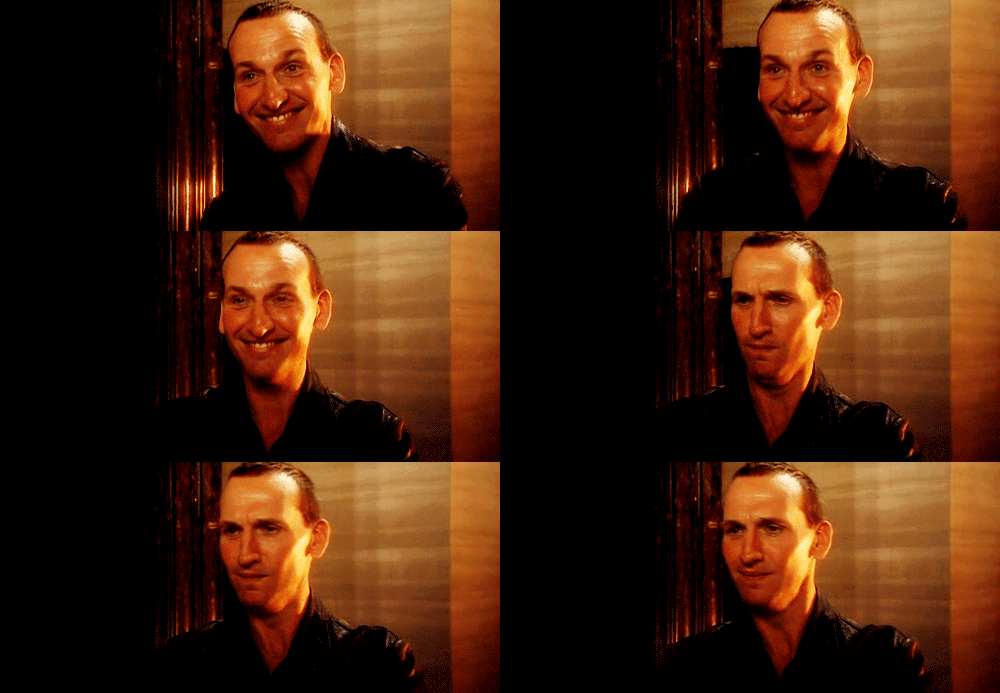
Posted: August 18, 2013 Filed under: On the Lucid Dreaming duology | Tags: drafting, Lucid Dreaming, writing 14 CommentsI finished my work in progress last night. Which makes me feel like this.
This book (working title: Melaina, which is the main character’s name because I suck at naming things) is 73k words and took me seven months to write.
By comparison, Isla’s Inheritance was about 80k words when I first finished it, and it took twice as long. I cut about 10k words from it in the editing process.
The difference in my writing speed is not that I have more time — I’m still a single parent with a little boy, and I can still only write after he’s gone to bed — but because I’ve learned that FIRST DRAFTS SUCK.
Seriously.
When I was writing Isla’s Inheritance, I obsesssed over the beginning. I knew you really had to land the beginning or your potential writer/agent/editor wouldn’t get any further to discover what your writing was like once you’d found your sea legs. And I knew there was something wrong with the beginning of my book, but I couldn’t fix it.
It wasn’t until I’d done several rounds of edits, received a bunch of agent rejections and had feedback from a pitching contest that I finally amputated the first couple thousand words from the start, and deleted an entire chapter in the first 10k words. It took me that long to gain perspective on it and see what the problem was.
And that’s why it’s not worth wasting a lot of time analysing your book in the drafting stage. You don’t have the perspective.
Also, drafting (despite what anyone tells you) is HARD. It requires dedication, finding the time to sit down when you’ve got washing to do or would rather be reading or sleeping. (Sleeping figures pretty highly for me.) I personally find dialogue easy and a lot of fun to write, but transition scenes? I have to make myself write them, and reward myself with cookies.
I’ve learned to cut myself some slack. Sure, what I come up with (especially during transition scenes) may be clunky and not flow properly. But I don’t let myself get too tied up in trying to fix it as I’m drafting. I will do one read over of what I wrote the previous session, and edit as I go. Then I move on. So far the only additional editing the bulk of Melaina has seen is when I’ve had an idea later on that’s involved a bit of foreshadowing; when I’ve edited that in I’ve often tinkered with the section I added it to.
That’s it.
There are hokey cliches in there (“my heart thundered”, “my pulse raced”). There are ridiculous phrases (for some reason I seem very fond of writing things like “my eyes roamed the room”, despite the anatomical impossibility of such an act). But that’s what editing is for.
It’s clunky but it’s done. The bones are there. You can’t edit nothing, and now I have something to polish.
Booyah!


 Cassandra Page