Muses and impudent characters (and bears, oh my!)
Posted: February 12, 2013 Filed under: On writing | Tags: fantasy novel, muses, protagonists, urban fantasy, writing 2 CommentsI always thought writers who talked about their muses as though they were people were being self-indulgent, using some of that artistic license that is one of the tools of the trade. In “On Writing” (yes, I go on about that book—I just re-read it over the break), Stephen King describes his muse as follows:
“He lives in the ground. He’s a basement kind of guy. You have to descend to his level, and once you get down there you have to furnish an apartment for him to live in. You have to do all the grunt labor, in other words, while the muse sits and smokes cigars and admires his bowling trophies and pretends to ignore you.” (The full quote is here.)

“Hésiode et la Muse” by Gustave Moreau. I’m pretty sure that translates to “My Muse is a Bit of a Cow”. (Image from Wikipedia Commons.)
I’ve seen my stories take unexpected turns—but I thought it was just that, as you were writing, you saw better options.
Then two experiences changed my mind.
The first was when, more than halfway through drafting my previous novel, there was an entirely unplanned kiss between two characters. One of them did something a little bit clever that the other didn’t see coming, and the other, in an excess of exuberance, gave the first a hug that suddenly got all romantic.
This was particularly awkward given that the kissee had a significant other.
I knew the kisser was interested, of course. But I never in a million years thought he’d make the first move. SURPRISE!
The other instance was more recently. Some of you may recall me having a whinge about not knowing which novel idea I wanted to pursue next: the fantasy (fully plotted out) or the urban fantasy (no plot whatsoever). I’d decided on the fantasy; I borrowed books to do research, so I could start my world-building, and was all good to go. Excited, even.
Then, one day driving home from work, I had the basic plot structure for the urban fantasy land in my head like someone had dropped a load of bricks on the car. I lay up half that night thinking about it. I couldn’t let it go for days, walking around like I was sleepwalking (I probably was, given the laying up all night!).
It only stopped when I gave in and started the other manuscript instead.
My conclusion from all of this is that my muse, whoever she is, isn’t a bloke smoking cigars in a basement. I don’t know where she lives or what she looks like, but she wears combat boots (for stompin’ ideas into my recalcitrant head) and probably has a battered and super-trashy novel featuring a love triangle tucked under one arm.
The bitch!
Is your muse personified? Has he or she pulled stunts like this on you?
An Ode to a Semicolon
Posted: February 10, 2013 Filed under: On writing | Tags: poetry, punctuation, writing 3 CommentsI said yesterday I’d written a poem about semicolons once. It was called “An Ode to a Semicolon”, and I wrote it back in my crazy university days. I was such a party animal.
Unfortunately the original version has been lost to the dusts of time, but I’ve had a go at recreating it (the second verse is new) for your reading pleasure.
And so you can all mock me. 😉
Little punctuation mark,
Seldom ever used,
Rarely used correctly,
Oftenest abused.Paired up with a bracket,
You’re a winking face,
But as a punctuation mark
You’re losing your place.Sometimes you’re like a comma,
To break up complex lists—
The use of semicolons
Oftentimes assists.Sometimes, you’re like a full stop
But gentler than he
Oh, little semicolon,
You have a friend in me!
Edit: If you want a proper description of how to use a semicolon, I’ve written one here.
Doing your dash: en rules and em rules …
Posted: February 9, 2013 Filed under: On writing | Tags: punctuation, writing 4 CommentsEver noticed how there are separate dashes of several lengths? Ever wondered how you use them correctly? Then, boy howdy, this is the blog post for you. (Yes, correct punctuation use excites me. I wrote a poem about semicolons once.)
En rules (also known as en dashes) are so called because they were traditionally the same length as an “n”. They can be typed in Word by pressing CTRL and the minus key on the number pad: –
(Note that “en” is pronounced like the letter, not like the French word for “in”.)
They can be used in a couple of ways. One is to connect spans of time or entities, with no spaces either side:
the January–February carnival
the US–Canadian border
The other way they can be used is to insert a break into a sentence, or to include a statement that could otherwise be broken out with commas or brackets/parentheses. If they are used for this they must have spaces either side.
My hair – which is really curly – refuses to do what it’s told.
Em rules (also known as, unsurprisingly, em dashes) are (also unsurprisingly) known as such because they are traditionally the same length as an “m”. They can be typed in Word by pressing CTRL, ALT and the minus key on the number pad: —
As with en rules, em rules can be used to insert a break or a parenthetical statement into a sentence. Unlike with en rules, though, they shouldn’t have spaces either side.
My hair—which is really curly—refuses to do what it’s told.
Em rules are also used to attribute quotations:
“Good books don’t give up all their secrets at once.” — Stephen King
Don’t use both “—” and “–” to break up your sentences in one document or you’ll look a little nutty. If you’re writing for a specific publisher, then you can have a look at other books they’ve published to see what they prefer. I personally use em rules in my writing, but at work the style is to use en rules.
Also, don’t overuse them. More than a set of en rules (or em rules) in a paragraph starts to make me feel like I’m being dashed in the eye!
So today is my hativersary
Posted: February 8, 2013 Filed under: On me | Tags: fears, hats, travel 2 CommentsYes, you read that right. Hativersary. It’s the anniversary of my traumatic encounter with a hat.

Duns Castle. My future home. ❤
Last year my boyfriend took me and my son (who was then two-and-a-half) on our very first overseas trip. The itinerary was Scotland, then Spain, then Italy. In Scotland we stayed at Duns Castle in the border region, an extravagance to celebrate the BF’s significant birthday. It was amazing. The atmosphere of the place was something I will never forget. Our room was one of the corner suites, in what used to be the guard tower, and even though I got the inevitable cold, I still really loved the place.
The other memories of Scotland that stay with me are the pubs—you don’t get pubs like that in Australia—and Edinburgh’s skyline at sunset. Oh, and the day we went to a falconry! I got to fly, and pat, a boobook owl, a species from Australia. He was a long way from home too.
My only regret was that we missed the snow by a day!
Then, after some frustrations including lost luggage for a party of five adults and two children, we got to Spain.

Gulliver’s Hat, from the outside.
In Valencia they have this awesome park based around Gulliver. You know, the fellow who got captured by the Lilliputians? Well, he’s a giant fiberglass man, reclining in the gravel, covered in slides and climbing frames and all sorts of other coolness. The BF and I were talking about how awesome it’d be to have something like that in Canberra, while we took photos of us standing inside his shoe, or of my son eyeing off a sword that was almost as wide across the pommel as he was tall.
Then we discovered why it’d never be feasible in Australia. They’d never get the public liability insurance.
See, Gulliver has a giant hat, and inside the giant hat is a little model of the entire park, like a 3D map. While the BF and my son were exploring another slide, I climbed onto the hat (the brim was a foot or so from the ground) to take a photo. After I was done, I distinctly remember looking down at the ground from the edge and thinking, “Nah, if I slip I’ll hurt myself; I’ll go use the stairs.”
And then, right beside the stairs, my foot slid off the edge and I fell.
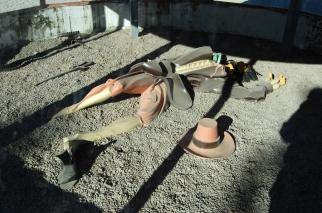
Inside Gulliver’s Hat. Acquiring this photo cost me a trip to Italy, so I hope you like it. :p
It twisted under me and rolled at an entirely unnatural angle. I’ve sprained my ankle before, but I’d felt nothing like this. By the time the BF ran over it had swollen up like I had a tennis ball instead of an ankle. He took off to get the first aid attendant—in hindsight, the fact they had a first aid office on site was a good warning sign—while I gave my son a cuddle, because he got quite hysterical to see me crying from pain. (And I suspect because all of a sudden the sliding had stopped. Hey, he was two!)
So that day I got to experience a few other new things I hadn’t before. I got to ride in a Spanish ambulance, and experience a crowded ED waiting room where no one (and I mean NO ONE) spoke English. I’ve never felt so helpless in my life. Fortunately after I got wheeled off on a stretcher, the BF got hold of the Australian consulate, and they were able to talk to the hospital staff and organise everything. They were, to hear him tell it, pretty amazing.
Your tax dollars at work.
Unfortunately I did enough damage to my ankle that I ended up in a cast and on crutches. Which meant that Italy was cancelled (yes, the whole country!) and we all came home, because there was no way my BF could manage me, a two-year-old, three suitcases and various carryon luggage on his own. After we got home I had to get physiotherapy for my ankle.
I am still sad that I missed seeing Rome and Pompeii, in particular, but hey. I’m the only person I know that ruined an overseas holiday by falling off a hat, and that’s worth something … right?
Right? *whimper*
My favourite grammar joke
Posted: February 7, 2013 Filed under: Uncategorized | Tags: tense 2 Comments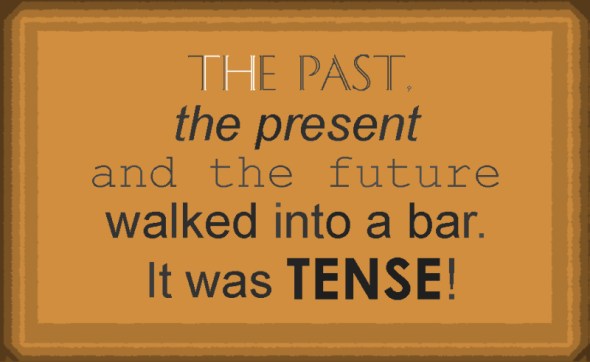
Laugh, damn you! LAUGH!
Info dumps and wilful ignorance
Posted: February 6, 2013 Filed under: On writing | Tags: editing, writing, young adult 8 CommentsI just finished a young adult (YA) novel that I wasn’t a huge fan of. I considered writing a review, but thought that rather than naming and shaming it might be more beneficial to instead outline the two main reasons I didn’t like the book. As a writer, I’ve found I learn just as much from bad books as good ones. Maybe I can share my learning without inflicting the object of the lesson on you directly!
This particular book was originally self-published. After it had good sales, it had a quick copy edit done (I presume, as some of the Goodreads reviews mentioned typos and I didn’t see any) and was then published in traditional form. You could tell it hadn’t felt a structural editor’s deft hand, though, because many of my objections were all things a good editor could have fixed.
Info dumps
The book featured a supernatural race and a main character who didn’t know she was part of that race: all fairly standard for YA urban fantasy (hell, my book has them!). The author clearly wanted to establish early on the signs the character was different—but it was done awkwardly, by way of the narrator explaining things to the reader in a giant info dump. You’re probably familiar with the concept of “show, don’t tell”. This was all tell.
Also, none of the supernatural indicators were that striking. The race easily passed for human. So it wasn’t “by the way, I have a tail and cloven hooves”, it was “by the way, I don’t like seafood and the colour pink” (yes, I made those up). It made the main character look fussy and difficult, although it was clear to me as a reader what was going on.
The end result of all this was that it took me out of the story and made me notice the (poor) craft. As a writer, taking your reader out of the story is the number one thing you want to avoid.
Wilful ignorance as a plot device
The author clearly wanted to dole out information about the race and its society over the course of the first half of the book. I get that. A slow reveal, when handled well, can be like a strip tease, making you stick around to see just a little bit more…
Unfortunately, in this case, it wasn’t at all sexy. Because it resulted in the main character not asking obvious questions, which made her look stupid, callous or both.
Likewise, the supporting characters, who were meant to be inducting her into her race, kept her deliberately ignorant when it made no sense for them to. And then they had the nerve to scold her when she did the wrong thing out of that ignorance! In one example, one guy told the leading lady it wasn’t his place to explain something—only to explain that same thing a chapter or two later with no indication of why he’d changed his mind. I wanted to slap him upside the head. With a semitrailer.
It’s challenging to have a “discovery” storyline when the teachers know everything and the reader and main character don’t. Managing the reveal is tricky. I get it. But if the reader starts to get frustrated and feels like they are being deliberately kept in the dark, you’ve pulled them out of the story again.
Another example of wilful ignorance was when, at the end of the book, the main character abruptly decided to do something that seemed out of character (based on her previous actions), justified by some extremely flimsy logic. Presumably this was to set up the start of the sequel, but it bugged me enough that I doubt I’ll ever know…
</end soapbox>
I wrote a stunt letter…
Posted: February 5, 2013 Filed under: On writing | Tags: agents, queries, writing Leave a commentI said a fortnight ago that I wasn’t willing to share my query letter because I wasn’t confident that it was actually going to provide a good template, given its lack of success to date.
I forgot that the divine Agent Sydney had offered to do query crits last year, and that I’d sent mine in on a whim. So, um, you can read my query letter as it stood back then, and her feedback on it, here. She said nice things, which was sweet of her.
Except my Jedi mind trick in the last paragraph—this is not the lack of publishing credits you’re looking for—didn’t work. I guess I’d better deal with that. :p
I’ve actually changed the query quite a bit since I sent it to Agent Sydney, tightening it up even further (I hope!). Queries evolve. Like amoebas.
(Also, the word count on the manuscript is now down to about 76k. I’m an editing machine.)
At the risk of this sounding like an Oscar speech, especially since I haven’t won anything, I need to give big ups to Lori, Stacey L, Stacey N, Lauren and Katie for helping me with the query at different times. 😀
Past and Present Verbs in Fiction
Posted: February 2, 2013 Filed under: On writing | Tags: tense, writing Leave a commentI was debating a day or two ago whether to write the next book in first or third person, and the subject of present or past tense came up in chatting to folks on Twitter. I was going to blog about it, but the gorgeous Nicole has more-or-less summarised my thoughts, so I’m going to be lazy and reblog her post. 😉
(Also, she just got an agent for her historical novel on Guinevere, so you should check out her blog anyway!)
I’ve always written in past tense. The only way I’d consider present tense was if I was writing a heavy action story where the pace was going to be through the roof. And I’m not sure I could do it even then! Old habits die hard.
I find that I adjust to present tense in others’ books (like “The Hunger Games”, or “Blackbirds” by Chuck Wendig) but it always takes me a chapter or two to get into the mode. Past tense just feels so much more natural to me. People have been telling stories for thousands of years, and they are usually told in past tense. I think maybe I’m just hardwired that way.
You?

 I’ve been noticing more and more books being written in present tense lately. This post is really just my thoughts and questions on the subject. I’d love it to spur dialogue among my readers because I want to know what you think.
I first read a book written in present tense about two years ago. It was historical fiction and jumped back and forth between the past and the present. If that wasn’t confusing enough, the sections in present time were written in past tense and the historical parts were written in present tense. (Because that’s logical, right?) While that was very confusing, I have enjoyed several books written in present tense, such as the Hunger Games series, Divergent by Veronica Roth, and Alyson Noel’s Immortals series.
But I try as I may, I can’t get myself to like present tense writing. I’ve read that it’s supposed to convey a greater…
View original post 201 more words
A three-haiku story…
Posted: February 2, 2013 Filed under: On writing | Tags: Chuck Wendig, contests, poetry, writing Leave a commentChuck Wendig issued a flash fiction challenge today: use three simple haikus (the 5/7/5 structure we all did at school) to tell a single story. He’s giving away some writing e-books; if you want to enter, go here.
Here’s my dodgy little contribution, which is also posted on his page, but I thought I’d share it here. I wrote it about Canberra’s 2003 firestorm. That was a hell of a day…
Sirens wail alarms.
The firestorm approaches;
the sky turns to ash.Trails of cars snake free
of flaming suburbia.
Will their homes survive?Some lose everything.
Others are more fortunate.
The city rebuilds.
Disney girls, aka “Meg’s the best; forget the rest”…
Posted: February 2, 2013 Filed under: Uncategorized | Tags: disney, movies, protagonists 10 CommentsMy son has recently been watching old Disney movies. The most recent one on the repeat cycle has been the 1997 movie Hercules. He loves it because Hercules is really strong and beats up monsters, something a little boy who’s afraid of the dark can fully appreciate.
I like it, though, because it’s the only Disney “princess” movie where the leading lady isn’t a sweet little princess. In fact, I doubt she’s actually a princess, although they never reveal anything about her family origins.
I realised, watching it, that Meg was my ideal novel protagonist as well. She’s sassy and self-sufficient, not innocent and naive (and probably not a virgin, although this is Disney so that’s suggested rather than stated outright). She does her damnedest to take charge and get herself out of problems, although that sometimes gets her straight into them. Which is called life, really—we all do it.

The image copyright belongs to Disney
When you compare her to the other Disney girls, she’s streets ahead. Some of them aren’t too offensive as female role-models (Jasmine is ok; at least she’s trying to have some independence, even if it’s not working); others make me deeply uneasy (Belle, although I love her bookish habits, basically teaches girls that if you love a man enough he’ll be “cured” of his abusive tendencies; Cinderella teaches girls the only way out of a shitty home situation is through marriage).
My characters come with varying levels of sass, but so far I haven’t had a wet noodle for a main character, and I don’t intend to start.
Here are a few choice quotes from Meg:
Hercules: “Aren’t you … a damsel in distress?”
Meg: “I’m a damsel, I’m in distress. I can handle this. Have a nice day.”
Meg: “I’m a big tough girl. I tie my own sandals and everything.”
Hercules: “You know, when I was a kid, I would have given anything to be exactly like everybody else.”
Meg: “You wanted to be petty and dishonest?”
Who’s your favourite kids movie leading lady and why?


 Cassandra Page