Hooking your reader: writing a blurb.
Posted: March 6, 2013 Filed under: On writing | Tags: blurbs, guest post, self-publishing 4 CommentsI hope you enjoy this: my first guest post, written by Sharon Sant!
The cover is the first thing that will draw a reader towards your book, but if you think of that as the shop window, then the blurb is the sales patter once you’ve entered the store. You’ve spotted that adorable teapot, or that divine sparkly dress, so you step inside the shop and are greeted by a smelly, rude, disinterested sales assistant. What do you do? You might still buy the item, enamoured by its beauty. More likely, you won’t want to give a penny of your hard-earned cash to such a vile specimen of humanity.
Think of your blurb that way. You’ve tempted in your customer with a fabulous cover, but then your blurb is a snore-fest. They’re not going to buy. It’s such a common mistake and easy to avoid. Your blurb is not a synopsis of the book; it’s a tickle under the chin that says: come on in and stay with us for a while. Your blurb needs to convince the reader, in a few short seconds, that they cannot live without discovering what happens in your book. There are a few simple points to consider that will help you achieve this:
Research
Know your genre. Look at what other blurbs are like, as many as you can. Take note of the language they use—it’s usually in keeping with the tone of the book. A thriller, for example, will use short, punchy sentences. A fantasy blurb will feel like it is weaving magic as it talks to you. A quirky comedy will try to make you laugh. Romance will want to seduce you. The more you read of others, the more you’ll get an intuitive feel for what needs to go in yours.
Keywords
This goes hand in hand with researching your genre. Every genre has its conventions—things that readers expect and want to see—and the blurb should adhere to that. Look at other blurbs for words that crop up again and again within the same genre; they’re there for a reason. Fantasy blurbs contain a lot of ‘destiny’ and ‘magic’. See where we’re going? These words will pique the interest of your potential reader; they’re browsing your genre because that’s what they like to read about.
Pose a question
Drive your potential buyer mad with curiosity. Pose ‘what if’ questions to lure them into your story. ‘What if this woman doesn’t get the man of her dreams?’ What will this woman do? Will she kill herself? Have a sex change? Become a nun? Leave your potential reader needing to know. It can be effective to hit them with your blurb first and then pose the question as the closing line. You can also do the question pose without actually using a question: ‘Her life would be perfect, if only she could catch the man of her dreams…’ Here, we leave the outcome as something unknown; just like when we posed the question, the reader doesn’t know where the story is going to end up and we’ve caught their interest.
Keep it short
You have no idea how many blurbs I’ve seen that seem to be longer than the book itself. Your book is awesome, but don’t tell the reader everything that happens on the blurb in a non-awesome, telling-not-showing way. Keep it short and retain your mystery, feed them just enough to lure them in. Personally, I think a paragraph or two is about right, but I’ve seen one-liners that work brilliantly. It’s up to you but always remember that your blurb is not your synopsis.
Sharon Sant holds a BA (Hons) in English and creative writing and is currently researching a PhD in literary studies. She is a freelance editor and is the author of YA novels, “Sky Song” and “The Young Moon”. You can find her blog here.

Call for guest posts!
Posted: March 5, 2013 Filed under: Uncategorized | Tags: blogging 4 Comments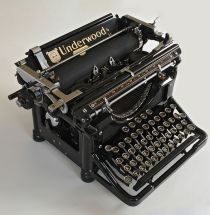
Blogging, old school. (Image from Wiki Commons.)
As some of you may be aware, I’m in the middle of getting my house ready to sell. My days lately have been filled with cleaning, boxing and rearranging—and today I plan on gardening. At night I tend to feed and wash the child, then put him to bed and collapse unconscious myself.
But because I want to keep up with the content so you don’t all abandon me (sniff), I put a call out on Twitter seeking people to write guest posts on writing and publishing. I’ve got a few awesome folks already working on posts for me, but I thought I’d put the call out here as well.
If you’ve got something to say in around 500 words about writing—the process, grammar, editing, seeking a publisher, self-publishing or anything else that springs to mind—send me an email (cassandrapage01_at_gmail.com) and we can talk! 🙂
A writer’s space
Posted: February 27, 2013 Filed under: On writing | Tags: real-estate, writing 10 CommentsI made a huge decision last night: I decided to sell my house and downsize to something smaller, something my three-year-old and I don’t rattle around in like marbles in a bathtub. I love my current house, but the mortgage is costing me the GDP of a small African nation.
So I’ve been looking at real estate websites, trying to get myself excited at the idea of moving somewhere that’s Not Here, and I decided one of my criteria is that I need a little bit of space for just me in the house. Either a study or a living area that’s not right next to the television—in other words, somewhere I can set up the computer and write in peace.
Some people would say that’s self-indulgent. I’d save more money getting us a tiny two-bedroom apartment. But I think it’s required for my sanity, and if I can do it I should.
(I’ve also got five bookshelves worth of books I need to accommodate. Don’t ask me to part with them!)
All of this got me to thinking. What do other writers work with? What’s your current space like? Is it ideal, or are there things you’d change if you could? Do you have to write with noise-cancelling headphones to ignore the chaos around you? Or write on your laptop in your room with the door locked?
Writers and publishers: do not do this to your readers!
Posted: February 23, 2013 Filed under: On Books, On writing | Tags: book covers, reviews, writing, young adult 14 CommentsI just finished a book that had what I’d have to say is the worst ending of all time. I know that’s a big call, but bear with me and I’m sure you’ll agree. Now, normally I wouldn’t name and shame the book, but in this case I don’t actually blame the author. I’d be surprised if the crime against readers that is the ending of this book was her idea.

Redeeming feature: the cover is lovely
The book is “Red Riding Hood” by Sarah Blakley-Cartwright.
I knew there was a movie based on the book—there’s a little fake sticker on the front that says “Now a major motion picture”. What I didn’t know when I bought it was that the book was actually written after the screenplay; they got Blakley-Cartwright in to write the novelisation. That’s why she has joint billing on the front of the book—the other guy is the screenplay writer. A lot of the oddities in the storytelling style (the omniscient third person narrator; the choppy, short scenes) clearly fall out of this process.
But the worst thing by far—which took the book from being an interesting horror/mystery to being an abomination—is that the publishers have printed the book without the last chapter.
I don’t just mean that the last chapter sucks or the story doesn’t finish. I mean that the final chapter of the book has actually been excised from the paperback. When you get to where it should be a web address refers you to the movie’s website, where the missing chapter is available as “bonus material”.
Don’t get me started on the idea of labeling the critical part of the novel I spent money on as a “bonus”!
Apparently the novel came out before the movie, and someone was worried that it would spoil the movie. Or decided that if people could read the ending of the book (and find out who the “Wolf” was, which was the mystery element) they wouldn’t want to see the movie. Never mind the fact that readers across the world have been managing to read books before movies for decades. Some people actually prefer to do it that way.
So the extra chapter wasn’t actually released onto the website till after the movie came out. I can’t imagine how furious I’d be if I’d bought the book beforehand and had to wait. I am frustrated enough as it is!
Withholding the end of a book from the readers isn’t a clever marketing strategy or a way to build hype. It’s insulting, and deprives readers of something they’ve (probably) paid good money for. I’m glad I bought this book secondhand. I feel less ripped off.
The other thing to consider is that a lot of book readers actually like to keep books they love on their shelves, to reread them or as a collector’s item. I’m one of those—I have shelves filled with books that I love. I would have kept this book (like I said, it’s not bad, and the cover is pretty), except it’s incomplete. What am I meant to do? Print the ten extra pages and stick them in the back? Yeah, that’s not going to happen…
I know I’m getting my ranty pants on here, but I felt extremely ripped off when I finished this book. I lay up past midnight fuming about it. (I know, I need to take a chill pill.) And I hear ranting is what blogs are all about!
I think the main lesson for writers (and publishers) is not to promise things you aren’t going to deliver in your book. If you’ve got a meta-plot arc that runs over the course of several books, that’s okay, but you’ve got to give a reader some closure at the end of your novel if you don’t want them throwing the book across the room.
Now I’m going to take a deep breath and move on. Thanks for letting me rant.
My other entry into the Bad Query contest
Posted: February 22, 2013 Filed under: On writing | Tags: agents, contests, poetry, queries 2 CommentsHere is my second and final entry into the Bad Query Contest. (See the previous post for my first one.)
At ten thousand words, my novel on birds
Is the tastiest treat you will read.
And I know Mum is right; she says it’s a delight
So become my agent, I plead.I’m sure that you know it. I am a poet—
But my book is written in prose.
It covers the tales of two Willy Wagtails,
Relating their highs and their lows.In case you’ve not heard, that type of bird
Comes from the land of Australia—
Rather like me. I’m sure you will see
My writing, it shall not fail ya.And so it is I wait for your reply.
Please send the contracts to me,
And so that I may send them back the same day,
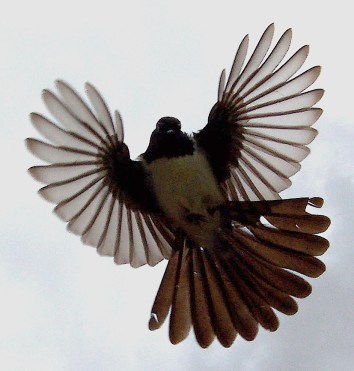
Please enclose an SASE.A picture of the main character. (From Wiki Commons.)
(Yes, I actually winced writing the end of the third verse. If you’re wondering.)
Edit: This one was posted on the Bad Query Contest blog, here. I won the “Best query in verse about birds” award. I’m so proud. Do you think I could use that as an author credit on future queries? 😉
My entry into the Bad Query contest
Posted: February 21, 2013 Filed under: On writing | Tags: agents, cheese, contests, queries 2 CommentsJessica Sinsheimer is running a Bad Query contest over at Tumblr. You should check it out, because it’s absolutely hilarious! I think the prize is a query critique, but honestly, that’s not why anyone is entering. 😉
Here’s my entry. For the love of God never write a query like this!
Hi Jessie,
I saw on Twitter that you really like cheese and seen as I really like cheese too I thought that you would be the perfect agent to buy my book, which is a cross between The Hunger Games and the Bible (it doesn’t currently have any cheese in it but i could add some if you think it would help you to seell the book to the Big Six or Five or whatever. Cause, you know, The Hunger Games is about hungry people adn who doesn’t like cheese anyway? I bet Jesus does, unless he’s a vegan. I’m not sure because I’ve never read the Bible. Don’t tell my mother!)/
My book is currently complete @ 25486 words long, although I am still editing it to add in extra scenes after getting feedback from my best friend and my boyfriend. I reckon when I’m done it will be 30000, easy.
Anyway, I have attached the full manuscript because while i know your website said to embed it in the email I thought you would be really keen to read it straight away and I didn’t want to slow you down. You’ll find I’m a super considerate client like that.
Oh, and have you seen Tim Minchin’s song called “Cheese”? I thought it could be our song. Watch it, you’ll see. We’re practically soul mates, you me and Tim!
Lots of love,
Brie Brewster
Here are a few of the things I did wrong:
* She refers to herself as Jessica on Twitter. For all I know “Jessie” one of her pet peeves! Get the name right, and use it the way the agent does.
* Agents don’t buy books. They offer representation. Publishers buy books.
* Spellchecker? What’s that? Proofreading? Ha!
* No genre or title has been provided. Also, the manuscript isn’t actually complete and 30,000 isn’t novel-length. And what’s the plot? Basically, everything that makes up the most important part of a query is missing!
* Sending attachments without being asked – that’s a paddlin’.
* The whole cheese thing… it’s nice to add a personal touch that shows you have actually done your research, but “Brie” took it way overboard. To stalker land!
‘Which’ versus ‘that’: when to use them!
Posted: February 19, 2013 Filed under: On writing | Tags: editing, words to be wary of, writing 4 CommentsIt’s time for another grammar rant from me. This one is about when to use “which” and when to use “that”. I see a lot of published documents—fiction and otherwise—that use them both (IMO) incorrectly.
Consider the following sentence:
I bought a car which is pink.
According to some grammar books, the “which” is wrong. According to others, it’s not incorrect but it’s also not the best choice of words because it leaves the reader to guess what you’re trying to say. Either way, it should be fixed.
Both “which” and “that” can be used to introduce a clause. But when they do, they flag different things to the reader. “Which” flags a non-defining clause: one that contains supplementary information not required by the main clause. “That” flags a defining clause: one that is part of your main message.
When used to introduce a clause, “which” requires a comma in front of it and “that” shouldn’t have one.
So, in the case of the car, if I’m trying to tell you a bought a car that happened to be pink, I’d say:
I bought a car, which is pink.
The information after the comma is supplementary, not essential to the sentence. But if I’m really excited about the fact my car is pink, and it’s the main focus of what I’m trying to say, then I’d use “that”:
I bought a car that is pink.
Of course, with a simple sentence like this I’d edit it further to tighten it up even more: I bought a pink car! But in a more complex example, such a rewrite isn’t possible to do elegantly. See below.
This is wrong:
I went into the bakery which sold egg-and-bacon pies and hot cross buns.
This is the non-defining clause (the bakery I went into happened to sell pies and buns):
I went into the bakery, which sold egg-and-bacon pies and hot cross buns.
This is the defining clause (I specifically went into a bakery that sold pies and buns as opposed to the one that sold, say, bread and sausage rolls—and why wouldn’t you?!):
I went into the bakery that sold egg-and-bacon pies and hot cross buns.
Mmm, egg-and-bacon pies…
…
Sorry, what were we talking about? :p
How to use a semicolon…
Posted: February 16, 2013 Filed under: On writing | Tags: adverbs, punctuation, writing 3 CommentsI noticed yesterday that some poor soul on the internet had been directed to my site via the search “how do I use a semicolon”. Presumably Google thought my poem about semicolons contained some jolly good advice. Which it does. But for any future random arrivals, here is a plain text explanation of correct semicolon use.
There are two ways (excluding emoticons) to use a semicolon.
The first is in complex lists. Let me show you what I mean. Here’s a simple list.
My dog likes running, scratching himself and digging holes.
(As an aside, you’ll note I didn’t put the comma before the “and”. That type of comma is called an Oxford comma—some people always use them, others regard them as optional. I personally only use them if the sentence would be confusing otherwise.)
Here is a complex list about the same dog.
My dog likes running, especially after the neighbour’s cat; scratching me, himself and the furniture; and digging holes in my flower garden.
In this example, one or more items in the list contains internal punctuation. If we were to use a comma after “cat” and “furniture”, it would be difficult to figure out where each part of the list ended. The semicolon therefore takes the place of the serial comma.
You can put a colon at the start of the list to flag it’s coming (so, in this case, after “likes”), but it isn’t required unless the list breaks out over several lines. That’s not the sort of thing you’ll be doing in a novel, but you may do it in a minute or academic text.
My dog likes:
* running, especially after the neighbour’s cat;
* scratching me, himself and the furniture; and
* digging holes in my flower garden.
(Bloody dog.)
The other time a semicolon is used is to join two clauses that could otherwise be written as complete sentences (“independent clauses”). You might want to do this if the two ideas are linked in some way—either contrasting or supplementing each other.
I say aluminium; you say aluminum.
My dog has no tail; we call him Stumpy.
Semicolons are awesome; I use them a lot.
If one of the clauses is a fragment, a semicolon is not correct. Likewise, you don’t need a semicolon if the second clause begins with a conjunction (and, but, for, nor, or, yet, so), even if the clause is otherwise independent. Use a comma instead.
Stumpy smells bad, but we still love him.
I love coffee, so I cried when we ran out.
But (and bear with me here) if the second clause starts with a conjunctive adverb such as however or therefore—or a transitional phrase such as of course—a semicolon should be used before it and a comma after.
(Interestingly, Wikipedia says not to use the comma after a conjunctive adverb if the adverb is only one syllable, like thus. Ok, maybe that’s only interesting to me. Wake up, you!)
Stumpy smells bad; however, we still love him.
I drank all the coffee; of course, she’ll never prove it!
I am allergic to cats; thus I don’t mind when Stumpy chases them away.
Now, I had someone on Twitter (who shall not be named) tell me he’d been told semicolons were a redundant form of punctuation, and that therefore he doesn’t use them. It’s true that, outside of complex lists, there’s nothing a semicolon does that a full stop doesn’t achieve—if all you’re after is a correctly punctuated sentence. But, to my mind, being able to link ideas gives a writer an additional tool to add nuance to their work. Unless you’re writing picture books or instruction manuals, why wouldn’t you embrace that?
And thus endeth the lesson. I hope this makes sense, random Googler, should you ever return.
Querying your book: tips and a glossary of terms.
Posted: February 13, 2013 Filed under: On writing | Tags: agents, queries, research, writing 2 CommentsIf you haven’t yet entered the query trenches (or hopped on the query treadmill), you may not be familiar with the terms that get used on literary agents’ websites and places like Twitter to describe the things a writer might be asked to provide. (From what I’ve seen, these terms are also used by publishers, but my experience is primarily with agents so your mileage may vary.)
Here’s a quick breakdown of the ones I’ve encountered:
Query. This is a short letter (no more than one page in Word, single spaced), that contains two to three paragraphs about your story, as well as the title, genre and word count rounded to the nearest thousand. It also has a paragraph detailing any previous publishing credits or other experience that you may have. Some agents say that if you don’t have any publishing credits, you can also talk here about your passion for the genre, why you’ve written that particular story—that sort of thing.
Don’t include how long it took you to write the novel. If the timeframe is too short it flags a lack of editing; if it’s too long the book looks overcooked.
The story paragraphs should read like a blurb on the back of a book; they should showcase your manuscript’s voice and tell the agent who the main character is, their age if it’s a middle grade or young adult book, and the conflict or challenges they face. The goal is to hook the agent, make them want to read more. The paragraphs shouldn’t provide an outline of the story—that’s what the synopsis is for. But make sure you write them in the third person, even if your story is in the first person; I’ve seen a lot of agents talk on Twitter about not liking first person queries from the main character’s point of view. (Save your first person for the other paragraphs of the query.)
You can see Jay Kristoff’s successful query letter here. And for a great guide to writing the story paragraphs, check out this blog.
Pages. Some agents ask for the first few pages of your manuscript with the query, or after receiving the query and liking it. The magic number is usually five or ten pages. I always assume they mean double spaced unless they say otherwise.
Synopsis. This is a document that actually outlines the story. Most agents give you one to two pages (here I assume single spaced unless they say otherwise), but I’ve seen some ask for three paragraphs or 300 words. It’s a good idea to prepare a longer version and a shorter one so you’re ready for either.
Partial. This is a certain number of chapters or pages (50 pages, usually double spaced, seems to be common)—it’s what an agent usually asks for if they’ve read your pages, query and/or synopsis and want to see more.
Full. Unsurprisingly, this is when the agent asks to see the full manuscript. If you get to this stage, high five! Even if they don’t offer to represent you in the end, you’ve still got some game. Double spaced is definitely the go here, unless they say otherwise.
R&R. This is a “revise and resubmit”—the phrase they use to describe the fact they like it, but have ideas for changes to the manuscript they’d like to see before they offer to represent you. You don’t have to do the changes, obviously, but if you don’t then you’re still looking for an agent. It’s your call.
Some basic rules of thumb for querying include:
Always check the agent’s website and follow their submission guidelines. In multi-agent agencies, make sure you pick the agent who is looking for your genre and otherwise seems to be the best fit. Many have blogs and Twitter accounts where you can investigate further. You only get one shot at each agency with each manuscript, so choosing the right agent is vital.
Don’t send unrequested attachments. Almost all agents want the requested materials at the query stage to be pasted into the body of an email to avoid viruses. If you send an attachment without being specifically asked to, you’ll almost certainly have your email deleted unread.
Be professional. You’re asking someone to represent you in what is, at the end of the day (and as much as we writers hate to admit it), a business endeavour. If they like your work but you come across as rude, pushy or precious, they won’t want to take a chance on you. If they say they don’t want to represent you, don’t do your nut at them. The best response is to not reply at all, but if you do, be polite and professional. Their rejection of your work is never personal.
Happy querying, and good luck!
Keeping your characters in line (reblog)
Posted: February 12, 2013 Filed under: On writing | Tags: aussie-owned, writing Leave a commentSuse suffers from impudent characters too, although hers are even more out of control than mine! o.O


Impossible? I used to think so.
I know that my characters tend to just do whatever they please, whether I like them to or not. I’ve even tried punishing some of them to try and pull them back into line, but I’ve discovered that, in so doing, I have just managed to make them even more rebellious. Whether I drown them, or break their hearts, give them heart attacks or other near death experiences I still have not been able to get them to understand that I am in charge. I am the boss, the authority. I brought them into this world, and I can take them out of it dangnabbit!
And this is only for the characters in one manuscript!
If you are anything like me (and I know there are a few of you out there) you’ll likely have more than one MS on the go at…
View original post 411 more words


 Cassandra Page