Review: ‘Johannes Cabal the Necromancer’ by Jonathan L. Howard
Posted: May 2, 2018 Filed under: Reviews | Tags: reviews Leave a commentWhen I’m not releasing books, most of what I post on this blog is book reviews, so let’s return to our regularly scheduled programming (or irregularly scheduled, at any rate!).
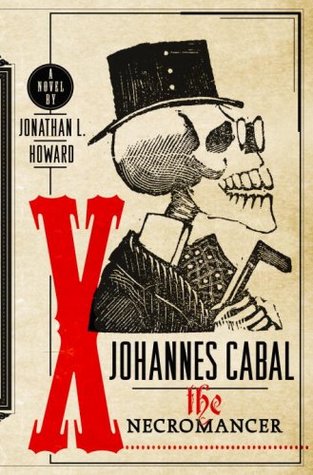
A charmingly gothic, fiendishly funny Faustian tale about a brilliant scientist who makes a deal with the Devil, twice.
Johannes Cabal sold his soul years ago in order to learn the laws of necromancy. Now he wants it back. Amused and slightly bored, Satan proposes a little wager: Johannes has to persuade one hundred people to sign over their souls or he will be damned forever. This time for real. Accepting the bargain, Jonathan is given one calendar year and a traveling carnival to complete his task. With little time to waste, Johannes raises a motley crew from the dead and enlists his brother, Horst, a charismatic vampire, to help him run his nefarious road show, resulting in mayhem at every turn.
I picked up Johannes Cabal after a recommendation from the same friends that got me onto Brandon Sanderson; they were 100% right about that (I’m basically a Sanderson groupie now), so I was so here for this. Of course, Johannes is a very different type of story — a whimsical paranormal tale set on Earth (mostly) rather than high fantasy — but I still really enjoyed it.
As the blurb says, Johannes engages in a wager with Satan to win his soul back: gather one hundred signed contracts for the procurement of souls in a year or be killed and receive a one-way ticket to Hell. Of course, Satan isn’t totally unfair (ha!), and he is willing to loan Johannes the use of a Satanic carnival to help him on his way.
I rather liked Johannes, despite how amoral he is most of the time. He’s a man on a mission, and it doesn’t occur to him to pause and consider the ethics of his actions. In fact, he can be positively cut-throat; the fact he turns to a vampire to help him with the more human aspects of setting up a carnival is a pretty telling sign. It’s hard to know from this book whether Johannes’s personality is a result of his background (for a start, being a necromancer is rather grusome work) or whether it’s just who he is.
Given the story is set over the course of a year, it could have been quite long, looking at each of the hundred souls one at a time. Instead, we really only see a handful; the first is a bit of a case study for the approach Johannes and his crew tend to take. The middle chapters are mostly vignettes, as Johannes and Horst deal with one crisis or another, while the last part of the book deals with the last few souls and how the bet plays out overall.
This story is funny and, as I said, quite whimsical — especially the chapters set in Hell. At other times, it is quite dark. Under Horst’s influence, Johannes tends to target people who would have gone to Hell anyway — and we see enough of some of those people that I was sometimes left feeling like I wanted a shower. Still, the writing style reminded me a little of Douglas Adams or Terry Pratchett, which is, needless to say, a high compliment. I laughed at inappropriate moments more than once.
Apparently the rest of the series isn’t quite so dark, or so I’m told. I’m curious to see where it goes next, and I enjoyed Johannes’s company. I’d be happy to spend more time with him in future — just not in a dark alley or similar!
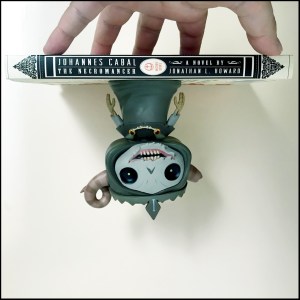

Review: ‘Godsgrave’ by Jay Kristoff
Posted: March 26, 2018 Filed under: Reviews | Tags: fantasy, jay kristoff, reviews Leave a comment
A ruthless young assassin continues her journey for revenge in this new epic fantasy from New York Times bestselling author Jay Kristoff.
Mia Corvere has found her place among the Blades of Our Lady of Blessed Murder, but many in the Red Church hierarchy think she’s far from earned it. Plying her bloody trade in a backwater of the Republic, she’s no closer to ending the men who destroyed her familia; in fact, she’s told directly that Consul Scaeva is off limits. But after a deadly confrontation with an old enemy, Mia suspicions about the Red Church’s true motives begin to grow.
When it’s announced that Scaeva will be making a rare public appearance at the conclusion of the grand games in Godsgrave, Mia defies the Church and sells herself to a gladiatorial collegium for a chance to finally end him. Upon the sands of the arena, Mia finds new allies, bitter rivals, and more questions about her strange affinity for the shadows. But as conspiracies unfold within the collegium walls, and the body count rises, Mia will be forced to choose between love and revenge, and uncover a secret that could change the very face of her world.
This is the second book in the Nevernight Chronicles (you can see my review of the first book here). Now, given that Jay Kristoff and co-writer Amie Kaufmann have a fabulous, bestselling YA series together, you might think this was YA. You’d be wrong. As I said about the first book, Godsgrave contains pretty much all those adult themes that make conservative school librarians faint: a bisexual main character, swearing, explicit sex and violent murder.
But if the idea of those things doesn’t bother you, and you love the idea of seeing a complex, dystopian fantasy world brought undone by a cold teenage killer, then this is the book for you.
If you took medieval Venice, mixed in some Ancient Rome, and added a daub of original World of Darkness Vampire: the Masquerade (but minus the vampires), you’d get the world of Godsgrave. Slaves, gladiators, masked balls, a looming and evil godlike presence, a secretive cult of assassins, a dissolute and entitled nobility that is either clueless or wilfully cruel — this book has it all.
And then there’s Mia. She was forced to watch her father hanged by her mother when she was a child, and was then taken in by a retired assassin who set her on that path. When you add in the fact that she can manipulate the shadows and is followed around by slices of shadow that eat her fear so she simply doesn’t feel it, she’s a little broken — although that spark of empathy we saw in her in the first book is still there, buried deep.
The plot twists and turns like a twisty, turny thing. And I didn’t see most of them coming, which always fills me with glee. I can’t wait to see what Mia does next.

Review: ‘This Is Where It Ends’ by Marieke Nijkamp
Posted: March 22, 2018 Filed under: Reviews | Tags: contemporary, lgbt, reviews Leave a comment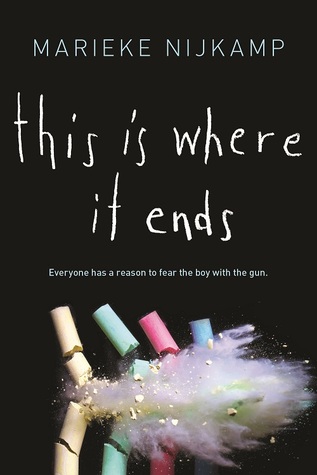
10:00 a.m. The principal of Opportunity High School finishes her speech, welcoming the entire student body to a new semester and encouraging them to excel and achieve.
10:02 a.m. The students get up to leave the auditorium for their next class.
10:03 a.m. The auditorium doors won’t open.
10:05 a.m. Someone starts shooting.
Told from four different perspectives over the span of fifty-four harrowing minutes, terror reigns as one student’s calculated revenge turns into the ultimate game of survival.
This book caught my eye last weekend in the bookstore because I recognised the author’s name from her involvement in the writing community, particularly as a PitchWars mentor. Then I read the blurb and the idea of it gave me chills, especially in light of what happened in Florida at Marjory Stoneman Douglas High last month.
This Is Where It Ends didn’t disappoint.
First, while I’m talking about the blurb, let me say that it’s a tiny bit misleading. This book isn’t really a “game of survival” — it’s not The Hunger Games set in a high school or anything like that. I loved THG, but TIWIE is contemporary, not spec fic; it is more realistic, and more dreadful. None of the characters manifest cool ninja superpowers or a talent with a crossbow that saves the day. They are scared teenagers who don’t want themselves or their loved ones to die.
Some of the story is told through flashbacks; the four characters all have a connection to the shooter in one way or another, and we get to explore that as the story progresses. But I don’t want to go into those connections any further, because there is a minor spoiler involved in who the shooter actually turns out to be.
The four characters are Autumn, the dancer from an abusive home; her girlfriend, Sylv; Sylv’s twin brother and teen rebel, Tomas; and track star Claire. Through them we get to see the shooting unfold from different points around the school. This means that — even at times when the characters trapped in the auditorium can’t do a lot other than watch and try not to die — the other characters have some ability to try and affect events, even in a small way. The way the storylines were interwoven was very well done, and all of the characters were well-rounded. (My only minor criticism is that I found the voices of all four characters rather similar. But each section starts with the narrator’s name, so it’s still easy to follow along.)
Another device that TIWIE uses is social media, with Twitter and blog posts at different points, as the event unfolds. Having read some of the tweets from during the Florida shooting, these particularly undid me (a little awkward when I was reading in the doctor’s waiting room, not gonna lie). They were so real — complete with a troll — and through them we got to watch smaller stories play out over the course of the larger one.
TIWIE isn’t a light read, by any means, but it is a powerful one, especially in light of the #NeverAgain movement. It doesn’t take a position on gun control — not overtly — but the fictional shooter in this book is so much like the real-life shooters we read about in school shootings. And he obtained his gun legally. Make of that what you will.


Review: ‘Silver and Stone’ by Felicity Banks
Posted: March 3, 2018 Filed under: Reviews | Tags: AWW, reviews 6 Comments
Getting into prison is easy.
Getting out is hard.
Getting away is nearly impossible.
Getting the power to control your own destiny might cost everything you have.Emmeline, Matilda, and Patrick are sworn to rescue Patrick’s mother from the infamous Female Factory prison, but when a vengeful police officer tracks down their hideout, things get worse fast.
Soon they’re framed for a double murder and fighting a magical monster in the eerie and unfamiliar island of Tasmania. Patrick’s mother hides crucial papers in a tin under her prison smock, and her best friend Fei Fei is dying in the overcrowded prison.
More than one woman’s life hangs in the balance.
This book is number two in the trilogy The Antipodean Queen; I reviewed the first book, Heart of Brass, here. A lot of what I said there is still true of Silver and Stone: it is a fast-paced story set in a parallel world to colonial Australia, one with steampunk technology and a slightly more modern feel in certain regards than was the reality — the author says in a note at the end that she wanted to write a tale that was fun, so she eased off on the worst of the grim racism and bigotry. But it wasn’t completely glossed over; there was still acknowledgement of some of the worse events in Australia’s history, such as the complete extermination of the Aboriginal people in Tasmania.
Emmeline is the narrator. She is a scientist and engineer in a world where metals can be activated and bestow certain abilities, and her passion for experimentation and discovery is enjoyable to see. Yet she is still quite the proper English woman in some ways. Although she’s an outlaw and a bandit, she can’t fathom the idea that she might choose not to wear a full dress, for example, and although she and Matilda are a couple, she gets very flustered at the other woman’s more casual approach to nudity. In a fight, Emmeline does tend to expect someone else to rescue her rather than rescuing herself — but, undermining the ‘damsel in distress’ trope a little, the one doing the rescuing is usually Matilda.
Did I mention that I love Matilda? She’s a feisty woman whose mother is Aboriginal and father English. She is clearly struggling to find her place a world that doesn’t quite no what to do with her, but at the same time, she’s not afraid to just be who she is. I also loved seeing Emmeline gradually growing more bold, following Matilda’s example.
The story flows quickly, with the characters barely having a chance to rest between one adventure and the next. Some of the things they get up to would be impossible in our world, but I didn’t have trouble suspending my disbelief given that our world also doesn’t have steel corsets that give a woman the strength of a man, or aluminium that, when affixed to an item, neutralises its weight. However, the story focuses less on the characters’ emotions and more on what happens next. I would have liked a bit more emotional depth.
As with Heart of Brass, the last 100 pages or so of the paperback are devoted to a Choose-Your-Own-Adventure-style story. This one is from the perspective of Patrick’s mother, as she waits for Patrick to rescue her from the Female Factory. I really enjoyed that!
The last book in the series comes out later this year, so I’ll be keeping my eye out for it.

Review: ‘Arcanum Unbounded’ by Brandon Sanderson
Posted: February 19, 2018 Filed under: Reviews | Tags: anthology, reviews Leave a comment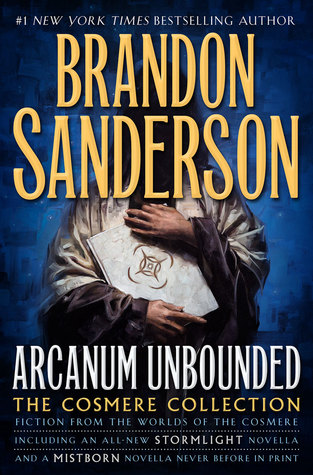
An all-new 40,000-word Stormlight Archive novella, “Edgedancer,” is the crown jewel of Arcanum Unbounded: The Cosmere Collection, the first book of short fiction by #1 New York Times bestselling author Brandon Sanderson. A must read for fans of the series.
The collection includes nine works in all. The first eight are:
“The Hope of Elantris” (Elantris)
“The Eleventh Metal” (Mistborn)
“The Emperor’s Soul” (Elantris)
“Allomancer Jak and the Pits of Eltania, Episodes 28 through 30” (Mistborn)
“White Sand” (excerpt; Taldain)
“Shadows for Silence in the Forests of Hell” (Threnody)
“Sixth of Dusk” (First of the Sun)
“Mistborn: Secret History” (Mistborn)These wonderful works, originally published on Tor.com and elsewhere individually, convey the expanse of the Cosmere and tell exciting tales of adventure Sanderson fans have come to expect, including the Hugo Award-winning novella, “The Emperor’s Soul” and an excerpt from the graphic novel “White Sand.”
Arcanum Unbounded also contains the Stormlight Archive novella “Edgedancer,” which appears in this book for the first time anywhere.
Finally, this collection includes essays and illustrations for the various planetary systems in which the stories are set.
I heard about this book a while ago (it came out in 2016), but didn’t buy it at the time because I hadn’t read the novels in all of these Cosmere worlds and didn’t want to expose myself to spoilers. However, after I finished Oathbringer (Stormlight Archive #3), I had such a massive book hangover and withdrawals that I bought this audiobook so that I could have a little more Stormlight.
This book was everything I could have asked for. I have a terrible long-term memory for details, so I was a bit worried that I wouldn’t be able to follow some of the short stories and novellas, but that wasn’t the case at all. I read Elantris a couple of years ago, and I had no issues at all slipping into that world when I read the novella set in that city. So I can say with confidence that this anthology would be accessible to those who haven’t read anything by Sanderson.
I loved all of these stories, though the stand outs for me were ‘Edgedancer’, ‘The Emperor’s Soul’ and ‘Shadows for Silence in the Forests of Hell’. I also loved ‘Mistborn: Secret History’, although that one in particular does contain massive spoilers for the Mistborn trilogy, so handle with care. Both ‘Sixth of Dusk’ and ‘White Sand’ were also excellent and left me craving more of those characters’ stories (‘White Sand’ in particular seemed a little truncated, which makes sense given that it’s an excerpt). Oh, and ‘Allomancer Jak and the Pits of Eltania, Episodes 28 through 30’ was whimsical and made me laugh out loud (for real) with a dangling modifier joke that convinced me that Brandon Sanderson is my soulmate. 😉
The whole anthology was excellent. What really made it stand out for me, though, were the introductions that set each world into the broader context of the Cosmere (the universe in which all of these planets and their stories co-exist). Sanderson’s ultimate plan is to have crossover between these worlds; the ambition of it blows my mind. The post script notes by him also gave fascinating insights into his process and each story’s history, which were to me — as a writer — utterly fascinating. And apparently the hardcover book contains maps.
When I win lotto, I will repurchase all of my Sanderson novels (which I have as audiobooks) so that I can see the illustrations for myself.
Fans of Sanderson won’t regret buying this anthology, which also provides an excellent taster for those curious to experience his amazing worldbuilding and magic systems.
Review: ‘Seeking Faith’ by Lauren K. McKellar
Posted: January 30, 2018 Filed under: Reviews | Tags: aussie-owned, AWW, reviews 2 Comments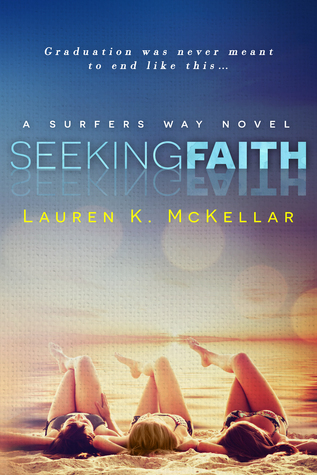
The inseparable are well and truly split.
Mack, Faith and Lacey, joined at the hip since they were kids, are about to graduate high school. You might think this sounds like a book about coming-of-age and taking that leap into adulthood.
It is — except one of them doesn’t make it …
Mackenzie Carter has one solid thing on the agenda for her future — get out of town and focus on her post-school studies. After all, she’s wanted to be a vet since she was a little girl, and nothing, not the thought of being apart from her two best mates or the idea that maybe she’s got more-than-friendly feelings for a sexy local surfer can alter that … can it?
Graduation changes everything.
Almost three years later, and Mack’s high school dreams are just that — figments of her imagination, thanks to the guilt that haunts her on a daily basis. Will a faux relationship with Byron Leckie be the thing she needs to get her life back on track? Or will it make everything worse?
One thing is for certain. When these two collide, the damage will be fierce. After all, graduation was never meant to end like this.
This is the second in the pair of companion novels that together comprise the Surfer’s Way series, parallel novels that look at the consequences of Faith’s death from the perspectives of her two best friends. I reviewed the first book, by Jennifer Ryder, here. (And if you’re flicking between the reviews, I recommend taking a moment to admire the cover art. The use of the same stock image has been so cleverly done here — it ties the two books together but is sufficiently different that you don’t get confused. I love it!)
I adored Seeking Faith. Mackenzie is a character struggling with guilt, forbidden love and a lack of direction that leaves her surviving rather than living, cut off from everyone she loves. Despite all this, when we first meet her, she isn’t flat and defeated — she still has the spark that defines her. I was cheering for her from the first chapter.
Her relationship with Byron evolves through both flashbacks and current day events, so that we get to see how they came to fall in love and be pulled apart. While Losing Faith (the other book in the series) is the story that tells you who killed Faith, Seeking Faith is the one that gives you the real, tangled backstory behind the events of graduation night.
Poor Lacey almost seems naive once you understand the full story.
As a writer, I’m amazed at the craft that has gone into these two books, that they each have their own puzzle and that neither one spoils the main secrets for the other. I take my hat off to both authors. Also, McKellar has this amazing knack for drawing you into her characters. She takes “show, don’t tell” to a whole new level. I’m in awe.
Like Losing Faith, Seeking Faith has some steamy sex scenes, so that’s something to be aware of if you’re worried about — or looking for — that sort of thing. It also has action, enough mystery to keep me (someone who isn’t normally a romance reader) hooked, and a hot leading man. What more do you need?
Review: ‘Losing Faith’ by Jennifer Ryder
Posted: January 26, 2018 Filed under: Reviews | Tags: AWW, reviews 2 Comments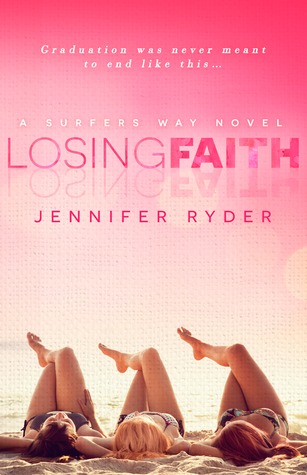
The inseparable are well and truly split.
Mack, Faith and Lacey, joined at the hip since primary school, are about to graduate high school. You might think this sounds like a book about coming-of-age and taking that leap into adulthood.
It is — except one of them doesn’t make it …
Lacey Marone had two solid things on her agenda for her future — working in the Pepperoni Palace until she figured out what the hell to do with her life, and getting together with her bestie’s older brother, Quade, who she’s crushed on since she was a kid.
Then graduation night changed everything. Almost three years later, Lacey won’t rest until she discovers the truth surrounding Faith’s death. She’s outcast by those who want to move on from the tragedy, as if the town’s sweetheart never existed.
Years after losing Faith, Quade Kelly returns home to Runaway Beach, determined to mend ties with his parents and cement a future in his hometown teaching at the local primary school. Quade soon learns that his sister’s ghost lives on, thanks to Lacey, the girl who still owns a piece of his heart.
Lacey is hung up on her quest for answers. Quade wants to bury his failures of the past. The pull between them can’t be denied but can the past be forgotten?
Truths will be uncovered and hearts will be cracked open wide. After all, graduation was never meant to end like this.
Losing Faith is one of a pair of companion novels; the other is Seeking Faith by Lauren K. McKellar, which follows Mack’s story. I am a huge fan of McKellar’s work, so I bought the pair and — on advance — read Losing Faith first. (You really seem to be able to read them in either order, but Losing Faith really whets your appetite for wondering what on earth Mack’s deal is!)
If I had to describe this book in one sentence it would be “love after tragedy in a sleepy coastal town”. I think I went into it expecting it to be a little bit more of a murder mystery than it was — Lacey is obsessed with finding the person responsible for Faith’s death in a hit-and-run accident, and with preventing something similar happening to anyone else. But her investigation doesn’t really have any sort of momentum within the book (understandably, as it’s three years later and any leads have petered out). It’s only when the clues are shoved under her nose that she puts everything together, well after I suspect most reads would have.
The romance between Lacey and Quade develops fairly quickly, but it doesn’t feel like insta-love because they have a long history of wanting to hook up from earlier in their relationship. The sex scenes are plentiful and also steamy (so be warned if that’s not your thing — though they get a big thumbs up from me). There is also a fair dose of the sort of humour you get in real life: foot cramps and mosquitoes and interrupting phone calls. I liked that realistic element, and that the book didn’t take itself too seriously.
The reason I’ve given Losing Faith 3.5 stars rather than a higher rating is that, for some reason, I didn’t connect with this story and its emotions as much as I wanted to or probably should have. I spent a couple of days after I finished it trying to figure out why, and I can’t put my finger on any one thing. The writing is good and Lacey is an enjoyable character to follow. I don’t normally read pure romance (McKellar’s work notwithstanding), so this might be an “it’s not you, it’s me” thing.
Still, 3.5 is a solid “I liked it”, and if you love romance by the beach and a hint of mystery, then this is definitely one for you to check out.

Review: ‘Carry On’ by Rainbow Rowell
Posted: January 20, 2018 Filed under: Reviews | Tags: lgbt, reviews Leave a comment
Simon Snow is the worst Chosen One who’s ever been chosen.
That’s what his roommate, Baz, says. And Baz might be evil and a vampire and a complete git, but he’s probably right.
Half the time, Simon can’t even make his wand work, and the other half, he starts something on fire. His mentor’s avoiding him, his girlfriend broke up with him, and there’s a magic-eating monster running around, wearing Simon’s face. Baz would be having a field day with all this, if he were here — it’s their last year at the Watford School of Magicks, and Simon’s infuriating nemesis didn’t even bother to show up.
Carry On — The Rise and Fall of Simon Snow is a ghost story, a love story and a mystery. It has just as much kissing and talking as you’d expect from a Rainbow Rowell story — but far, far more monsters.
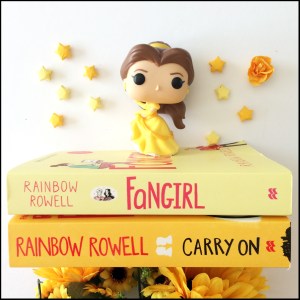
Carry On is the book inspired by the fictional characters in the young adult contemporary, Fangirl — which I reviewed last year. In that book, the main character, Cath, is a huge fan of the Simon Snow series (which is, in turn, loosely inspired by Harry Potter); she writes a highly successful fanfic called ‘Carry On, Simon’, which is based in the Simon Snow world.
This novel is that fanfic. Or, at least, I like to imagine it is. It does have one of the key elements of Cath’s fanfic — that Simon and Baz are attracted to one another — which I don’t believe is in the “original” books whose world she’s writing about. Of course, it’s hard to say, given that the preceding six novels in the fictional world don’t actually exist! 😉
Carry On is the equivalent of the last book in the Harry Potter series, when all the skirmishes with the bad guy finally come to a head and everyone’s dark secrets are revealed. It has other Potter-ish elements (brainy female best friend, headmaster mentor who throws Simon in harm’s way, friendly gamekeeper, use of wands), and at the beginning it’s hard not to make comparisons, but the story goes off in a completely different direction.
And I loved it.
The magic system is cute and clever. Instead of pseudo-Latin phrases, spells in this universe use “magic words” — phrases that are used so often by humans that they become idioms or cliches that have entered the public’s consciousness. The more often the phrase is used, the more powerful the spell effect is that results. For example, “make a wish” to put out a fire (think birthday candles), or “hear ye, hear ye” to amplify your voice. Maybe it’s a little corny, but I’m a word nerd, so I loved it as much as I loved playing “spot the root word” in J.K. Rowling’s spell words.
Despite being a chosen one who never knew his parents, Simon isn’t actually that much like Harry. His life outside school is perhaps a little rougher than Harry’s, and Simon is an expert at going where he’s directed. He is paranoid about Baz (possibly even more paranoid than Harry is about Snape). He is also an expert at denial — not thinking about things that upset him — and doesn’t seem to have the same independent problem-solving ability that Harry does. Luckily, his best friend Penny is clever and organised. She’s like Hermione but with a little less empathy and tact. (And she’s Indian — her mother has a thing for P names.) I really enjoyed Penny’s point of view chapters.
I didn’t enjoy Agatha’s so much. She’s the ex-girlfriend, and almost entirely self-absorbed. She just wants to be left out of the danger and adventure so she can have a manicure, pine after True Love ™ and avoid all discussion of magic. But, although she is a bit frustrating, she’s also incredibly realistic. (I’d rather not get into danger saving the world either, thanks … and I did my share of pining at that age.)
Carry On is a multi-POV book — Simon, Penny and Baz get the lion’s share of the chapters, but there are chapters from maybe a half dozen or dozen other characters. That’s one of the things that reminded me of a lot of the fanfic I read back in the day, and made me think that this was more likely to be Cath’s version of the story rather than that of the original author, Gemma T. Leslie. (Okay, yes, I know both Cath and Gemma are creations of Rainbow. Shush!)
In terms of pacing, the book starts off a little slow. There’s a lot of backstory that is mentioned in passing — especially references to Baz’s past misdeeds. But once Baz enters the story personally, things really pick up and get interesting. For me, the reveals at the end were sufficiently foreshadowed that I guessed what was coming, but I still loved it.
And yes, the dialogue and the kissing scenes that the blurb mentions are excellent. 😉
Review: ‘The Last Days of Us’ by Beck Nicholas
Posted: January 15, 2018 Filed under: Reviews | Tags: aussie-owned, AWW, reviews 2 Comments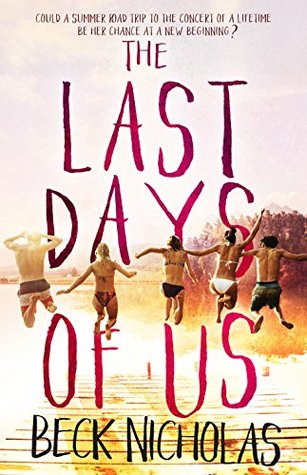
Five teens, one derelict Kombi and an unforgettable road trip…
Six months ago, Zoey’s life went off the rails. After the tragic loss of her brother, she partied her way to oblivion, estranged her best friend, Cass, and pushed away her now ex, Finn. But when her destructive behaviour reaches dangerous heights, Zoey realises she needs to pull herself together and get her old life back, including her ex. There’s just one complication: Finn is now dating Cass.
Now, it’s the last week of summer and Zoey, Cass and Finn are setting out on the road trip of a lifetime to see their favourite musician, Gray, perform live, joined by Finn’s infuriatingly attractive bad-boy cousin Luc and his vibrant younger sister Jolie. Zoey thinks this is her chance to put things to rights and convince Finn they should get back together. But she wasn’t counting on her friends’ lingering resentment, Luc’s disarming sincerity, and Jolie’s infectious love for life to turn her plans upside down.
I bought this book yesterday, and finished it last night (well, technically this morning — it was after midnight). That’s something that never happens to me these days, so I needed you to know that upfront. I mean, I’ve owned this book for so short a time that I haven’t even taken a bookstagram pic of it to go with this review yet!
While some of the speed with which I read it is due to the relatively short length of this young adult contemporary, especially compared to the last book I reviewed here on the blog, most of it is due to Nicholas’s accessible writing style and the natural momentum of a road trip story.
But The Last Days of Us isn’t just any road trip story. Firstly, it’s Australian, set on the road between Adelaide and Melbourne as the characters travel there to see the musician Grey in concert. That has particular appeal for me, because — although that’s not a drive I’ve done myself — I’ve seen photos of a lot of the landmarks that the teens visit. It’s always self-affirming to see your own world in fiction.
Secondly, The Last Days of Us is a powerful exploration of grief and grieving. As the blurb says, Zoey is trying to piece her life back together after losing herself in alcohol and wild parties following her brother’s death. She has broken up with her boyfriend, has grown distant from her best friend (who is now dating her boyfriend, so that seems fair), and is estranged from her parents. She can see that her life is a mess, but the only way she can see to fix it is to try and return to the “old” Zoey, the one she was before Dan died. She tries to do this in a very literal sense — same haircut, same fashion sense, same boyfriend.
Some may find Zoey’s intention to get between Cass and Finn a little shocking, but it didn’t prevent me from being able to get behind her as a character. For a start, Zoey isn’t particularly nefarious about it. She doesn’t set out to directly sabotage Cass with Finn. She instead tries to reconnect with him, show him that the old Zoey is back (even if she’s not and never can be), and see if that is enough. Also, it’s clear from the beginning that Finn is a terrible choice for Zoey (and probably for Cass), so I guess I never expected Zoey’s scheme to go very far.
I’m not going to lie, those moments in the first half of the book where she tries to orchestrate things so she can talk to Finn alone are awkward as anything. But, here’s the thing — I found them so cringey because I remember how, when I was seventeen, I tried to arrange things so I could be with a crush. Not one that had a girlfriend, admittedly, but I was just about as ham-fisted about it as Zoey. I could really relate to her in that regard.
There are other elements of grief in the story, ones I won’t get into because of spoilers. They are fairly well telegraphed, and play out as you might expect — but that didn’t make them any less heartbreaking. Still, the scene that made me cry is one that is all Zoey, mourning for her brother. Her grief is so raw.
The relationship that develops between Zoey and Luc is sweet, and didn’t feel rushed despite the relatively short timeframe in which most of the book takes place. He is perceptive, is sweet without being a pushover when Zoey is rude to him, and provides an excellent foil for the shallowness that is Finn. Cass is a little more problematic as a character — she clearly struggles with having Zoey back on the scene and is insecure about her relationship with Finn, but she resorts to some pretty low comments for a supposed best friend. (She and Finn try to slut-shame Zoey, which did make me want to punch them a little bit.)
The other thing I really loved about this book was Grey, the teen musician they are travelling to see. He’s only in a couple of scenes, but excerpts from his songs (written by the author, obviously) are at the start of each chapter, so his fingerprints are throughout. His music leans towards tortured and broody, so the excerpts are a nice note … so to speak.
Definitely check out The Last Days of Us for an easy but compelling summer read.
Review: ‘Oathbringer’ by Brandon Sanderson
Posted: January 5, 2018 Filed under: Reviews | Tags: reviews 1 Comment
In Oathbringer, the third volume of the New York Times bestselling Stormlight Archive, humanity faces a new Desolation with the return of the Voidbringers, a foe with numbers as great as their thirst for vengeance.
Dalinar Kholin’s Alethi armies won a fleeting victory at a terrible cost: the enemy Parshendi summoned the violent Everstorm, which now sweeps the world with destruction, and in its passing awaken the once peaceful and subservient parshmen to the horror of their millennia-long enslavement by humans. While on a desperate flight to warn his family of the threat, Kaladin Stormblessed must come to grips with the fact that the newly kindled anger of the parshmen may be wholly justified.
Nestled in the mountains high above the storms, in the tower city of Urithiru, Shallan Davar investigates the wonders of the ancient stronghold of the Knights Radiant and unearths dark secrets lurking in its depths. And Dalinar realizes that his holy mission to unite his homeland of Alethkar was too narrow in scope. Unless all the nations of Roshar can put aside Dalinar’s blood-soaked past and stand together — and unless Dalinar himself can confront that past — even the restoration of the Knights Radiant will not prevent the end of civilization.
I read the first two books in the Stormlight Archive back-to-back in the middle of last year, and I didn’t have to wait too long, relatively speaking, for the third book to come out. But, according to Goodreads, this is a ten book series. So I’ll be over here, crying. I have the mother of all book hangovers, you guys. I need a sixth star in my rating system for books like this one. It’s everything that the first two books were, only more so. As a result, I’m sure this review is going to be all AAAAH and NEEDS MORE!, and probably not very coherent.
Bear with me.
I say it with every review of a Sanderson book, but he is an amazing builder of worlds. This series puts the epic in epic fantasy. As I said the other day, I listened to this on audiobook and the download was available in five parts. FIVE. For those playing at home, that’s fifty-five hours of listening time. (Goodreads tells me the hardcover is more than 1200 pages. The first two books clock in at over 1000 pages too.)
As well as using that space to build up a cast of characters that I love (and sometimes loathe), Sanderson also uses it to detail a word that is strange and unique in its plant and animal life. Plants retreat from predators and storms like crabs into shells. Animals are mostly shelled, as well, with gems for hearts, as are the parshmen former slaves that the blurb mentions. Occasionally, we see glimpses of familiar animals, especially horses, but also including “chickens” (a term for any feathered bird).
It’s all wonderfully detailed, and — as this is a Brandon Sanderson novel — the details are important to the story, to the whole. I can’t say more than that without spoilers, but that’s been my experience of all his fantasy books so far; I think he is perhaps being self-indulgent, but it turns out, OMG, it was all relevant. He is a genius. (Have I reached my gush quotient yet?)
In terms of the characters, familiar faces from the first two books are here. My favourites are still Shallan and Kaladin (who I still ship, not gonna lie — a weird combo for me, as I usually dismiss the brooding character as a love interest), with Dalinar coming in a close second. Wit, surprisingly, is third.
I adore Kaladin so much I drew fanart of him while listening to the book the other day. It’s below, because apparently I have no shame. Don’t laugh too hard.
In terms of the plot, this book actually ties things off really nicely, and it could have been a good finish to a trilogy if that was the way Sanderson had wanted to go. Of course, there are still dangling plot threads, some of them huge — and I’m glad I get more Stormlight Archive.
But there’s something that really came to the fore for me in this book, something that pushed it onto a whole new level. I mentioned in my review of the first book in the series, The Way of Kings, that Kaladin suffers from depression; Shallan also had issues to do with suppressed memories. It becomes apparent throughout this book that almost all the heroes are broken. I won’t name names, but various characters struggle with (among other things) alcoholism, drug addiction, sensory processing disorder, PTSD, and multiple personality disorder. And there’s no magic cure for any of these things, like you see in some books. The characters are broken and they strive and fail and succeed and are so authentically human.
I loved it.

Yes, I drew fanart of Kaladin like I’m a teenage girl. (And, yes, his eyes are too big because I’m super-rusty at drawing people.)


 Cassandra Page