So, whassup? I’m glad you asked…
Posted: December 24, 2013 Filed under: On me, On the Isla's Inheritance trilogy, On the Lucid Dreaming duology, Short stories | Tags: contests, Isla's Inheritance, Lucid Dreaming, short story, writing Leave a commentI know I haven’t posted a huge amount lately. What with work being busy–that last-minute “HALP I NEED TO GET THIS DONE BEFORE THE END OF THE YEAR!” rush–as well as various non-work edits that needed finishing, I haven’t had much time for blogging.
Here’s a brief rundown on the things that have been happening lately.
PitchWars
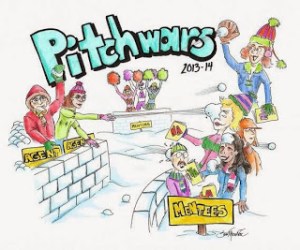
If you read this post, you’d know I entered Lucid Dreaming into PitchWars, one of the festive season pitching contests. I didn’t get chosen as a mentee, obviously, or you’d have heard me yelling all around the globe, without the aid of technology.
What I did get, once again, was some fantastic feedback. The mentors didn’t have to, and frankly I’m not sure how they found the time given some of them had close to 100 entries, but three of the four I pitched to gave me personalised feedback. They were also very encouraging, and said things like “I have every confidence I will see your words in the bookstore some day in the not so distant future.” Aww. Also, squee!
And Dannie, one of the mentors I pitched to, also gave me an honourable mention on her blog:
Most creative use of technology in mentor stalking: Cassandra Page
I stalk like a BOSS.
Anyway, following some edits to my manuscript, I then entered it in…
PitchMAS
 PitchMAS is a bi-annual three-day pitchfest and workshop, held in July and December. It has two phases. The first is where 75 pitches are selected to be posted to the blog, where they can be requested by agents and acquisition editors for various presses.
My pitch for Lucid Dreaming was selected to go on the blog, and, as you can see, I got some interest. I got even more from the Twitter pitches. I’m not going into details because a lady doesn’t, er, pitch and tell, but if you want to know badly enough, the information is out there the Twitterverse. You just need to stalk like a BOSS too.
Santa Clash
 The premise of Santa Clash was that a bunch of writers would produce Christmas-themed short stories. They didn’t have to continue on from one another like the Zombie Project did. No, this time the catch was much more diabolical. Each writer was challenged to write in a genre they didn’t usually delve into. I was given “adult”. Those of you who know me will realise how HARD THIS WAS FOR ME!
My short story, Letting Go, went up yesterday. I’ve had two people tell me they cried when they read it, so, you know. There’s that.
Meanwhile, over at Aussie Owned and Read

Today my December post went up over at Aussie Owned and Read. It’s called Stop, Revive, Survive, after the NSW road safety message. Don’t drive when tired this Christmas, mkay? Or write, actually.
Also, the post has some of my holiday snaps on it. Ok, one holiday snap. It’s a pretty one, though. Promise.
Isla 3
Finally, edits complete, last weekend I was able to get started on the third book in Isla’s trilogy. I only started yesterday but I’m pleased to say drafting is JUST like falling off a bike. You skin your knees, and maybe your teeth are kinda wobbly afterwards (or is that just me?), but you don’t actually forget how to ride.
My TMP editor will be pleased to know I’ve only bled on the manuscript a little bit so far. I will try and clean it up before I send it to her. I promise.
PS. Don’t forget to enter my blogaversary giveaway if you haven’t already. 🙂
PitchWars Mentee Bio
Posted: December 6, 2013 Filed under: On me, On the Isla's Inheritance trilogy, On the Lucid Dreaming duology | Tags: aussie-owned, Isla's Inheritance, Lucid Dreaming, PitchWars 4 CommentsIf you’re a writer and on Twitter, you’ve probably heard of PitchWars, an annual battle run by Brenda Drake where writers attempt to win the love of one of several mentors. Those mentors in turn get overwhelmed with, ah, love, but choose one writer (and two spares!) to polish and take forward to the final round. There, each writer–mentor team competes for the further love of one or more agents.
It’s a giant lovefest, basically. I believe there’s some sort of prize involved, but I doubt the winning writer cares, because agent love!
Last year I entered PitchWars with Isla’s Inheritance. I didn’t win, but what I did do was receive some encouraging feedback and insightful advice that helped me improve the manuscript into something truly saleable. I’m confident that if it weren’t for that advice, Isla wouldn’t have the deal it does.
The other thing PitchWars gave me last year was exposure to an awesome network of writers, some of whom are now my closest tweeps and crit partners. It was via PitchWars that I met Stacey Nash and the rest of the guys I work with on Aussie Owned and Read.
Lucid Dreaming, which is a new adult urban fantasy unrelated to Isla, is now taking its turn in the PitchWars ring.
Pimp My Bio
The PitchWars mentors have bios, so we have the best chance possible of finding a match for our manuscript. One of the mentors, Dannie, is encouraging entrants to write their own bios, so the mentors can stalk them in turn.
Presumably this is so we know how they feel, having us paw over their blogs for clues. :p
Ten Things About Me

BATMAN!
One. I’m a single mother to the cutest four year old boy in the world. (Yes, he really is.) Sometimes he moonlights as Batman. I’m really looking forward to him learning to read, so that I can share my joy in books with him.
Two. This Sunday, as an early Christmas present, we are getting two Cairn Terriers, a mother-and-son team named Chilli and Leo. Chilli is an Australian Champion going into retirement at the advanced age of two. Leo is named after the Ninja Turtle.
There will be pictures—oh yes!
Three. I work full time as a professional editor for a big organisation, which means I’m used to the process. I’ve been editing for five years now (with breaks for coffee).
Four. COFFEE.
Last weekend my boyfriend and I went to an isolated national park to go caving, and he brought his espresso machine. Because, as he said, “Just because we’re on holidays, we don’t have to live like savages.”
Five. I’m an uber-nerd. One of the things that drew me to some of the mentors I chose is that they liked the same nerdy things as me. Doctor Who, Firefly… even the political nerdiness (and writing genius) that is The West Wing.
Six. I tabletop roleplay. I used to live action roleplay too. I dressed up as a vampire before they sparkled in the sun. (See point five.)

I have a TARDIS teapot.
Seven. I’ve written three books now, and each of them has an element of Greek mythology. I could say that this is by virtue of my name—Cassandra being the infamous Greek prophetess cursed not to be believed—but who knows?
(As an aside, the mythological Cassandra clearly never heard of reverse psychology. “Yeah, bringing that big wooden horse inside the walls of Troy and then having an early night is a TOPS IDEA!” “What? No way! Burn the horse!”)
Eight. Other than the aforementioned shows (and Castle, because Nathan Fillion), I watch very little television. I discovered that, despite points one and three, I could still find time to write if I quit most computer games and TV. Before that I was a WoW addict. And had a flirtation with Farmville. DON’T JUDGE ME!
Nine. I’ve been reading urban fantasy for longer than I’ve known what the genre is called. I used to call it “books that have magical elements but are set in the real world.” This is why people shouldn’t let me name things.
I also love fantasy, light sci-fi, cyberpunk and some horror. I don’t mind PNR but it’s not my true love like urban fantasy is—I just struggle to get into books where the romance is the only plot.
Ten. My writing weakness is semicolons. I LUFF THEM! But don’t worry, mentors, a crit partner already made me take 160 of them out of Lucid Dreaming. *tear*
Show, don’t tell
Posted: November 16, 2013 Filed under: On the Isla's Inheritance trilogy, On writing | Tags: editing, Isla's Inheritance, writing 10 CommentsI’ve been in the edit cave since I finished Lucid Dreaming at the end of August. There’s been Isla’s Inheritance, Lucid Dreaming and now Isla’s Oath, as well as a couple of critiques for good friends. If there was a NaNoEditMo, I’d be totally caning it — even if the goal were more than the 50,000 that the NaNoWriMo folks are aiming for.
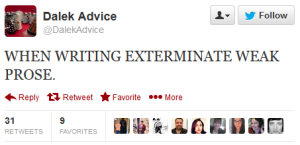
Weak prose: daleks say no
At least, that’s what I’m telling myself. (I’m not doing NaNoWriMo because I’m more of a NaNoSlowMo!)
Anyway, I always knew one of the writing mantras was show, don’t tell. But it wasn’t till after I went through my wonderful editor’s feedback on Isla’s Inheritance that I truly appreciated the breadth of this phrase.
It’s a funny expression, in a way. I mean, we’re writers. By definition, everything we do is telling, not showing. But the trick is to make the reader forget that you’re telling them. 😉
I always applied it to info dumps: those really boring parts of a book where you, say, summarised a piece of a character’s history. Better to have the character discuss said history in conversation — with someone who doesn’t know about it, obviously. (Don’t commit that awful crime you see on TV where characters repeat things to each other that no real person would, just to convey meaning to the reader/watcher. Ugh.)
That’s not to say that I didn’t have any info dumps in Isla’s Inheritance, but I managed to keep them under control for the most part. Or at least I recognised them when I saw them when I edited under my own steam, and cut them out.
But where I hadn’t fully applied show, don’t tell was in describing my character’s emotions, and in things she observed in the world around her. My manuscript was full of phrases like:
I felt guilty.
I heard sirens.
I saw him flinch.
Better to say:
My stomach churned with guilt.
The wail of sirens drew closer. (Or “The sirens’ wails drew closer”, if you’re on a passive sentence crusade.)
He flinched.
They convey the same meaning, but the latter set punches it up a notch. It’s the difference between telling someone a story and giving them the full immersion experience.
Show, don’t tell is my new favourite piece of advice. I may get it tattooed on my arm. (Ok, probably not, but it’s still a good one!)
Writing process blog tour
Posted: October 28, 2013 Filed under: On the Isla's Inheritance trilogy | Tags: blog hop, Isla's Inheritance 1 CommentI was tagged by Melissa A. Petreshock to participate in a blog hop about my writing process. It’s a simple one – answer four questions, and then tag three more authors, until it spreads, virus-like, across the WHOLE INTERWEBS!
Mwahahahahahah!
Ahem.
So, here are the questions, and my answers:
What are you working on right now?
I’m currently doing the first-round edits on my debut novel, Isla’s Inheritance, which comes out with Turquoise Morning Press in the second half of 2014. When that’s done, I’ll be doing a quick brush-up edit on the sequel, Isla’s Oath, so it’s ready to send to TMP when they ask for it. And then I’ll have to get to work on the third book in the trilogy. I’ve got an outline ready to go, although there are still a few blank spots that need sorting out. I’m looking forward to it. I haven’t drafted anything new in more than a month and I’m getting twitchy!
How does it differ from other works in its genre?

A fairy. Not like my fairies. (Source)
The series is a young adult urban fantasy—with fae. There are a few ways it differs, but my favourite one is the setting. I’ve always been interested in the mythological creatures of Europe, but at the same time I always wanted to write a novel set in Australia. I struggled with this for a long time, until I came up with the notion that maybe some of these mythological creatures fled to Australia over the years, came here to escape tyrannical leaders.
So I have fae, but they aren’t pretty, girly fairies—they are from a very cruel world. And they are hiding. When Isla, with her curious heritage, starts making some “noise”, that attracts all sorts of unwanted attention, with consequences not only for her but for her family and fae she’s never even met.
Why do you write what you do?
My muse doesn’t give me a choice.
It’s true. I started on the first chapter of a historically inspired Steampunk/fantasy, and my muse came along with her steel cap boots and said NO, you will write another urban fantasy. (That one is Lucid Dreaming, which I’m getting ready to pitch between other projects.)
I think one reason is that I am mostly reading urban fantasy these days. And part of it is that the idea of the sort of heavy-duty worldbuilding you need to do for a fantasy novel intimidates me, and I’m pretty much a giant chicken. (I will try it one day, if my muse permits.)
I’ve considered writing contemporary fiction with no supernatural element whatsoever, but every time I do, I start thinking about a magical element to the story. My imagination just doesn’t seem to work that way.
How does your writing process work?
Because I’m a single, working mother with a young son, I don’t get time to write every day. I wish I could, but I don’t. I usually manage once or twice a week—my goal when I’m drafting is to produce at least 2000 words a week. That means I write slowly. My most recent manuscript, which was Lucid Dreaming, took me seven months to draft. But it also means I have a lot of plotting time. My commute to and from work, moments of peace in the shower, even standing in a queue for a sandwich—those are all times when I can think about the story and what’s going to happen next.
It means I have yet to get “writer’s block”, because when I sit down to write I almost always know exactly what I need to happen in that scene. It’s the one upside of having so little time to actually write, so I’ll take advantage of it while I can!
Look for these authors next week…
Katie Hamstead, whose second book, Kiya: Mother of a King, came out this month with Curiosity Quills Press.
S. M. Johnston, whose debut novel, Sleeper, comes out in December 2013 with Entranced Publishing.
Stacey Nash, whose debut novel, Forget Me Not, comes out in February 2014, also with Entranced Publishing.
Edits, procrastination and Chicken of the Year…
Posted: October 16, 2013 Filed under: On the Isla's Inheritance trilogy | Tags: editing, Isla's Inheritance, Turquoise Morning Press 2 CommentsI edit for a living. Not in the publishing industry, mind you—so don’t try and pitch me anything!—but in the public sector. Lots of boring non-fiction. So I’m pretty familiar with the process.
Not the receiving end of it, though.
As I mentioned in my last post, I got my first-round edits back from Turquoise Morning Press a few days ago. In her email, Shelby said, “Please don’t be discouraged when you open it and see all the comments and marks. This is the first round and I ask a lot of questions.”
Uh oh, I thought. That’s the same thing I write in my feedback emails when I’ve totally smashed a piece.
I mentioned it to a colleague, who laughed and asked me what I’d do if I opened the document and it was a wall of red. I squirmed.
I should add, everything Shelby said in the email itself made perfect sense, and some of it confirmed quiet suspicions I’d had about some of my characters (one in particular I neglected as the book went on, and I probably shouldn’t!).
I wasn’t able to open the file at first. I was still in the process of setting up my PC, and hadn’t installed Word yet (a long story that involves a product key not kept with the disc, because it was in my email, which I couldn’t access until my ADSL had been set up, which I couldn’t access because my network card wasn’t wireless—ok, not that long a story).
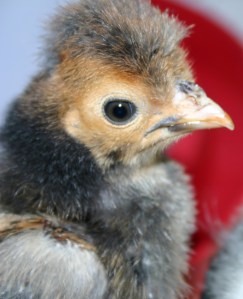
This is basically me, without the glasses. (Source)
But I got my Word and email set up on Sunday night. It’s now Wednesday, and I probably qualify for Chicken of the Year.
I told myself that, since I was part-way through a beta-read of Stacey’s manuscript, I really should finish that first.
I finished it yesterday evening.
Now I’m telling myself that I’ve got guests tonight, so I couldn’t possibly have time to have a quick look at Shelby’s comments. Thursday. I’ll do it Thursday.
Although I do still have to unpack the rest of my books, and sort out the garage so I actually have room to use it as a, you know, garage.
Maybe by the weekend?
You may commence making chicken noises in three, two, one—GO!
I’m baaaack!
Posted: October 13, 2013 Filed under: On me, On the Isla's Inheritance trilogy | Tags: betas, Isla's Inheritance, real-estate, Turquoise Morning Press 2 CommentsSo I know you guys have all been wondering where I was. Well, probably not, because if you read my blog at all you know I was about to move into my new house — and if you don’t, you wouldn’t care. 😉
I’ve been in the new place for five days and we only just got the PC set up and connected to the internet. I was a bit alarmed to find myself getting twitchy and a little depressed about being sans PC. Even though I had my smart phone and access to social media, at least, I really felt the lack of access to the internet — and to word processing facilities.
Especially when I downloaded my emails yesterday and saw that my editor at Turquoise Morning Press SENT BACK THE FIRST ROUND OF EDITS ON ISLA’S INHERITANCE!
*faints*
I haven’t cracked open the file yet — I’ll save that for when my little guy is in bed — but Shelby’s notes in the email were spot on. I’m really looking forward to getting stuck into them. (Make a note of when I said that, because I bet you $100 I’ll be suffering soon enough!)
I’m also beta reading a YA sci-fi by my friend Stacey, which I haven’t been able to touch for a week, so it’ll be good to get back into that too. The last time I read it was a climactic scene and having to wait has been killing me!
I’ve unpacked two and a half out of six bookshelves — I had to wait to do the rest till the PC was set up, in case we had to move furniture. It’s been fun reuniting with all my novels; once they are all out and looking fine I’ll post a photo of my study. I’m surrounded by books and have dual screens. And this is my view:
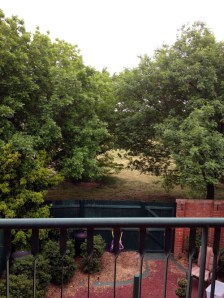
How’s the serenity?
Aww yeah.
He said, she said: dialogue tags
Posted: September 26, 2013 Filed under: On the Isla's Inheritance trilogy, On writing | Tags: editing, Isla's Inheritance, words to be wary of, writing 4 Comments
Source: wiki commons
I mentioned dialogue tags briefly a while ago in a post about “crimes” I commit when drafting—I tend to leave out the name of the other actor in a conversation between them and my first-person main character. It’s one of the things I edit in later.
Here’s a more comprehensive set of thoughts on dialogue tags. Anyone who’s read On Writing by Stephen King will know his advice, but here’s a summary:
- Don’t underestimate the power of “said”. Readers usually don’t notice it, and it lets you anchor the identity of the speaker in the reader’s mind with a minimum of fuss.
- You don’t have to attribute every single line of dialogue. In a back-and-forth conversation between two characters, it’s usually pretty obvious who is speaking for several lines after you include a dialogue tag. And if you have “X said” at the end of every quote, your reader will get annoyed.
- Dialogue tags other than “said” should be used sparingly (see example one, below).
- Consider using character action as part of the same paragraph that contains the dialogue. The action then identifies the speaker.
Example one: too many dialogue tags
This excerpt is taken from Isla’s Inheritance, although I’ve edited it to demonstrate how jarring excessive dialogue tags can be.
“It’s me. Dominic,” he said.
“Dommie?!” I squealed.
“If you must,” he replied dryly.
“I didn’t know you were back!” I exclaimed.
“Got back a few days ago; been catching up with the folks. Hence the lack of effort,” he laughed, indicating his Halloween costume with a wave of his sheet.
“It could have been embarrassing—I almost wore the same thing,” I admitted.
I’ve actually seen poorly edited books that read like this. I sit there wondering whether the author used a thesaurus to avoid repeating the same descriptive word—which means I’ve stopped paying attention to the story and am paying attention to the poor craftsmanship instead.
To make it clear: I’m not saying to never use these words. But I avoid any dialogue tag that doesn’t describe something the reader wouldn’t have gotten from the dialogue itself. For example, “shouted” and “whispered” are okay in moderation, as are “murmured” and “muttered”. But there’s never a reason to use “exclaimed” (because the punctuation mark already indicates that the dialogue is an exclamation), and if you’re using words like “flirted”, consider instead describing the flirtation. (“Hi there,” I flirted doesn’t tell us much; “Hi there,” I said with a wink is much more descriptive.)
Example two: a mix of tags and action
Here is the same sample text as in example one, with minimal dialogue tags, and action used to anchor the reader in the scene. (I also used fewer adverbs.)
“It’s me. Dominic.”
“Dommie?!” I sat up straight.
“If you must,” he said, voice dry.
“I didn’t know you were back!”
“Got back a few days ago; been catching up with the folks. Hence the lack of effort.” He indicated his Halloween costume with a wave of his sheet.
“It could have been embarrassing—I almost wore the same thing.”
Because there are only two characters, I don’t need to attribute every line. It gets more complicated when you’re dealing with multiple characters, but that’s where use of action really comes into its own.
Know the rules before you break them
One technique I noticed Aussie bestseller John Marsden use is not bothering even trying to attribute the dialogue. He used this particular technique when he had a bunch of teenage characters chatting excitedly and it didn’t really matter who was saying what. Stripping all the dialogue tags and action out sped the dialogue up to a sprint, which conveyed the conversation’s sheer chaos.
This is definitely a case where you need to understand the rules before you disregard them, though—the same technique wouldn’t have worked in any of the other dialogue scenes in his book, so he didn’t use it there.
Variety is key
As with most things in life, the best guide for dialogue tags is “everything in moderation”. If you mix up “said” with other dialogue tags, no dialogue tags and action, you’ll have a pretty solid foundation for conveying your dialogue and furthering your story.
‘Where do you get your ideas?’
Posted: September 15, 2013 Filed under: On the Isla's Inheritance trilogy, On writing | Tags: fanfic, inspiration, Isla's Inheritance, muses, writing 6 CommentsI think the single most common question authors—especially very successful authors—get asked is about their sources of inspiration. The question is almost a stereotype now. And a lot of them reply along the line of, “The real trick is making them stop!”
I used to not understand this answer. I spent a lot of time toying with ideas, usually for high fantasy novels, but never getting far because the well would run dry: the ideas I had felt derivative, or paper thin.
It wasn’t till I said “hell with it” and started writing anyway that I discovered the truth. Like writing skill, the ability to come up with story ideas—for me at least—is like a muscle. The more I write, the more I come up with ideas, the easier it is. I suspect a lot of other writers are the same.
Getting to the point where I had an idea with enough weight for an entire novel was a long process, though. I started out, like a lot of people, writing fanfiction. I wrote some short stories in another writer’s fantasy world; it felt easy to me, because the worldbuilding had been done. This was in the days before the internet was huge (don’t laugh!) so the stories were published in the author’s “official” fanzine and distributed via the post. Old school, yo. *poses*
Then I wrote two or three novella-length stories that were another type of fanfiction: the type with famous people as characters (no, I won’t say who). But the stories were my own. These novellas were about 25k words each; when a friend pointed out to me that if I’d put that amount of effort into real fiction I’d have a novel, it was a sobering realisation. And a motivating one, too. It showed me I could do it, whereas before I’d thought I couldn’t.
So I revisited one of the novellas, and took an extra element of an old (non-fanfic) short story, threw them in a pot, and stirred. Then I started from scratch with the ideas born from this mix. The result was Isla’s Inheritance. The only element from the original novella fanfic that has carried across is one of my original (non-famous) characters: Isla’s cousin Sarah.
And once I finished Isla’s Inheritance, that seemed to open the floodgates on my subconscious. Ideas for a sequel, and another beyond that. Another urban fantasy idea (now finished). A solid fantasy/Steampunk concept (outlined). And other, half-formed ideas.

The muses from Hercules (copyright Disney; source).
These days it seems like whenever I hear a story on the news, or am talking to a friend, part of my brain is turning what I’m hearing over and looking at it from all sides to see whether there’s a kernel of a story idea there. I can see why writers call that their muse. I think of it more as part of myself—but a part I have very little control over. As my friend Stacey Nash describes in her latest blog post, it seems to have a mind of its own.
I’m curious though—do you find it easy to come up with story ideas? Has that always been the case, or have you had to train yourself/awaken the muse, like I have?
FAQ: Search Term Bingo
Posted: August 28, 2013 Filed under: On the Isla's Inheritance trilogy | Tags: adverbs, Isla's Inheritance, poetry, search terms, words to be wary of 6 CommentsI was just browsing the various search terms people have used to find my blog. I suspect many of them went away without knowing the answers they were seeking, so here is a post that attempts to remedy that for at least some of them.
isla vs cassandra
In a battle between myself and the main character of Isla’s Inheritance, she would win. As well as having Powerz (TM), she’s also seventeen and spry. I am not seventeen. Nor am I spry.
will kiya hope of the phraoh be available on amazon uk
I checked with the author and it already is. Here ya go!

“Love Bomb”
cassandra’s lazy style
How kind of you to notice. My hair is brought to you by bobby pins and a pony tail. My clothes are courtesy of “whatever jeans I can find that fit my epic shortness”, and “the internet for cool geek t-shirts”. Currently I’m wearing a Minecraf t-shirt courtesy of Threadless (see right).
girl smoking sexy
I’m unclear due to the lack of grammar, but if you’re asking me if I think girls smoking is sexy, the answer is no. Eau de ashtray is not for me.
If you’re looking for a picture of a girl smoking something sexy, or the abstract notion of “sexy” itself, I can’t help you … but I doubt it’s hygenic. Just saying.
summer heacock twitter
grammar joke
“The past, the present and the future walked into a bar. It was tense.”
That’s my favourite. What’s yours?
when writing dialogue is there a comma after said when an adverb is used?
No. But may I urge you to reconsider using the adverb?
poem about a me and my dog with adverbs
Here you go:
I quickly walk my dog
He swiftly jumps a log
Hurriedly fetching a stick
I carelessly gave the flick
It’s covered in his spit
He doesn’t give a–
Ok, and that’s my daily allocation of adverbs consumed. I’ll have to finish it another time.
i follow the rules
Me too. Mostly.
words to edit out of a novel heard
That’s a pretty good suggestion to add to my list of words to be wary of, actually. Why say,
“I heard an eagle shriek.”
when you can say:
“The eagle shrieked.”
Good job, you!
play your cards right hashtag
May I suggest #PlayYourCardsRight?
grow out your hair
I tried but it didn’t work. Really, I tried for about ten years! I just had it cut back to shoulder length and it’s much healthier and more managable. Thanks for the advice, though.
fantasy book with isla as a character
Mine comes out in the (northern) fall of 2014. 😉
On themes and dinosaur bones
Posted: August 6, 2013 Filed under: On the Isla's Inheritance trilogy, On writing | Tags: Chuck Wendig, Isla's Inheritance, theme, urban fantasy, writing 2 CommentsI’ve written almost three novels now, but I’ve never consciously developed a story’s theme as I was writing it. I always felt a little guilty about that, because everyone tells me that theme is one of those things that binds a story together. Like grammar, or pacing, or dialogue tags.
My current work in progress is at 69k words (dude) and I’m at the start of the final confrontation scene. I’m having a moment of what I could call writer’s block, except I don’t feel blocked—I feel more like an archaeologist who’s revealed a small part of the skeleton and is dusting away at it with a little brush to reveal HOLY CRAP IT’S A FREAKING DINOSAUR!
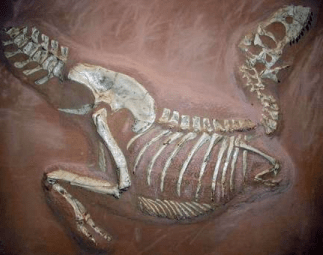
The final scene of my book: an artist’s impression (image from Wiki commons)
The reason I wouldn’t call it writer’s block has a couple of elements:
1. I know which characters are involved in the scene, and what the inter-personal dynamics are.
2. I know who is going to win and what the final outcome will be.
What I don’t have yet is the how. How are they going to win? I’ve been pondering this for a couple of days, and it dawned on me that the other thing I know about the scene is that I want them to win not by dint of awesome superpowers (I write urban fantasy, so there are a few of those kicking around) but by virtue of accessing the part of them that is human.
And then I realised tonight, HOLY CRAPBISCUITS! THAT’S MY BOOK’S THEME!
In fact, it’s been a theme of all three of my books—both of Isla’s stories and this latest one (which is about a different character).
My books are about people struggling with what it is to be human and other, and to become an adult, all at the same time. And that’s kind of cool.
Although maybe not for my characters.
As is often the case, Chuck Wendig says it best. (Check out point three: apparently I don’t have to feel bad about not writing it in consciously after all. Phew!)
Now excuse me—I have to go back to dusting these dinosaur bones.


 Cassandra Page