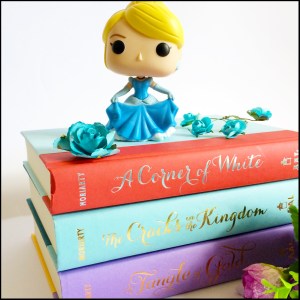
Review: ‘A Tangle of Gold’ by Jaclyn Moriarty
Posted: April 13, 2017 Filed under: Reviews | Tags: AWW, fantasy, reviews Leave a comment
The Kingdom of Cello is in crisis. Princess Ko’s deception has been revealed and the Elite have taken control, placing the Princess, Samuel and Sergio under arrest and ordering their execution. Elliot is being held captive by the Hostiles and Colour storms are raging through the land. The Cello Wind has been silent for months.
Plans are in place to bring the remaining Royals home from the World but then all communication between Cello and the World will cease. That means Madeleine will lose Elliot, forever.
Madeleine and Elliot must solve the mystery of Cello before it is too late.
A Tangle of Gold is the final book in The Colours of Madeline trilogy by Aussie author Jaclyn Moriarty. You can find my first two reviews here and here. I commented in my review of the second book that the series title didn’t quite work for me, because Madeline’s parts of the story in the first two books were the less engaging parts.
It’s fair to say that, in the third book, Madeline finally comes into her own. I can’t say much more than that, because it’d be spoiler-tastic, but at last she becomes more than bizarre homeschooling, her mother’s illness, and her quirky friends. Events in Cello rather than in the World (what they refer to Earth as) are definitely where the story is at, and they drive events. But there’s a lot more crossover, not just a parking metre-based postal service, so the World side of things gets a lot more interesting.
There are things that you need to know about these books if you are considering giving them a go:
- Moriarty’s prose is beautiful. It’s lyrical and strange at times, but always beautiful. I’m sad that she never truly described the Cello Wind (which is alluded to often but remains off camera, so to speak). It would have been glorious.
- Her world-building is astonishingly detailed. As a result, sometimes the story feels like it’s dragging a little, but things are always happening — even if their significance doesn’t become clear till later. Which brings me to…
- The plot twists. OMG. There are things resolved in the third book that were delicately foreshadowed in the first. And some of these twists blindsided me. I usually guess or at least suspect in the right direction of plot twists, but I was way off base on this one, several times.
If you have the patience to read three 500-page books, and love parallel world stories with a truly unique alternate world and intense, intellectual and quirky characters, then this is the series for you.

Review: ‘The Cracks in the Kingdom’ by Jaclyn Moriarty
Posted: March 31, 2017 Filed under: Reviews | Tags: AWW, fantasy, reviews Leave a comment
Princess Ko’s been bluffing about the mysterious absence of her father, desperately trying to keep the government running on her own. But if she can’t get him back in a matter of weeks, the consequence may be a devastating war. So under the guise of a publicity stunt she gathers a group of teens — each with a special ability — from across the kingdom to crack the unsolvable case of the missing royals of Cello.
Chief among these is farm-boy heartthrob Elliot Baranski, more determined than ever to find his own father. And with the royal family trapped in the World with no memory of their former lives, Elliot’s value to the Alliance is clear: He’s the only one with a connection to the World, through his forbidden communications with Madeleine.
Through notes, letters, and late nights, Elliot and Madeleine must find a way to travel across worlds and bring missing loved ones home. The stakes are high, and the writing by turns hilarious and suspenseful, as only Jaclyn Moriarty can be.
This is the second book in The Colours of Madeline trilogy by Sydney writer Jaclyn Moriarty. I finished it last weekend, and it’s taken me a while to sit down to write a review — largely because it took me more than a month to read, and I’ve been trying to put my finger on why.
Other than general life busyness and the danger of reading hardcover books in bed when you’re tired (ow), the obvious reason is that all the books in this series are quite long (and also heavy — ow). This one is almost 500 pages, and maybe my attention span isn’t what it used to be, but it just seemed like a lot. If you’ve read the first book in the series (or my review of same), you will know that the series is a parallel world tale where one of the two main characters, Madeline, is in England while the other is a boy named Elliot who lives in a magical modern-day equivalent of Earth that is called Cello. Moriarty puts a lot of work into world-building as far as Cello goes. Like, a lot. There are extracts from guide books, for example, and newspaper clippings, as well as the letters that the blurb mentions. They are relevant to the story, but gosh there are a lot of them!
There were some parts of the story that dragged and — despite the name of the trilogy — they are almost all Madeline’s sections. She doesn’t have as much to do in the second story other than live her quirky life, post some letters, and be increasingly interested in Elliot, who is (apparently) forever unattainable.
Elliot on the other hand is a very interesting character, as are the other members of the Royal Youth Alliance, Ko, Kiera, Sergio and Samuel. I far enjoyed reading about their meetings and efforts to rescue the royal family. That’s where all the action in the book is. (Sorry, Madeline.)
I realise this review might seem lukewarm, but I really did enjoy most of it — hence the four stars! I went straight into the last book in the series, and I’m hoping I can get it done more quickly than this one. 😉
 This month on Aussie Owned and Read we’ve been doing a round robin series of interviews. I was interviewed by the lovely Heather Bosevski; you can find it here. I on the other hand interviewed spec fic author Sharon M. Johnston, and you can find that one here.
Review: ‘The Wife Drought’ by Annabel Crabb
Posted: March 6, 2017 Filed under: Reviews | Tags: AWW, non-fiction, reviews Leave a comment
‘I need a wife.’
It’s a common joke among women juggling work and family. But it’s not actually a joke. Having a spouse who takes care of things at home is a Godsend on the domestic front. It’s a potent economic asset on the work front. And it’s an advantage enjoyed – even in our modern society – by vastly more men than women.
Working women are in an advanced, sustained, and chronically under-reported state of wife drought, and there is no sign of rain.
But why is the work-and-family debate always about women? Why don’t men get the same flexibility that women do? In our fixation on the barriers that face women on the way into the workplace, do we forget about the barriers that – for men – still block the exits?
The Wife Drought is about women, men, family and work. Written in Annabel Crabb’s inimitable style, it’s full of candid and funny stories from the author’s work in and around politics and the media, historical nuggets about the role of ‘The Wife’ in Australia, and intriguing research about the attitudes that pulse beneath the surface of egalitarian Australia.
Crabb’s call is for a ceasefire in the gender wars. Rather than a shout of rage, The Wife Drought is the thoughtful, engaging catalyst for a conversation that’s long overdue.
I’ve had a bit of a crush on journalist Annabel Crabb for years, something that was crystalised when I saw her speak at an event last year. She’s an incredibly engaging and intelligent speaker, both funny and charming. At the time, the audiobook of The Wife Drought wasn’t yet available, and I never quite got around to buying the paperback. I was therefore very excited at the end of last month to discover that the audiobook had finally been released and that Annabel herself was the narrator.
The Wife Drought is both demoralising and insightful, often at the same time. It defines a “wife” as a part time or stay at home partner who does the bulk of the domestic duties — cleaning, school drop offs, dealing with tradies — so as to free the other partner up to pursue earning a crust. A “wife” can be a man by this definition, but the truth is that it is almost always a woman. And it’s a huge economic benefit to have one.
Annabel is a journalist, and you can see her thoroughness in this book: she draws on a number of studies that talk about pay gap trends, division of housework, divorce rates in relationships where women become suddenly successful, women in politics, social expectations on both the husband and the wife*, and much more. Interspersed throughout are often lighthearted and always illustrative anecdotes. A lot of the conclusions she draws seemed obvious to me once she’d pointed them out, but as I haven’t read a lot of feminist literature they were a bit of a revelation.
(* Note that this book is about the male and female partner dynamic. While Annabel acknowledges the wonderfully diverse society that we live in, The Wife Drought tackles the most common relationship structure. I am a single parent — no wife for me! — and I still found it fascinating.)
As one example, the book considers the idea that women are better at raising kids in light of the concept of specialisation and the human tendency to seek the most efficient or economical solution. Given that women usually stay at home with the baby in the first few months, they are the ones who get the early child-rearing experience. It’s not that they are genetically predisposed towards changing nappies; they just get more practice. As for why they stay home, Annabel points to the typical difference in pay between a man and a woman as the primary explanation. (She doesn’t touch at all on the push for women to breastfeed and how difficult that can be if a woman returns to work, which I thought was a curious omission.)
Another point that Annabel makes is that the expectation that fathers will go back to work after their children are born and, if anything, work even harder to support them is actually just as detrimental to dads and their relationship with their kids as it is to their wife’s career. The judgement (and condescending praise) heaped on men who do traditionally feminine childcare duties is a barrier to men who also want to “have it all”.
The overarching argument of the book is that women have seen a huge change in the way we get to live our lives. We are not banned from working while married anymore (yes, it used to be a thing). We are permitted — and often encouraged — to work and have children. But men haven’t seen a concurrent revolution in what society expects of them.
There isn’t an earth-shattering revelation for how to achieve this, of course. It’s a slow process, where men have to not only be given access to the same leave conditions but not be punished in the workplace for exercising the rights that they do have. The change is coming, enabled in part by the digital revolution and an increased ability to work from home. But it is slow.
Review: ‘Untamed’ by A. G. Howard
Posted: February 18, 2017 Filed under: Reviews | Tags: reviews Leave a comment
A post-Ensnared collection of three stories—available in both print and e-versions.
Alyssa Gardner went down the rabbit hole and took control of her destiny. She survived the battle for Wonderland and the battle for her heart. In this collection of three novellas, join Alyssa and her family as they look back at their memories of Wonderland.
In Six Impossible Things, Alyssa recalls the most precious moments of her life after Ensnared, and the role magic plays in preserving the happiness of those she loves. Alyssa’s mother reminisces about her own time in Wonderland and rescuing the man who would become her husband in The Boy in the Web. And Morpheus delves into Jeb’s memories of the events of Splintered in The Moth in the Mirror, available in print for the first time.
This collection expands upon Ensnared‘s epilogue, and includes some deleted scenes to provide a “director’s cut” glimpse into the past and futures of our favorite Splintered characters.
This book is set after the end of the Splintered trilogy, and contains three stories that reveal more about the world — about events that come after the end of Ensnared. As a result, it’s super-spoiler-y, and really won’t make sense if you don’t read the trilogy first. You can find my review of the first book in the series here, if you want to see whether it’s something you might be interested in.
Please note that the rest of my review does contain mild spoilers for the end of the trilogy; it’s more aimed at people who are familiar with the books and are deciding whether to pick up this compilation. Read on at your own peril.
The first story, The Boy in the Web, contains backstory about Alyssa’s parents and was sweet enough, though I really wanted more to happen.
The second, The Moth in the Mirrror, is a bit of a non-entity in that it’s some of Jeb’s story from the trilogy told through Morpheus’s eyes — and, yeah, I didn’t really like Jeb that much, so I could have lived without it.
The third one, Six Impossible Things, is the story that I was really keen to read: the transition from Alyssa’s life with Jeb to her life with Morpheus. I liked it best of the three stories, although all the reminiscing by the characters towards the front end of the story dragged a little.
A. G. Howard can write. Her prose is glorious. But this book felt a little bit like fanfiction, a “what comes after the happily ever after” story. I could live without it in the same way that I wasn’t a fan of the end of the Harry Potter series — I didn’t need to know what Harry named his kids, or what Alyssa and Jeb did. The original trilogy had action and tension, and there was almost none of the former and not as much of the latter as I would have liked. What there was was a lot of “look how perfect their lives are”.
Also — bigger spoiler here — the way that Alyssa is made a virgin again after having three kids during her mortal life made me twitch. The way she seemed to forget how childbirth worked after having three kids made me roll my eyes. Morpheus loved her when she was frail and old, so why was it necessary that she have her “innocence” restored along with her youth? It erased her family and her womanhood in a very literal sense. Blah.
Untamed was nice enough. It was an easy read. But it didn’t wow me the way the original books did. While I’d still highly recommend the original trilogy, you can give this one a miss.

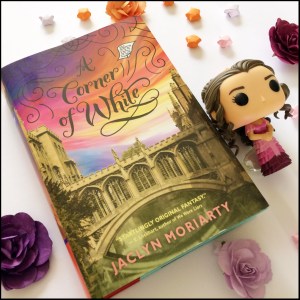
Review: ‘A Corner of White’ by Jaclyn Moriarty
Posted: February 6, 2017 Filed under: Reviews | Tags: AWW, fantasy, reviews 2 Comments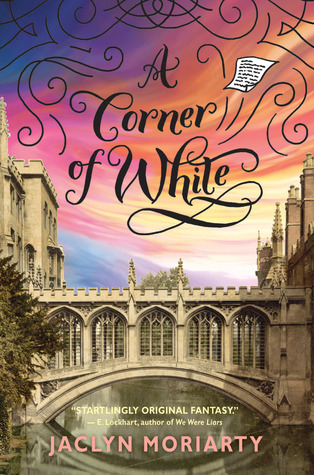
The first in a rousing, funny, genre-busting trilogy from bestseller Jaclyn Moriarty!
This is a tale of missing persons. Madeleine and her mother have run away from their former life, under mysterious circumstances, and settled in a rainy corner of Cambridge (in our world).
Elliot, on the other hand, is in search of his father, who disappeared on the night his uncle was found dead. The talk in the town of Bonfire (in the Kingdom of Cello) is that Elliot’s dad may have killed his brother and run away with the Physics teacher. But Elliot refuses to believe it. And he is determined to find both his dad and the truth.
As Madeleine and Elliot move closer to unraveling their mysteries, they begin to exchange messages across worlds — through an accidental gap that hasn’t appeared in centuries. But even greater mysteries are unfolding on both sides of the gap: dangerous weather phenomena called “color storms;” a strange fascination with Isaac Newton; the myth of the “Butterfly Child,” whose appearance could end the droughts of Cello; and some unexpected kisses…
At the end of last year, fabulous teen blogger Emily Mead did a huge post with a mini-review of the 100+ books that she read in 2016. I added a bunch of books to my TBR pile as a result (curse you, Emily), and the first of these was A Corner of White.
This is actually quite a difficult book to review. It’s a parallel world story (partly set in our world and partly in a fantastical other world — think Alice in Wonderland or, well, a bunch of other books). But it’s even more of a parallel world story than usual, in that the main characters, Madeline and Elliot, live very similar lives. Both live away from their fathers and are missing them. Both come to see what they believe are problematic elements of their fathers in their own personalities. Both of them are dissatisfied with their situation and want to leave it for one reason or another. Both are charming and loved by those around them.
But in some other ways, this book is quite baffling. I spent maybe the first third of it being dissatisfied and somewhat unengaged by Madeline’s real-world antics and her life, which was so quirky that it seemed, well, unrealistic. By comparison, Elliot’s life — in the magical kingdom of Cello — actually seemed more normal. Certainly he had more things going on than strange “homeschooling” classes and slightly deranged (albeit generally well-meaning) friends. His world and story were kept me guessing, whereas Madeline’s, well, didn’t.
If you’d asked me at 100 pages how I thought I’d be rating A Corner of White, it would have been three-star at best, despite the lovely prose and the unique world of Cello. Which made me sad, because I wanted to love it. Luckily for me, it turns out that once Moriarty got the bit in her teeth and got going, the story picked up and I raced through the rest of it. I didn’t see the plot twists coming, and I loved the way that Moriarty wove them all together at the end. I loved how Madeline’s introspective rambling about science and history drove Elliot nuts, but also taught him something valuable about his own world.
The way that the book ended, while not exactly cliff-hanger-y, definitely left me wanting more. Happily books two and three have already been released! Yay! (Now, hurry up, Mr Postman!)
Overall, this was a four-star read for me, based on simple maths: three for the start, five for the end. I feel like Madeline would approve of that approach.
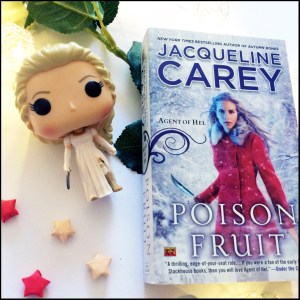
Review: ‘Poison Fruit’ by Jacqueline Carey
Posted: January 24, 2017 Filed under: Reviews Leave a comment
The Pemkowet Visitors Bureau has always promoted paranormal tourism — even if it has downplayed the risks (hobgoblins are unpredictable). It helps that the town is presided over by Daisy Johanssen, who as Hel’s liaison is authorized by the Norse goddess of the dead to keep Pemkowet under control. Normally, that’s easier to do in the winter, when bracing temperatures keep folks indoors.
But a new predator is on the prowl, and this one thrives on nightmares. Daisy is on her trail and working intimately with her partner and sometime lover from the Pemkowet PD, sexy yet unavailable werewolf Cody Fairfax. But even as the creature is racking up innocent victims, a greater danger looms on Pewkowet’s horizon.
As a result of a recent ghost uprising, an unknown adversary — represented by a hell-spawn lawyer with fiery powers of persuasion — has instigated a lawsuit against the town. If Pemkowet loses, Hel’s sovereignty will be jeopardized, and the fate of the eldritch community will be at stake. The only one who can prevent it is Daisy — but she’s going to have to confront her own worst nightmare to do it.
Poison Fruit is the third and apparently final book in the Agents of Hel series by unfairly talented speculative fiction writer Jacqueline Carey. You can read it as a stand-alone novel, but you’ll get more out of it if you read at least the previous book, if not the entire series.
Of course, I just reviewed the second book earlier this month, and a lot of what I said then is still true here. The love square has thinned down to a love triangle (and boy, what a triangle!), but we still have the chatty, cranky, awesome Daisy and her Scooby Gang friends.
Reading about them was like coming home.
For something different, here’s a handy list of different reasons I loved this book (and the series).
Things I loved about Poison Fruit
- Daisy and her mother are so sweet with each other. Also, Daisy’s surrogate aunt, Lurine, is seriously badass but calls Daisy the most adorable pet names. I have a bit of a crush on Lurine, tbh.
- Jen, Daisy’s best friend, makes with the best friend realtalk. And sends embarrassing texts on Daisy’s phone when they are drunk. So real.
- There’s Cody and Stefan, who are the two other points of the love triangle. I had my personal favourite, however — and it wasn’t the one I’d usually go for. #TeamCody
- When one of the love triangle points broke it off with Daisy and then got jealous, she told him not to be a jackass. Jealousy is not a sexy character trait, people!
- Daisy screws up, sometimes in a very big way, but she owns it.
- The supernatural community of Pemkowet is a big old jumble. I was going to say a melting pot, but there’s definitely no melting together here. There’s Hel, the Norse deity; a hell-spawn lawyer who works for the Greek diety, Hades; various cranky seelie fairies; a surprisingly chill unseelie bogle; a wonderfully diverse witch’s coven; and a ton more. It’s chaotic and nonsensical and I loved it!
Things I didn’t like as much
- The book meanders and explores a few sub-plots while the big plot plays out sooooooo slooowly. About three-quarters of the way through I was, like, LET’S GET TO THE SHOWDOWN, PEOPLE! But then we did and it was glorious.
Read these books.
Review: ‘Atlanta Burns’ by Chuck Wendig
Posted: January 14, 2017 Filed under: Reviews | Tags: Chuck Wendig, reviews Leave a comment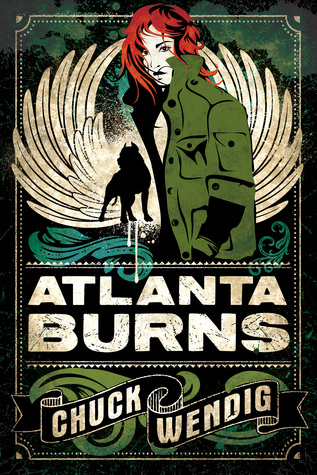
You don’t mess with Atlanta Burns.
Everyone knows that. And that’s kinda how she likes it — until the day Atlanta is drawn into a battle against two groups of bullies and saves a pair of new, unexpected friends. But actions have consequences, and when another teen turns up dead — by an apparent suicide — Atlanta knows foul play is involved. And worse: she knows it’s her fault.
You go poking rattlesnakes, maybe you get bit.
Afraid of stirring up the snakes further by investigating, Atlanta turns her focus to the killing of a neighborhood dog. All paths lead to a rural dogfighting ring, and once more Atlanta finds herself face-to-face with bullies of the worst sort. Atlanta cannot abide letting bad men do awful things to those who don’t deserve it. So she sets out to unleash her own brand of teenage justice.
Will Atlanta triumph? Or is fighting back just asking for a face full of bad news?
Atlanta Burns is a kind of YA contemporary that is dark — so dark that the world in which the titular character exists is almost a caricature of itself. I’ve seen the book described as noir, which is something I usually associate with detectives in oversized coats, but that works here in the sense that Atlanta’s world is bleak. Almost everyone is corrupt, incompetent, or outright evil. The handful of characters that aren’t evil are damaged as a result of being the victims of those who are. These include Atlanta (mostly) and the two boys she befriends at school, Shane and Chris.
It’s a tough read. One I enjoyed, but at the same time — oof.
Firstly, if you are triggered by any of the following, this isn’t the book for you: rape, child abuse, torture, suicide, animal harm, homophobia and violent racism.
Also, if swearing and drug use bother you, again, maybe don’t go here.
(I told you it was dark.)
Atlanta is the survivor of childhood sexual abuse — a situation she extricated herself from by buying herself a secondhand gun and shooting the perpetrator. She was then sent away to therapy for either six months or a year (my copy of the book says both — oops). The story opens up two weeks after she comes home to a mother that seems to be terrified of her and former best friends who don’t even want to make eye contact.
Atlanta suffers PTSD and panic attacks, but her particular coping mechanism whenever she’s bullied, or sees anyone else being bullied, is to confront the bully with extreme prejudice, cans of mace and her trusty shotgun — generally without thinking anything through in advance. She’s quite fragile beneath the bluster, and afterwards she suffers, but in a crisis she is as hard as nails. Maybe this reaction is a result of the same personality trait that made her buy the gun in the first place, or maybe it’s a result of therapy gone awry. It’s unclear.
Of course, given the world Atlanta lives in, there’s no shortage of opportunities for her to leap in and make things worse. Which, given her fire and lack of planning, she generally does.
In many ways, Atlanta Burns was a satisfying read. As a reader, nothing frustrates me more than when I see a character that is sufficiently evil get away with their evilness. And I’ve learned I’m kinda sorta bloodthirsty (as a reader, honest!), in that I love to see the bad guy get comeuppance at the hands of the good guy. Atlanta’s lack of impulse control and readiness to resort to violence meant I saw all sorts of bad guys get hurt. It was very satisfying!
Where it got a little unrealistic was when the bad guys didn’t seem to strike back as hard as I thought they would or should given their other behaviour. Atlanta does quite a few things to goad people without actually killing them, and their reactions don’t seem to match up to their apparent level of evilness.
The other thing that bothered me was that I kept trying to apply my understanding of the real world to the situation, and Atlanta’s world clearly wasn’t like mine. In the world of this story, the police can’t be trusted and the only adult in her life is her useless, timid mother. The teachers are largely non-entities. I realise that Atlanta going all vigilante defender of the weak does require a corrupt setting (in the same way that Batman needs his Gotham City) but at times I did raise an eyebrow at her thinking she had no other alternative but violence.
At least, I sincerely hope that there aren’t really places like the town where Atlanta lives in the world. 😦
Atlanta Burns is a hard read, but I loved Atlanta as a character. I’m sure I’ll go back for the next book, but I couldn’t read the sequel back-to-back. I need something a bit lighter to cleanse my psyche first!
Review: ‘Autumn Bones’ by Jacqueline Carey
Posted: January 8, 2017 Filed under: Reviews, Uncategorized | Tags: reviews, urban fantasy Leave a comment
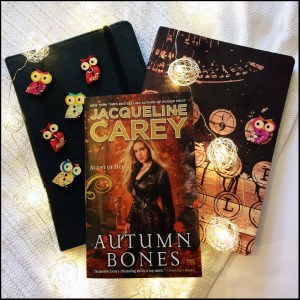
Fathered by an incubus, raised by a mortal mother, and liaison to the Pemkowet Police Department, Daisy Johanssen pulled the community together after a summer tragedy befell the resort town she calls home. Things are back to normal—as normal as it gets for a town famous for its supernatural tourism, and presided over by the reclusive Norse goddess Hel.
Not only has Daisy now gained respect as Hel’s enforcer, she’s dating Sinclair Palmer, a nice, seemingly normal human guy. Not too shabby for the daughter of a demon. Unfortunately, Sinclair has a secret. And it’s a big one.
He’s descended from Obeah sorcerers and they want him back. If he doesn’t return to Jamaica to take up his rightful role in the family, they’ll unleash spirit magic that could have dire consequences for the town. It’s Daisy’s job to stop it, and she’s going to need a lot of help. But time is running out, the dead are growing restless, and one mistake could cost Daisy everything…
Anyone with a very long memory will recall that I was looking forward to Autumn Bones releasing in 2014. More than two years later, I finally read the thing — though I don’t know why I didn’t read it sooner. I’m easily distracted by shiny things, I guess!
Autumn Bones is the second in the Agent of Hel series by brilliant fantasy writer Jacqueline Carey. I read the first, Dark Currents, back in 2012 and loved it (but that was before I was regularly reviewing books so I can’t link you a review, sadly). Of course, before starting Autumn Bones I couldn’t remember much about the series except for the fact it had a main character named Daisy who was half demon.
All of this is a roundabout way of saying that you can read Autumn Bones as a standalone book if you get the opportunity; you’ll be able to follow the story just fine. Daisy’s voice is such that she has a way of reminding you about things in a chatty way that makes you feel like she’s catching you up on her story over a cup of coffee and a slice of pie. It’s one of my favourite things about the book, honestly. (Also, she and her friends compare themselves the Buffy and the Scooby Gang, so you know they’re speaking my language!)
The other is the fact Daisy has a tail. Which is apparently very sensitive; she likes it when it’s scratched.
On that note, Autumn Bones is adult urban fantasy, but — despite Carey’s other books being quite, erm, intense — goes pretty light on the sex scenes. They do happen, but they are either glossed over or are described but in a very general way. We’re not talking erotica here. (Honestly, I was a tiny bit disappointed … but that says more about me than it does about the book.)
I’m not a usual fan of the love triangle story device. In this instance the book has something closer to a … love square? But Daisy is an old-fashioned and relatively wholesome girl, despite her ancestry, so it’s mostly that she notices other guys — we’re not talking orgies* or affairs or anything. It’s more that there’s the man she’s had a crush on since she was in school, who likes her but can’t hook up with her for family reasons. There’s the hot biker ghoul that she is attracted to but generally keeps it professional with. And there’s her actual boyfriend, who is fun, albeit related to some rather unsavoury types.
(*Except that one time, in the opening chapter of the book. But she’s there to break the orgy up, not take part. And she’s mortified by the experience; there’s a lot of “ew” from her, which made me giggle.)
You might be wondering about the clash between Daisy being the daughter of a demon and the fact she’s named Daisy and says “ew” at orgies. It’s because her mother didn’t set out to summon a demon; it was an accident, and once she got pregnant she set out to raise her daughter to be a good person. As well as the tail, Daisy wrestles with strong emotions — strong enough that things tend to get creepy around her if she gets mad enough — but she has been taught that to give in to the demon side of herself would fracture the wall between earth and hell, which is a lot of incentive to stay on (or at least adjacent to) the path of righteousness.
As a reader, part of me really wants to see Daisy embrace her inner demon, though. I’m imagining it’d be like Elsa in Frozen, except with fire. I’ll bring the marshmallows!
Ahem. Anyway. The story in Autumn Bones is a little meandering, and is sometimes slow-paced, especially towards the start. There weren’t any earth-shattering plot twists, but I enjoyed the story and was entertained nevertheless. I’ve already ordered the sequel, which I gather is the last book in the series. (Noooo!)
In case you missed it, last Thursday I was over at Aussie Owned and Read, talking about starting a story right.
Australian Women Writers Challenge – 2016 wrap up
Posted: December 31, 2016 Filed under: Reviews | Tags: AWW, AWW2016 2 Comments
he Australian Women Writers’ Challenge is part of a world-wide movement to raise awareness of excellent writing by women. It helps readers to challenge the subconscious stereotypes that govern our choice of books to read. The challenge encourages avid readers and book bloggers, male and female, Australian and non-Australian, to read and review books by Australian women throughout the year. You don’t have to be a writer to sign up. You can choose to read and review, or read only.
This is my third year doing the Australian Women Writers challenge — I set myself the goal of reading and reviewing 15 books, the same as I achieved last year. Again, I managed to get there, but only by a hair’s breadth. Well, a day. Which could be construed as a hair in some circles, I suppose.
I also did the Goodreads challenge, which I completed a while back. I’ll do a post on that in the next day or two. (I don’t want too many posts in a row; given I’ve been AWOL lately, I don’t want to frighten you all!)
Here is a link to each review, as well as my star rating for each book. They are listed in chronological order.
- Pretend… by Stacey Nash — 4 stars
- The Twenty-One by Lauren K. McKellar — 5 stars
- Fame by Lauren K. McKellar — 5 stars
- This Shattered World by Amie Kaufman and Meagan Spooner — 4 stars
- The Incredible Adventures of Cinnamon Girl by Melissa Keil — 5 stars
- Their Fractured Light by Amie Kaufman and Meagan Spooner — 4.5 stars
- Every Word by Ellie Marney — 5 stars
- Every Move by Ellie Marney — 5 stars
- Faking It by Gabrielle Tozer — 4.5 stars
- Divided by Sharon M. Johnston — 4 stars
- Shattered by Sharon M. Johnston — 4 stars
- Heart of Brass by Felicity Banks — 4 stars
- Gemina by Amie Kaufman and Jay Kristoff — 5 stars
- The Firebird by Sophie Masson — 3 stars
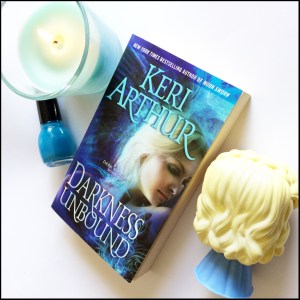
- Darkness Unbound by Keri Arthur — 3 stars
You’ll note that the link to Undivided is to my review on Goodreads; I originally reviewed the book a couple of years ago when it had another name, but I re-read it before I read Shattered. I updated the Goodreads review, but not the one on the blog. You’ll also note that I couldn’t find a paperback cover anywhere for The Firebird (which I listened to as an audiobook, or I would’ve scanned it!). This fact still pains me… :S
It has been a good year. I can’t wait to see what awesome books I discover in 2017!






Review: ‘Darkness Unbound’ by Keri Arthur
Posted: December 30, 2016 Filed under: Reviews | Tags: AWW, urban fantasy 1 Comment
The fight against darkness rages on for the next generation—in New York Times bestselling author Keri Arthur’s exciting new series set in the world of the Guardians.
Being half werewolf and half Aedh, Risa Jones can enter the twilight realms between life and death and see the reapers, supernatural beings that collect the souls of the dead. But she soon makes a terrifying discovery: Some sinister force is stealing souls, preventing the dead from ever knowing the afterlife.
Reapers escort souls — not snatch them — but Risa is still unnerved when a reaper shadows her in search of someone Risa has never met: her own father, an Aedh priest, who is rumored to be tampering with the gates of hell for a dark purpose. With the help of her “aunt” — half-werewolf, half-vampire Riley Jenson — and an Aedh named Lucian who may have lost his wings but none of his sex appeal, Risa must pursue whatever shadowy practitioner of blood magic is seizing souls, and somehow stop her father . . . before all hell breaks loose.
I had a vague idea that this was the first book in a series set in a world already established by a previous series. But, because it was the first book, I figured I’d be safe not to read the other series first. I was only partially correct in that assumption.
Keri Arthur’s world is … complicated. By way of example, her main character, Risa, is the daughter of a woman who is a cloned werewolf psychic consultant to celebrities; her father is an Aedh (a spirit being roughly akin to an angel). Her housemates and business partners are a horse shapeshifter who is a powerful witch, and a half-werewolf with pyrokinetic powers.
I managed to wrap my head around that part, but then you have all of Risa’s “aunts” and “uncles” (who I thought were really her aunts and uncles until towards the end of the book, when I realised they were her mother’s friends, presumably from the first series). They include half vampires, werewolves, guardians and I don’t even know what else. There were so many names and supernatural backstories that they blurred together. But I found once we got past the cameos and associated info dumps and I decided it didn’t matter, Darkness Unbound was an easier read.
The other thing I had to put to one side was that Risa is a bit of a Mary Sue character: gorgeous, with a selection of awesome superpowers and scad-loads of money. She even describes herself as “obscenely wealthy” at one point, and she had her housemates co-run a successful restaurant. I found her a little hard to relate to, because she never seems to really struggle for anything in her day-to-day life (and her restaurant income doesn’t seem to explain her alleged wealth). Again, this might be a symptom of the second-generation nature of the story — maybe her mother and the aunts and uncles already did the struggling so that Risa could benefit? I don’t know.
All of that being said, I still gave Darkness Unbound three stars, which is “I liked it” on the Goodreads scale (which I use because I’m lazy!). There are redeeming features in the story itself: there are bad guys with dastardly plans that Risa gets drawn into investigating. There’s a fair amount of shirtless eye candy (although a baffling lack of regular humans given the story is set in Melbourne!). Risa does get her ass handed to her on occasion, but she is also competent and quick-thinking when she gets into a jam, and can kick a decent amount of butt in her own right. That’s my favourite kind of heroine, so she gets points for that too.
One thing I should point out that didn’t bother me but that may not be to everyone’s taste is that werewolves in this world have the morals and sexual drive of a cat on heat. It may be related to the moon being full? I wasn’t clear on the details, but the upshot is that Risa is part-werewolf and casual sex is a thing. (I gather she has also used male werewolf sex workers in the past to satisfy her lusts — I personally like that girl power angle!) There’s even an orgy at one point. We’re not talking “Anita Blake later in that series” numbers of sexual encounters, thank goodness — it’s not the point of the story by any means. But the sex scenes in Darkness Unbound are explicit to the point of being erotica.
The last quarter of the book is where things really pick up pace and get more interesting, and that’s what saved Darkness Unbound somewhat for me. But there is less closure than some might like. The plot involving the “gates of hell” mentioned in the blurb is obviously the meta-plot for the series, and — although some questions are answered and there’s a twist that I found motivating (if not that surprising as it was well foreshadowed) — there are a lot of threads left unresolved.
If you’re looking for a complex urban fantasy world with some steamy sex, then I’d recommend this series. Actually, no, I think I’d recommend the other series first. That way this one will be less of a shock to the system.
(Edited to add: Goodreads tells me the first book in the original series has a lot more sex than this one … if that influences your decision-making one way or the other! 😉 )


 Cassandra Page