The Dream Journal – One Writer’s Inspiration
Posted: January 8, 2014 Filed under: On writing | Tags: dreams, guest post, inspiration, Lucid Dreaming 1 CommentToday’s guest post is by Mary Crockett, co-author of Dream Boy, which is due for release in mid-2014.
When Cassandra invited me to do a guest post, I used the title of her manuscript, Lucid Dreaming, as a springboard. I’ve always been obsessed with dreams—not surprising for someone whose upcoming co-authored novel is named Dream Boy, right?

But it’s not just me who’s obsessed. Fascination with dreams is as old as dreams themselves. Ancient Egyptians looked to dreams for portents of the future, while Australian Aborigines saw dreams as the secret to understanding the past. There’s Aristotle’s On Dreams, Freud’s Interpretation of Dreams, the Biblical representation of dreams as God’s cosmic telephone, the zillion weird dreams that figure in folklore and fairy tales, the zillion more books that interpret the symbolism of dreams… and of course let’s not forget Leonardo DiCaprio going all dark and broody as the lovelorn dream thief in Inception.
As a writer, though, I’m perhaps most interested in how we can allow our dreams to inspire and shape creative works.
That’s where the dream journal comes in.
One of the characters in Dream Boy keeps just such a journal. Drawing a line down the middle of the page, she writes everything she remembers about a dream on one side; on the other, she jots notes about real life events that may have triggered her subconscious.
In the notebook, reality goes in one place and dreams go in another; a clear line is drawn between the two. Of course, very little in life is quite as tidy as that—certainly not our creative processes.
So, why keep a dream journal in the first place?
For one thing, it’s fun.
For another, all the weird stuff that floats around in your subconscious can be a good place to go when your work-in-progress gets blocked up. Make a game of it: choose some random element from a recent dream and work it into a scene you’re writing. It will keep you going—and in writing, if you just keep going (somewhere… anywhere!), you often end up headed in the direction you genuinely needed to go.
(Plus, here’s a secret: the random element you select is probably not that random, even if it seems downright absurd. What happens when you dream and what happens when you write is not so different, really. They both connect to the subconscious. And the images that feed the subconscious have a way of making their own sense, regardless of your intentions.)
Perhaps most importantly, however, using a journal to map out the chaotic terrain of your dreams can feed your over-all imaginative life in very rewarding ways.
As you go along—recording your dreams—you are essentially trying to make sense of something that is by its very nature senseless. That process inevitably opens you up to contradiction. (Real world says X and ONLY X is true; Dreamworld says Y and Z and X’s second cousin Arnie is true. On Tuesdays. On other days, it says that baseballs turn into feathers when you sneeze on them. And your favorite dog never really died, but was just trapped all this time in a bomb shelter with elves.)
Contradiction, as you can see from the above, is pretty noisy. But it is also (at least in my experience) inspiring.
Think of it this way: the tension between two opposing ideas is often the wire on which good writing balances. So, exploring the boundary between reality and dream allows us to perch for a moment on that wire. When we return to our work of fiction, we see more. We see better. We see connections we might have missed otherwise.
But what about those who don’t even remember their dreams? How can any of this help them?
Unexpectedly, I have found that the very act of keeping a dream journal stimulates the recollection of dreams. So the more you plan to remember, the more you remember. Weird, but true.
Here’s how it works in two super-easy (super-cheesy?) steps:
- Put a notebook and pen beside your bed. Before drifting to sleep, remind yourself that you intend to remember and record your dreams. You might even say something as socially uncomfortable as “Hey, you are going to dream, and you will remember your dreams! They will be interesting dreams! Enjoy!”
- In the morning, before you get up or start thinking about your day, write down whatever scraps of dream you remember.
And at first they may be just scraps. But as you go on, exercising both your memory and tolerance for awkward conversations with yourself, you may find that you can build up to a pretty impressive recall. And remembering your dreams is a good thing—not only for the creative advantage—but also because your dreams can be an important shaping influence in your life.
I recently tweeted my two-year-old’s dream: “The cat was in my dream, and he was happy to be with me.” (Of course in real life, the cat barely tolerates my son, so this was pure wish fulfillment.) I was amazed at how many people tweeted back to share their own dreams—from the workaholic who dreams only of work to the woman who dreams of resuscitating zombies with a friendly Tyrannosaurus Rex.
Dreams are something we take with us into our day. Whether we entirely remember them or not, they are there, an essential part of us—telling us who we are. (Maybe in some ways even making us who we are.)
So listening to dreams—paying attention to wildness of the mind at moments when it answers to no master—is a worthwhile endeavor. And a dream journal is a great place to start.
About DREAM BOY (coauthored by Mary Crockett and Madelyn Rosenberg)
Annabelle Manning feels like she’s doing time at her high school in Chilton, Virginia. She has her friends at her lunchtime table of nobodies. What she doesn’t have are possibilities. Or a date for Homecoming. Things get more interesting at night, when she spends time with the boy of her dreams. But the blue-eyed boy with the fairytale smile is just that—a dream. Until the Friday afternoon he walks into her chemistry class.
One of friends suspects he’s an alien. Another is pretty sure it’s all one big case of deja vu. While Annabelle doesn’t know what to think, she’s willing to believe that the charming Martin Zirkle may just be her dream come true. But as Annabelle discovers the truth behind dreams—where they come from and what they mean—she is forced to face a dark reality she had not expected. More than just Martin has arrived in Chilton. As Annabelle learns, if dreams can come true, so can nightmares.
Pre-order DREAM BOY today: Amazon | Barnes & Noble | Indiebound
Add DREAM BOY to your Goodreads list.
About Mary
A native of the Shenandoah Valley of Virginia, Mary grew up as the youngest of six children in a family of misfits. She has worked as everything from a history museum director to a toilet seat hand model. In her other life, she’s an award-winning poet, professional eavesdropper, and the person who wipes runny noses. If you tweet at her @MaryLovesBooks, chances are she will tweet back.
Connect with Mary: Website | Blog |Twitter | Facebook | Goodreads | Tumblr | Pinterest
Beginnings: starting in the right place
Posted: January 6, 2014 Filed under: On the Isla's Inheritance trilogy, On writing | Tags: editing, Isla's Inheritance, writing 4 Comments
Starting your journey… Source
One bit of advice you’ll often hear from agents and various other book people—such as PitchWars mentors and other competition judges—is to make sure your book starts in the right place. I’m basically giving you that same message, but thought I’d do it with an example.
The inciting event—the first big, life-changing incident that triggers the plot—in Isla’s Inheritance happens at a Halloween party. That event is in the first chapter of the novel, and always was…but the first draft of that chapter started with Isla and her cousin Sarah receiving the party invitation and sorting out costumes. I’m still fond of that scene, because it sets up the relationship between the two characters, and Sarah is a lot of fun to write. But it wasn’t the best place. Isla thinking about whether she had time to get her homework done before the party wasn’t exactly the sort of thing that hooked the reader.
In my defence, it was my first novel, and I learned by making the mistake. :p
The fact my opening sucked bugged me all through drafting the book, so after I’d finished and taken the time to get a bit of distance from the writing, I went back again. (The distance is crucial. As I said, I was fond of the costume-choosing scene, which meant I needed to take the time to see it for what it was.) I cut the first part, and started the scene instead with the two girls and Sarah’s older brother, Ryan, arriving at the party. That’s better, I thought!
That was the version of the book I started querying. I entered it in PitchWars at the end of 2012, and the feedback I got from mentors really shook me. I was still starting in the wrong place, damnit! Again, I was still taking time to establish the characters. I had Sarah and Isla giggle over an old school crush. Dance. I thought I was setting the scene, but it was still slow.
I went back and amputated even more from the scene. By this point I’d probably removed around 2000 words. Now it starts with Isla, at the party, meeting Dominic—her eventual boyfriend—and getting invited to participate in a séance. Sarah doesn’t even appear until the end of the chapter.
Whether that ends up being the perfect starting point for the book will ultimately be decided by my editor at Turquoise Morning Press, and—if she is happy with it—by the reader. But it is far, far better than where I began.
If you’re getting told your book starts too slowly, have a look at what you’re trying to show the reader in your opening scene. For example, say you start with your character jogging, thinking about their life (apparently this is a very common beginning, as is staring into a mirror). You want the reader to see upfront that your main character is a physical creature who has problems that need pondering. Instead, why not start with the manifestation of the problems. You can always have the character jog later, or mention the athletics trophies being knocked to the ground during a zombie attack—that sort of thing.
Obviously there are exceptions to every rule. (For example, if your character is doing a marathon and they rupture their Achilles tendon in the first page, or get hit by a car, because the rest of the story is about their healing journey.)
I’d like to think I’ve learned this lesson now. I’ve started three other novels, and all of them have a much quicker beginning to the plot. But I learned it the hard way. Avoid my mistake, grasshopper!
In case you missed it, check out my latest advice post over at Aussie Owned and Read… Querying agents and publishers: a glossary.

Editing to music
Posted: November 28, 2013 Filed under: On writing | Tags: music, Tripod Leave a commentI don’t write to music much (unless I need it to block out some other, more annoying sound — like my son watching kids TV). Usually it’s about the silence for me.
But I can edit to music. This song is what has gotten me through NaNoEditMo. Well, this and the rest of the Perfect Tripod album it’s from.
Shared for your aural enjoyment. (Also, I have a MASSIVE geek crush on Scod, the guy on the far right with the glasses. This is one reason I can’t write romance — most romance readers seem to prefer beefcake. I don’t do beefcake.)
Musical inspiration: Tripod vs the Dragon
Posted: November 18, 2013 Filed under: On writing | Tags: inspiration, music, Tripod Leave a commentTortured bad guy inspiration. This. Watch it.
It’s from a (mostly) comedy DVD called Tripod vs the Dragon. I’ll give you one guess which one she’s playing.
(Note: there are two copies of this on YouTube — I’ve linked this one because it’s better quality but if you are watching this with small people around or the f-bomb bothers you, don’t watch the last two seconds of the clip. The song is safe though.)
I was made in darkest night
Of chalky ash and children’s fright
I do not think you know what you behold
I was made of aching hurt
Of fairy tales and bloody dirt
I hope you do exactly as you’re toldSiegfried and Saint George
Potter, Baggins, Beowulf
Were tempered in my forge
So I say to you and yoursAll caught fire in the ivory tower
In the marble arches
In the dust and darkness
And I have you on my mindOnce a mighty tree was grown
For you to know all that is known
I hope you hear exactly what I say
And by your sword a branch came down
And where the blood fell to the ground
It is my cradle and there I must stayAnd should ever you return
Well I must confess my story to be true
You will be burned
And I hope that you have learned:All caught fire in the ivory tower
In the marble arches
In the dust and darkness
And all caught fire in the ivory tower
And I have you on my mind
You’re on my mind
You’re on my mind
I could watch this on repeat all day, if only YouTube had a repeat function. (Someone get onto that, will you?) I have the DVD too, but that’s less convenient. :p
Show, don’t tell
Posted: November 16, 2013 Filed under: On the Isla's Inheritance trilogy, On writing | Tags: editing, Isla's Inheritance, writing 10 CommentsI’ve been in the edit cave since I finished Lucid Dreaming at the end of August. There’s been Isla’s Inheritance, Lucid Dreaming and now Isla’s Oath, as well as a couple of critiques for good friends. If there was a NaNoEditMo, I’d be totally caning it — even if the goal were more than the 50,000 that the NaNoWriMo folks are aiming for.
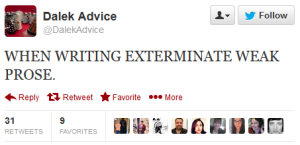
Weak prose: daleks say no
At least, that’s what I’m telling myself. (I’m not doing NaNoWriMo because I’m more of a NaNoSlowMo!)
Anyway, I always knew one of the writing mantras was show, don’t tell. But it wasn’t till after I went through my wonderful editor’s feedback on Isla’s Inheritance that I truly appreciated the breadth of this phrase.
It’s a funny expression, in a way. I mean, we’re writers. By definition, everything we do is telling, not showing. But the trick is to make the reader forget that you’re telling them. 😉
I always applied it to info dumps: those really boring parts of a book where you, say, summarised a piece of a character’s history. Better to have the character discuss said history in conversation — with someone who doesn’t know about it, obviously. (Don’t commit that awful crime you see on TV where characters repeat things to each other that no real person would, just to convey meaning to the reader/watcher. Ugh.)
That’s not to say that I didn’t have any info dumps in Isla’s Inheritance, but I managed to keep them under control for the most part. Or at least I recognised them when I saw them when I edited under my own steam, and cut them out.
But where I hadn’t fully applied show, don’t tell was in describing my character’s emotions, and in things she observed in the world around her. My manuscript was full of phrases like:
I felt guilty.
I heard sirens.
I saw him flinch.
Better to say:
My stomach churned with guilt.
The wail of sirens drew closer. (Or “The sirens’ wails drew closer”, if you’re on a passive sentence crusade.)
He flinched.
They convey the same meaning, but the latter set punches it up a notch. It’s the difference between telling someone a story and giving them the full immersion experience.
Show, don’t tell is my new favourite piece of advice. I may get it tattooed on my arm. (Ok, probably not, but it’s still a good one!)
This short film gave me ALL OF THE FEELS!
Posted: November 8, 2013 Filed under: On writing | Tags: muses, writing Leave a commentI while ago I reviewed the children’s picture book The Fantastic Flying Books of Mr Morris Lessmore. My son got it for his fourth birthday, and I loved it — it’s such a sweet metaphor for books as a source of healing after disasters.
Then my boy wanted to see the short film on which the book was based, so we watched it together. In the video version, the other subplot, about Morris rediscovering his muse and getting his own book to “fly” (a metaphor for not sucking) is more prominent and just as beautiful.
It’s fifteen minutes long, but well worth your time.
ALL OF THE FEELS, YOU GUYS!
Update: words to be wary of
Posted: October 31, 2013 Filed under: On writing | Tags: editing, words to be wary of, writing Leave a comment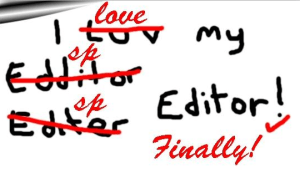 I’ve been doing a lot of editing in the last two months. A lot. I’ve done a first read on Lucid Dreaming, and separately incorporated feedback from a CP on it. I’ve CPed something in return. And, the biggest one of all, I got my first-round edits back from Turquoise Morning Press on Isla’s Inheritance.
So I guess it’s no surprise that I’ve added words to my list of things to keep an eye out for. So here’s an updated version. Maybe it will help others out too.
Adverbs (words usually ending in ly) – Do a search for words ending in “ly” and see whether you need them. Sometimes you can delete them outright; other times you can write around them. Rarely will you need them.
Dialogue tags such as gasped, shouted, yelled, cried, squealed, exclaimed, pronounced, whispered… I could go on all day. Check out this post if you want more information.
began to, started to, suddenly – “She began to run” is a long-winded way of saying “she ran”. Sometimes “began to” can be useful—say, when a girl begins crying halfway through an argument with her boyfriend—but not usually. And the house “suddenly” exploding isn’t any more shocking than the house exploding.
had – I’ve seen some people suggest you never need the word “had”. I don’t agree; in a past-tense novel it can be useful to flag that you’re talking about something that happened prior to the current scene. For example, “I had been to the shops”. If you say “I went to the shops” the way you would in a present-tense document (or life) then people will get confused about when the event happened. That being said, it’s not always necessary so use with caution.
of the – This is a typical indicator of a passive sentence, which is often unnecessary and always more wordy than an active sentence. For example: “The hair of the dog” vs “The dog’s hair”. Times you might want to keep a passive sentence include when the actor in the sentence is irrelevant or unknown; for example, “He was killed” versus “Bob killed him”. The latter is spoileriffic!
around, possibly, probably, likely, usually, almost, mostly – Do you need the qualification? If not, it should go.
seemed to – Because both my books are in the first person I overuse this phrase to describe my character’s interpretation of others’ feelings, thoughts or opinions. But nine times out of ten it doesn’t need to be there.
realised, knew, thought, saw, heard, felt (or their present-tense equivalents) – These phrases all flag a place where you’re telling rather than showing. “I felt angry” is the author telling the reader how the character felt, rather than showing it: “My fists clenched as fury raced through my veins”. (It’s terrifying how often I misuse these words!)
of – Sometimes this is unnecessary. Consider ‘The rage beat inside of my heart’. What is the ‘of’ contributing?
that – Sometimes you need “that” in a sentence. There are quite a few of them throughout this blog post. But you can often delete it with no impact on the meaning. Also, make sure you shouldn’t really be using ‘which’.
very, really, pretty (when it’s being used to mean “very”), just, simply, totally, finally, apparently, allegedly, supposedly, usually, awesome, fabulous, fantastic, incredible, wonderful – I keep these in dialogue and thoughts (because that’s how people talk), but at almost no other time. Note a lot of them are also adverbs?
Writing space
Posted: October 24, 2013 Filed under: On writing | Tags: real-estate, writing 7 Comments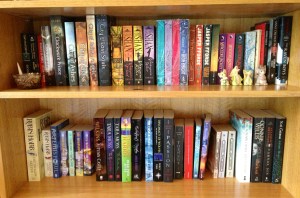
My to-be-read shelf has conducted a hostile takeover of adjacent territory
My writing space is almost set up. I was adamant when I bought my new house that as well as a bedroom for me and one for my son, there’d be a third room I could use as a study.
My old house was big. It was four bedrooms, and had an L-shaped lounge. There, one of the bedrooms was a library, and the computer lived in one part of the lounge. It was good then, because if my toddler was playing in the lounge or watching TV I could watch him while attempting to write (or, more likely, playing on social media). I wrote both of my Isla books there, and most of Lucid Dreaming.
This place is smaller. But I have my study. I had to put one bookshelf in the lounge because they wouldn’t all fit (and a smaller one in the dining room — yes, I have a lot of bookshelves). But the other five, and my computer desk, all tuck away quite nicely into my study.
There’s a view of our courtyard, and beyond that of the local park. And the study is far enough away from the lounge room that as my son grows older I won’t have to listen to him watch TV or play Final Fantasy XXIII on the Playstation 7.
As you can tell, I love it. It’s no isolated cottage at the end of a winding path, surrounded by flower gardens, but I did alright. ❤
What’s your ideal writing environment?
Meanwhile, over at Aussie Owned and Read…
Posted: October 18, 2013 Filed under: On Books, On writing | Tags: aussie-owned, contests, Halloween, reviews 1 Comment
It’s competition time! Share your favourite scary story (or write an original one) on your blog post and then register via the link list to be in the running to win a candy bag full of prizes! For more details go HERE!
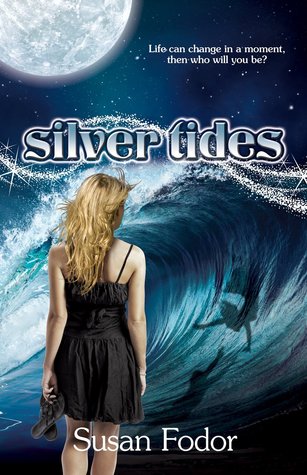
I also reviewed “Silver Tides” by Susan Fodor, which — among other things — has a simply gorgeous cover. See? The review is HERE if want to know more.
Writing for Young Adults
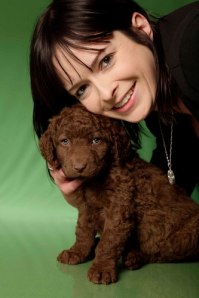
Posted: October 7, 2013 Filed under: On writing | Tags: contests, guest post, writing, young adult 1 CommentToday’s guest post is by Lauren K. McKellar, whose debut YA novel, Finding Home, came out on 1 October. Yay!
I have to confess: I wasn’t a YA author by choice.
I’ve always loved writing and reading, and my taste has always been to read up. When I was ten, I read Lord of the Rings. At eleven, there wasn’t anything ‘mature’ enough for me in the school library, so I read the dictionary.
 Yep, I had all the friends.
When I decided I wanted to try writing again, like I used to when I was younger, it was natural that I should try my hand at my current flavour of the moment: chick lit. I tried it during NaNoWriMo of 2011 and, needless to say, like many good first forays do, it sucked.
Badly.
Then I saw a competition advertised, Hardie Grant Egmont’s The Ampersand Project. It looked perfect: run by Aussies, a comp for first-time authors…it had everything! The only thing that didn’t quite fit with my master plan was the age group: it was for Young Adult writers.
‘No worries,’ I told my partner. ‘I’ll just write a YA.’
Ha! Like it’s that easy.
My first attempts at YA were terrible, so much worse than my first chick lit novel. I gave up. I deleted documents, I scrunched up pieces of paper and I threw my virtual competition entering spirit in the bin.
Then, something crazy happened.
I read a YA book.
It was completely by accident and, to be honest, I don’t think I knew it was YA before I picked it up.
And what happened? I was hooked.
I loved it. I loved it so much that I went out and bought a stack of other YA books, gorging myself on these teenage novels like a starving person at an all-you-can-eat buffet. Possibly with less restraint.
At the eleventh hour, I went back and attempted a complete rewrite of my Ampersand attempt. This time, I was armed with knowledge. I knew things, things I didn’t know before, including:
- Don’t write down to your audience. Who likes being spoken to like they’re a little kid? Not me.
- Try to avoid trends, e.g. brands of phone, social media specifics and current bands/movies. Trends change quickly for us all, but not so much as they do for teenagers.
- Don’t preach. My novel does feature a lot of teenage drinking, and it was hard to straddle the line between positive message and lecturing on the evils of booze. I’d like to think I’ve achieved it. Or, if not, I’ve given it a damn good shot!
- Research your genre. The kind of YA books I liked showed me things, things that some people might frown upon but that I loved reading about when I was a teenager. I wanted to read about sex. I wanted to read about drugs. I didn’t want them glossed over; I wanted details.
That doesn’t mean it’s the right thing to do, and Finding Home (my debut novel) doesn’t feature a whole heap of graphics on either matter. But they both feature. And I think that’s okay.
I didn’t get chosen for the Ampersand project. Honestly, I’m a little embarrassed when I think back to the copy I handed in then.
 Luckily for me, though, I did get a publishing contract. I actually had two publishers who I tricked into thinking that Finding Home was worth putting to print.
And, after much hard work, deliberation and excitement, Finding Home is on sale now, for young adults, through Escape Publishing, a Harlequin Australia imprint.
And do I read chick lit anymore? Hell to the no.
For a chance to win one of two $5 Amazon cards, one $10 Amazon card or a copy of Finding Home, click HERE!
Lauren McKellar is a writer and reader of Young and New Adult books. Her debut novel. Finding Home, is out now, and can be bought from all your usual eBook sites (links available here). She also works as a freelance editor for novels for all age groups and you can chat to her on Twitter or Facebook any time you like!


 Cassandra Page