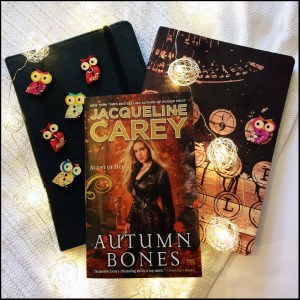
Review: ‘Autumn Bones’ by Jacqueline Carey
Posted: January 8, 2017 Filed under: Reviews, Uncategorized | Tags: reviews, urban fantasy Leave a comment
Fathered by an incubus, raised by a mortal mother, and liaison to the Pemkowet Police Department, Daisy Johanssen pulled the community together after a summer tragedy befell the resort town she calls home. Things are back to normal—as normal as it gets for a town famous for its supernatural tourism, and presided over by the reclusive Norse goddess Hel.
Not only has Daisy now gained respect as Hel’s enforcer, she’s dating Sinclair Palmer, a nice, seemingly normal human guy. Not too shabby for the daughter of a demon. Unfortunately, Sinclair has a secret. And it’s a big one.
He’s descended from Obeah sorcerers and they want him back. If he doesn’t return to Jamaica to take up his rightful role in the family, they’ll unleash spirit magic that could have dire consequences for the town. It’s Daisy’s job to stop it, and she’s going to need a lot of help. But time is running out, the dead are growing restless, and one mistake could cost Daisy everything…
Anyone with a very long memory will recall that I was looking forward to Autumn Bones releasing in 2014. More than two years later, I finally read the thing — though I don’t know why I didn’t read it sooner. I’m easily distracted by shiny things, I guess!
Autumn Bones is the second in the Agent of Hel series by brilliant fantasy writer Jacqueline Carey. I read the first, Dark Currents, back in 2012 and loved it (but that was before I was regularly reviewing books so I can’t link you a review, sadly). Of course, before starting Autumn Bones I couldn’t remember much about the series except for the fact it had a main character named Daisy who was half demon.
All of this is a roundabout way of saying that you can read Autumn Bones as a standalone book if you get the opportunity; you’ll be able to follow the story just fine. Daisy’s voice is such that she has a way of reminding you about things in a chatty way that makes you feel like she’s catching you up on her story over a cup of coffee and a slice of pie. It’s one of my favourite things about the book, honestly. (Also, she and her friends compare themselves the Buffy and the Scooby Gang, so you know they’re speaking my language!)
The other is the fact Daisy has a tail. Which is apparently very sensitive; she likes it when it’s scratched.
On that note, Autumn Bones is adult urban fantasy, but — despite Carey’s other books being quite, erm, intense — goes pretty light on the sex scenes. They do happen, but they are either glossed over or are described but in a very general way. We’re not talking erotica here. (Honestly, I was a tiny bit disappointed … but that says more about me than it does about the book.)
I’m not a usual fan of the love triangle story device. In this instance the book has something closer to a … love square? But Daisy is an old-fashioned and relatively wholesome girl, despite her ancestry, so it’s mostly that she notices other guys — we’re not talking orgies* or affairs or anything. It’s more that there’s the man she’s had a crush on since she was in school, who likes her but can’t hook up with her for family reasons. There’s the hot biker ghoul that she is attracted to but generally keeps it professional with. And there’s her actual boyfriend, who is fun, albeit related to some rather unsavoury types.
(*Except that one time, in the opening chapter of the book. But she’s there to break the orgy up, not take part. And she’s mortified by the experience; there’s a lot of “ew” from her, which made me giggle.)
You might be wondering about the clash between Daisy being the daughter of a demon and the fact she’s named Daisy and says “ew” at orgies. It’s because her mother didn’t set out to summon a demon; it was an accident, and once she got pregnant she set out to raise her daughter to be a good person. As well as the tail, Daisy wrestles with strong emotions — strong enough that things tend to get creepy around her if she gets mad enough — but she has been taught that to give in to the demon side of herself would fracture the wall between earth and hell, which is a lot of incentive to stay on (or at least adjacent to) the path of righteousness.
As a reader, part of me really wants to see Daisy embrace her inner demon, though. I’m imagining it’d be like Elsa in Frozen, except with fire. I’ll bring the marshmallows!
Ahem. Anyway. The story in Autumn Bones is a little meandering, and is sometimes slow-paced, especially towards the start. There weren’t any earth-shattering plot twists, but I enjoyed the story and was entertained nevertheless. I’ve already ordered the sequel, which I gather is the last book in the series. (Noooo!)
In case you missed it, last Thursday I was over at Aussie Owned and Read, talking about starting a story right.
Goodreads reading challenge – 2016 wrap-up
Posted: January 2, 2017 Filed under: On Books | Tags: Goodreads, reading Leave a comment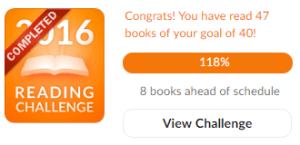
Actual figure: 48. See note below.
I’m a huge fan of the Goodreads reading challenge, as it’s something that keeps me motivated to read, even when life gets crazy busy and sometimes I’d rather just sleep. (What? I like sleep!) So, once again, here are the books I read in 2016, with some handy statistics. (I also like statistics. I did up an Excel spreadsheet with formulas and everything!)
I haven’t included any of my own books that I’ve read in the editing process, because then Goodreads asks me to rate them and I personally don’t want to go there.
- 77% were one stripe or another of speculative fiction, with 27% being fantasy, 21% being urban fantasy and 17% being sci-fi. Interestingly, 10% were superhero fiction, which is something I hadn’t really read at all before 2016.
- 63% of the books I read were by women writers (or had a women co-author in the case of Gemina). I am very happy with this stat. In 2015, I over-corrected from my male-dominated reading habits to get to 87% women. I prefer it to be closer to balanced, but — given that I do the Australian Women Writers challenge every year too — the numbers are always going to favour women writers a little.
- Two new-to-me authors featured very heavily this year: Brandon Sanderson (21%) and Emmie Mears (13%). I hadn’t read either of them before 2016 and they are now big favourites. (They are also responsible for all the superhero books I read, and the bulk of the fantasy!) Sanderson also made up the majority of the books by men that I read in 2016. I am nothing if not consistent.
- Format-wise, 48% of my reads were paperback or hardcover books; 16% were audiobooks; and 9% were on my Kindle.
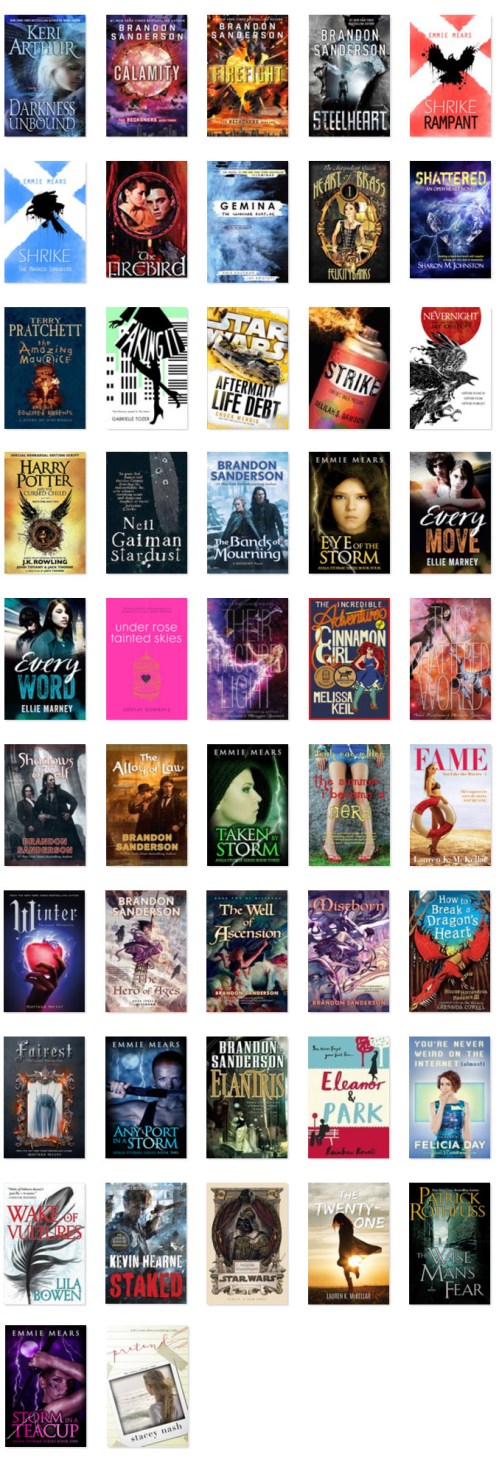
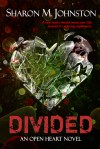
One thing I noticed after I got the screen grabs from Goodreads is that it didn’t record me having re-read Divided, even though I changed the date completed. Grr. I did include it in the stats above, but here is a picture of the cover, so the book doesn’t feel left out:
How did you go with your reading this year? What was your favourite book (or your favourite top five if you’re like me and can’t commit to one)?
Australian Women Writers Challenge – 2016 wrap up
Posted: December 31, 2016 Filed under: Reviews | Tags: AWW, AWW2016 2 Comments
he Australian Women Writers’ Challenge is part of a world-wide movement to raise awareness of excellent writing by women. It helps readers to challenge the subconscious stereotypes that govern our choice of books to read. The challenge encourages avid readers and book bloggers, male and female, Australian and non-Australian, to read and review books by Australian women throughout the year. You don’t have to be a writer to sign up. You can choose to read and review, or read only.
This is my third year doing the Australian Women Writers challenge — I set myself the goal of reading and reviewing 15 books, the same as I achieved last year. Again, I managed to get there, but only by a hair’s breadth. Well, a day. Which could be construed as a hair in some circles, I suppose.
I also did the Goodreads challenge, which I completed a while back. I’ll do a post on that in the next day or two. (I don’t want too many posts in a row; given I’ve been AWOL lately, I don’t want to frighten you all!)
Here is a link to each review, as well as my star rating for each book. They are listed in chronological order.
- Pretend… by Stacey Nash — 4 stars
- The Twenty-One by Lauren K. McKellar — 5 stars
- Fame by Lauren K. McKellar — 5 stars
- This Shattered World by Amie Kaufman and Meagan Spooner — 4 stars
- The Incredible Adventures of Cinnamon Girl by Melissa Keil — 5 stars
- Their Fractured Light by Amie Kaufman and Meagan Spooner — 4.5 stars
- Every Word by Ellie Marney — 5 stars
- Every Move by Ellie Marney — 5 stars
- Faking It by Gabrielle Tozer — 4.5 stars
- Divided by Sharon M. Johnston — 4 stars
- Shattered by Sharon M. Johnston — 4 stars
- Heart of Brass by Felicity Banks — 4 stars
- Gemina by Amie Kaufman and Jay Kristoff — 5 stars
- The Firebird by Sophie Masson — 3 stars
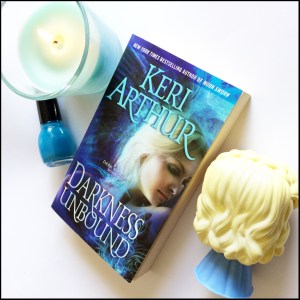
- Darkness Unbound by Keri Arthur — 3 stars
You’ll note that the link to Undivided is to my review on Goodreads; I originally reviewed the book a couple of years ago when it had another name, but I re-read it before I read Shattered. I updated the Goodreads review, but not the one on the blog. You’ll also note that I couldn’t find a paperback cover anywhere for The Firebird (which I listened to as an audiobook, or I would’ve scanned it!). This fact still pains me… :S
It has been a good year. I can’t wait to see what awesome books I discover in 2017!






Review: ‘Darkness Unbound’ by Keri Arthur
Posted: December 30, 2016 Filed under: Reviews | Tags: AWW, urban fantasy 1 Comment
The fight against darkness rages on for the next generation—in New York Times bestselling author Keri Arthur’s exciting new series set in the world of the Guardians.
Being half werewolf and half Aedh, Risa Jones can enter the twilight realms between life and death and see the reapers, supernatural beings that collect the souls of the dead. But she soon makes a terrifying discovery: Some sinister force is stealing souls, preventing the dead from ever knowing the afterlife.
Reapers escort souls — not snatch them — but Risa is still unnerved when a reaper shadows her in search of someone Risa has never met: her own father, an Aedh priest, who is rumored to be tampering with the gates of hell for a dark purpose. With the help of her “aunt” — half-werewolf, half-vampire Riley Jenson — and an Aedh named Lucian who may have lost his wings but none of his sex appeal, Risa must pursue whatever shadowy practitioner of blood magic is seizing souls, and somehow stop her father . . . before all hell breaks loose.
I had a vague idea that this was the first book in a series set in a world already established by a previous series. But, because it was the first book, I figured I’d be safe not to read the other series first. I was only partially correct in that assumption.
Keri Arthur’s world is … complicated. By way of example, her main character, Risa, is the daughter of a woman who is a cloned werewolf psychic consultant to celebrities; her father is an Aedh (a spirit being roughly akin to an angel). Her housemates and business partners are a horse shapeshifter who is a powerful witch, and a half-werewolf with pyrokinetic powers.
I managed to wrap my head around that part, but then you have all of Risa’s “aunts” and “uncles” (who I thought were really her aunts and uncles until towards the end of the book, when I realised they were her mother’s friends, presumably from the first series). They include half vampires, werewolves, guardians and I don’t even know what else. There were so many names and supernatural backstories that they blurred together. But I found once we got past the cameos and associated info dumps and I decided it didn’t matter, Darkness Unbound was an easier read.
The other thing I had to put to one side was that Risa is a bit of a Mary Sue character: gorgeous, with a selection of awesome superpowers and scad-loads of money. She even describes herself as “obscenely wealthy” at one point, and she had her housemates co-run a successful restaurant. I found her a little hard to relate to, because she never seems to really struggle for anything in her day-to-day life (and her restaurant income doesn’t seem to explain her alleged wealth). Again, this might be a symptom of the second-generation nature of the story — maybe her mother and the aunts and uncles already did the struggling so that Risa could benefit? I don’t know.
All of that being said, I still gave Darkness Unbound three stars, which is “I liked it” on the Goodreads scale (which I use because I’m lazy!). There are redeeming features in the story itself: there are bad guys with dastardly plans that Risa gets drawn into investigating. There’s a fair amount of shirtless eye candy (although a baffling lack of regular humans given the story is set in Melbourne!). Risa does get her ass handed to her on occasion, but she is also competent and quick-thinking when she gets into a jam, and can kick a decent amount of butt in her own right. That’s my favourite kind of heroine, so she gets points for that too.
One thing I should point out that didn’t bother me but that may not be to everyone’s taste is that werewolves in this world have the morals and sexual drive of a cat on heat. It may be related to the moon being full? I wasn’t clear on the details, but the upshot is that Risa is part-werewolf and casual sex is a thing. (I gather she has also used male werewolf sex workers in the past to satisfy her lusts — I personally like that girl power angle!) There’s even an orgy at one point. We’re not talking “Anita Blake later in that series” numbers of sexual encounters, thank goodness — it’s not the point of the story by any means. But the sex scenes in Darkness Unbound are explicit to the point of being erotica.
The last quarter of the book is where things really pick up pace and get more interesting, and that’s what saved Darkness Unbound somewhat for me. But there is less closure than some might like. The plot involving the “gates of hell” mentioned in the blurb is obviously the meta-plot for the series, and — although some questions are answered and there’s a twist that I found motivating (if not that surprising as it was well foreshadowed) — there are a lot of threads left unresolved.
If you’re looking for a complex urban fantasy world with some steamy sex, then I’d recommend this series. Actually, no, I think I’d recommend the other series first. That way this one will be less of a shock to the system.
(Edited to add: Goodreads tells me the first book in the original series has a lot more sex than this one … if that influences your decision-making one way or the other! 😉 )

Three of my 2016 Australian Women Writer reads that you should definitely check out
Posted: December 28, 2016 Filed under: On Books | Tags: aussie-owned, AWW, reviews Leave a commentLike I did in 2015, I set myself the goal of reading and reviewing fifteen books by Australian women writers. I’m currently at fourteen and on my last read now — hopefully I’ll be able to get it finished in the next couple of days, despite various holiday commitments. I’ll review it and then post a wrap-up post when I’m done.
Still, I’m confident in being able to recommend three reads from these fifteen books already. I was originally going to make this a top five for 2016, but that got too hard. I’ve already listed my top five YA reads over at Aussie Owned and Read; three of those were by Australian women writers — Gemina, The Incredible Adventures of Cinnamon Girl, and Every Word (as well as Every Move in the same series) — and I didn’t want to be repetitive. Consider all three of them already heartily endorsed.
I’ve also excluded the Aussie Owned and Read girls’ books because I am friends with them (though you should check out Fame, Pretend… and Shattered).
So, with that in mind — and noting that I’m basically recommending nine books here, not three 🙂 — here are three you should definitely check out.
‘Heart of Brass’ by Felicity Banks
Regular readers of my blog will know that I only reviewed this one last month. It’s by a Canberra writer who I only just discovered, and is a steampunk set in gold rush Victoria. In the space of a couple-hundred words, we get to see the main character, Emmeline, go from proper society lady who conforms to (most) social expectations while chaffing at the restrictions they impose to convict and criminal rebelling against an unfair system. The last 100 pages of the paperback are a Choose Your Own Adventure. Seriously!
‘Faking It’ by Gabrielle Tozer
Faking It is the sequel to The Intern, which I reviewed last year; however, it stands alone. It’s very light, fun and easy to read, with a fair number of cringe-worthy moments. But, for me, the shining treasure in this book is the dialogue, especially Josie’s. Her intermittent verbal filter meant that she often came out with lines that had me giggling, and at other times were raw in their honesty. The other thing I really enjoyed was catching a glimpse of Josie’s mother recovering from her shattered relationship and starting to date again. Even though Josie was quietly horrified, I was all, “You go, Josie’s mum!”
‘Their Fractured Light’ by Amie Kaufman and Meagan Spooner
This is the third and final book in the Starbound series; I also read the second book this year, but I enjoyed the third one more. However, unlike with Faking It, you really need to read the entire series to fully appreciate the conclusion to the meta-plot that flows through all three books. You won’t regret it, though. (By the way, I know that Meagan Spooner isn’t Australian, but Amie is — in the same way that I included Gemina as an AWW read despite the fact that Jay Kristoff is a dude. It totally counts!)
Now, since I’m planning on doing the AWW challenge again in 2017, this is your chance to recommend me some awesome books by Aussie women from your own reading lists. Please leave a comment! 🙂
Review: ‘Steelheart’ by Brandon Sanderson
Posted: December 8, 2016 Filed under: Reviews | Tags: reviews, superheroes Leave a comment
Ten years ago, Calamity came. It was a burst in the sky that gave ordinary men and women extraordinary powers. The awed public started calling them Epics. But Epics are no friend of man. With incredible gifts came the desire to rule. And to rule man you must crush his will.
Nobody fights the Epics … nobody but the Reckoners. A shadowy group of ordinary humans, they spend their lives studying Epics, finding their weaknesses, and then assassinating them.
And David wants in. He wants Steelheart — the Epic who is said to be invincible. The Epic who killed David’s father. For years, like the Reckoners, David’s been studying, and planning — and he has something they need. Not an object, but an experience.
He’s seen Steelheart bleed. And he wants revenge.
If Emmie Mears is my favourite new urban fantasy discovery for 2016, then Brandon Sanderson has to be my favourite general fantasy discovery. I listened to Steelheart on audiobook, and it gripped me to the point where I was sneakily listening to it while waiting for my son at school pick-up yesterday.
(It was the penultimate chapter! Don’t judge me!)
Things to love about Steelheart:
David, the main character, is a nerd. But — because he’s spent most of his life in a post-apocalyptic, super villain (aka Epic) world — his nerdiness runs to gun manufacture and use, and to research and trivia about Epics. He manages to be focused on revenge without being broody and obnoxious (phew). And he has the most hamhandedly delightful inability to use metaphors that I’ve ever encountered in a character.
The rest of the Reckoners team is interesting and dynamic. There’s Prof, the gruff leader with a secret; Tia, the scientist and researcher; Abraham, the spiritualist and crack shot with a gun; and Cody, the ex-cop and comic relief. And, of course, Megan, the ice princess who David starts crushing on pretty much immediately.
The plot is full of planning, scheming and a bunch of action sequences that leave you gripped. Guns! Explosions! More guns! (I got a little tired of Sanderson’s gun obsession, truth be told.) A car chase, but with motorbikes and helicopters! BOOM! POW!
The villains are suitably evil, with non-traditional superpowers. Steelheart himself is a bit like Superman, if he swapped out the ice breath for the ability to transform any non-living material around him into, well, steel. A lot of the book is spent (between gunfights) trying to figure out what Steelheart’s kryptonite is. The revelation is one of the final plot twists. Which brings me to…
The plot twists. Sanderson is a master at these things. I thought this time that I was onto him. I saw a lot of the foreshadowing, but … I drew completely the wrong conclusions! Aaah! (Next time, Sanderson! Next time!)
Things I loved a little less about Steelheart:
Some of the descriptions (such as of the guns, or of simple things like the fact Abraham had a soft French accent) got a tiny bit repetitive after a while. I think this might just be Sanderson’s style, because I’ve noticed the same thing in his other books.
I found David’s obsession with Megan, the prettiest girl in the room, a little … I don’t know, shallow? Her attitude towards him was almost always somewhere between chilly and frosty, with only occasional glimpses of warmth. By the end of the book that all made sense, but I never really understood why David kept persisting in trying to impress her. I had to keep reminding myself that he was 18 and not very experienced with girls … or other humans in general.
I think, in the end, I expected more from the book’s leading lady — someone like Vin or Sarene. Megan’s portrayal felt a little more “fan service-y”, where the fans are presumed to be teenage boys.
The counter to this is that her story arc takes a very interesting turn. I’m keen to see where it goes next.
Mini-review: ‘Rampant’ by Emmie Mears
Posted: December 4, 2016 Filed under: Reviews | Tags: reviews, superheroes, urban fantasy Leave a comment
Gwen Maule is Edinburgh’s hero. She’s got a new job for a boss she actually likes, and by night as Shrike she singlehandedly keeps her city’s crime rate at an all time low. But now Rosamund Granger has escaped custody and is killing people across Scotland. Desperately trying to get ahead of the murders, Gwen discovers that Britannia are not as gone as she hoped — and their newest plan will soak the earth in blood.
This is a mini-review, since I only reviewed The Masked Songbird, the first book in this series, less than a week ago. If you’re looking for a new urban fantasy/superhero series, I can’t recommend this one highly enough — but you should definitely start there.
Here are additional things you can look forward to in Rampant, book two in the series:
- It’s less of an origin story and gets more into the day-to-day of superhero life. Gwen’s superpowers continue to develop in delightful ways.
- We get to see how Gwen, Taog and Magda cope with PTSD in a way that comes across as realistic without crippling any of them to the point where they hide in cupboards (hi, Katniss).
- We don’t get to see any more of Angus, which I’m sure is a relief for everyone.
- We learn much more about Britannia, the organisation of villains (aka crazy cult) that were the baddies in the first book. They are still the baddies in this one.
- And, hoo boy, are they bad. The death toll is pretty high, you guys. And poor Gwen feels every death, which means we do too.
The only thing holding me back from giving this one five stars is that I found the end a little bit … anticlimactic? A lot of stuff happens, but Gwen is a little bit sidelined in the action, which was unsatisfying because I wanted her to lay out more smackdown than she got to. (It’s hard to be more specific than that without spoilers.)
Still, I really liked this book; I don’t know if Mears is planning on writing more books in this series, but I really hope she does!

Review: ‘The Masked Songbird’ by Emmie Mears
Posted: November 27, 2016 Filed under: Reviews | Tags: reviews, superheroes, urban fantasy Leave a comment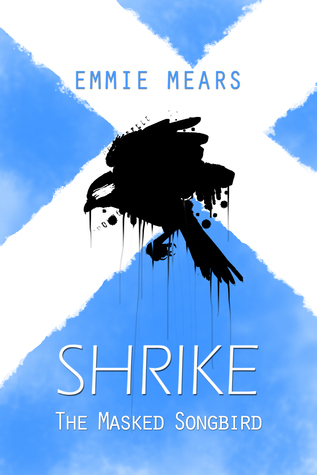
Edinburgh accountant Gwenllian Maule is surviving. She’s got a boyfriend, a rescued pet bird and a flatmate to share rent. Gwen’s biggest challenges: stretching her last twenty quid until payday and not antagonising her terrifying boss.
Then Gwen mistakenly drinks a mysterious beverage that gives her heightened senses, accelerated healing powers and astonishing strength. All of which come in handy the night she rescues her activist neighbour from a beat-down by political thugs.
Now Gwen must figure out what else the serum has done to her body, who else is interested and how her boss is involved. Finally—and most mysteriously—she must uncover how this whole debacle is connected to the looming referendum on Scottish independence.
Superpowers don’t make a superhero. Real strength isn’t something you’re born with — it’s something you build.
Emmie Mears is my favourite new urban fantasy discovery for 2016. I devoured her Ayala Storme series and then went looking for more. The Masked Songbird was her debut, but didn’t suffer for it — it has all the hallmarks of her writing, in that it’s action-packed and full of heart.
Despite the blurb, Gwen starts off in a pretty dark place. Yes, she has a boyfriend — but Angus is a manipulative prick one step away from being abusive. Yes, she has a job — but her terrifying boss is clearly a corporate psychopath (and, it turns out, a regular psychopath too) who has it out for her. Gwen’s life is very grey and grim.
That all changes when, in typical superhero-origin style, Gwen ingests an experimental serum hidden in a bottle of soft drink. But not in a “wow, I have powers; I rock now” way. More in a “what the hell is happening” way. She pays a pretty steep price for her powers (I won’t go into details, because spoilers), and gets her ass handed to her at least once because she gets in over her head. Strength does not automatically equal skill, after all.
And, even with her superpowers, it takes Gwen a while to realise she deserves better than what she has, especially with regards to Angus. She suffers from that sadly fairly common delusion that being with a scumbag is better than being single. (Hint: it’s not!) I’m pleased to say that she grows throughout the story and comes to realise she doesn’t need him.
I haven’t read very many true superhero books, though a lot of urban fantasy has the trappings of a superhero story. The Masked Songbird is pure superhero, down to the spandex costume and the crime-fighting. I loved it so much!
I loved watching Gwen’s friendship with her flatmate Magda turn from “friendly acquaintances” into “BFFs”. And Taog (pronounced “took”, apparently — Welsh names do my head in), the kindly and hot next door neighbour, is patient and committed to his beliefs. There is definite tension there, but Gwen resists it, not wanting to cheat on Angus. Hopefully their relationship will develop further in the sequel.
The overarching events that provide the backdrop and the external story relate to the Scottish independence referendum in 2014 (when The Masked Songbird was originally released). The book is set in the lead-up to the vote, and explores the idea of an extremist pro-UK group, Britannia, trying to suppress the “leave” campaign while scaring the public into voting to stay. I did struggle with how truly evil the Britannia members were at times … but I suppose every superhero needs an evil super-villain. (And there’s no doubt that people have gotten violent over this sort of thing in the past … though not usually without religion being a factor too.)
Oh, I should add: the other thing I really enjoyed on a personal level was the evocative descriptions of Edinburgh. I went there on holiday in 2012 and it was so easy for me to picture the places I’d visited.
I’ve already bought the sequel and can’t wait to get stuck into it. I highly recommend this one.

Because I read this on my Kindle, I printed out the cover to take a photo with. I didn’t realise until afterwards that it was a different cover. Aargh!
Review: ‘The Firebird’ by Sophie Masson
Posted: November 21, 2016 Filed under: Reviews | Tags: AWW, reviews Leave a comment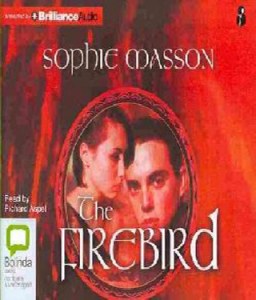
I had the devil’s own time finding a decent image of the book cover. Sad. 😦
Ivan, youngest son of the powerful, greedy Tsar Demyan, is resigned to a life of misery and humiliation at the hands of his brothers, brutal Yuri and sly Igor. And to add to his torment, Yuri has been promised in marriage to the girl Ivan has loved all his life — the bold and beautiful Princess Tamara, daughter of a neighboring king.
Then one day, Ivan sees the legendary Firebird in his father’s garden. The tsar, obsessed with the beautiful creature, orders his sons out in a quest to capture it and bring it back to the palace. Determined to find the bird before his brothers do, Ivan embarks on a thrilling journey of reckless endeavor and strange magic.
The Firebird is a sweet little story that draws on Russian folklore — not something I’ve read a huge amount of, although a lot of the tropes were familiar (such as the kind and honest younger son suffering from abuse at the hands of his cruel and conniving older brothers).
I found The Firebird an interesting but somewhat straightforward tale; there was only one plot twist that I didn’t see very far in advance, and that was because we are only told the relevant information shortly beforehand.
Ivan, said youngest son, is passive and mopey to the point that I wanted to shake him. Once his quest begins, he shows a little more strength of character, but he is intuitive, rather than logical, and kind to the point of naiveté. Because The Firebird is a fairytale, that naiveté becomes a strength rather than the debilitating weakness it would be in a more-realistic genre. (Is that too cynical of me?)
I quite like Tamara, who is betrothed to Ivan’s evil oldest brother in order to save her kingdom, a betrothal that is the cause of Ivan’s moping. I think I’d have preferred this story if more of it were from her perspective.
A lot of the chapters are unfortunately from the perspective of Ivan’s brothers, Yuri (the cruel one) and Igor (the conniving one). They are irredeemably evil — though, again, they would have been worse in a different genre — and I didn’t really enjoy their chapters very much. It was entertaining seeing them being led around by the nose by a bunch of elderly Russian magicians, though.
What kept me reading (well, listening to my audiobook) was that Sophie Masson’s writing is delightful: her descriptions are as vivid and beautiful as her story is whimsical. At the end of the day, I think this is a “it’s not you, it’s me” situation — I did like The Firebird but I didn’t love it as much as others who dig this genre will.
PS I felt a bit the same about Stardust, which is a similar story, with a similar protagonist. I think maybe “fairytale” isn’t my thing? I’ll stick to “fairytale retellings” instead.
 In case you missed it, earlier in the month I was over at Aussie Owned and Read, with my four tips for ways to see your writing anew.
Review: ‘Gemina’ by Amie Kaufman and Jay Kristoff
Posted: November 17, 2016 Filed under: Reviews | Tags: AWW, jay kristoff, reviews, sci-fi, young adult 2 Comments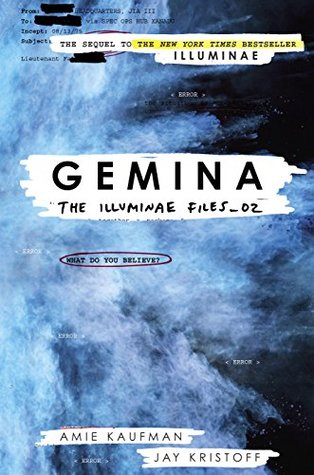
Moving to a space station at the edge of the galaxy was always going to be the death of Hanna’s social life. Nobody said it might actually get her killed.
The sci-fi saga that began with the breakout bestseller Illuminae continues on board the Jump Station Heimdall, where two new characters will confront the next wave of the BeiTech assault.
Hanna is the station captain’s pampered daughter; Nik the reluctant member of a notorious crime family. But while the pair are struggling with the realities of life aboard the galaxy’s most boring space station, little do they know that Kady Grant and the Hypatia are headed right toward Heimdall, carrying news of the Kerenza invasion.
When an elite BeiTech strike team invades the station, Hanna and Nik are thrown together to defend their home. But alien predators are picking off the station residents one by one, and a malfunction in the station’s wormhole means the space-time continuum might be ripped in two before dinner. Soon Hanna and Nik aren’t just fighting for their own survival; the fate of everyone on the Hypatia—and possibly the known universe—is in their hands.
But relax. They’ve totally got this. They hope.
Gemina is over 600 pages. I devoured it in two sessions, despite being a single mother who works full time. That should demonstrate that you should read it.
*waits*
Okay, you want more? Well, first off, know that this is the sequel to the magnificent Illuminae, which was one of my favourite 2015 reads — if not my favourite. I gave it five stars on a one to five scale.
Gemina is better.
The genre is, broadly, a young adult, fast-paced, alternate-format sci-fi series. The key adjective there is “alternate format” — both books are presented in a “found footage” way: instant message and radio transcripts, emails and security camera footage (transcribed by a character known only by his analyst code, and also — in this book — by my favourite crazy-ass computer). There’s another difference in Gemina, in that Hanna, our leading lady, has a journal and is an artist. This means we get character sketches, a rough map of the space station, and a creeping sense of dread at the bloodstain slowly spreading in each new page we see.
If Illuminae is space zombies meets 2001: A Space Odyssey, Gemina is a mash-up of space terrorists and space, um, aliens. Like, aliens from the movie Aliens. (This isn’t a spoiler if you’ve read the blurb, btw.) While the latter combination is definitely creepy, Illuminae gave me more chills — although that has a lot to do with my near-phobia of invisible killers such as plagues, I suspect.
I’d find it hard to choose between the leading ladies of Illuminae and Gemina — both are kick-butt in their own ways, though Hanna is in the literal sense that she’s a black-belt with military training, courtesy of ol’ Dad. Definitely a handy lady to have on your side in a terrorist-alien situation.
As for the blokes, I was fond of Ezra but would pick Nik any day of of the week. (Sorry, Ezra.)
We do get to see a handful of characters from the previous book — those that survived, at any rate. There’s a third book to come in the series, where hopefully Kady and Hanna (and the others, I guess, but mainly Kady and Hanna!) will team up and kick BeiTech face first through a black hole. I’ll be cheering for them from over here!
I hear the audiobook is amazing, but I read the paperback. Whichever way you do it, get this series. Love it. Name your children after it.



 Cassandra Page