Review: ‘William Shakespeare’s Star Wars: Verily, A New Hope’ by Ian Doescher
Posted: February 20, 2016 Filed under: Reviews | Tags: geekery, reviews, shakespeare Leave a comment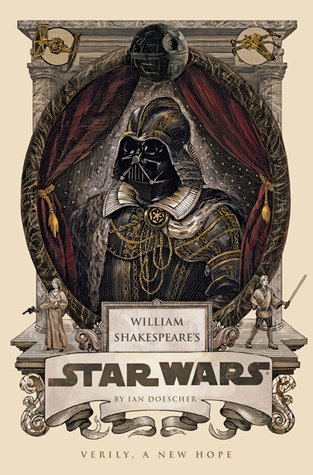
MAY THE VERSE BE WITH YOU!
Return once more to a galaxy far, far away with this sublime retelling of George Lucas’s epic Star Wars in the style of the immortal Bard of Avon. The sage of a wise (Jedi) knight and an evil (Sith) lord, of a beautiful princess held captive and a young hero coming of age, Star Wars abounds with all the valor and villainy of Shakespeare’s greatest plays. ‘Tis a tale told by fretful Droids, full of faithful Wookiees and fearsome Stormtroopers, signifying… pretty much everything.
Reimagined in glorious iambic pentameter, William Shakespeare’s Star Wars will astound and edify Rebels and Imperials alike. Zounds! This is the book you’re looking for.
I bought this as a present for a friend because the concept tickled me. When I got it home I started flicking through it … and before I knew it, I’d read the entire thing. (Sorry, Peter!)
Though I do love episode seven, I’d otherwise describe myself as a casual fan of the Star Wars franchise — I don’t own any of the DVDs and the only book I’ve read is Chuck Wendig’s Aftermath, because I’m a fan of his writing. Likewise, I’ve read some Shakespeare, but probably not since my university days.
Still, I’m familiar enough with each to recognise the famous quotes, which is fortunate, because I got a lot of joy from seeing Star Wars rendered in iambic pentameter, and from seeing Shakespeare quotes adapted to a Star Wars plot. (There was also a cheeky reference to Star Trek’s “boldly go” statement, which made me snigger.) Doescher has clearly taken a lot of care in adding these sorts of in-jokes for the reader, which take this book from a straight retelling to something both beautiful and slyly amusing.
The other thing I really liked about the adaptation is the Shakespearean use of the soliloquy to give glimpses into the true nature of each of the major characters. We hear C3PO talk about his true feelings for R2-D2 (despite his constant, snark-filled badgering), R2-D2 in turn reveal his disdain for C3PO, Darth Vader give a glimpse into the darkness in his soul, and Han reveal that he’s not just a scruffy criminal but something more. Luke’s starry-eyed desire for adventure and realisation it’s not all it’s cracked up to be makes me like his character more than his whining in the movie did.
The language is a lot easier to follow than genuine Shakespeare too, because — although Doescher has used the rhythm and basic linguistic trappings — I didn’t have to look up any of the words to see what they meant. YMMV. As I said, I haven’t read Shakespeare for a long time!
I strongly recommend this for fans of the movies who also love a bit of Shakespeare.

Review: ‘The Twenty-One’ by Lauren K. McKellar
Posted: February 16, 2016 Filed under: Reviews | Tags: aussie-owned, AWW, reviews 1 Comment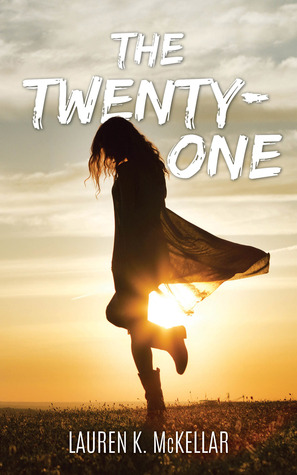
I look both ways before I cross the road. I knot my laces twice. Boring? Sure. But it’s also settled. Stable. Safe.
And I like safe.
Because broken bones may be hard to heal, but broken hearts are even harder. And when the man I loved and lost reappears in my life, I won’t fall for his charms again … will I?
Joel Henley just might be my biggest risk yet.
My name is Ellie Mayfield. And this is my undoing.
Before I started reading this book, I asked the author whether I’d need to have the tissues on standby. She said maybe. MAYBE. Afterwards, she clarified that tissues may not have been absorbent enough. Related to this, I have a Goodreads shelf called “made me cry”. There are now eleven books on there (I don’t cry that easily while reading), and three of them are by Lauren K. McKellar.
Needless to say, this book is one that will give you feels. Many feels.
At the start of the book, Ellie (who is a side character in McKellar’s How To Save A Life) could best be described as a bit of a doormat. Her mother is an a-grade cow and her younger sister is manipulative and getting worse. Ellie doubts herself when she shouldn’t and lets her family take advantage of her, putting her own desires to one side and seeing herself as bound by a promise to her dying father to look after them both when he’s gone.
That’s when we meet Joel Henley, Ellie’s high school boyfriend. He left her suddenly when she was 16, and within the blink of an eye manages to again sweep her off her feet, dragging her along with him as he works through a bucket list of twenty-one things he wants to do before he turns twenty-one. Everything seems to be going swimmingly till maybe halfway through the book … and that’s when (as is traditional in these sorts of books, I guess?) the wheels come off.
From that point on, everything gets harder on all fronts — but there are sweet moments too, bright spots in the gloom like stars in the night sky. That comparison isn’t just me being poetic; stars are a theme throughout the book, one I like to think McKellar put there deliberately for that exact reason.
I really liked Joel. I especially liked the way that he helps Ellie to stand on her own two feet, take (reasonable) risks and discover the spine that she forgot she had all along. Her character growth as a result of his influence is wonderful to watch, and those moments where she put her foot down and said no to others were simply glorious.
If you’re a fan of heart-wrenching stories then pretty much anything by McKellar is worth a look. Most of her books largely stand alone, so you don’t need to read How to Save a Life to be able to follow this one, but I loved that book too, so you definitely should.

Review: ‘The Wise Man’s Fear’ by Patrick Rothfuss
Posted: February 13, 2016 Filed under: Reviews | Tags: fantasy, reviews Leave a comment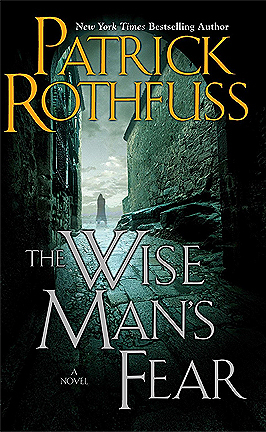
“There are three things all wise men fear: the sea in storm, a night with no moon, and the anger of a gentle man.”
My name is Kvothe.
I have stolen princesses back from sleeping barrow kings. I burned down the town of Trehon. I have spent the night with Felurian and left with both my sanity and my life. I was expelled from the University at a younger age than most people are allowed in. I tread paths by moonlight that others fear to speak of during day. I have talked to Gods, loved women, and written songs that make the minstrels weep.
You may have heard of me.
So begins the tale of a hero told from his own point of view — a story unequaled in fantasy literature. Now in The Wise Man’s Fear, an escalating rivalry with a powerful member of the nobility forces Kvothe to leave the University and seek his fortune abroad. Adrift, penniless, and alone, he travels to Vintas, where he quickly becomes entangled in the politics of courtly society. While attempting to curry favor with a powerful noble, Kvothe uncovers an assassination attempt, comes into conflict with a rival arcanist, and leads a group of mercenaries into the wild, in an attempt to solve the mystery of who (or what) is waylaying travelers on the King’s Road.
All the while, Kvothe searches for answers, attempting to uncover the truth about the mysterious Amyr, the Chandrian, and the death of his parents. Along the way, Kvothe is put on trial by the legendary Adem mercenaries, is forced to reclaim the honor of the Edema Ruh, and travels into the Fae realm. There he meets Felurian, the faerie woman no man can resist, and who no man has ever survived…until Kvothe.
In The Wise Man’s Fear, Kvothe takes his first steps on the path of the hero and learns how difficult life can be when a man becomes a legend in his own time.
The Wise Man’s Fear is the second in The Kingkiller Chronicle. If you haven’t read the first book, then this isn’t the place to start; they need to be read in order. This book continues Kvothe’s retelling of his life to date, picking up where the first book leaves off. It is now day two of Kvothe telling the story and, again, the book jumps between Kvothe’s tale and events in the inn where he is telling it.
I adore the foreshadowing that Rothfuss is able to do by virtue of glimpses of “current” events. One non-spoilery example is the fact that Kvothe at some point killed a king. I’ve been getting a kick out of building my own little theory as to who that might be and why, and will be very interested to see how the story unfolds. Likewise, the fate of Denna has a question mark over it. Regardless of what I think of her (I have mixed feelings), she is definitely past-Kvothe’s love, and her marked absence from present-Kvothe’s life (and his obvious depression) suggests she meets some kind of sticky end.
I NEED TO KNOW WHAT HAPPENS, YOU GUYS.
There are elements of this book that I didn’t enjoy as much as the first book, although I suppose they are inevitable given the story is about the development of a hero (who must at some point have learned magic and how to fight). They mostly revolve around loose threads. I get really frustrated when characters seem to put one (quite important) thing on hold to chase up another. I’m not talking about Kvothe taking a break from university — I think that was a good idea to mix up the story — but when he decided to take a several month (several hundred page) detour before reporting back to Alveron, I got a bit twitchy. Especially with the Felurian episode … although why that was important became clear by the end of the book.
Still, even the more tangential bits of history are interspersed with action set in the present, and there are little mysteries unfolding there too. For example, what is going on with his student, Bast (a character I really enjoy)?
Overall I’ve given The Wise Man’s Fear 4.5 stars. It was very good, but the first book in the series was very, very good. Regardless, I will definitely be going back for book three, Doors of Stone, when it comes out … which will hopefully be some time this decade. *sniff*

Review: ‘Storm in a Teacup’ by Emmie Mears
Posted: February 4, 2016 Filed under: Reviews | Tags: reviews, urban fantasy Leave a comment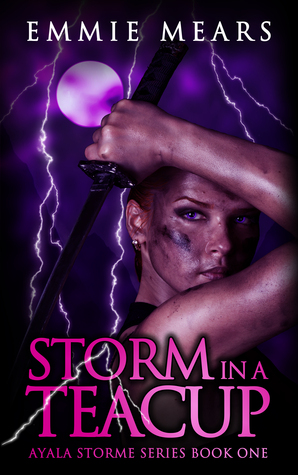
Mediator Ayala Storme handles PR by day and kills demons by night. She avoids Mediator luncheons and a fellow Mediator who’s been trying to get in her pants for years. She does her job. She keeps her sword clean and her body count high. But when a rash of disappearances leads her to discover that Nashville’s hellkin are spawning a new race of monster in human hosts, Ayala will be the first line of defense against these day-walking killers.
That is, until one of the creatures saves her life.
Ayala’s new knowledge of the hybrids’ free will challenges everything she’s ever known about her job. Racing the clock while trying to outrun her comrades and enemies alike, she’s not sure who will catch her first…
I got the ebook of Storm in a Teacup last year, and it kicked around on my Kindle for a while, until I began to crave a fresh new urban fantasy. And boy, does this series deliver.
Despite a couple of somewhat cheesy elements (the main character’s surname being one, and the fact she and the other Mediators all have violet eyes being the other), Storm in a Teacup gave a fresh face to the idea of a society of demon hunters in an alternate USA.
The violet eyes indicate that a person is destined to be a Mediator; they are taken from their parents and trained from a young age. The means by which they get their supernatural powers — whether they are inherent, or bestowed during the training via external means — aren’t addressed in the first book, but hopefully will be down the track. One of the side-effects of that power is quite sinister and makes me wonder if the Mediators’ origins are less than pure. The “taking babies from their parents” thing is another sign, as is the euphemistic name. They don’t really “mediate” anything that we see; they are basically the world’s pest control, trained to slaughter any demons that stick their noses out of hell. And they don’t even get paid for it, which I found even more appalling!
Ayala is a strong female lead who knows what she wants. She has a taste for luxury in the privacy of her own home, and orange hair … although I never pictured her that way due to the book’s cover. (Also, orange and violet? Poor girl!) Far and away my favourite thing about the book was Ayala’s voice. She is clever, sassy and fun, and tells her story in a first-person, conversational and often hilarious style that totally drew me in. I’d recommend this book just for the voice!
As far as the plot goes, it starts out in a fairly conventional “monster hunt” way, with the demons being the usual, icky and irredeemable evil. As the blurb foreshadows, though, the results of the demons’ new project aren’t as black and white as all that, and Ayala is quickly thrown between the rock of her Mediator indoctrination (demons bad) and the hard place that is her moral code (don’t kill the innocent). I saw the main plot twist coming, but was happy to be taken along for the ride.
Although there is a lot of violence, the sex scene is of the “fade to black” sort, making this book a fairly clean read for anyone from their late teens onwards. (I don’t remember there being swearing, but I tend not to notice that as much.) The story resolves itself, so I was left satisfied, but there are enough elements and questions left that I’ll be reading on to find out more about this intriguing world.
Review: ‘Pretend…’ by Stacey Nash
Posted: January 25, 2016 Filed under: Reviews | Tags: aussie-owned, AWW, reviews Leave a comment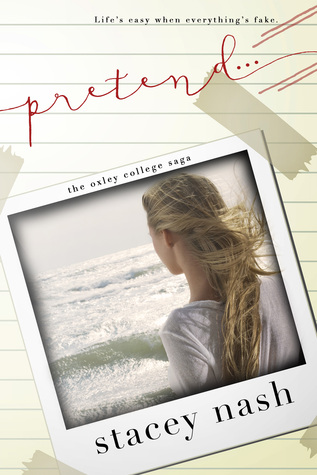
Life’s easy when everything’s fake.
Savannah West had it all: popularity, good grades and a family who loved her, but how quickly things can change. Living half a state away doesn’t stop the painful memories of her past ripping her heart in two. And sometimes lies are easier than coping with the truth.
The thing she didn’t bank on was Dane Beaumont. A blast from her horrendous past, he’s the last person she expected to run into at college … and it’s not just because he knows the truth. Hot as sin, he’s more off limits than generic brand clothing, but staying away isn’t easy when he insists on looking out for her. Dealing with the reality of finding her place in the world, Savvy must face the guy who tears down all her carefully placed walls and pull herself together. It’s time to grow up.
Pretend… is the sequel to Shh! and Wait! — which I have also reviewed — and is part of the Oxley College series. (Oxley is the name of a student housing dormitory at Armidale University, if you’re wondering.) Pretend… is actually set concurrently with Shh!, which was a lot of fun — I enjoyed those little outside glimpses into Olivia and Logan’s story.
I confess I wasn’t in love with Savannah’s story to the same extent as either Olivia’s or Hex’s; my main reservation is neatly captured by the blurb. Although Savvy has issues and traumas in her past, most of her current problems are caused by her own reluctance to be honest with people. I’m not saying I didn’t understand why — it’s definitely easier to pretend to be the carefree socialite than to risk rocking the boat — but still. The end result was that, at times (particularly at around 60%), I wanted to knock her gorgeous blond head into a wall.
I also didn’t like Dane as much as Logan, who was the love interest in the first book. The reasons for this are mostly personal taste: I don’t generally enjoy cocky alpha male types. And Dane seems quite shallow and vain at first. However (and this is a big however), given the dual POV, we get to see inside his head, which gives us a chance to see that there is more going on than a surfboard and immaculate pecs. I admit he, erm, grew on me. :p
And the pairing of Savvy and Dane really worked. I liked that he saw past her smokescreen and was, from the start, the one she could rely on, who knew the truth and who called her out on her BS. I liked the way they grew throughout the book.
The other thing I really loved about Pretend… was how much of it was set at the beach. It made me really hanker for a holiday!
Like all the Oxley College books, Pretend… is sweet new adult romance, meaning that although there is heated kissing (boy howdy!), the sex all happens off camera, so to speak. There is more swearing in this book than in the previous two, which I actually found a relief as it read more naturally.
If you enjoy clean-ish college/university romances with raw and honest alpha male leads and fashion-conscious female leads with tragic pasts, then Pretend… is the book for you. Although the story would stand alone, if it were me I’d start with Shh! and then read this one, then Wait!.

Review: ‘Fairytales for Wilde Girls’ by Allyse Near
Posted: December 29, 2015 Filed under: Reviews | Tags: AWW, fairy tales, reviews Leave a comment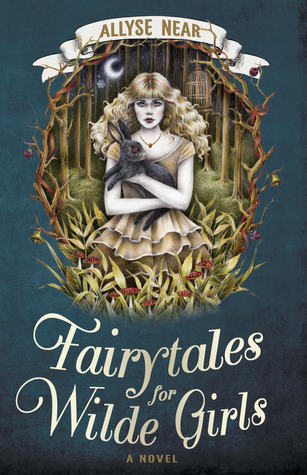
‘He’s gone the same way as those little birds that bothered me with their awful songs! And you will too, you and your horrible heart-music, because you won’t stay out of my woods!’
There’s a dead girl in a birdcage in the woods. That’s not unusual. Isola Wilde sees a lot of things other people don’t. But when the girl appears at Isola’s window, her every word a threat, Isola needs help.
Her real-life friends – Grape, James and new boy Edgar – make her forget for a while. And her brother-princes – the mermaids, faeries and magical creatures seemingly lifted from the pages of the French fairytales Isola idolises – will protect her with all the fierce love they possess.
It may not be enough.
Isola needs to uncover the truth behind the dead girl’s demise and appease her enraged spirit, before the ghost steals Isola’s last breath.
Fairytales for Wilde Girls is a strange and wonderful little début from Melbourne author Allyse Near. The genre could be described as contemporary fairytale, a bit like the Splintered series by A. G. Howard. But Fairytales also falls squarely into the gothic fiction category — with those traditional elements — and has some quirky screenplay influences (when, for example, the characters are introduced as though you’re reading a script). There are also gorgeous pictures throughout the book of Isola’s six princes.
I don’t know why the blurb describes the book as “bubblegum gothic”, though. I didn’t get a bubblegum feel from Fairytales at all.
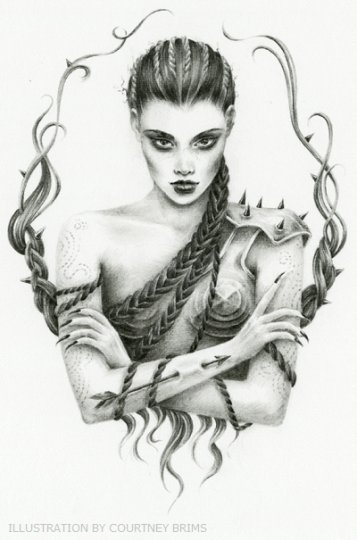
Ruslana, one of the six princes. Yes, she’s a woman. I noticed that too.
The book is masterfully executed. Allyse Near’s writing is some of the most luscious and rich I’ve read; her prose is magical, her metaphors often both beautiful and disturbing. The story is seeded with references to Edgar Allan Poe, the Grimm Brothers, Shakespeare, Oscar Wilde and Alice in Wonderland (plus probably others I missed). But the tales with the heaviest influence on Isola and the story is the fictional book The Pardieu Fables and Fairytales by Lileo Pardieu — the author whose name Isola has as her own middle name. We get to read excerpts of The Pardieu Fables scattered throughout the story, and they are even more beautiful and strange than the rest of the novel.
There are ghosts, a mermaid, a fury, fairies and a hilariously grumpy gargoyle — a menagerie that appealed to my urban fantasy-loving heart. There’s a wonderful best friend; a talented, quirky guy; and a bad boy I wanted to snot (that’s my usual reaction to bad boy characters, by the way)…
There’s also a plot twist that I didn’t see coming till maybe a chapter beforehand, but that made total sense and begs for a re-read, just so you can admire the way it was foreshadowed.
The one thing that disappointed me at the outset was that I half-expected the book to be set in Australia. It’s actually set in England, in a little town called Avalon, near the magical Vivien’s Wood (where Vivien supposedly entrapped Merlin in a tree). Given the circumstances, I forgave Near for not setting it here. 😉
Grab yourself a copy of Fairytales for Wilde Girls. You won’t regret it.

Review: ‘The Name of the Wind’ by Patrick Rothfuss
Posted: December 27, 2015 Filed under: Reviews | Tags: fantasy, reviews Leave a comment
Told in Kvothe’s own voice, this is the tale of the magically gifted young man who grows to be the most notorious wizard his world has ever seen. The intimate narrative of his childhood in a troupe of traveling players, his years spent as a near-feral orphan in a crime-ridden city, his daringly brazen yet successful bid to enter a legendary school of magic, and his life as a fugitive after the murder of a king form a gripping coming-of-age story unrivaled in recent literature. A high-action story written with a poet’s hand, The Name of the Wind is a masterpiece that will transport readers into the body and mind of a wizard.
I used to read a lot of epic fantasy in my teens and 20s. Eventually I lost the endurance for it — for the sort of weighty tomes that give you a concussion if you fall asleep reading them in bed. Also, I discovered YA and urban fantasy (both of which don’t run that long, as a rule).
Just over a week ago, I was lamenting to friends that I had finished my current audiobook series (The Hollows by Kim Harrison). These friends are all book nerds who didn’t give up on epic fantasy, and all of them recommended Patrick Rothfuss.
They were right.
It took me a chapter or two to get into The Name of the Wind. The whole “three silences” thing at the start threw me — although that sort of epic, bardlike introduction to a fantasy novel isn’t unusual, like I said, it’s been a while. Still, since I’d paid for the audiobook already I persisted, and it was so worth it.
The flashback-style mechanism of Kvothe telling his story to a scribe means that we get to jump between his detailing his childhood misadventures and the present. Because most of the story is the former, the latter serves as excellent foreshadowing of tragedy to come. Interestingly, the latter also contains foreshadowing for events that presumably happen later in the series, once the retelling is complete. (At least, that’s my read of things.) I admire the level of craft that has gone into that.
Kvothe himself is an interesting character, and by maybe halfway through the book I’d fallen a little bit in love with him (present Kvothe, not the 15-year-old whose tale comprises the bulk of the book, because That Would Be Wrong). He’s the kind of character that is brilliant but not Mary Stu-ish; he’s rather cocky and arrogant, and gets himself into all kinds of trouble.
But I think my favourite thing about him is that he sees the beauty in things. For example, I’d noticed that all the girls he met he described as beautiful, and at first I wondered if this was a sort of wish fulfilment thing on the part of the author — but then one of the other present-day characters pulled him up on one of his descriptions, pointing out the flaws in one girl’s appearance. That made it clear to me that Kvothe (at least young Kvothe) just had rose-coloured glasses on. I thought that was sweet. 🙂
The world-building is excellent, masterfully handled; the bulk of Kvothe’s story covers his time in the university, which means we get to learn the mechanics of magic as he does.
My biggest bugbear about this book is that Goodreads tells me this came out in 2007, and the one and only sequel came out in 2011. That means I’m going to be in the market for a new audiobook series very soon, because I doubt the third book will be out any time soon…
Maybe I’ll look for another epic fantasy audiobook after this. At least audiobooks have a much smaller risk of causing concussion.
Review: ‘Illuminae’ by Amie Kaufman and Jay Kristoff
Posted: December 17, 2015 Filed under: Reviews | Tags: AWW, jay kristoff, reviews, sci-fi 1 Comment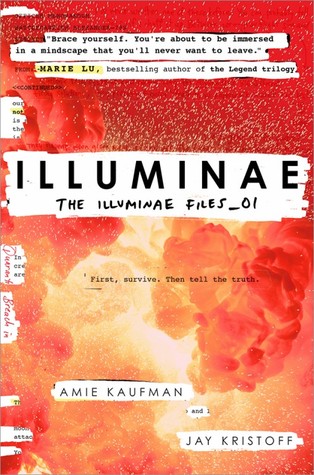
This morning, Kady thought breaking up with Ezra was the hardest thing she’d have to do.
This afternoon, her planet was invaded.
The year is 2575, and two rival megacorporations are at war over a planet that’s little more than an ice-covered speck at the edge of the universe. Too bad nobody thought to warn the people living on it. With enemy fire raining down on them, Kady and Ezra—who are barely even talking to each other—are forced to fight their way onto an evacuating fleet, with an enemy warship in hot pursuit.
But their problems are just getting started. A deadly plague has broken out and is mutating, with terrifying results; the fleet’s AI, which should be protecting them, may actually be their enemy; and nobody in charge will say what’s really going on. As Kady hacks into a tangled web of data to find the truth, it’s clear only one person can help her bring it all to light: the ex-boyfriend she swore she’d never speak to again.
Told through a fascinating dossier of hacked documents — including emails, schematics, military files, IMs, medical reports, interviews, and more — Illuminae is the first book in a heart-stopping, high-octane trilogy about lives interrupted, the price of truth, and the courage of everyday heroes.
This book, you guys. I pre-ordered it because I love both Amie’s and Jay’s other books, and then took a month to pick it up due to life and other things. Also, I confess, I found the 600-odd pages quite daunting.
I shouldn’t have.
Despite the length, Illuminae is a very easy read (and I suspect, due to the design, has tens of thousands less words than your average 600 pager). Once I started it, I devoured it in about two days; it would’ve been faster but pesky life things got in the way.
If you haven’t heard of Illuminae by now, the first thing you should know about it is that it is ground-breaking in its design. The “found footage” vibe is conveyed not just through the (excellent) writing but through the book’s internal layout. You really get the feeling that you’re holding a dossier of documents that has been cultivated from various sources about the events at Karenza (Kady and Ezra’s home planet) and what follows.
The end result is that the atmosphere this “weird little bookthing” (as Jay Kristoff calls it) conveys is of epic proportions. The creeping dread associated with the plague gave me the shivers, as did pretty much any transcript associated with the crazy AI, AIDAN. (And yet, AIDAN was also my favourite character. Don’t judge me!)
I loved both Kady and Ezra too; although I will never have a book crush on the latter, I did love his sense of humour. And Kady was all the things you want from a young adult leading lady: clever, empathetic, and a little bit sly. Her resilience in particular is off the charts, which, given the circumstances, is probably for the best. 😉
There are also some great little sci-fi easter eggs in Illuminae, such as a sneaky reference to Red Dwarf and a nod to 2001: A Space Odyssey. Another, more personal source of joy for me was spotting all the names of victims that I recognised in the various lists (Jay and I used to move in the same circles and have a lot of friends in common — friends who seem to have all died horribly at one point or another)!
It’s a big call, but I think Illuminae is my favourite read of 2015. It’s definitely in my top two. Read it. Give it to your friends for Christmas.
PS I am counting this review against my Australian Women Writers challenge, because it is at 50% written by an Australian woman. So nyah!

Review: ‘Never Forgotten’ by Stacey Nash
Posted: November 16, 2015 Filed under: Reviews | Tags: aussie-owned, AWW, reviews, young adult 2 Comments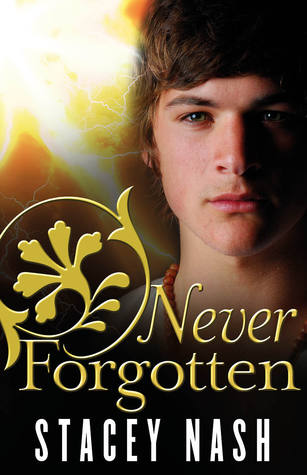
Continuing on from Forget Me Not and Remember Me, this is the thrilling third novel in Stacey Nash’s unforgettable series.
Since the strike on Collective territory during Anamae’s rescue, things have taken a turn for the worse. Unprovoked attacks on innocent people have Anamae and her friends fighting day and night to minimize the damage. With hundreds of lives lost, morale amongst the resistance fighters has plummeted. But that’s the least of her worries.
Manvyke still has Anamae’s mom, Annie, secreted away somewhere and after the way they parted, Anamae worries it’s not at her mother’s bidding. Maybe Annie’s disappearance all those years ago wasn’t her choice. But with Manvyke scouring the world, there’s something far more pressing than the need to find Anamae’s mother …
It’s a fight against time to find the other keys before Manvyke. In his hands, the three relics could unlock enough power to reek a much worse havoc than the current issues at hand. If the councillor gets his hands on those keys, civilization will bow down.
THE RACE IS ON.
This book is the third of four in the young adult modern world/sci-fi Collective series, and gives us more details of the world and the hunt for the founders’ keys. If you haven’t read the first two books (Forget Me Not and Remember Me), I recommend that you go back and do so; this isn’t the sort of series that you can jump into partway through.
I loved the little glimpses of foreign locations as Jax hunts for the second of the three powerful relics, trying to get there before Manvyke and his batshit crazy son, Nik, can. Mae, in the meantime, is trying to figure out what Manvyke has done with her mother, working on the assumption that she’s a prisoner … or worse. Mae’s group also runs afoul of Nik at various points.
I keep mentioning Nik, because he was definitely the villain of the piece. Manvyke is largely off camera, whereas Nik appears frequently to taunt Jax, leer at Mae, and beat the snot out of all and sundry.
A lot of the story focuses on Mae’s dilemma in choosing between Jax and Will. I’m not usually a love triangle kind of person, so I admit this particular sub-plot slowed things down for me a little. Still, the angsty bits are interwoven with other events, which were enough to keep me reading.
As far as the love triangle dilemma itself goes, it was obvious from the start of the series (not just this book) that Mae loved Jax. I didn’t really understand why she chose to torture herself about the whole thing, except that Will is her best friend and she didn’t want to hurt his feelings by rejecting him out of hand, I suppose?
Out of the two boys I actually prefer Will — Jax is a little bit too angry and broken for me (and what’s with him actually believing a word that comes out of Nik’s mouth? I know they are brothers, but sheesh!). But by about halfway through I was cheering for Jax and Mae to get together just so they could both stop angsting all over everything. 😉
My favourite character is still Lilly, the sweet and sad friend of Mae’s who is determined to be an active part of the resistance despite her overprotective father.
Never Forgotten does a good job as a “middle book” in that it transitions us from the discovery stories in the first two books to the set-up for the finale in book four. The pace is zippy, there is a respectable amount of kissing, and the touch of sci-fi tech is still my favourite part about this world.
Review: ‘The Wild Girl’ by Kate Forsyth
Posted: November 1, 2015 Filed under: Reviews | Tags: AWW, reviews 2 Comments
Dortchen Wild fell in love with Wilhelm Grimm the first time she saw him.
Growing up in the small German kingdom of Hessen-Cassel in early nineteenth century, Dortchen Wild is irresistibly drawn to the boy next door, the young and handsome fairy tale scholar Wilhelm Grimm.
It is a time of war, tyranny and terror. Napoleon Bonaparte wants to conquer all of Europe, and Hessen-Cassel is one of the first kingdoms to fall. Forced to live under oppressive French rule, the Grimm brothers decide to save old tales that had once been told by the firesides of houses grand and small all over the land.
Dortchen knows many beautiful old stories, such as ‘Hansel and Gretel’, ‘The Frog King’ and ‘Six Swans’. As she tells them to Wilhelm, their love blossoms. Yet the Grimm family is desperately poor, and Dortchen’s father has other plans for his daughter. Marriage is an impossible dream.
Dortchen can only hope that happy endings are not just the stuff of fairy tales.
I finished The Wild Girl more than a week ago, but haven’t been able to review since it due to a massive book hangover. I’m also finding this review difficult to draft, so please excuse any incoherence on my part!
Like the last of Kate Forsyth’s books that I read (Dancing on Knives), The Wild Girl was a hard read. Not the prose — the prose was lovely — but the subject matter. This isn’t a fluffy romance between a scholar and the apothecary’s daughter. This is a gritty tale about the realities of life in nineteenth century Germany, the horrors of war, and the awful things one human being can do to another.
Importantly, and I want to say this up front: this book needs to come with a trigger warning for rape. I had to put The Wild Girl down for two days after one particularly traumatic scene. What enticed me back to it was to see the perpetrator get his just desserts. The subject is delicately handled by Forsyth, not gratuitously or in a fashion designed to titillate, but in a way that fills you with a creeping sense of horror and dread.
It’s something to be aware of.
The parallels between Dortchen’s life and the various fairytales she tells Wilhelm at different times are masterful. The telling of “All Kinds of Fur” in particular was so moving it gave me chills. The control that society and religion gave men over the females of their households was both illuminating and scary, and made me so thankful that I live now! All the fancy dresses in the world aren’t worth subjugation. I loved Dortchen’s sister Hanne for her scandalous rebellion against the patriarchy.
One of the other parallels with Dancing on Knives (other than the awful father figure) is that The Wild Girl too has a hint of magical realism. The herb lore that Dortchen has is fascinating, making her something of a nurse to her loved ones … and some of her housekeeper’s superstitions lead in the direction of pagan magic. There aren’t any flashy spells or anything; nothing happens that can’t be explained. But I adored that touch nonetheless, and it gave Dortchen a chance to rebel in her own, tiny way — to try and effect a world that is so utterly out of her control.
A special mention goes to Old Marie, said housekeeper. She was one of my favourite characters, warming every scene she was in.
Part of me wishes that Dortchen and Wilhelm hadn’t had to wait so long for their happily ever after, but Forsyth was bound by the facts given this is historical fiction. (The amount of research that has gone into The Wild Girl is staggering.) She has come up with a convincing, albeit poignant, explanation for why the relationship evolved the way it did.
It’s a hard read, but The Wild Girl is an example of a story by an author who is the master of her craft.


 Cassandra Page