NestPitch submissions NOW OPEN!
Posted: April 2, 2014 Filed under: On writing | Tags: contests, NestPitch, pitches Leave a commentThe submission window for NestPitch is NOW OPEN!
It will remain open for 24 hours, from noon on 1st April to 11.59am 2nd April (USA EST). That’s 24 hours from this post going live, folks.
There’s no cut off number for entries. Everyone who submits during the window will make it into the contest. All entries will receive an email receipt. If you don’t, check with Nik Vukoja on Twitter @nestpitch and/or @nik_vukoja
Send your entries to nestpitch @ outlook .com (no spaces)
For formatting instructions and rules check this post out (although an excerpt is contained below).
NestPitch is a contest where participants email their 35-word pitches together with the first 300 words of their finished manuscript (or 100 words for picture books).
The selected pitches will be featured on these blogs (show them all some follow love — you know, if you want to):
Brooke Powell | Kimberly P. Chase | Jeffe Kennedy | Tina Moss | Amanda Foody | Dannie Morin | Sharon M Johnston | Sharon Bayliss | Stacey Nash
Then agents, identities hidden, will leave a request for pages, partials or fulls of the featured pitches.
Entries must be embedded within email (no attachments) with following:
Name: YOUR NAME
Title: TITLE OF MANUSCRIPT
Genre: Category/Genre of Manuscript (i.e. NA Romance)
Word Count: (round to the nearest 1000)
PITCH: 35-word (maximum) logline
Answer to this question in one sentence of no more than 15 words: If my Main Character were an Easter Egg, what flavour would he or she be and why?
First 300-words of your manuscript. If the 300th word falls in the middle of a sentence, go to the end of the sentence. For picture book submissions please only submit 100-words. If the 100th word falls in the middle of a sentence, go to the end of the sentence.
Please ensure:
(i) your manuscript has not been featured (you can have entered but can’t have been a finalist) in another pitch competition in the past 12 months – that’s ANY pitch competition (excluding Twitter pitches) from the period April 1st 2013 to 31st March 2014
(ii) your manuscript IS NOT published. This INCLUDES self-published.
Our Slush Bilbies (Cass: that’s me!) and Nest Bloggers will read through the pitches and pick the top 72 pitches for the agent round: April 17th – 18th
We’ll try to get a good mix of various genres, but the writing comes first. Basically, if the submissions aren’t ready, it’s in your best interests that we pass. The last thing anyone wants is your manuscript to be old and tired from “doing the rounds” before it’s ready.
Writing loglines
Posted: March 31, 2014 Filed under: On writing | Tags: loglines, Lucid Dreaming, NestPitch, pitches 2 CommentsIn just over 24 hours, NestPitch submissions open. Submitting writers will provide details about their manuscript includuding their logline and the first 300 words, which will then go through slush readers (or slush bilbies) for shortlisting before being chosen by the nest bloggers.
Finally, the chosen pitches will be posted to hopefully get scadloads of agent requests. We’ve got ten agents participating from nine agencies. It’s exciting stuff.
 I’m one of the slush bilbies for NestPitch. (I like to imagine a shy marsupial drinking an iced treat through a straw. Who’s with me? Anyone? Anyone?)
I’ve blogged before about how hard shortlisting for these sorts of contests is. But I know from experience that as hard as it is to judge them, it’s just as hard to muster the courage to enter in the first place. I’ve been there. Believe me.
So if, like me at this point before a submission window opens, you’re in a last-minute agony of indecision about whether you’re ready to go, here are my tips for writing an awesome logline.
What’s a logline?
It’s the answer you give when someone says, “So, what’s your book about?”
In 35 words or less. Easy, no?
No.
Tips for writing a logline
There are three things you need your logline to do:
- describe the main character (you don’t need to name them)
- describe the antagonist (or main challenge)
- describe the stakes
What you don’t want to do is describe the ending. You want to hook the reader, make them want to offer you representation/a contract/money/booze.
If you’re struggling, one thing I’ve found really handy when writing loglines and query letters is to use the when/then structure. When X, then Y.
For example, here’s my logline for Lucid Dreaming, the new adult urban fantasy I’m currently querying:
When half-Oneiroi dream therapist Melaina banishes a nightmare spirit from a client, she unleashes the wrath of an enemy who targets her job, her best friend, her family and her life.
I’ve had a few different versions of this, where I’ve toyed with how to describe the Oneiroi (dream spirits) — because, unlike vampires and werewolves, they aren’t a particularly well-known supernatural beastie. In this version I’ve tried to make sure the dream context is clear from the rest of the pitch.
You’ll note I didn’t reveal who the antagonist is, because one of the story’s elements is the mystery of who is actually behind the attacks. If that weren’t the case, I’d add it in there: jealous ex-boyfriend or demon-spawn shopkeeper or cheerleading cyborg. You get the idea.
I saw an awesome quote about loglines that I’m going to claim as though it were my own:
Don’t tell the story, sell the story.
Good luck, folks. See you in the slush pile!

When small presses go bad
Posted: March 27, 2014 Filed under: On Books, On writing | Tags: small presses 8 CommentsI’ve been debating whether to write this post or not. On the one hand, this issue affects some fellow authors who are very dear to me. On the other hand, there’s a lot of anger out there — mostly being very politely handled, at least in public, to folks’ credit — and I didn’t want to be seen as adding to the noise or trying to drum up a lynch mob.
But then I thought, I’ve written posts explaining why I chose to sign with a small press rather than self-publish. And the issue I’m referring to relates to the small press that offered on Isla’s Inheritance at the same time Turquoise Morning Press did…so this one would cut a little close to home even if I didn’t know others who’d been affected.
What I’m talking about, if you hadn’t guessed, is a small press that went belly up this week.
Fortunately the authors in this instance are all getting their rights back, but will they get royalties owed? Nope. Will the cover artists and editors ever get paid? Nope.
There’s nothing about this situation that doesn’t suck.
I don’t know whether the owner of the press set out to scam people or just went into creating a company with blinkers on and not enough startup capital to pay the bills till the royalties came in. I gather from reading this post at Absolute Write (which I found the day before yesterday) that lack of starting capital and a failure to do the proper paperwork are the two biggest reasons small presses collapse.
One thing I took into consideration when choosing which small press to sign with, out of TMP and the other one, was how long they’d each been around. I read somewhere that most small presses collapse within the first two years of being established.
When they offered on Isla, the press that collapsed was about four months old.
There were other reasons, obviously, that I chose TMP. But both had lovely editors who were really enthused about the book. Both were willing to negotiate parts of the contract I didn’t love. I really could have gone either way.
Collapses like this one are likely to be enough to scare writers off small presses altogether. I’ve got to say, if I’d been with this other press, I’d be self-publishing Isla rather than risking going through the same heartache again. And I don’t blame anyone that does a bit. (In fact, given there were three separate books from this press that I loved and was waiting for the sequel to, I kind of hope they do!)
Anyway, in the interests of trying to come up with something useful to drag out of this mess, here are the things I suggest you look at when considering a small press:
- How long has the press been around?
- Look for them on a site like Absolute Write. What does the thread about them say? If there’s not a board for that press, start one. (This is a great place to research agents too.)
- Does the press have a decent sales record on sites like Amazon? They don’t need to have a list of bestsellers, but if their books all rank in the billions, that’s a bad sign.
- If there are free book samples available online, what is the editing like?
- What do other authors signed with the press say about what it is like to work with? Find one that’s been with them for a year or more, ask about the royalties and statements. Are they prompt?
- Do they offer any kind of marketing? (Most small presses rely on you to do the gruntwork, but obviously more is better.)
Are there other things you’d want to know before you signed with a small press? Please leave a comment and I’ll edit them in.
And to everyone who’s feeling down this week after what happened, I LOVE YOU!
This Writer’s Space: Lauren K. McKellar
Posted: March 26, 2014 Filed under: On writing | Tags: aussie-owned, inspiration, this writer's space, writing 3 Comments
All the regular readers of my blog know how much I adore Lauren K. McKellar. Her books make me cry, in an “oh god, my heart is breaking, Lauren!” kind of way.
Where I Write
When I drafted my latest novel, The Problem With Crazy, I wrote EVERYWHERE. I was working full-time, juggling freelance editing jobs and madly scrambling to learn all the extra things I could about this fabulous world of writing craft and technique, so I took every opportunity that became available to me. I wrote on the train to work, in my lunchbreak, on the couch in front of the TV (also known as ‘couple bonding time’), at bars—I even tried to dictate notes while I walked from the train station to work and cleaned the house.*
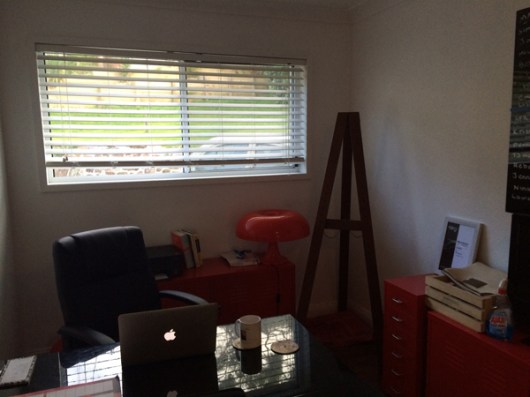
However, now all this has changed. I have gone freelance with my editing work and so when I write I do so at my desk, in my office—and it feels GREAT. Having a designated writing area, with my planning blackboard and comfy high-backed chair is fabulous. Plus, there’s no strange guy falling asleep and drooling on my shoulder, like there was on the odd public transport trip. Drool = uninspiring.
*NB: This was a dismal failure. I can write the things, but I cannot speak them. I apologise if you ever meet me and expect a coherent sentence.
Where I’m Inspired
Many things and places inspire me, but one of the main locations is the beach. I can catch a glimpse of it from my balcony, but every morning I get up, and go for a long run across the sand with my two dogs. The sound of the waves crashing never fails to soothe my oft-busy head, and helps my mind run wild with new story ideas.

The other main place I am inspired is *cringe* when I’m with my fiancé. I know he’s not technically a place, but sitting down with him over a table—beer and chips on the side—really helps me nut out my story ideas and takes my little half-conceived baby concepts and turns them into fully-fledged potential story adults.

What I’m Reading
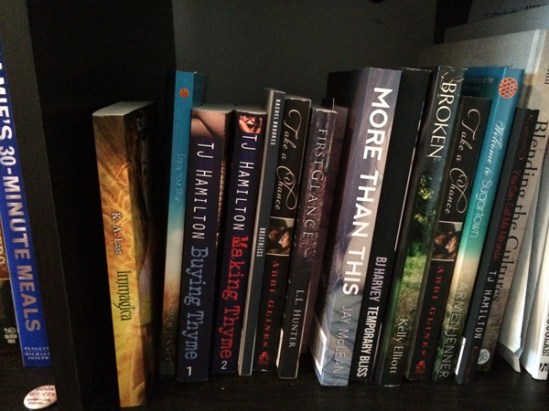
I just came back from Indie Authors Down Under, Australia’s first self-published writer signing exhibition. I was there exhibiting as an author, but somehow managed to come home with almost as many books as I sold! I’m not sure where I’ll be starting, but I have Take A Chance by Abbi Glines, Broken by Kelly Elliot and First Glance by L.L. Hunter all vying for my attention right now. I can’t wait to devour them all!
About Lauren K. McKellar
Lauren K. McKellar is a writer and editor of fact and fiction. She has worked in publishing for more than eight years, and recently returned to her first love: writing books that make you feel.
Lauren loves to write for the Young and New Adult markets, and her debut novel, Finding Home, is a YA Contemporary, published through Escape, a Harlequin Australia imprint. Her second novel, The Problem With Crazy, is a NA Contemporary Romance.
Lauren is a member of the YA Rebels (vlog) and the Aussie Owned and Read blogging team. In her free time, she enjoys long walks on the beach with her two super-cute dogs and her partner-in-crime/fiancé.

Introducing NestPitch
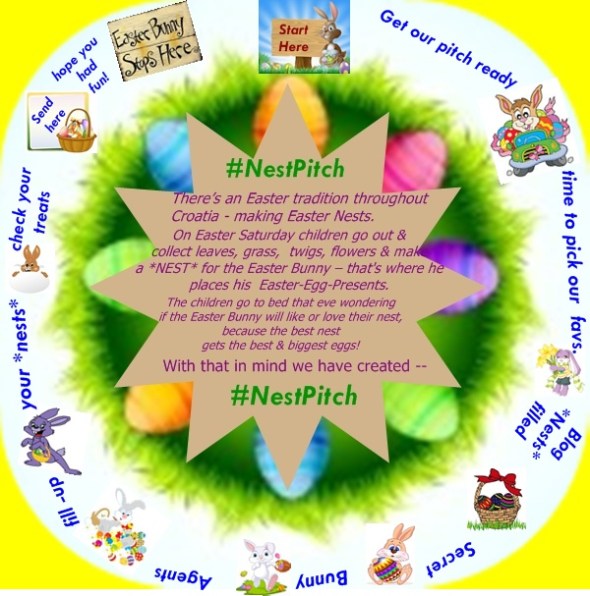
Posted: March 20, 2014 Filed under: On writing | Tags: agents, contests, NestPitch, pitches, queries, writing 2 CommentsThere’s a special Easter tradition throughout central and northern Croatia – making Easter nests. On the afternoon or eve of Easter Saturday children go out into the garden and collect leaves, grass, twigs, flowers and then make a “nest” for the Easter Bunny – that’s where he places his Easter egg presents. The children go to bed that eve wondering if the Easter Bunny will like or love their nest, because the best nest gets the best and biggest eggs!
NestPitch is based on this idea where an author’s ‘pitch’ is the nest and the Easter Treats are the Agents requests.
 The submission window opens on 1st April.
Once Submissions are closed, firstly the SLUSH BILBIES will go through the submissions and pick the top 100-120. Then the NEST BLOGGERS will each pick eight of their best and brightest NESTS and post on their blogs.
After that, the SECRECT AGENT BUNNIES will jump from blog site to blog site and leave their Easter treats.
Why am I telling you all this? Because I AM A SLUSH BILBY! (A bilby is an adorable, long-eared, endangered Australian marsupial. You can of course see the resemblance…right?) You think I’d have learned from the madness that was Pitcharama how hard it is to choose between a whole bunch of awesome pitches. But no, apparently not.
In just over 24 hours, the Pre-Pitch Post clinic starts, for those of you that want to have someone look at your pitch. The details are here. And the rules for NestPitch are here.
If you’re wondering why the mix of Croatian and Australian, that’s because the host of the contest, Nikola Vukoja, is exactly that. Running these sorts of contests is hard, so show her the Twitter love here, mkay?
And if anyone wants to send me masses of chocolate on 1st April, I’d appreciate it. 🙂
This Writer’s Space: Nicole Evelina
Posted: March 19, 2014 Filed under: On writing | Tags: inspiration, this writer's space, writing 2 Comments
Today’s This Writer’s Space features Nicole Evelina, Arthurian author extrodinaire.
Where I Write
When I’m at home, I’m usually on my couch with two cats vying for space with the laptop. Not very glamorous, but it gets the job done! I do have a second bedroom that doubles as an office (and my cats’ bedroom), but I don’t usually do much writing there. I think the couch is just more comfortable, plus I get beautiful afternoon sun through the front window.

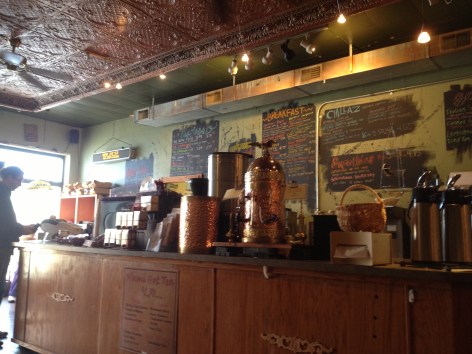
When I venture out to write, my favorite place is a little coffee shop about 15 minutes from where I live. It’s loud (darn college students) and the music is terrible (thank God for headphones) but I love the old-world vibe.
Where I’m Inspired

This is a man-made lake that’s less than 10 minutes from my house. I go there to walk/run a lot and it really clears my head. But I’ve also taken my laptop and written and plotted there. There’s something about being out in all four elements – grass/sand beneath my feet, wind in my hair, water nearby and sun on my face – that shuts down my worrying side and allows my creativity to flourish. My characters seem to like it, too, as they are more fond of talking to me there than any other place (except the shower!).

This is Fir Cottage, my home for a week at Hedgebrook, a writing retreat on Whidbey Island, outside Seattle. I recently attended a Master Class on creative writing there that was taught by author Deborah Harkness. This is where I lived and wrote, honestly assessing all that still needs to be done to my third book. It’s a place of beauty, for communing with nature and the muse. I’ll be there in my memories whenever I need inspiration and plan to apply for a residency at some point in the future.
To Be Read
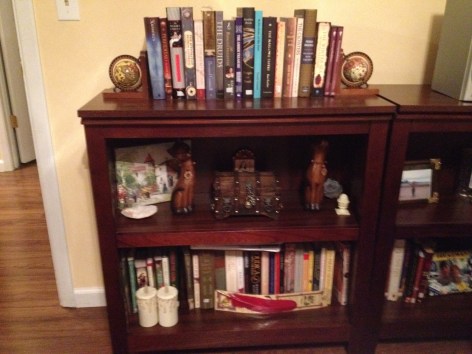
Some of these I have read, but most are still on the TBR list. And these are only the non-library books. The pile gets bigger each spring after our annual charity book fair. Last year, I came home with 21 books. Some of these are research, but the vast majority are fiction.
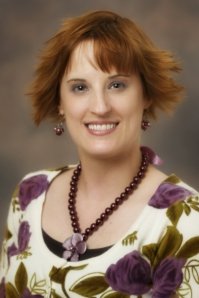 Nicole Evelina is St. Louis-born historical fiction writer represented by Jen Karsbaek of Foreword Literary. She is the author of an Arthurian legend trilogy that tells Guinevere’s life story from her point of view, as well as a work of women’s fiction. Nicole is a member of and book reviewer for the Historical Novel Society, and Sirens, a group supporting female fantasy authors, as well as a member of the St. Louis Writer’s Guild and Women Fiction Writers Association.
She is one of only six authors who recently completed a week-long writing intensive taught by #1 New York Times bestselling author Deborah Harkness. Nicole has traveled to England twice to research the Guinevere trilogy, where she consulted with internationally acclaimed author and historian Geoffrey Ashe, as well as Arthurian/Glastonbury expert Jaime George, the man who helped Marion Zimmer Bradley research The Mists of Avalon.
Her website/blog is http://nicoleevelina.com and she can be found on Twitter as well as on Pinterest and Facebook.
Research: the geography and climate of Egypt
Posted: March 14, 2014 Filed under: On writing | Tags: research, small presses, writing 2 CommentsToday’s guest post is by Katie Hamstead, whose book KIYA: Rise of a New Dynasty (the third in the Kiya trilogy) came out last month. I love these books like a crazy person, if you hadn’t already guessed! She’s here today to talk about the setting of her series, ancient Egypt.
Ancient Egypt
I know, how boring! But not really. Like any story, the environment plays its part in shaping and molding events.
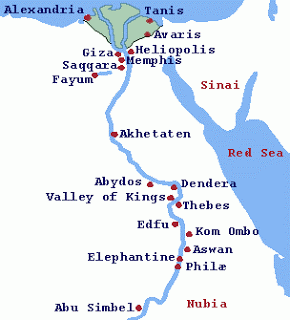
The Egyptian Empire was built around the Nile. At the time of the 18th Dynasty—in which the Kiya trilogy is set—it stretched from Abu Simbel (which was constantly disputed with the Nubians) up to the delta and into parts of the Saudi Arabian peninsula.
In general, the area is arid, but along the Nile, it is extremely fertile. The silt which flooded the plains annually comes from the White Nile, which starts at the Great Lakes region of central Africa (Rwanda), and also the Blue Nile, which begins at Lake Tana in Ethiopia. They meet in Sudan and form the Nile. Most of the fertile soil which is flushed through is brought up from the the Blue Nile.
If you look at the map, you will see the major cities of Ancient Egypt. Note the location of Thebes in the south (Upper Egypt) and Memphis in the north (Lower Egypt). You will then notice Akhetaten’s (Tel El Amarna, which is where Kiya 1 is set) location approximately halfway between. It is not known whether this was deliberate on Akhenaten’s account, but it’s definitely an interesting theory that he chose the halfway point between the two royal capitals deliberately. It could also have been because the land had not been dedicated to any other god up until then. The legend is that while he was traveling along the Nile, he awoke and saw the sun rising over the cliffs and claimed to have a vision from Aten, telling him it was the place he needed to build his city. Whatever his intentions were, the Egyptian populous moved into the city on his orders.
The Climate—hot, as it’s the desert. The areas Kiya is focused on are very hot and dry during the day and it rarely rains, and cools down during the night. Winter is very mild, but the nights can get close to freezing.
Plants are basically reeds and other grasses along the Nile banks, some palms, then desert, desert and more desert!
Being in northern Africa, the animals in the area include lions and crocodiles, both of which are mentioned in the books, along with water fowl, cats, dogs, jackals and anything else you can see on traditional Egyptian art.
Kiya: Rise of a New Dynasty is available at Amazon, Barnes & Noble and Kobo.
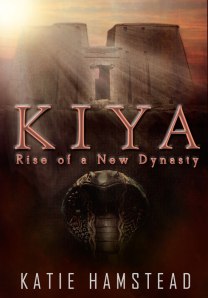
Tut has grown into his position as Pharaoh, but he is a wild young man. Naomi fears for him, not only because of his recklessness, but because he has put his trust in Ay–the man determined to destroy Naomi—despite her and Horemheb advising against it.
Meanwhile, death and slavery hang over Naomi and her family. With fear of the booming Hebrew numbers causing talk of enslaving them, conscription is reinstated and Naomi fears for the lives of her other children. Especially since Ay’s children are now adults, and just as dangerous as their father. They threaten to take Itani, conspire against Tut, and push for power.
But Tut is in trouble. While Ay’s daughter draws Horemheb’s attention, and Naomi deals with the struggles of her family, everyone’s distraction could spell death for the young Pharaoh.
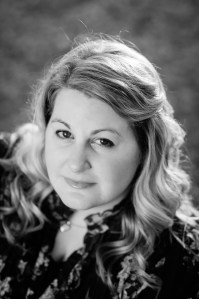 Born and raised in Australia, Katie’s early years of day dreaming in the “bush”, and having her father tell her wild bedtime stories, inspired her passion for writing. After graduating High School, she became a foreign exchange student where she met a young man who several years later she married. Now she lives in Arizona with her husband, daughter and their dog. She has a diploma in travel and tourism, which helps inspire her writing. She is currently at school studying English and Creative Writing.
Katie loves to out sing her friends and family, play sports and be a good wife and mother. She now works as a Clerk with a lien company in Arizona to help support her family and her schooling. She loves to write, and takes the few spare moments in her day to work on her novels.
You can find Katie on her blog, Goodreads, Facebook, Twitter or Goodreads.
This Writer’s Space: Louise D. Gornall
Posted: March 12, 2014 Filed under: On writing | Tags: inspiration, this writer's space, writing 7 Comments
Today on This Writer’s Space I have Louise D. Gornall, author of one of my favourite urban fantasy reads from last year, In Stone. She’s one of the coolest people on Twitter, so I’m very excited to have her here!
My name is Louise and I write urban fantasy and horror stories for young adults.
I like dark and edgy. Swears don’t offend me. Ignorance does.
I work at Swoon Romance, and I’m currently studying for a BA (Hons) degree in English language and literature.
Identical twin, junk food aficionado, book bird, film nerd, Jedi. Represented by super agent Mandy Hubbard at D4EO!
Where I Write
This is where the magic nearly never happens. I mean, this is where I make beautiful music, dance a passionate tango with the alphabet, reach Nirvana… No, but seriously, I love my desk and I feel lost when I’m away from it.
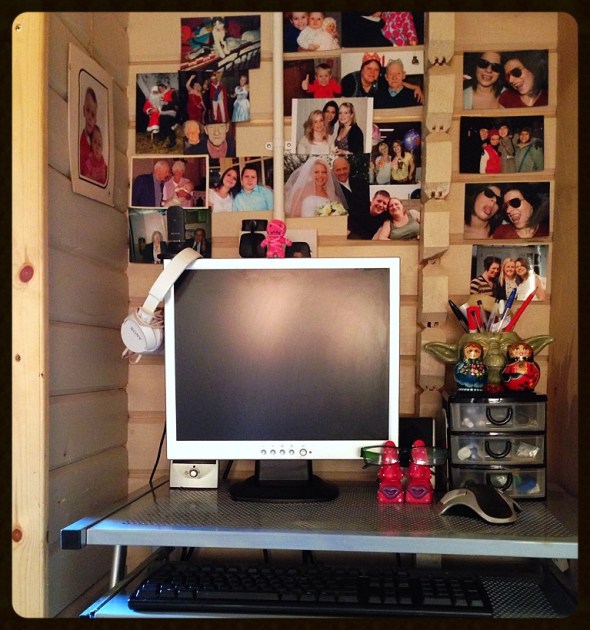
Where I’m Inspired
My most favorite place in the world is the Lake District. We go up a couple of times every year. It’s the kind of place that takes your breathe away. It’s so quiet and peaceful. Everything is so perfect and fresh it’s like waking up in The Shire. It just makes me want to write.

To Be Read
My actual TBR pile is currently being used by NASA as a stepladder into space. Seriously, it’s a pile of epic proportions, but these are the books I’m planning to read in the next week or two. I’m writing a thriller/horror right now, so I’m trying to surround myself with heart-stopping-feely stories.
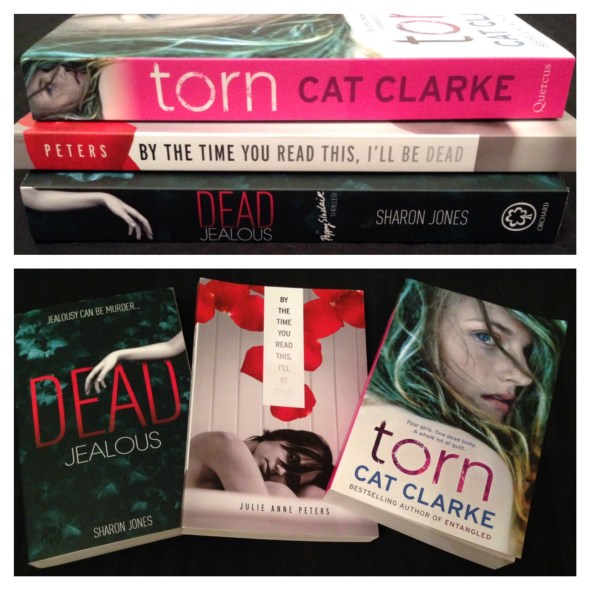
If you now have as big a crush on Louise as I do, you can find her on her blog, Twitter, Facebook or Goodreads. Thanks for stopping by, Lou!
My penmonkey evaluation
Posted: March 6, 2014 Filed under: On writing | Tags: Chuck Wendig, editing, Isla's Inheritance, Lucid Dreaming, writing Leave a commentA couple of days ago on his blog, author and blogger extraordinaire Chuck Wendig posted what he called a penmonkey evaluation—a chance for writers to self-evaluate. I thought it was an interesting exercise so decided I’d do it here. If you decide to evaluate yourself too, please post your blog link in the comments. I’d love to see how others fare.
 What’s your greatest strength/skill in terms of writing/storytelling?
Definitely my editing skills. I still have the same problems with being able to impartially view my own work as everyone else, but I think I produce a fairly clean initial draft.
At least grammatically—I make no guarantees as to content!
What’s your greatest weakness in writing/storytelling? What gives you the most trouble?
Transition scenes can die in a fire. I try to avoid them if I can, because I struggle with them so much.
How many books or other projects have you actually finished? What did you do with them?
Three.
Isla’s Inheritance – scheduled for release with Turquoise Morning Press in around October 2014
Isla’s Oath – scheduled for release with Turquoise Morning Press in around January 2015
Lucid Dreaming – currently on the agent query world tour
Best writing advice you’ve ever been given? (i.e. really helped you)
After considering all the wonderful advice I’ve received (minimise adverb use, avoid dialogue tags, etc), I couldn’t come up with just one thing I’d rate about the others.
Then I realised it was this, which I got from Mister Wendig himself.
“Just write.”Writing your first novel is daunting. It’s a bit like mountain climbing solo, or at least what I imagine mountain climbing solo might be like. You have all these tools, and maybe some people to yell at you or inspire you, but you have to do the hard yards yourself. Each step can be torturous. There’s a risk of avalanches, and of being eaten by wolves.
But the feeling when you get to the top is ah-MAY-zing, and the next mountain you climb is just that little bit easier.
Even if you only manage to write 200 words in a session and it’s like squeezing blood from granite, that’s still another step forward.
Worst writing advice you’ve ever been given? (i.e. didn’t help at all, may have hurt)
“The beginning is critical. If you don’t hook your reader, or that agent or editor, you’re screwed.”This is not inherently bad advice. It’s actually very true. But where it tangled me up was when I was starting that mountain climb on my first book. I knew how critical the beginning was, and I felt from the start that mine had issues. I got so hung up on getting the beginning right that it took me a very long time—embarrassingly long—to move on with writing, you know, the rest of the book.
The reason this is bad advice is because I fixated on it at the wrong time: during drafting rather than editing. When you’re drafting, just draft.
One piece of advice you’d give other writers?
You can edit badly written words. You can’t edit a blank page.
Just write.
In other news, on Tuesday I was over at Marcy Peska’s blog, doing an interview about writing dialogue. Yes, I was talking about writing about talking.
This Writer’s Space: K. A. Last
Posted: March 5, 2014 Filed under: On writing | Tags: aussie-owned, inspiration, this writer's space, writing 1 Comment
Today’s This Writer’s Space is brought to you by fabulous indie author K. A. Last! Take it away, Kim!
Where I Write
When I first started writing I would write anywhere I could. My laptop wandered around the house with me, and usually ended up wherever the kids happened to be. I also used to write a lot in my rocker-recliner, but I find my legs get sore having the computer on my lap for so long.
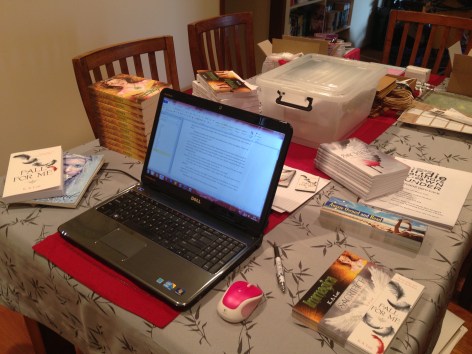
Now my kids are in school, I can sit down in the peace and quiet, in one place, and get my brain working better. I wish I had an office—which I actually do—that I could devote solely to writing, but I prefer to write at the dining room table. The office is great, and I have a fab desktop PC in there which I love, but I use it mainly for my graphic design work, admin tasks, promotional time etc. The dining room table works better for me because I have more room to spread out. As you can see from the pic, it’s a mess (and usually is). I’ve been getting ready for a signing event on the Gold Coast which is happening in less than three weeks (eeek!), so there are stacks of books and swag everywhere. I’m also more inspired at the dining room table because I don’t feel like I’m locked away in a cave. There’s air flow, light and space around me.
After saying all that, sometimes I do write in the office, like I am now, if the table needs to be used for something like, I don’t know—eating!
Where I’m Inspired
I’m inspired at all different times, in a lot of different places, and in many different ways. Mostly though, I’m inspired inside my head. That sounds a little weird, but it doesn’t matter where I am, or what I’m doing, for me to get inspired. My hubby often gets annoyed with me because I have the ability to switch off just like that, even mid-conversation. I end up inside my head, thinking through a scene or creating a new character, and then I have clicking fingers in front of my face.
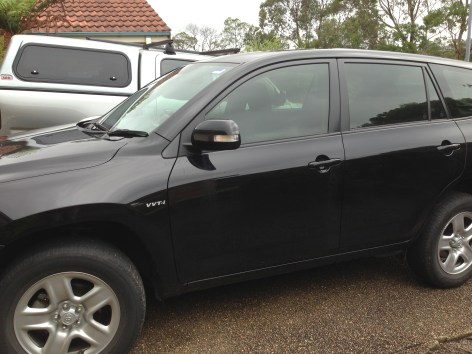
If I was to pick a place where most of the inspiration happens, I’d have to say inside my car. I work two days a week—in Sydney. The traffic is horrendous, which means I have anywhere up to three (sometimes more) hours of thinking time on the drive to and from work. Music really aids my inspiration. All of my books have a theme song, and a playlist, and every time I hear particular songs, they remind me of my characters, their actions, and even particular scenes.
To Be Read
Okay, this is a bit of a sore spot in my house. Hubby can’t believe—or understand—why I have so many books. I love books, especially pretty ones. I love all the pretty covers. About a third of my books I’ve bought because I loved the cover. I’m a graphic designer; I have to have the pretty covers.
There are so many books I want to read that I don’t have a ‘next on the list’ list. I’m an eclectic reader. I basically pick up whatever I feel like at the time, and I have a lot to choose from.
The shelves on the left side of the photo are all books I haven’t read. Yep, and they are double stacked. The ones on the right side are the books I have read, also some of them double stacked. As you can see though, the unread books far outweigh the read ones. Don’t even get me started on the number of books on my iPad. I have a panic attack just thinking about it.

If by any chance you don’t have too much on your TBR, I’d love you to check out my YA Paranormal Romance series. I also have a standalone lower YA fantasy adventure. Come by my Facebook page or tweet me if you want to know more.
K x
 K. A. Last was born in Subiaco, Western Australia, and moved to Sydney with her parents and older brother when she was eight. Artistic and creative by nature, she studied Graphic Design and graduated with an Advanced Diploma. After marrying her high school sweetheart, she concentrated on her career before settling into family life. Blessed with a vivid imagination, she began writing to let off creative steam, and fell in love with it. She now resides in a peaceful, leafy suburb north of Sydney with her husband, their two children, and a rabbit named Twitch.
You can find her at her website, or on Twitter, Facebook, Goodreads or on Amazon.


 Cassandra Page