
Interview: Natalie Miller, performer and writer
Posted: April 6, 2013 Filed under: On writing | Tags: Interview, scripts, writing Leave a commentOnce upon a time, a long time ago (let’s not dwell on how long), I went to school with a wonderful girl named Natalie. We shared the same interest in writing and drama—except where I went on to be a public service editor, she went on to be Australia’s top kids ministry performer. That is to say she is a ventriloquist who writes comedy scripts for a Christian and secular audience, for adults and children.
I know, right?! Words cannot express how awesome that is!
Natalie very kindly agreed to do this interview, where we focus on her writing process. I hope you enjoy it.

Natalie (on the right).
Which books have influenced your writing? Other than the Bible, I mean—that’s a given.
I read a lot of joke books—being a performer, the jokes are important, I also read comedy biographies—Tina Fey, Jeff Dunham, Steve Martin—which inspire me. One of my favourite “go to” books for creative inspiration is Twyla Tharp’s The Creative Habit. It’s awesome for
anyone creative working on a project: dance, music, writing, etc.
What is more fun to write: scripts for adults or for children?
They’re both so different. It’s very satisfying to have a joke that “gets” the grownups—being clever enough to make them laugh. But then seeing a kid laugh with their whole body over something ridiculous is also awesome. My favourite scripts are the ones that get both at once!
What’s your preferred way to write, your ideal process?
It really changes every time. Sometimes I’ll have an idea in the back of my head or scribbled in a notebook that could sit there for months and suddenly I’ll get inspired and sit down and get it all out in less than an hour. Other times if I’m “trying” to write I can sit for hours and write and it ends up being rubbish with just a few good lines. My most successful writing venture was when I disappeared off the grid for two days and went to a cottage in the bush with no internet to just write—I wrote non-stop and got ten GREAT scripts written. Obviously the clear space and serenity helped!
How do you deal with writer’s block?
Coffee. Chocolate. Repeat. If I’m really stuck, I’ll go do something else for a little while, go get a coffee or do something else; have a run. Sometimes I just have to leave what I’m writing for a few days and come back to it. It depends how “stuck” I am. The best cure is always to leave it and come back, though; otherwise I get frustrated and stressed and end up hating whatever it is I’ve written.
What is your favourite theme to write about?
I love writing about value – encouraging people that they are loved and important and have something worthwhile to offer the world, no matter where they’ve come from, what their history is. I love encouraging kids that they’re awesome just the way they are. There is so much negative media about image and self-worth; I feel privileged to be able to stand in front of people, make them laugh themselves silly and then through the way I’ve written a story or script end with something really positive that makes people not only feel like they’ve had fun but also been encouraged.
What are your current projects? Can you share a little of your current work with us?
I’m currently trying to work on a biography—or life story—of how I got to where I am. It’s 25 years since I started as a ventriloquist and it’s been a pretty big journey—not always pretty either, so I’m sort of trying to get my head around writing that. Not sure if anyone will want to read it, but maybe my kids can read it one day!
If you want to learn more about Natalie or her work, check out her website here.

Choosing Your Publishing Path (Reblog)
Posted: April 5, 2013 Filed under: On writing | Tags: publishing, self-publishing, small presses Leave a commentThis is a great blog post by Dahlia Adler about the different forms of publishing (traditional, small press and independent) and the pros and cons of each. It’s a good place to start if you’ve written a manuscript and you’re trying to decide what next.
I’d love to be able to write such a post myself rather than reblogging someone else’s, but at the moment my experience of the process just doesn’t extend that far. So I hope you’ll forgive me for referring you to someone else’s work. :p

I’d really like someone to tell me to my face that publishing is dying, because I haven’t laughed in someone’s face in a really long time, and I miss that feeling. To think publishing is dying is to be walking around with your eyes closed, to have failed to stop the Q-tip when it met resistance. Publishing is evolving, changing, and in many ways, even growing. And as a result, we have some lovely and scary things called choices.
It used to be that there were really big houses, and then less big houses, and that was kind of it. Sure, you could go with a vanity press if you had serious money to burn and either true belief no one would know the difference or apathy whether anyone would, but none of those books ever ended up on my shelf. (Or on my ereader, because they didn’t exist! That’s…
View original post 2,228 more words
Writing fight scenes
Posted: March 27, 2013 Filed under: On writing | Tags: muses, protagonists, writer's block, writing 3 CommentsI came a little unstuck in drafting my current work in progress last week. The WIP is an urban fantasy, like my last two, but this time it’s for adults rather than young adults. Anyway, I was working on a fight scene and, halfway through drafting it, I drew a giant mental blank as to what to do next. My muse basically stormed off to her trailer with a sassy flick of her hair and a rude gesture.
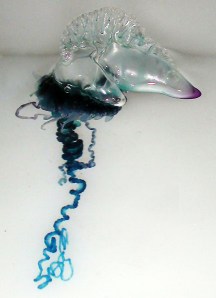
Bluebottle aka Portuguese Man-o-War. These things strike fear into the hearts of Australian children every summer at the beach. (Image from Wiki Commons.)
The problem I had was that I was working with a non-traditional bad guy (rather like an evil flying jellyfish), so its attack options were pretty much limited to striking out with its tentacles. And my leading lady, Melaina, wasn’t using any weapons either.
I had a whinge about it on Twitter and my tweep Pippa recommended I buy Rayne Hall’s ebook, “How to Write Fight Scenes”. I’m almost halfway through reading it (a lot of the chapters are about types of weapons, for example, so they are interesting but not directly relevant to my current scene). But it managed to get me unstuck.
I’d worked Melaina’s combat weakness into the book already, but emphasising it a little more in the scene established the stakes, which is important if I want the readers to be cheering for her as the underdog rather than having a little snooze. For example, in typical Hollywood fight scenes I tend to get bored and start thinking about something else—because the scene usually involves a lot of stunts but no real sense that it advances the story, and no real risk to the protagonists.
The other problem was that, given Melaina was fighting unarmed, I needed to have her use the environment. And my initial description of the place where the fight takes place built up the atmosphere but didn’t really include any features she could use as weapons. So last night I went back and added a couple more things that she could use—including the “weapon” she used to strike the killing blow.
She killed that flying jellyfish good! 😉
I think it’s easy for writers of speculative fiction—where their characters are magic users of one stripe or another—to forget that all magic needs to have a cost to the user. Otherwise, the magic users become overpowered demigods. And where’s the fun in that?
Knowing When to Follow the Rules and When to Break ’Em
Posted: March 23, 2013 Filed under: On writing | Tags: agents, contests, editing, guest post, writing 3 CommentsI hope you enjoy this guest post by Lori A. Goldstein. I first discovered her novel, BECOMING JINN, when she and I both entered the same competition. Needless to say, she did a little better than I did. So you should listen to her advice. :p
Hi, my name is Lori.
Hi Lori.
I’m a fiction writer, and I’m addicted to starting novels with a character waking up.
Nods, awkward smiles.
For those of you who are unaware, this is a no-no. Maybe the no-no. But I am not alone. Apparently, so many of us have this particular addiction that we’re the ones who’ve made it a no-no. Not necessarily for readers. My small, informal, highly unscientific poll shows that readers have no idea this is a common way of starting a novel, let alone so common that it has become an on-the-books writing “don’t”.
But agents know. And agents care. For many agents, starting with a character waking up is an instant turnoff. Rejection based on that very first yawn, stretch, or tossing off of a blanket.
Sure, The Hunger Games starts with Katniss stretching across the bed for Prim. The Road opens with the protagonist reaching for his sleeping child. Every Day begins with the words “I wake up”.
Again, readers aren’t aware of this. They don’t remember exactly how a novel starts by the time they finish it. Most don’t remember how it starts by the time they hit Chapter 3. All they know is they were sucked in.
As for why other authors “get” to start with their characters waking up and I don’t? The answer is simple.
You are no Suzanne Collins. You are no Cormac McCarthy. You are no David Levithan.
But that’s not the whole answer. Novels need to begin in the right spot. And whether it’s taboo or not, the truth is, sometimes that jackpot moment is the instant a character’s eyelids flutter open.
Yeah, yeah, defend it all you want but don’t expect to win.
When writing my first manuscript, I had no idea that this “rule” existed. The finished novel I queried ultimately did not begin with that character waking up, but not because I discovered the list of novel-opening gaffes. It changed during revision because it should have changed. Waking up was not the right place for that story to start.
I have no excuses for my second novel. I was well aware of the rule. Still, I wrote the opening with my character waking up and looking in a mirror. Double no-no. Before you shake the house with your shuddering, this made sense for my character and her story. Plus, I liked it. And maybe, just maybe, I wanted to defy the odds. I entered two contests and did not get chosen for the next round in either one.
I caved. I rewrote the start. I tried so many versions of my opening page and opening chapter that I had to create a second folder on my computer just to keep some semblance of organization.
Eventually, with a little help from my friends, more than a little patience from my husband, and a concession to myself (my character no longer wakes up on page one, but a mirror still worms its way in on page two), I had a new opening.
With my rule-following page one, I entered several contests. And you know what? My work started gaining traction. It got amazing feedback. It won contests where there were fifty entries and contests were there were five-hundred entries. It was the same character and the same story and the same voice, but it followed the rules. It led to me finding my agent.
So am I converted? Am I law-abiding writer? The answer is a resounding no. Because my rebellious tendencies do not just violate the rules of beginnings but they stomp all over the laws of endings too.
The advice I was given from other writers, websites and craft books was this: novels in a series should be standalone. Do not end with a cliffhanger. This too is a no-no. But apparently, it’s not the no-no. If that’s what’s best for your story, if it completes your character arc, if you have a fantastic rebel of an agent like I do, then breaking that rule can be a big yes-yes!
I guess if someone, reader or agent, has gone on the entire ride with you, ending with a bang can actually be a turn-on.
But to ensure you get there, don’t start with that character waking up. Yawn.
Lori A. Goldstein is a fiction writer whose YA novel BECOMING JINN is currently under representation. She is a freelance copy editor and can be found on Twitter.

Collaboration, not competition
Posted: March 18, 2013 Filed under: On Twitter, On writing | Tags: guest post, social-media, Twitter, writing 4 CommentsA guest post by Sharon Sant on one of the downsides of Twitter. I’d love to hear what you think.
I’ve made a lot of friends through writing. Many of these are in real life, through my university course and local writing networks. Many more have been via social media. It’s been a strange experience in many ways, particularly ‘meeting’ people virtually. Some of my online friends I’ve since met in real life and they’ve been every bit as delightful as they are in the ether. Some, I know I will never meet, and that makes me sad, because they are people I feel I have a strong friendship with, even a deep affection for, despite never having met them face to face.
In today’s writing world, I think there is no stronger tool than collaboration with other writers. In the days of ink and quill, writing was considered a solitary affair, but not anymore. In our rapidly shrinking world, we have so many ways to link up. We’re in constant contact every day, updating each other from across the globe about how many words we’ve done, when we’re taking a break, how our editing is driving us nuts. We participate in blog hops and Nanowrimo and virtual launch parties.
Some of us take these relationships, cherish them and build on them, because we understand that you can’t make it alone. People just like you are the people who will root for you, will retweet you, will send readers to your blog, will beta read for you and critique with the best of intentions, will give you heads-up on news, will egg you on when you flag. And you will do the same for them. In my opinion, that’s how it should be—a community based on mutual respect and collaboration.
But I have also encountered the flip-side of this. Take this example: a friend on twitter chats to a friend of theirs who has exactly the same interests as me, has other mutual friends, even writes the same genre. I follow that person, attempt to chat to them, and I’m ignored. I don’t understand why. Not for a minute am I suggesting that everyone has to follow me because I follow them, or reply to me when I mention them, but I fail to see the logic in not doing these things when we quite clearly have so much in common. We have all the necessary ingredients to make another strong link in the chain; why would you throw that opportunity away? Why would you actively set yourself apart from other writers like you? What does this achieve?
Sometimes, I admit, I feel envious of others I consider vastly more talented, successful or popular than me. But I fight those feelings because I think that life as an indie author is hard enough without negativity taking hold. I’d rather try my best to be happy for others, even when I have a down day and I don’t feel like it, than sit stewing in my juices. The writing journey is a much more fulfilling one when you can share it with people who understand each step.
Sharon Sant holds a BA (Hons) in English and creative writing and is currently researching a PhD in literary studies. She is a freelance editor and is the author of YA novels, “Sky Song” and “The Young Moon”. You can find her blog here.

Indie publishing: pricing your book
Posted: March 11, 2013 Filed under: On writing | Tags: guest post, self-publishing, writing Leave a commentThis guest post is by JC Emery, independent author.
Being an independent author is about more than having the freedom to do as you please, though that is a definite draw. After being underwhelmed by the traditional publishing process, I sought out other, scarier avenues. Being rejected by agents and publishers is one thing, but totally failing at not only writing but publishing was a terrifying prospect.
Now that I’ve released my first novel, Marital Bitch, I’m not any more certain of what I’m doing than I was before the book went live. I first set the book at $.99 so that it would be a no-brainer for readers who were considering taking a chance on an unknown author. I figured I could price future books at or above the $2.99 threshold. I intended to make the book free for a promotion just before Valentine’s Day, but quickly found out that it’s not so easy to make a book free on Amazon. In fact, you have to “trick” the system by reporting a lower price to get it to work and even then it can be difficult to get Amazon to re-price the title to charge when your promotion ends. So there I was, having submitted the price adjustment report to Amazon, thinking the sale would never go into effect.
Weeks passed and I totally forgot about it. Three days after the sale went into effect a friend contacted me and asked if I had meant to make it free. Well, I had, but then I also hadn’t. The first thing I did was to check out my sales. I hadn’t been doing too bad charging for the title and I expected some kind of spike since it had been free for a few days.
Sure enough, in the three days the book had been free, over five times the number of books I had sold in nearly a month had been downloaded. Not only that, but the number of reviews (mostly positive) had doubled on Amazon and Goodreads. I was in heaven and I started stalking my sales page like a madwoman. A few days later I had found Marital Bitch on the Top Free 100 list on Amazon, eventually making it to #1 in Women’s Fiction and #2 in Contemporary Fiction.
With over fifty thousand downloads in just two weeks, I feel Marital Bitch is a success. As a new author, my main goal isn’t to make money, it’s to entertain people by providing an enjoyable reading experience. Sure, it’d be great if the book was making money, but right now it’s generating something far more valuable and in higher numbers—readers. I feel that for now it’s the right choice to keep Marital Bitch free and hope that readers remember me and they’ll take a chance paying for my next book.
Not everyone is going to be comfortable offering their book for free—nor should they! Novels take hundreds of hours from start to finish and, like any other craft, the artist has the right to expect some return on their hard work. One day I hope to see some financial return on the investment of my time, but as an unknown author, reviews and happy readers are the best form of currency. I keep reminding myself that my career as an author is just beginning and that this is a marathon, not a sprint. I’m in it for the long haul.
JC writes adult, new adult, and young adult fiction. She dabbles in many different genres including science fiction, horror, chick lit, and murder mysteries; but she is most enthralled by supernatural stories—and everything has at least a splash of romance. You can download “Marital Bitch” for free here.

Signing with a small press
Posted: March 10, 2013 Filed under: On writing | Tags: guest post, publishers, small presses, social-media, Twitter, writing 2 CommentsThis is a guest post by Louise Gornall, about how she signed with the small press Entranced Publishing.
As some of you may know I recently signed with Entranced Publishing. I wanted to write this post and tell you a little bit about my experience with a small press, maybe even pass on some pearls of wisdom. Okay, maybe “passing on pearls of wisdom” is a bit strong, but I figure if you’re anything like six-months-ago-me, you might find what I have to say helpful.
They say that 90% of this writing game is luck and I was lucky enough to have my MS noticed by Entranced during Brenda Drake’s #PitMad event on Twitter. At this point I was clueless about what a small press is, but luckily Danielle Ellison and Jennifer Iacopelli were running an insight-into-small-press series on their blog, which was loaded with need-to-know information.
Senior editor at Entranced, Eden Plantz, had my manuscript for a grand total of four days before she offered me a contract. I had some serious thinking to do. Truth: I didn’t have a publishing plan. Before Eden’s offer and Danielle’s blog series all I had was an idea of the traditional route to publishing.
Anyway, being a Twitter addict I’d come across a lot of stories on how I got my agent/editor and the one constant of all of those stories seemed to be that there’s an instant connection between the writer and the acquiring party. I felt this too, the second I saw Eden tweet about girl boners. 😉 Seriously though, she shared my sense of humour, which was an automatic tick. She’s also a YA writer and has experience in marketing and editing: still ticking boxes. Above all things she loved my story. We’ve even discussed the possibility of a sequel. This was important to me because I’m planning on a writing career and was hoping to build a long-term relationship with my publisher.
As I had no agent it was up to me read through the contract. So many big words. But Eden sent me an email urging me to message her with any questions. At first I felt uncomfortable doing this. I had many, many questions and I knew she was busy. But here’s the thing: Eden was lovely and all, like, “No, really, hit me with your questions anytime. I’m happy to help.” Now she can’t get rid of me. I’m always in her inbox. *insert maniacal laugh here*
After I signed with Entranced, I was introduced to the team and met all the other Entranced authors, who were welcoming and have definitely earned a place on my Christmas card list. After all the meeting and the virtual hugging was over, Eden emailed me with a ton of information about the marketing and editing process. I know that marketing is essential to my books success and despite Entranced only being a small press I was stoked to discover it had a solid marketing plan.
One of the most exciting things for me has been filling out my cover design form. Since before the book was even written I’d had cover design fantasies and Entranced asked me for input! Between you and me, I’ve also cast the movie. 😉
Right now we’re at the content edit stage of book production. Then when we’re done with that, In Stone will go and meet the line editor for one final polish…
I’ve never had any experience with a large press so it wouldn’t be fair to start comparing the two. All I can tell you is that I’m having a great time working with Entranced. I’m loving being so involved with the publishing process and am really excited about the release of my novel.
Louise D. Gornall is a writer at Entranced Publishing. Her YA urban fantasy story, ‘In Stone”, will be released in the Northern Hemisphere fall.

How “Professional” Writing Experience Can Help / Hurt You as a Novelist
Posted: March 8, 2013 Filed under: On writing | Tags: guest post, writing 1 CommentThis guest post is written by the divine Veronica Park!
How it HELPS:
1. You probably don’t subscribe to the ‘no words without inspiration’ school of thought.
Or, better yet, you’ve trained yourself to become inspired on command. This is great, because so many others out there will spend countless hours sitting in front of their antique typewriters, sipping scotch and staring out of windows … waiting for inspiration to hit them like a freight train of rhetoric. Meanwhile, you’ll be bent over your laptop, head down like a mule. Writing away, and leaving all those other fools in the dust.
2. You’re probably good with deadlines.
Similar to the fallacies inherent in #1, but much more dire, is the belief that ‘great’ writing has to be allowed to form in its own sweet time. Unfortunately for writers, editors—and most members of the publishing world as a whole—do not share this belief. If you’re able to recognize that and, better yet, forge ahead with eyes levelled on that deadline horizon (or, heck, even schedule your emotional breakdowns accordingly?) you’re on the road to success, my friends.
3. You’ve probably been trained to follow things through to completion.
A lot of writers without professional experience find they lack the drive, or the self-confidence, to keep hacking away at a WIP until it’s finished. No matter how ugly things get in the process. As a result, they shelve countless manuscripts, telling themselves they just aren’t good enough to succeed. My question for those writers is this: how will you ever know for sure, if the completed version of that idea is never allowed to see the light of day? (Let alone the gently critical, yet encouraging eyes of your crit partners?)
4. You’re probably good at juggling.
I’m not just speaking in terms of handling multiple writing projects at once. Even though, yes, that’s an incredibly important skill to cultivate as an author. As Tchaikovsky once supposedly said, “My greatest work is always the next one.” In this case, however, I’m also referring to the rest of your life. How you manage to reconcile all of the boring, everyday details of “real” life—work, grocery shopping, feeding the family, picking up the dry cleaning, soccer practice, etc.—with the fantasy world you’ve created in your mind.
Creative efforts, even ones which are based in reality, do have a habit of making the real world seem less attractive. When you’re immersed in a story, it can be really tempting to just ignore that world and live in your pyjamas until the book is finished. But not everyone has that luxury. As a professional writer, you’ve probably already come face to face with that challenge, and hopefully conquered it.
How it can HURT:
1. You’re probably used to being told what to do next.
As a journalist, you become accustomed to taking orders from a higher power (your editor, your CEO, your readership). By extension, you learn to take a great deal of constructive criticism. Above all, you adapt the style and scope of your writing to fit the needs of a target audience. These probably sound like good things. And they are.
But it’s also very easy to become dependent on these things for validation. If you’re used to just slapping something together and dropping it on your editor’s desk, confident that he’ll rip it to shreds and then come back with a list of very detailed demands—eh … I mean notes—you might have fallen victim to this attitude. What happens then, when your friends and beta readers and CPs think the book is ‘almost, but not quite’ amazing? Will you have the skill it takes to look at your WIP and figure out how to take it to the next level?
2. You’re probably used to calling all—or at least some—of the shots.
As an associate editor and later as a producer, I was able to control about 90% of the process. As a freelance journalist, I’m in charge of about 100% of the process, from inception to storyboarding to editing and even where and when I want to publish. This is NOT the case for most authors. Even self-published authors have to answer to a higher power, and that power is SALES NUMBERS. No matter how hard you work, no matter how well you market, a lot of your success as an author will depend on timing, industry, readership, luck … and that might be difficult for a bunch of control freaks like us to accept.
3. You’re probably used to getting PAID.
For me, I know this was a struggle. For a long time, I would keep track of my writing hours, filming hours … heck, even my brainstorming hours … on an organised little log sheet. At the end of every pay period, I would turn this log sheet in, and in return I would get piles (very, very small piles) of glorious, spendable money. This is not often the case with authors. Sometimes, it might feel like you’re cashing in your precious time in exchange for magic beans (the nebulous dream of someday being published). The trick is to realise that patience—and budgeting—comes with the territory. (Also, as my agent will tell you, get a good accountant ASAP.)
Here’s what you can do to make your experience WORK FOR YOU:
1. Treat your personal writing like it’s your JOB, not your hobby. As NYT Bestselling author Suzanne Brockmann once told me in an interview, she never lets anyone make her feel like her job is less important than theirs. “Take yourself seriously,” Suz said. “Published or unpublished, you are a writer. Your writing is work time—don’t use it to do errands or laundry or favours for friends.” (For a full transcript of this interview, click here.)
2. Track your time. If you struggle with time management, pretend you ARE being paid. Keep a log sheet of how many hours you spend writing, editing, or staring into space trying to figure out what the heck happens next. (Hey, it counts.) If you really want to motivate yourself, maybe keep those records somewhere safe, and tell yourself that when you sell your first book you’ll pay yourself back in Christian Louboutin shoes. Or whatever.
3. Focus on the WRITING. That’s the one thing that you can absolutely, completely control. If you start to feel helpless or hopeless, write a scene where your character takes on a seemingly insurmountable task, and wins. Don’t let reality get you down. That’s why we’re writers in the first place. We’re the ones who look reality in the face and say, “I can do better than this.” Never forget that, and you’ll be fine.
V’s Mini-bio: (In case you’re wondering who in the heck wrote this)
Veronica Park is a former broadcast and print journalist, indie movie producer, and aspiring author. She is represented by Eric Ruben of the Ruben Agency. Her current projects include a loose series of NA contemporary novels and several short stories and screenplays. She currently lives on a rather remote island in the Caribbean with her medical student husband Jake and her cat, Skeletor. You can find out more about V here.

Hooking your reader: writing a blurb.
Posted: March 6, 2013 Filed under: On writing | Tags: blurbs, guest post, self-publishing 4 CommentsI hope you enjoy this: my first guest post, written by Sharon Sant!
The cover is the first thing that will draw a reader towards your book, but if you think of that as the shop window, then the blurb is the sales patter once you’ve entered the store. You’ve spotted that adorable teapot, or that divine sparkly dress, so you step inside the shop and are greeted by a smelly, rude, disinterested sales assistant. What do you do? You might still buy the item, enamoured by its beauty. More likely, you won’t want to give a penny of your hard-earned cash to such a vile specimen of humanity.
Think of your blurb that way. You’ve tempted in your customer with a fabulous cover, but then your blurb is a snore-fest. They’re not going to buy. It’s such a common mistake and easy to avoid. Your blurb is not a synopsis of the book; it’s a tickle under the chin that says: come on in and stay with us for a while. Your blurb needs to convince the reader, in a few short seconds, that they cannot live without discovering what happens in your book. There are a few simple points to consider that will help you achieve this:
Research
Know your genre. Look at what other blurbs are like, as many as you can. Take note of the language they use—it’s usually in keeping with the tone of the book. A thriller, for example, will use short, punchy sentences. A fantasy blurb will feel like it is weaving magic as it talks to you. A quirky comedy will try to make you laugh. Romance will want to seduce you. The more you read of others, the more you’ll get an intuitive feel for what needs to go in yours.
Keywords
This goes hand in hand with researching your genre. Every genre has its conventions—things that readers expect and want to see—and the blurb should adhere to that. Look at other blurbs for words that crop up again and again within the same genre; they’re there for a reason. Fantasy blurbs contain a lot of ‘destiny’ and ‘magic’. See where we’re going? These words will pique the interest of your potential reader; they’re browsing your genre because that’s what they like to read about.
Pose a question
Drive your potential buyer mad with curiosity. Pose ‘what if’ questions to lure them into your story. ‘What if this woman doesn’t get the man of her dreams?’ What will this woman do? Will she kill herself? Have a sex change? Become a nun? Leave your potential reader needing to know. It can be effective to hit them with your blurb first and then pose the question as the closing line. You can also do the question pose without actually using a question: ‘Her life would be perfect, if only she could catch the man of her dreams…’ Here, we leave the outcome as something unknown; just like when we posed the question, the reader doesn’t know where the story is going to end up and we’ve caught their interest.
Keep it short
You have no idea how many blurbs I’ve seen that seem to be longer than the book itself. Your book is awesome, but don’t tell the reader everything that happens on the blurb in a non-awesome, telling-not-showing way. Keep it short and retain your mystery, feed them just enough to lure them in. Personally, I think a paragraph or two is about right, but I’ve seen one-liners that work brilliantly. It’s up to you but always remember that your blurb is not your synopsis.
Sharon Sant holds a BA (Hons) in English and creative writing and is currently researching a PhD in literary studies. She is a freelance editor and is the author of YA novels, “Sky Song” and “The Young Moon”. You can find her blog here.


 Cassandra Page