Coming home
Posted: August 1, 2013 Filed under: On me, On writing | Tags: real-estate, Thursdays Children 7 Comments After a week and a half of packing and more packing, and then moving and more moving, my son and I are out of the place that’s been our home for the last three years. I wish I could say I was emotional about it, but the only emotion I feel is relief.
Maybe that’s a side effect of packing a four-bedroom house on your own. The exhaustion leaves no room for anything else.
We’re temporarily staying at my parents’ place for the next month or so. They are out of the country, so it’s just my boy and I. He’s sleeping in what was my childhood bedroom. I’m in my sister’s old room (the latter was fully furnished, and I figured my son would adapt better if he had his own bedroom furniture).
This is the house I grew up in, in the suburb I grew up in.
We won’t be here for long, but it really felt like coming home.
I don’t think most adults learn their neighbourhoods the way a child does. Kids explore all the back alleys and parks during their romps; they know where the blackberry bushes grow over the fence to be plundered, or where the plum trees are. They know which path to avoid in spring when the magpies are swooping, exactly how the tree trunk at the local park can double as a rocketship, and where to find willow fronds to weave into headbands.
I think I’m going to miss this place when I move, possibly more even than the house I just sold. Don’t get me wrong. I loved that house. It was beautiful and spacious. But it was also the source of a lot of stress–my ex-housemate and I regularly joked that its extension had been built on a hellmouth.
As a result of all the packing and moving, I haven’t written in two weeks. I’m starting to feel extremely twitchy, especially as my WIP is at the point where I’m about to write the final confrontation. I was really looking forward to it, too. Of course, Murphy’s Law being what it is, I got sick halfway through the move, so I’ve had to hold off a few more days–at least until the fever subsided.
But you know what? When I get to write again, that’s going to feel like coming home too.
Click here to see this week’s other Thursday’s Children blog posts.
Why I have an agent
Posted: July 28, 2013 Filed under: On writing | Tags: agents, guest post, traditional publishing, writing 4 CommentsToday’s guest post is by Amy Reichert. I’ve had a few posts on indie publishing and small presses, so I’m really happy that she and Emery (see previous post) have provided us with the other side of the coin. I’m all about “fair and balanced”. 😉
When Cassandra asked me to blog (and a huge thank you for that), she suggested I write about why I chose to go the agented route—I’m represented by the talented Rachel Ekstrom of the Irene Goodman Literary Agency. My initial response was, “Why wouldn’t you?” But with the rise of small publishing houses and self-publishing, many do feel finding an agent isn’t worth the hassle. The queries, the rejections, dear God, the waiting. It can crush your writerly dreams like Snuffaluffagus on a grape. So, dear reader, your path to publishing is your own, but here are few reasons why I wanted an agent.
- Reassurance. You know that kid in school who always wanted the teacher’s approval. Or your co-worker that needs the pat on the head from the boss to feel good about his work? That’s me. I want someone in the publishing industry to read my book and say, “I read a lot of books and this is so good I will convince people to buy it and print it.” I don’t have the confidence or the balls to do that myself. I need the approval.
- Guaranteed Critique Partner. Critique partners are essential to making a manuscript better. If you don’t have some, get them. However, until you establish a solid circle of beta readers, it’s hard to tell if you’re getting the honesty you need. Many people aren’t comfortable telling you your writing sucks. Since my agent has a vested interest in my book being its best, I know she’ll give me high quality, blunt if necessary, feedback.
- Options. With an agent, I have all the options. I’m not limited to small presses or self-publishing. I could get a book deal with a big house, or medium, or still end up self-publishing (though that isn’t my preference—see the following reason). Together, my agent and I will discuss what is best for my book and my writing career, then work as a team to make that happen.
- Publisher. While having an agent leaves me with all the options, I really do want a publisher for my book. One that comes with an editor, a beautiful-cover designer, and people who know about paper, ink, and fonts. And maybe a little marketing on the side would be nice. I don’t want to do it all. I want to focus on writing and interacting with readers. Working with a publishing house gives me a team of experts who are there to help my book into the world. I’m willing to give up some creative control to have all that publishing knowledge.
- Negotiation. Unless I’m at a street market in Mexico (in which case I’m a badass negotiator), I suck at negotiating things. I don’t even like calling the cable company and asking for a refund when service goes out. My agent knows the industry and what would be a fair offer, what rights to give up, which rights to keep. She knows everything is open for negotiation. She will also play bad cop if I’m not happy with my publisher. This is good because I also don’t like conflict. I’m a midwesterner, I like to be agreeable and feed people.
- Knowledge. Legal contracts are complicated, nuanced beasts that even regular lawyers don’t understand completely, but agents eat them for breakfast, lunch and dinner. As boring as they are, it’s what makes the publishing world clunk along. I want someone who will have my back and make sure I don’t give away my left kidney in exchange for an ebook deal.
- Money. I like money and I’d like more of it so I can take fun trips with my kids and maybe pay for their books when they finally go to college. Yes, every dollar I make will have a slice removed for my agent, but I’m more than OK with that. I feel that with her support in selling my book and future books, her knowledge of the industry, her negotiations skills, etc… I’ll make more money in the long run than if I went it alone. Maybe even enough for a fancy treadmill desk.
Have any questions for me? Ask in the comments, I love to share my wisdom. If I don’t know, I’ll just make up an answer.
Amy Reichert is a first-time novelist, mother of two (three if you count the dog—and you should), beloved wife, spectacular procrastinator, die-hard Harry Potter fan, and amateur baker. She earned her MA in English Literature and worked for several years as a technical writer. When she’s not writing or reading, she’s taking the children somewhere, drinking hard cider, or collecting more cookbooks than she could possibly use. Amy is represented by Rachel Ekstrom of the Irene Goodman Literary Agency.
You can find Amy at Twitter or her blog.

What I wish I knew before my book deal
Posted: July 25, 2013 Filed under: On writing | Tags: editing, guest post, queries, traditional publishing 5 CommentsToday’s guest post is by Emery Lord, whose first contemporary YA novel is out with Walker/Bloomsbury next April. I’ve had a few posts on indie publishing and small presses, so I’m really happy that she and Amy (whose post will go live on Sunday) have provided us with the other side of the coin.
Hi y’all, I’m Emery! Cass was kind enough to invite me to talk about what I wish I knew before my book deal.
My biggest Wish-I-Knew? That the querying process was giving me tools I needed for the rest of my publication path.
(Just for clarification, I’m going to be talking about the way I pursued [traditional] publication: wrote a book, revised it a lot, queried agents, signed with one, revised some more, went on submission to houses, sold. Also, add in some rejection, angst and brownie-gobbling during and between every step. 😉 )
I guess I thought of querying as a wall—a tall gatekeeper set up on the road to publication. For some people, it’s a glass wall, easily demolished with a few thrown query-rocks. For others, it’s a brick wall that is chipped away at over years. It can be laborious and time-consuming and sometimes disheartening. I think it’s easy to wish that an agent would magically pick you from on high, before you even struggle through the querying.
But the querying process isn’t just a way to get an agent. It’s a way to get vital practice for what’s waiting down the publication road. If I’d known that at the time, I think querying might have felt a bit easier to handle!
Pitching
When querying, you write up a few-paragraph pitch, maybe a synopsis, and possibly a one-line “elevator pitch.” Learning how to describe your story with brief but distinct details is vital once you sell a book. Plus, your agent may actually pull from your query text to create the submission pitch! So, all that time laboring over my query and synopsis? I now see it as a training ground for a skill I needed to start learning.
Waiting/Radio Silence
It’s so hard. But waiting is a reality of every step of traditional publishing. It’s good to learn your coping mechanisms sooner. (Mine: whipped cream straight from the can, shoe shopping, and diving into a new project.)
Rejection
It happens with editors much the same way it happens with agents: inevitably–some quickly, some slowly. You might get feedback; you might get a generic ‘not for me’.
These are hard messages to receive, but I’m glad I’ve gotten a taste of that. Because writing is so personal … but publishing makes it public consumption. There will always be rejection or disinterest from someone, and that’s okay. It’s still worth it. (Can you tell I’m trying to emotionally prepare myself for the 1-star Goodreads reviews…? 😉 )
Feedback
Sometimes you get feedback from agents you queried; sometimes you don’t. Same goes for editorial submissions. I learned not to judge that feedback from my first week’s reaction to it. Sometimes it rang true once the sting wore off. Some agents (and likewise some editors) will give you an R&R (revise and resubmit). Even if they don’t ultimately sign you, they’ve given you experience in revising with/for someone, which is a huge part of the post-book-deal process!
So, there you have it: the fruitful moments I wish I’d recognized when I was in the querying trenches! Happy writing to all of you, and thanks to Cass for having me!
Emery Lord is a 20-something American girl who writes stories about high school and best friends and weird families and the crushes that make you feel combustibly alive and also more awkward than you thought was possible. If you’re not sure how to pronounce Emery, try slurring the name “Emily,” and that will get you really close. Her first book, OPEN ROAD SUMMER, will be out in Spring 2014 with Walker/Bloomsbury.

‘Possession’ cover reveal and giveaway
Posted: July 23, 2013 Filed under: On Books | Tags: book covers, contests 1 Comment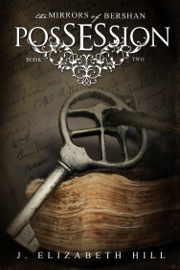
Possession (Book 2 of the Mirrors of Bershan)
by J. Elizabeth Hill
Coming September 10, 2013
Cover by Regina Wamba of MaeIDesign.com
Book Description
“I never meant any of this, least of all for you to pay the price of my pride.”
After binding themselves to each other through their magic, Faylanna Derrion and Tavis journey back to her ancestral home, Iondis, intent on restoring the estate to its former beauty. From the moment they arrive, they find the secret horrors of the place aren’t exhausted yet.
Faylanna finds an old journal of her father’s, one that shakes her understanding of her own past. Worse, Faylanna and Tavis are both nearly killed when attacked by one of the men set to guard the Ninth Mirror of Bershan, still residing at Iondis. In the aftermath, he disappears with the newly-found journal. Sure there is more to this event than they know, Faylanna and Tavis return to the capital, Rianza, for help.
More secrets await them there, ones kept for years by people Tavis never suspected. When the truth is revealed, it alters his present and future completely. Can he rise to the challenges this new fate presents him with or will the change be more than he can handle?
The truths each learn about themselves and those they thought they knew will test Faylanna and Tavis’ love for each other. Will they be able to endure the pain and chaos they face, or will it tear them apart?
Haven’t met Faylanna and Tavis? BOUND is on sale! You can pick up the ebook for only 0.99 from Amazon.com, KoboBooks or Barnes & Noble!

About the Author
Born in Toronto, Ontario, Julie Elizabeth Hill exported herself to Vancouver, British Columbia after many years of staring longingly at the map following every snowfall. For as long as she can remember, she’s been making up stories, but it wasn’t until high school that someone suggested writing them down. Since then, she’s been hopelessly in love with story crafting, often forgetting about everything else in the process. You can find her on Twitter, Facebook or her blog.
Cover Reveal Giveaway:
Enter to win HERE!!!
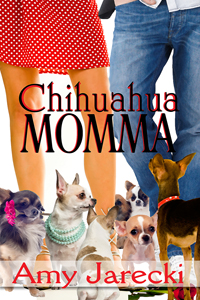
Interview with author and ‘Chihuahua Momma’, Amy Jarecki
Posted: July 22, 2013 Filed under: On Books | Tags: book launch, Interview, small presses, Turquoise Morning Press 8 CommentsWant a book about love in the glamorous world of doggy beauty pageants? Wondering if there all that hairspray and valium (and that’s just for the dogs!) can lead to something more? Then CHIHUAHUA MOMMA may be the book for you!
CHIHUAHUA MOMMA is by Amy Jarecki. Born in Alturas, California, Amy holds an MBA from Heriot-Watt University in Edinburgh, Scotland. She now lives in south-west Utah with her husband, and writes contemporary romance and Scottish historical romance. Amy loves dancing, hiking, golfing, but above all, she is a true Chihuahua Momma.
Amy has very kindly answered a few questions about books and life here.
 Where did you get the inspiration for CHIHUAHUA MOMMA? Do you show dogs?
Well, it all started when my daughter showed dogs in 4-H. She won the Wisconsin State championship, and begged me to buy a top-notch Chihuahua that she could show in the American Kennel Club. So I did my homework, drove to Michigan and bought a dog. Then my daughter got a driver’s license, a job and a boyfriend. Silly me. I wanted a return on my investment, so I started showing him and, after a few classes, I was hooked.
What’s your favourite thing about Rebecca and Matt, the main characters?
Oh boy, there’s so many things. Do I have to pick a favourite? Rebecca’s trying to hold on and keep things on an even keel—she’s making ends meet alone with two teenaged kids. Of course, Matt looks mighty hot in a pair of jeans. He’s always been a playboy, but he’s forty now, and his last disastrous relationship sent him packing across the US all the way from Malibu to New Jersey. Yep, there’s an attraction, but there’s a lot of excess baggage that needs to be shed before the pair have any chance at romance.
CHIHUAHUA MOMMA isn’t your first release, is it? Can you tell us about your other works?
My first published work was Koicto, a Native American historical novel about a boy’s fight for his place as chief of the Nahchee Nation.
I’ve got a few other novels in the works:
Virtue—A romantic suspense about a dancer who ends up on the sacrificial altar of a Mayan cult. Release date: 1 December, 2013
Rescued by the Celtic Warrior – Release August, 2014
Celtic Maid – Release December, 2014
 My only overseas holiday was to Scotland so I’m fascinated to see that you studied there. How did that come about?
Funny you should ask. I was living in Australia, working for Arnott’s Biscuits in Sydney, and my daughter was a year old. Heriot-Watt University advertised in the National Accountant (a trade magazine). I contacted them and found I could do most of my studies by distance learning—took some of my exams at the New South Wales Board of Studies—for all you Aussies out there!
I just spent the month of May in Scotland researching my Highlanders of Raasay series—and gathering information for my next as well. I love Scotland, and my maiden name is Lowland Scots (yes, I do rock)!
Coffee or tea? Sweet or savoury?
Tea and savory.
Thanks for hosting me, Cass! You ROCK!
BLURB FOR CHIHUAHUA MOMMA:
In the frenetic world of canine pageants like Westminster, where dog hair flies and personalities diverge, Rebecca Lee remains in a cocoon of loneliness. Widowed, with two teenaged kids and a business to run, Rebecca would rather mow through five-hundred poodle cuts than think about dating. But when former quarterback Matt Johnson shows up to buy a Chihuahua, his irresistible grin rocks her world—until Matt’s ex decides she wants him back and Rebecca’s daughter decides she’s against her mom dating. Rebecca now has a choice—crawl back into her realm of dogs or fight for the powerful love that fills her soul.
Chihuahua Momma releases in eBook on 28 July; keep an eye out for the paperback a couple of months later.
You can find Amy on Twitter, Goodreads or at her blog.
Moving myself, my son and my book babies
Posted: July 20, 2013 Filed under: On Books | Tags: books, real-estate 5 CommentsAs my long-time reader will know, I’ve been trying to sell my house for months. Well, we’re all systems go; the house finally sold. Settlement is at the start of August, but my son and I are moving into my parents’ place next weekend, until we can find our new, downsized home…
…which still needs to be big enough to hold not only two humans, but my study (which has a big writing desk) and a whole lot of books.

At least once we set up in the new place I can make sure the bookshelves are correctly paired together. This random jumble has been bothering me for years!
It also means that I spent an entire day packing over 30 boxes of books. I did keep a few out to read over the next couple of months, but I feel weird about seeing the rest of my cherished collection packed away.

These books aren’t all mine. Two of the boxes belong to my son. :p
Now I guess I’d better pack the rest of the house!
Anyway, that’s why I’ll be semi-MIA on the blog over the next week and a bit. However, a few excellent folks are providing guest posts, so you won’t be totally neglected! And I’ll still be around on social media … no doubt whinging about packing. 😉
Stay frosty!
Why editing is like streaking
Posted: July 19, 2013 Filed under: On writing | Tags: aussie-owned, editing, guest post, writing 4 CommentsI’ve seen a lot of writing metaphors in my time. But this one is totally new to me. I hope you enjoy this guest post by Lauren McKellar!
If you’re a sports fan you’ve no doubt seen a man naked before. Of course, I’m not referring to the locker room or some more extreme version of sumo wrestling, but more to the one sport that seems to get everybody talking: streaking.
Recently, us Aussies watched a rugby league game where two of our fine states went head-to-head in a battle to win the shield. Or it could have been a plate. Maybe even a trophy. Have I mentioned I’m an editor, not a sports journalist?
So, they battled it out to win. It was the series decider and the question on everyone’s lips was: Will Queensland take it out for the eighth year in a row?
Yet the day after the match the winning state wasn’t the most reported on topic of conversation; instead, it was the guy who streaked.
Which got me to thinking (and I should warn you, this is a stretch): editing is like streaking. Do it well, and you notice it. Fail to have it, and you’re left with a lack of exposure and no chance of going viral.
That’s not where my loose connection ends. When preparing your book for an editor, there are a few leaves you can take out of the streaker’s book to enable your expert to focus on the bigger elements at play. These tips include:
Shedding those outer layers, baby. If there’s one thing a streaker does well, it’s delete excess items of clothing. You need to ask yourself if, as a writer, you have any.
Is every paragraph, every scene, every chapter moving your story forward? Are you telling us some new information we need to know with every sentence you craft?
Because if not, it’s time to make like a streaker and delete, delete, delete! Your editor will thank you for it.
Break the rules. Yes, there are rules of grammar and no, you don’t want to look like an idiot and use ‘there’ when ‘their’ would have been a better choice. Still, there are times in writing when you’re allowed to break the rules.
Technically, you’re not supposed to start a sentence with the word ‘and’,
And I guess you’ve never done that, right?
If there were a naked man at every game we’d quickly get bored and lose attention. But a well-timed streaker can take a rugby match from dull to damned interesting in a heartbeat!
Sometimes, being a literary badass can give your writing character and help get your point across. Go against the grammar grain and run naked across that football field; you deserve it.
Eliminate the backstory. One of the most common editing issues I come across is excessive chunks of backstory just vomited throughout a manuscript.
I have to confess; I am guilty of committing this crime in my own work. I’ll be all ‘What? No! Never!’ and then look at the highlighted paragraph in question: a quick little explanation on my childhood best friend, my family dynamics throughout history and a short snippet on how I used to be a nerd but now I’m a crime-fighting superhero, and realise I’m guilty as the next person.
Search your manuscript for backstory and include it naturally through relevant dialogue, pertinent flash backs or a subtle sentence here and there. Remember, as readers, we’d like to think we’re pretty smart. We get it, already.
And how is this like streaking? Well, just like you don’t want to have too much backstory on the record in your manuscript, a streaker doesn’t want to have too much of a streaking history on his criminal record. After all, get caught streaking once, face a hefty fine. Get caught for streaking twice…now you’re a crazy man who thinks he’s the emperor wearing a new suit.
Lauren McKellar is a freelance editor currently taking on new clients for late August and beyond. With over six years publishing experience, she is currently a Senior Editor for digital romance house Entranced Publishing. For more information on her services, visit her website here.
Like a Virgin blog hop: all about firsts
Posted: July 14, 2013 Filed under: On the Isla's Inheritance trilogy | Tags: blog hop, fanfic, Isla's Inheritance 21 Comments I don’t have a manuscript eligible for entry into the Like a Virgin contest—and, even if I did, that ship has sailed. But I thought I’d participate in their “Getting to Know You” blog hop anyway, because: BLOG HOP. 🙂
1. How do you remember your first kiss?
Vaguely. I was at a party and had been partaking of something bubbly and intoxicating. Sambuca may have been involved. The fellow in question had amazing eyes (although maybe that was the bubbles talking).
If it weren’t for the alcohol making me relax, it would probably have never happened. That being said, don’t do what I did, kids. It could have all gone horribly wrong.
2. What was your first favorite love song?
Speaking of horribly wrong… Back in the 1980s, Kylie Minogue and Jason Donovan (at the height of their Neighbours fame) released a schlocky duet called Especially For You. Yeah, that.
Hey, I was twelve!
3. What’s the first thing you do when you begin writing for the day?
Re-read what I wrote the previous day. I give it a once-over edit and then hunker down. If I could actually write every day I might not but, because I can usually only write once or twice a week, I need to re-read to remind myself of exactly what was going on, to anchor myself in events, emotional context, etc.
4. Who’s the first writer who truly inspired you to become a writer?
Mercedes Lackey is the first one I can recall doing it. I was writing before that, but for a while there I joined a fanclub called Queen’s Own, and discovered fanfic. This was before the internet was widespread; stories got distributed via newsletter.
Old school, my friend.
5. Did the final revision of your first book have the same first chapter it started with?
It’s the same chapter, but it’s significantly shorter than it was. I amputated somewhere between 500 and 1000 words off the front.
6. For your first book, which came first: major characters, plot or setting?
It was a combination of characters and plot. I had the idea for Isla, and for her, uh, “condition”—and I knew roughly what that meant for her.
Interestingly, her name wasn’t Isla to start with. But I had to rename her after an ex started dating a girl with the name that I’d chosen. Awkward.
7. What’s the first word you want to roll off the tip of someone’s tongue when they think of your writing?
“Easy to read” is three words, gorramit! How about “accessible”? I’ve got very little patience for writing that is dense, rambling and self-indulgent, so those are things I try and avoid in my own writing.
Click here to check out the other “getting to know you” blog posts.
A picture book for writers: ‘The Fantastic Flying Books of Mr Morris Lessmore’
Posted: July 11, 2013 Filed under: On Books | Tags: reviews, Thursdays Children, writing 5 Comments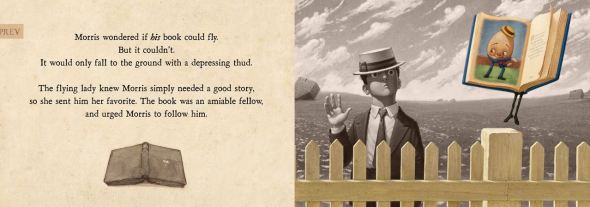
Image from http://morrislessmore.com/
My son received The Fantastic Flying Books of Mr Morris Lessmore (along with a pile of other picture books) on his birthday. Once we’d read the superhero books to death, we gave this one a go—and we love it.
I’ve never reviewed a picture book here before, and I probably never will again. But this one struck a chord with me, because it’s a book for and about readers and writers. The story is pretty straightforward. Morris Lessmore writes in his book about “all that he knew and everything that he hoped for”. Then he suffers a disaster, a hurricane. Everything is scattered, even the words in his book.
At this point, the world is depicted in black and white. So is Morris. The next bit of colour we see is a lady flying through the sky, being pulled along by a squadron of flying books. Morris is sad that his book can’t fly (a metaphor for the muse, anyone?) and she sends him her favourite book, to help him out.
When the book touches him, Morris suddenly appears in colour again. It leads him to a library of flying books, which he then cares for until he’s old and grey; and every night, he writes in his book again. At the end of the book, when he flies away with his own squadron of flying books, presumably heading off to book heaven, his book is left behind—and now it can fly too.
I Googled The Fantastic Flying Books of Mr Morris Lessmore while writing this blog post; apparently it’s based on a short film that was, in turn, based on a story. (That explains the gorgeous animation-style illustrations.) My favourite part* is that everyone Morris loans books to at the library is black and white, like he was when he arrived, and when he hands them the books their colours are restored too. So not only is he getting back in touch with his own muse by writing, but he’s sharing that joy with others who have been turned grey by the disaster.
It’s such a sweet little metaphor for the restorative power of stories.
* My son’s favourite part is the flying books. Because FLYING BOOKS!
Click here to see this week’s other Thursday’s Children blog posts.
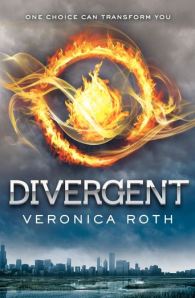
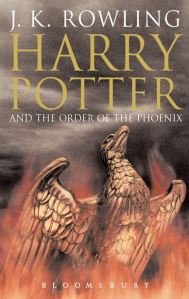
Nominate the best people-free YA or NA book cover
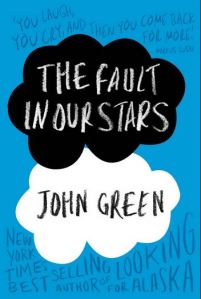
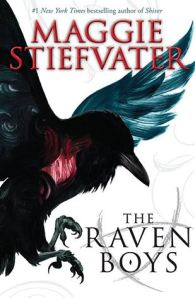
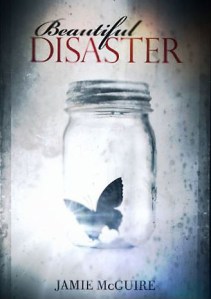
Posted: July 7, 2013 Filed under: On Books | Tags: aussie-owned, book covers 11 CommentsLooking at my Pinterest account made me realise what a sucker I am for a cover with a pretty boy or girl on it. I’m not sure whether that’s because I look at a lot of YA covers, and most of them feature people, so my collection is reflective of what’s out there—or whether it’s due to my own biases. But to try and address this, my post over at Aussie Owned and Read this month will be a poll where we vote for the best YA or NA cover that has no people on it. I’m extending this to include bits of people, such as eyes, or silhouettes of people. (Animals, however, are fine.)
But in order to vote, we first need covers to choose from, so I’m asking you guys to nominate your favourite covers first. Post in the comments with your favourite cover, and make sure to include a link to the cover you mean so I get the right edition. Then on 25 July come on over to Aussie Owned and vote for your favourite! The winner gets bragging rights.
Here are a few gorgeous covers to get you started.



 Cassandra Page