Editing: my four (well, five) writing weaknesses
Posted: September 6, 2013 Filed under: On writing | Tags: aussie-owned, editing, writing 11 CommentsBefore we start, have you guys read my interview with the awesome Steampunk writer Jay Kristoff over at Aussie Owned and Read? If not, it’s here. Go on, I can wait.

An overworked train metaphor, chugging away… (Image via Wiki Commons)
Since I finished my most recent work-in-progress, I’m back on the editing train, steaming my way from the tiny villiage Stream of Consciousness to the (hopefully) shiny metropolis Compelling Prose.
(Fact: sometimes “steaming” can also be applied as an adjective to my first drafts!)
One of the things that makes you a better editor of your work is to know your writing weaknesses—the crimes you commit against the English language when you’re caught up in the initial drafting rush—so you can spot and fix them. Here are a few of mine, to give you an idea of what I’m taking about.
I LOVE the word “that”. Love it. In my first book, there were hundreds of unnecessary uses. I’m getting better but it’s still a problem. I use it when it’s necessary, when it’s unnecessary, and when it’s just plain wrong—for example, when I should instead say “who”, I say “that”. Every time. When I finished my manuscript a fortnight ago, I did a search for the word “that” and checked each usage.
It took hours.
I describe impossible bodily actions. My characters’ eyes do all sorts of things they shouldn’t. They roam the room instead of staying in their sockets where they are meant to be, the cheeky little sods. So I search for “eyes” and make sure to change it to “gaze” (or similar) when I’ve used it in that context.
As an aside, I’ve seen a senior editor suggest the word “blush” causes a similar problem in first-person books. Blushing is actually a reddening of the cheeks, and the first person character can’t see her own cheeks to know they reddened; she feels her cheeks burn, but can’t see it. This editor consequently said not to say “I blushed”. One to watch out for.
I describe redundant body parts. “He shrugged his shoulders”; “she nodded her head”. Given these are the traditional body parts to use, mentioning them is redundant. The only time you should mention the body part in these cases is when the character is using an atypical part—for example, nodding a hand during a puppet show.
Likewise, saying a first-person (or close-perspective third-person) character “saw” or “heard” something is almost always unnecessary. Given they are telling the story, if you describe something to the reader it’s implicit that the character noticed it.
He said, she said. When I’m describing dialogue between two characters in the first person, I can go for ages without mentioning the name of the second character. It’s all “I said, he said”. My solution to this is, again, to search for the character name and scan through the section of dialogue. Word 2010 highlights any found words in yellow, so if I see a whole page with no yellow, that’s a sign it needs review.
Complex sentences. I love these too. I go nuts with the ands, commas, dashes and semicolons to link ideas together. Sometimes it’s not a problem, but other times—such as during fight scenes or other adrenalin moments—a long sentence slows the action down. When I edit, I find these scenes and chop the sentences up, sometimes even into fragments.
So, those are my main writing sins—and yes, you got five instead of four. Counting? Me?
What are your writing weaknesses?
A big moment for me…
Posted: August 21, 2013 Filed under: On me, On writing | Tags: aussie-owned, Interview, university, writing 3 CommentsMany years ago, I did professional writing at university. I landed there because in year twelve I wasn’t sure what I wanted to do with my life, and a very lazy career adviser said, “Well, what classes do you enjoy?” and I said, “Um, English?”
I also enjoyed computing, so if the career adviser had asked a slightly different question or if I’d mentioned the other class first I might be a highly paid IT nerd right now. I’d still be writing, regardless, but maybe not quite as well. (Much love to any IT nerds reading this. My boyfriend is one; I mean no disrespect.)
As it was, I got a degree that was broadly applicable to every job I had — I draft a mean minute — but only became specifically applicable in the last five years when I landed my precious editing job, and started writing again.
The head of the course — let’s call her Janey — was a huge fan of literary, feminist fiction. Genre fiction fans like me didn’t get a lot of credit from her, and the male genre fiction fans in the class got even less. She also believed in what she probably would’ve called tough love, but what I secretly believed was her way of trying to scare us all into not bothering to write so that she had a better shot at getting her own Great Australian Novel published.
I remember one lecture where Janey was talking about the Australian publishing industry. She told us there were maybe half a dozen Australian fiction writers who could make a living off their work, that they all wrote literary or mainstream commercial fiction (ie they were Bryce Courtenay), and that we should all give up any hope of ever being successful enough to pay a mortgage.
Especially us genre fiction writers.

I have no words
(Note: Her advice is both good and very crappy. Kids, don’t give up your day job to write unless you are independently wealthy or you’re already earning enough from your existing royalties to pay the bills and save for your superannuation. But don’t believe it’s not possible to achieve the latter with a lot of hard work and persistence, either.)
Anyway, a few years later I discovered Kate Forsyth.
Kate is a Sydney writer. She writes speculative fiction. She is very good at her job, and she makes a living from it. When I read her high fantasy series The Witches of Eileanan, I loved the story — but who Kate was and what she was doing was, simply put, a revelation.
And yesterday I got to interview her over at Aussie Owned and Read.
Take that, Janey.
Achievement unlocked: novel complete
Posted: August 18, 2013 Filed under: On the Lucid Dreaming duology | Tags: drafting, Lucid Dreaming, writing 14 CommentsI finished my work in progress last night. Which makes me feel like this.
This book (working title: Melaina, which is the main character’s name because I suck at naming things) is 73k words and took me seven months to write.
By comparison, Isla’s Inheritance was about 80k words when I first finished it, and it took twice as long. I cut about 10k words from it in the editing process.
The difference in my writing speed is not that I have more time — I’m still a single parent with a little boy, and I can still only write after he’s gone to bed — but because I’ve learned that FIRST DRAFTS SUCK.
Seriously.
When I was writing Isla’s Inheritance, I obsesssed over the beginning. I knew you really had to land the beginning or your potential writer/agent/editor wouldn’t get any further to discover what your writing was like once you’d found your sea legs. And I knew there was something wrong with the beginning of my book, but I couldn’t fix it.
It wasn’t until I’d done several rounds of edits, received a bunch of agent rejections and had feedback from a pitching contest that I finally amputated the first couple thousand words from the start, and deleted an entire chapter in the first 10k words. It took me that long to gain perspective on it and see what the problem was.
And that’s why it’s not worth wasting a lot of time analysing your book in the drafting stage. You don’t have the perspective.
Also, drafting (despite what anyone tells you) is HARD. It requires dedication, finding the time to sit down when you’ve got washing to do or would rather be reading or sleeping. (Sleeping figures pretty highly for me.) I personally find dialogue easy and a lot of fun to write, but transition scenes? I have to make myself write them, and reward myself with cookies.
I’ve learned to cut myself some slack. Sure, what I come up with (especially during transition scenes) may be clunky and not flow properly. But I don’t let myself get too tied up in trying to fix it as I’m drafting. I will do one read over of what I wrote the previous session, and edit as I go. Then I move on. So far the only additional editing the bulk of Melaina has seen is when I’ve had an idea later on that’s involved a bit of foreshadowing; when I’ve edited that in I’ve often tinkered with the section I added it to.
That’s it.
There are hokey cliches in there (“my heart thundered”, “my pulse raced”). There are ridiculous phrases (for some reason I seem very fond of writing things like “my eyes roamed the room”, despite the anatomical impossibility of such an act). But that’s what editing is for.
It’s clunky but it’s done. The bones are there. You can’t edit nothing, and now I have something to polish.
Booyah!
On themes and dinosaur bones
Posted: August 6, 2013 Filed under: On the Isla's Inheritance trilogy, On writing | Tags: Chuck Wendig, Isla's Inheritance, theme, urban fantasy, writing 2 CommentsI’ve written almost three novels now, but I’ve never consciously developed a story’s theme as I was writing it. I always felt a little guilty about that, because everyone tells me that theme is one of those things that binds a story together. Like grammar, or pacing, or dialogue tags.
My current work in progress is at 69k words (dude) and I’m at the start of the final confrontation scene. I’m having a moment of what I could call writer’s block, except I don’t feel blocked—I feel more like an archaeologist who’s revealed a small part of the skeleton and is dusting away at it with a little brush to reveal HOLY CRAP IT’S A FREAKING DINOSAUR!
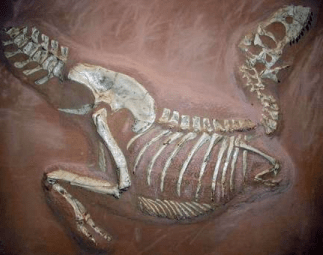
The final scene of my book: an artist’s impression (image from Wiki commons)
The reason I wouldn’t call it writer’s block has a couple of elements:
1. I know which characters are involved in the scene, and what the inter-personal dynamics are.
2. I know who is going to win and what the final outcome will be.
What I don’t have yet is the how. How are they going to win? I’ve been pondering this for a couple of days, and it dawned on me that the other thing I know about the scene is that I want them to win not by dint of awesome superpowers (I write urban fantasy, so there are a few of those kicking around) but by virtue of accessing the part of them that is human.
And then I realised tonight, HOLY CRAPBISCUITS! THAT’S MY BOOK’S THEME!
In fact, it’s been a theme of all three of my books—both of Isla’s stories and this latest one (which is about a different character).
My books are about people struggling with what it is to be human and other, and to become an adult, all at the same time. And that’s kind of cool.
Although maybe not for my characters.
As is often the case, Chuck Wendig says it best. (Check out point three: apparently I don’t have to feel bad about not writing it in consciously after all. Phew!)
Now excuse me—I have to go back to dusting these dinosaur bones.
Why I have an agent
Posted: July 28, 2013 Filed under: On writing | Tags: agents, guest post, traditional publishing, writing 4 CommentsToday’s guest post is by Amy Reichert. I’ve had a few posts on indie publishing and small presses, so I’m really happy that she and Emery (see previous post) have provided us with the other side of the coin. I’m all about “fair and balanced”. 😉
When Cassandra asked me to blog (and a huge thank you for that), she suggested I write about why I chose to go the agented route—I’m represented by the talented Rachel Ekstrom of the Irene Goodman Literary Agency. My initial response was, “Why wouldn’t you?” But with the rise of small publishing houses and self-publishing, many do feel finding an agent isn’t worth the hassle. The queries, the rejections, dear God, the waiting. It can crush your writerly dreams like Snuffaluffagus on a grape. So, dear reader, your path to publishing is your own, but here are few reasons why I wanted an agent.
- Reassurance. You know that kid in school who always wanted the teacher’s approval. Or your co-worker that needs the pat on the head from the boss to feel good about his work? That’s me. I want someone in the publishing industry to read my book and say, “I read a lot of books and this is so good I will convince people to buy it and print it.” I don’t have the confidence or the balls to do that myself. I need the approval.
- Guaranteed Critique Partner. Critique partners are essential to making a manuscript better. If you don’t have some, get them. However, until you establish a solid circle of beta readers, it’s hard to tell if you’re getting the honesty you need. Many people aren’t comfortable telling you your writing sucks. Since my agent has a vested interest in my book being its best, I know she’ll give me high quality, blunt if necessary, feedback.
- Options. With an agent, I have all the options. I’m not limited to small presses or self-publishing. I could get a book deal with a big house, or medium, or still end up self-publishing (though that isn’t my preference—see the following reason). Together, my agent and I will discuss what is best for my book and my writing career, then work as a team to make that happen.
- Publisher. While having an agent leaves me with all the options, I really do want a publisher for my book. One that comes with an editor, a beautiful-cover designer, and people who know about paper, ink, and fonts. And maybe a little marketing on the side would be nice. I don’t want to do it all. I want to focus on writing and interacting with readers. Working with a publishing house gives me a team of experts who are there to help my book into the world. I’m willing to give up some creative control to have all that publishing knowledge.
- Negotiation. Unless I’m at a street market in Mexico (in which case I’m a badass negotiator), I suck at negotiating things. I don’t even like calling the cable company and asking for a refund when service goes out. My agent knows the industry and what would be a fair offer, what rights to give up, which rights to keep. She knows everything is open for negotiation. She will also play bad cop if I’m not happy with my publisher. This is good because I also don’t like conflict. I’m a midwesterner, I like to be agreeable and feed people.
- Knowledge. Legal contracts are complicated, nuanced beasts that even regular lawyers don’t understand completely, but agents eat them for breakfast, lunch and dinner. As boring as they are, it’s what makes the publishing world clunk along. I want someone who will have my back and make sure I don’t give away my left kidney in exchange for an ebook deal.
- Money. I like money and I’d like more of it so I can take fun trips with my kids and maybe pay for their books when they finally go to college. Yes, every dollar I make will have a slice removed for my agent, but I’m more than OK with that. I feel that with her support in selling my book and future books, her knowledge of the industry, her negotiations skills, etc… I’ll make more money in the long run than if I went it alone. Maybe even enough for a fancy treadmill desk.
Have any questions for me? Ask in the comments, I love to share my wisdom. If I don’t know, I’ll just make up an answer.
Amy Reichert is a first-time novelist, mother of two (three if you count the dog—and you should), beloved wife, spectacular procrastinator, die-hard Harry Potter fan, and amateur baker. She earned her MA in English Literature and worked for several years as a technical writer. When she’s not writing or reading, she’s taking the children somewhere, drinking hard cider, or collecting more cookbooks than she could possibly use. Amy is represented by Rachel Ekstrom of the Irene Goodman Literary Agency.
You can find Amy at Twitter or her blog.

Why editing is like streaking
Posted: July 19, 2013 Filed under: On writing | Tags: aussie-owned, editing, guest post, writing 4 CommentsI’ve seen a lot of writing metaphors in my time. But this one is totally new to me. I hope you enjoy this guest post by Lauren McKellar!
If you’re a sports fan you’ve no doubt seen a man naked before. Of course, I’m not referring to the locker room or some more extreme version of sumo wrestling, but more to the one sport that seems to get everybody talking: streaking.
Recently, us Aussies watched a rugby league game where two of our fine states went head-to-head in a battle to win the shield. Or it could have been a plate. Maybe even a trophy. Have I mentioned I’m an editor, not a sports journalist?
So, they battled it out to win. It was the series decider and the question on everyone’s lips was: Will Queensland take it out for the eighth year in a row?
Yet the day after the match the winning state wasn’t the most reported on topic of conversation; instead, it was the guy who streaked.
Which got me to thinking (and I should warn you, this is a stretch): editing is like streaking. Do it well, and you notice it. Fail to have it, and you’re left with a lack of exposure and no chance of going viral.
That’s not where my loose connection ends. When preparing your book for an editor, there are a few leaves you can take out of the streaker’s book to enable your expert to focus on the bigger elements at play. These tips include:
Shedding those outer layers, baby. If there’s one thing a streaker does well, it’s delete excess items of clothing. You need to ask yourself if, as a writer, you have any.
Is every paragraph, every scene, every chapter moving your story forward? Are you telling us some new information we need to know with every sentence you craft?
Because if not, it’s time to make like a streaker and delete, delete, delete! Your editor will thank you for it.
Break the rules. Yes, there are rules of grammar and no, you don’t want to look like an idiot and use ‘there’ when ‘their’ would have been a better choice. Still, there are times in writing when you’re allowed to break the rules.
Technically, you’re not supposed to start a sentence with the word ‘and’,
And I guess you’ve never done that, right?
If there were a naked man at every game we’d quickly get bored and lose attention. But a well-timed streaker can take a rugby match from dull to damned interesting in a heartbeat!
Sometimes, being a literary badass can give your writing character and help get your point across. Go against the grammar grain and run naked across that football field; you deserve it.
Eliminate the backstory. One of the most common editing issues I come across is excessive chunks of backstory just vomited throughout a manuscript.
I have to confess; I am guilty of committing this crime in my own work. I’ll be all ‘What? No! Never!’ and then look at the highlighted paragraph in question: a quick little explanation on my childhood best friend, my family dynamics throughout history and a short snippet on how I used to be a nerd but now I’m a crime-fighting superhero, and realise I’m guilty as the next person.
Search your manuscript for backstory and include it naturally through relevant dialogue, pertinent flash backs or a subtle sentence here and there. Remember, as readers, we’d like to think we’re pretty smart. We get it, already.
And how is this like streaking? Well, just like you don’t want to have too much backstory on the record in your manuscript, a streaker doesn’t want to have too much of a streaking history on his criminal record. After all, get caught streaking once, face a hefty fine. Get caught for streaking twice…now you’re a crazy man who thinks he’s the emperor wearing a new suit.
Lauren McKellar is a freelance editor currently taking on new clients for late August and beyond. With over six years publishing experience, she is currently a Senior Editor for digital romance house Entranced Publishing. For more information on her services, visit her website here.
A picture book for writers: ‘The Fantastic Flying Books of Mr Morris Lessmore’
Posted: July 11, 2013 Filed under: On Books | Tags: reviews, Thursdays Children, writing 5 Comments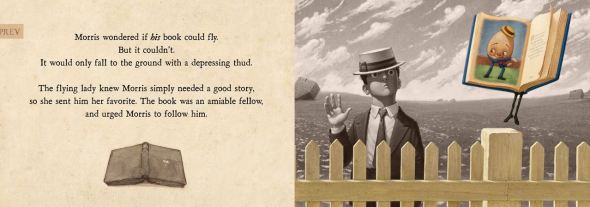
Image from http://morrislessmore.com/
My son received The Fantastic Flying Books of Mr Morris Lessmore (along with a pile of other picture books) on his birthday. Once we’d read the superhero books to death, we gave this one a go—and we love it.
I’ve never reviewed a picture book here before, and I probably never will again. But this one struck a chord with me, because it’s a book for and about readers and writers. The story is pretty straightforward. Morris Lessmore writes in his book about “all that he knew and everything that he hoped for”. Then he suffers a disaster, a hurricane. Everything is scattered, even the words in his book.
At this point, the world is depicted in black and white. So is Morris. The next bit of colour we see is a lady flying through the sky, being pulled along by a squadron of flying books. Morris is sad that his book can’t fly (a metaphor for the muse, anyone?) and she sends him her favourite book, to help him out.
When the book touches him, Morris suddenly appears in colour again. It leads him to a library of flying books, which he then cares for until he’s old and grey; and every night, he writes in his book again. At the end of the book, when he flies away with his own squadron of flying books, presumably heading off to book heaven, his book is left behind—and now it can fly too.
I Googled The Fantastic Flying Books of Mr Morris Lessmore while writing this blog post; apparently it’s based on a short film that was, in turn, based on a story. (That explains the gorgeous animation-style illustrations.) My favourite part* is that everyone Morris loans books to at the library is black and white, like he was when he arrived, and when he hands them the books their colours are restored too. So not only is he getting back in touch with his own muse by writing, but he’s sharing that joy with others who have been turned grey by the disaster.
It’s such a sweet little metaphor for the restorative power of stories.
* My son’s favourite part is the flying books. Because FLYING BOOKS!
Click here to see this week’s other Thursday’s Children blog posts.
I signed with Turquoise Morning Press. Again!
Posted: July 3, 2013 Filed under: On the Isla's Inheritance trilogy | Tags: Isla's Inheritance, Isla's Oath, small presses, Turquoise Morning Press, writing 17 CommentsLoyal readers of my blog (ha!) will know that I always intended Isla’s Inheritance be the first book in a trilogy. There’s a three book arc, a meta-plot … and how cool is the phrase “meta-plot” anyway? I feel like I need to say it in this big, booming voice: “I have this plot, and it is meta.”
I’ve drafted the sequel to Isla’s Inheritance; it is in the beta-reading stages. Until last week I was calling the manuscript Book Two, because I am the queen of naming things and all shall bow before me. But when my amazing editor over at Turquoise Morning Press, Shelby, asked me for a synopsis for Book Two, I had to come up with a proper name. And a synopsis. Aaah! I wrote the latter, and then ran it past my Aussie Owned girls. Sharon suggested Isla’s Oath. For she is the true queen of naming things, and all shall bow before her.
Bow! *shakes fist*
Seriously, I’m pretty stoked with that. Isla’s Oath. It rolls off the tongue. (If you’re wondering, Isla is pronounced eye-la.)
I sent the synopsis to Shelby and then—be still my heart—she asked for a one-page pitch for the third book as well.

Now, book three is currently just a series of thought bubbles in my head. I have been working on a different project these last six months, because at the start of the year I’d had no joy in placing Isla’s Inheritance and, since I write so slowly, I didn’t want to spend almost a year working on the third book in a series that might never go anywhere.
Also, the plot bunnies were biting on this new idea. And you can never tell those plot bunnies anything.
But I wrote the pitch (with a working title that I’ll keep to myself for now). And THEY SAID YES!
That’s right, I now have a three-book deal with Turquoise Morning Press. I just, I can’t even … there are no words. (That’s not a problem for a writer, is it?)
The current plan is to release Isla’s Inheritance around the middle of next year, and then the subsequent two in gaps of up to six months after that. As that firms up I’ll let you guys know.
Thanks to everyone who’s supported me in this, especially my boyfriend, the evil genius, Peter; Chynna-Blue; and all of the Aussie Owned ladies. Also, to all of my friends on Twitter and Facebook, and everyone I’ve ever met. Also to people I haven’t met yet. Glomps to you all!
Finding inspiration, and ‘In Stone’
Posted: July 3, 2013 Filed under: On Books, On writing | Tags: book launch, guest post, inspiration, writing, young adult 3 Comments
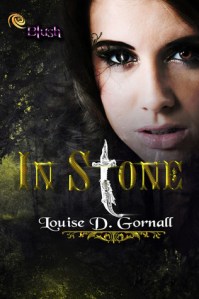
Today’s post is by one of my mates from Twitter, the gorgeous Louise D. Gornall. Her debut novel, IN STONE, was released on Monday, so the first thing I wanted to say was HAPPY BOOK BIRTHDAY!
Massive thanks for having me on your blog today, Cass!
So, I’m here to tell you guys the inspiration behind In Stone. Of course there was music, various breath-taking landscapes and thousands of hours spent searching through pictures on Pinterest. Then there were the emails between me and my CP, as well as the countless 4am brainstorming session with my twin sister. All of these things were inspirational, and the book would have undoubtedly sunk without them. However, if I HAD to single out three things that were inspirational in the pre-writing stages of In Stone, they would be:
 1. This quote from Friedrich Nietzsche: “And if you gaze for long into an abyss, the abyss gazes also into you.”
2. Then there was a conversation I saw between two agents on Twitter that amounted to ‘stakes in a story are significantly lowered when immortals are involved because immortals, after all, can’t die.’
3. And then there was the plot of The Lord of the Rings.
I’m not going to go into too much detail because I will undoubtedly—however inadvertently—end up giving away the plot of In Stone. It wouldn’t be the first time I’ve done that. I just wanted to tell you a little bit about how these things wormed their way into my imagination and helped me cook up a story.
So, I think the first point is pretty standard. Who doesn’t find inspiration in a good quote? This one spoke volumes to me. I’ve read a couple of academic articles that all ponder its meaning, but I took it at face value when I applied it to my plot. To me this quote says that if you’re going to hang around with bad guys, eventually some of that badness is going to rub off on you…
The second point was something I’d been thinking long and hard about for a while. I knew I wanted my MC to be an immortal, but I didn’t want my stakes to be significantly lower because of it. This conversation really got me thinking about how I could avoid compromising my stakes, and that in turn helped me to develop a huge element in my plot.
Finally, The Lord of the Rings is my favourite film of all time. I love everything about it. I would have loved to have had the balls to attempt a retelling of Tolkien’s epic tale…but I don’t. So instead I borrowed some aspects of LOTR. Location, for example. One of my favourite things about LOTR is that it is as much a physical journey as it is a mental one. Plus, you know, I’m a writer. I like to add to my characters hell whenever I can, and dumping them in unfamiliar landscapes while they had this epic task to undertake was just too perfect. And then of course, there was the idea that this one tiny thing (a ring) could cause so much trouble and make even the most loyal of people turn rogue.
…and I’m going to stop now because my spoiler senses are tingling. I’m a bit of a sponge when it comes to inspiration. I find a little bit of something in everything, but these three things were definitely responsible for shaping In Stone.
BOOK BLURB
Beau Bailey is suffering from a post-break-up meltdown when she happens across a knife in her local park and takes it home. Less than a week later, the new boy in school has her trapped in an alley; he’s sprouted horns and is going to kill Beau unless she hands over the knife.
Until Eighteenth-century gargoyle, Jack, shows up to save her.
Jack has woken from a century-long slumber to tell Beau that she’s unwittingly been drafted into a power struggle between two immortal races: Demons and Gargoyles. The knife is the only one in existence capable of killing immortals and they’ll tear the world apart to get it back. To draw the warring immortals away from her home, Beau goes with Jack in search of the mind-bending realm known as the Underworld, a place where they’ll hopefully be able to destroy the knife and prevent all hell from breaking loose. That is, provided they can outrun the demons chasing them
In Stone is available from Amazon, Barnes & Noble and Kobo. You can also add it to your Goodreads list here.
EXCERPT

Louise. I told you she was gorgeous.
As a general rule, nobody walks the Switch on account of the overgrown nettle bushes, a pungent aroma of foot infection, and a collective fear of encountering something feral. However, the Switch shaves at least ten minutes off my journey, and lately I don’t trust the dark. I blame my encounter with the almost-corpse, two nights ago. Before then the dark was just a natural progression: something to be slept in, a different color in the sky. Now, shadows make me jump, and the dark carries a silence that makes me think of funerals. It breathes life into creatures that had always been safely contained behind a TV screen. I make my way down the Switch, striding over vicious flora and trying to ignore the occasional nip that sinks straight through my jeans.
“Hey, Beau!” A voice from behind startles me. When I turn, Gray is jogging in my direction, thwarting thorn bushes with his bare hands. “I was looking for you.”
The hairs on the back of my neck bristle. My hand is in my pocket, and my fingers are wrapped around a slender cylinder of pepper spray as he reaches me.
“Well you found me. What’s up?”
“There’s something I need to ask you,” he says sheepishly. He hammers his toe against the ground, grinding it nervously into the dirt and crushing several stems of dandelion into gold dust. He giggles; it’s a soft, sweet sound that suffocates my hostility. He reminds me of Mark moments before he’d asked me out on our first date. Maybe this guy could be the one to liberate me from my social network sabbatical. Maybe my slightly-too-heavy eyeliner and my reputation as the mortician’s daughter hasn’t freaked him out.
“Really?” Surprise raises my pitch. “What’s that?” The pepper spray is abandoned in my pocket.
“Where’s the knife?” he replies, snatching my throat and slamming my back up against the concrete wall. It’s so forceful, so hard, that my spine ripples. Red flashes across my vision. The muscles in my neck go slack, and my head flops forward. He stabs his thumb up under my chin, forcing me to look him in the eye. His eyes are like the moon; cold, giant circles of icy-silver. But a change in his eye color is nothing in comparison to the change happening on either side of his head. I don’t understand it. It makes me wonder, briefly, if what I’m seeing is a side effect of the migraine pills Leah slipped me at lunch. Gray is growing horns. Giant grey horns that slide out of the side of his skull and then curl like springs around his ears. They’re animal.
Brake and accelerate: writing advice from Chuck Wendig
Posted: June 30, 2013 Filed under: On writing | Tags: Chuck Wendig, editing, pacing, writing Leave a commentOne of the things I struggle with as a writer is pacing. My first book needed major editorial surgery—after pointy-edged feedback from various folks, whom I owe for their insight and honesty—before I was able to get it right. It was less a problem of exposition in my case but of description. I was describing a lot of things, but many of them were the wrong things. What a room looked like, rather than what the character was feeling. Boring stuff, not the juicy stuff a reader really wants to know. Yawn.
So when Chuck Wendig posted his latest advice blog post, 50 Rantypants Snidbits Of Random Writing & Storytelling Advice, this one particularly struck me.
Know what speeds your story up and what slows it down. Dialogue is lubricant: frictionless. Description is grit: friction-filled. Action is a coked-up jackrabbit; exposition is a tired sloth. Short chapters are a bottle rocket; long chapters are a big boat. A story is the slowness of alcohol with the swiftness of meth; sometimes a story needs oxygen to breathe. Sometimes a story needs oxygen to light things on fire. Tension/recoil. Momentum/restriction. Green light. Red light.
Because I love writing dialogue, now I suspect I’ll need to guard against going too far the other way—too fast instead of too slow. (Of course, this is a problem to deal with when you’re editing, not drafting. When you draft, just get it down any way it falls out of your hands or mouth.)
Anyway, follow Chuck Wendig’s blog. Even if profanity offends you (and, believe me, he doles that out like Halloween sweets), follow his blog. He’s cussing you out for your own good. :p


 Cassandra Page