Knowing When to Follow the Rules and When to Break ’Em
Posted: March 23, 2013 Filed under: On writing | Tags: agents, contests, editing, guest post, writing 3 CommentsI hope you enjoy this guest post by Lori A. Goldstein. I first discovered her novel, BECOMING JINN, when she and I both entered the same competition. Needless to say, she did a little better than I did. So you should listen to her advice. :p
Hi, my name is Lori.
Hi Lori.
I’m a fiction writer, and I’m addicted to starting novels with a character waking up.
Nods, awkward smiles.
For those of you who are unaware, this is a no-no. Maybe the no-no. But I am not alone. Apparently, so many of us have this particular addiction that we’re the ones who’ve made it a no-no. Not necessarily for readers. My small, informal, highly unscientific poll shows that readers have no idea this is a common way of starting a novel, let alone so common that it has become an on-the-books writing “don’t”.
But agents know. And agents care. For many agents, starting with a character waking up is an instant turnoff. Rejection based on that very first yawn, stretch, or tossing off of a blanket.
Sure, The Hunger Games starts with Katniss stretching across the bed for Prim. The Road opens with the protagonist reaching for his sleeping child. Every Day begins with the words “I wake up”.
Again, readers aren’t aware of this. They don’t remember exactly how a novel starts by the time they finish it. Most don’t remember how it starts by the time they hit Chapter 3. All they know is they were sucked in.
As for why other authors “get” to start with their characters waking up and I don’t? The answer is simple.
You are no Suzanne Collins. You are no Cormac McCarthy. You are no David Levithan.
But that’s not the whole answer. Novels need to begin in the right spot. And whether it’s taboo or not, the truth is, sometimes that jackpot moment is the instant a character’s eyelids flutter open.
Yeah, yeah, defend it all you want but don’t expect to win.
When writing my first manuscript, I had no idea that this “rule” existed. The finished novel I queried ultimately did not begin with that character waking up, but not because I discovered the list of novel-opening gaffes. It changed during revision because it should have changed. Waking up was not the right place for that story to start.
I have no excuses for my second novel. I was well aware of the rule. Still, I wrote the opening with my character waking up and looking in a mirror. Double no-no. Before you shake the house with your shuddering, this made sense for my character and her story. Plus, I liked it. And maybe, just maybe, I wanted to defy the odds. I entered two contests and did not get chosen for the next round in either one.
I caved. I rewrote the start. I tried so many versions of my opening page and opening chapter that I had to create a second folder on my computer just to keep some semblance of organization.
Eventually, with a little help from my friends, more than a little patience from my husband, and a concession to myself (my character no longer wakes up on page one, but a mirror still worms its way in on page two), I had a new opening.
With my rule-following page one, I entered several contests. And you know what? My work started gaining traction. It got amazing feedback. It won contests where there were fifty entries and contests were there were five-hundred entries. It was the same character and the same story and the same voice, but it followed the rules. It led to me finding my agent.
So am I converted? Am I law-abiding writer? The answer is a resounding no. Because my rebellious tendencies do not just violate the rules of beginnings but they stomp all over the laws of endings too.
The advice I was given from other writers, websites and craft books was this: novels in a series should be standalone. Do not end with a cliffhanger. This too is a no-no. But apparently, it’s not the no-no. If that’s what’s best for your story, if it completes your character arc, if you have a fantastic rebel of an agent like I do, then breaking that rule can be a big yes-yes!
I guess if someone, reader or agent, has gone on the entire ride with you, ending with a bang can actually be a turn-on.
But to ensure you get there, don’t start with that character waking up. Yawn.
Lori A. Goldstein is a fiction writer whose YA novel BECOMING JINN is currently under representation. She is a freelance copy editor and can be found on Twitter.

On how you write and how you live
Posted: March 14, 2013 Filed under: On me | Tags: editing, writing 7 CommentsI like my books like I like my home: tidy, not too cluttered, and functional.
Over the past two weeks, as my regular reader will know, I’ve been getting my house ready to sell. That has involved packing away an inordinate amount of things we don’t use every day: toys (not all of them—I’m not that mean); ornaments; some pictures. And there has been cleaning. Lots and lots of cleaning. Oh, and weeding. Sweeping. Removing cobwebs.
Anyway, not to bore you with house stuff (“Too late,” she cried!), now that I’m living in this de‑cluttered house, it occurred to me that, while I like the space to move and how tidy it is, it does seem a little … sterile, without the detritus of life kicking around. Like living in an open home, which I guess I pretty much am till the house sells.
And then, because I’m a book-obsessed freak, it occurred to me that I like the prose in the books I read to be of a similar style to the environment I live in. Friendly but not overbearing. Decorative but not overly lush (or the writing equivalent of an episode of Hoarders). Functional but not Spartan. Working correctly. Always working correctly.
I’d like to imagine that’s how I write too, but I’ve learned that’s not the case. My original drafts are much messier. But that’s where editing comes in: it’s the dusting, vacuuming and weeding of the writing world.
The difference is that, to me at least, editing is fun! I will never EVER feel the same way about mopping.
This is Cassandra Page, signing off before I drive this metaphor any further into the ground… :p

‘Which’ versus ‘that’: when to use them!
Posted: February 19, 2013 Filed under: On writing | Tags: editing, words to be wary of, writing 4 CommentsIt’s time for another grammar rant from me. This one is about when to use “which” and when to use “that”. I see a lot of published documents—fiction and otherwise—that use them both (IMO) incorrectly.
Consider the following sentence:
I bought a car which is pink.
According to some grammar books, the “which” is wrong. According to others, it’s not incorrect but it’s also not the best choice of words because it leaves the reader to guess what you’re trying to say. Either way, it should be fixed.
Both “which” and “that” can be used to introduce a clause. But when they do, they flag different things to the reader. “Which” flags a non-defining clause: one that contains supplementary information not required by the main clause. “That” flags a defining clause: one that is part of your main message.
When used to introduce a clause, “which” requires a comma in front of it and “that” shouldn’t have one.
So, in the case of the car, if I’m trying to tell you a bought a car that happened to be pink, I’d say:
I bought a car, which is pink.
The information after the comma is supplementary, not essential to the sentence. But if I’m really excited about the fact my car is pink, and it’s the main focus of what I’m trying to say, then I’d use “that”:
I bought a car that is pink.
Of course, with a simple sentence like this I’d edit it further to tighten it up even more: I bought a pink car! But in a more complex example, such a rewrite isn’t possible to do elegantly. See below.
This is wrong:
I went into the bakery which sold egg-and-bacon pies and hot cross buns.
This is the non-defining clause (the bakery I went into happened to sell pies and buns):
I went into the bakery, which sold egg-and-bacon pies and hot cross buns.
This is the defining clause (I specifically went into a bakery that sold pies and buns as opposed to the one that sold, say, bread and sausage rolls—and why wouldn’t you?!):
I went into the bakery that sold egg-and-bacon pies and hot cross buns.
Mmm, egg-and-bacon pies…
…
Sorry, what were we talking about? :p
Info dumps and wilful ignorance
Posted: February 6, 2013 Filed under: On writing | Tags: editing, writing, young adult 8 CommentsI just finished a young adult (YA) novel that I wasn’t a huge fan of. I considered writing a review, but thought that rather than naming and shaming it might be more beneficial to instead outline the two main reasons I didn’t like the book. As a writer, I’ve found I learn just as much from bad books as good ones. Maybe I can share my learning without inflicting the object of the lesson on you directly!
This particular book was originally self-published. After it had good sales, it had a quick copy edit done (I presume, as some of the Goodreads reviews mentioned typos and I didn’t see any) and was then published in traditional form. You could tell it hadn’t felt a structural editor’s deft hand, though, because many of my objections were all things a good editor could have fixed.
Info dumps
The book featured a supernatural race and a main character who didn’t know she was part of that race: all fairly standard for YA urban fantasy (hell, my book has them!). The author clearly wanted to establish early on the signs the character was different—but it was done awkwardly, by way of the narrator explaining things to the reader in a giant info dump. You’re probably familiar with the concept of “show, don’t tell”. This was all tell.
Also, none of the supernatural indicators were that striking. The race easily passed for human. So it wasn’t “by the way, I have a tail and cloven hooves”, it was “by the way, I don’t like seafood and the colour pink” (yes, I made those up). It made the main character look fussy and difficult, although it was clear to me as a reader what was going on.
The end result of all this was that it took me out of the story and made me notice the (poor) craft. As a writer, taking your reader out of the story is the number one thing you want to avoid.
Wilful ignorance as a plot device
The author clearly wanted to dole out information about the race and its society over the course of the first half of the book. I get that. A slow reveal, when handled well, can be like a strip tease, making you stick around to see just a little bit more…
Unfortunately, in this case, it wasn’t at all sexy. Because it resulted in the main character not asking obvious questions, which made her look stupid, callous or both.
Likewise, the supporting characters, who were meant to be inducting her into her race, kept her deliberately ignorant when it made no sense for them to. And then they had the nerve to scold her when she did the wrong thing out of that ignorance! In one example, one guy told the leading lady it wasn’t his place to explain something—only to explain that same thing a chapter or two later with no indication of why he’d changed his mind. I wanted to slap him upside the head. With a semitrailer.
It’s challenging to have a “discovery” storyline when the teachers know everything and the reader and main character don’t. Managing the reveal is tricky. I get it. But if the reader starts to get frustrated and feels like they are being deliberately kept in the dark, you’ve pulled them out of the story again.
Another example of wilful ignorance was when, at the end of the book, the main character abruptly decided to do something that seemed out of character (based on her previous actions), justified by some extremely flimsy logic. Presumably this was to set up the start of the sequel, but it bugged me enough that I doubt I’ll ever know…
</end soapbox>
Editing: more things to watch out for
Posted: January 20, 2013 Filed under: On writing | Tags: dangling modifier, editing, words to be wary of, writing 3 CommentsIn this post I had a bit of a rant about words to watch out for when you’re drafting or (more likely) editing. I want to add a couple more to the list. Well, one word and one sentence construction.
The word is the humble “of”. The book I’m reading now is well edited, except for slightly awkward sentences like this:
The rage beat inside of my heart.
Every time I see a sentence like this it pulls me out of the story, because I want to cross the “of” out. It isn’t doing anything there except adding to the word count, which is only ok in the first draft of a NaNoWriMo manuscript—but once you’re past the drafting stage, show no mercy.
NO MERCY!
The other construction is more egregious because of the potential to cause the reader to giggle. I heard this one on the news the other day:
Large and out of control, hundreds of fire fighters are working to control the blaze.
I’m sorry, what?!
This type of construction is called a “dangling modifier” (I usually call it a “dangling whatsit”, because that’s how I roll.) I’m sure you can see the problem: by having the modifying clause where it is, the sentence reads as though the fire fighters are the ones out of control, rampaging through the wilderness like Godzilla with a fire hose.
I want it to be true, but I’m pretty sure that’s not what they meant.
Whenever a clause doesn’t contain the subject (like “large and out of control”), make very sure the part that follows immediately after specifies what the subject is. Likewise, if you use an “it” or a “they” (or any other pronoun), make very sure it’s 100% clear what you are referring to. (Or “to what you are referring”, if you want to be all stuffy about it. This is a plain English blog, though, so I don’t tend to bother with that.)
Wikipedia has a good post on dangling modifiers here if you want to learn more.
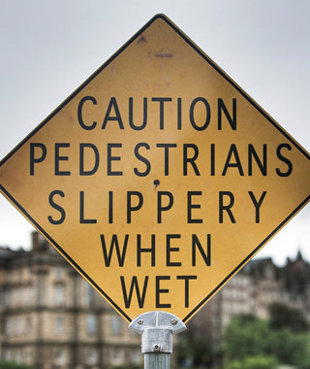
Caution: lack of punctuation in use!
My editing process, and words to be wary of…
Posted: January 9, 2013 Filed under: On writing | Tags: adverbs, editing, passive sentences, words to be wary of, writing 7 Comments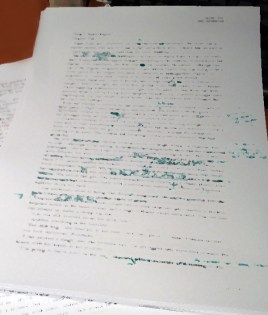
I’ve made this all blurry so you can’t read my shame.
I mentioned here that I like to let a completed manuscript sit for a month before I do my first edit on it. I have one very good reason: to give myself a bit of distance from the draft, so I can start to see issues with the text, pacing, plot, characters—everything. This month, between reading and thinking about my next book I’ve started re-editing Isla’s Inheritance (my first MS).
One of the other tricks I use to give myself some impartiality on my work is to edit a hard copy printout. I draft on screen (well, duh), usually in a san serif font like Arial or Calibri. Then I convert it to Times New Roman, a serif font, and print it. Some studies claim san serif fonts are easier to read on screen and serif fonts on paper; it works for me, at any rate.
I love Word track changes when I’m editing other peoples’ work. It saves me (or them) having to enter in the edits, which is great. But if I read my work on screen I tend not to see things that need fixing. Incorporating all those hard copy edits onto the electronic manuscript is tedious, but I have yet to find a better way that works for me.
Other tricks I’ve heard writers use to try and give themselves that mental space include changing font size; formatting it so it looks like a book (justified text, number of words per line, etc); reading out loud; or even using a text-to-speech function so their computer reads it out loud for them. Maybe one of these will work for you.
I waffle when I write. Unnecessarily passive sentences, wordy sentences—you name it. This time around, I’ve been especially brutal with dialogue tags. You know the things you put after someone speaks? Those. I try and avoid using them if it’s obvious who is speaking. Sometimes I can indicate who’s speaking by having them do something in the same paragraph as the dialogue. For example:
“Get stuffed.” He scratched his chin with his middle finger.
If I can’t avoid a dialogue tag, my first choice is “said”. Readers don’t even see “said”; they skim right over it without pausing, so it doesn’t slow them down (if they stop and notice a word, it’s usually the wrong word). The only time I use any other dialogue tag (whisper, grunt, gasp, cry, wail, snarl, growl) is when there is no way the reader could get the tone from the words. For example, I wouldn’t usually use “yell” or “shout” because you can convey that with an exclamation point and the words the character is using.
If you do decide to use a dialogue tag other than “said”, make sure you don’t go overboard. A conversation in which everyone is gasping, crying and growling is, well, silly.
I’m also a big fan of the find and replace tool as a supplement to a thorough read of my work; if I notice I’m overusing a word or phrase, I’ll search for it throughout the entire document.
Here is a list of words and phrases to be wary of; some of these I’ve added to my list after folks on Twitter commented on them. Thanks, Twitter. 🙂
Suspicious words
Adverbs (words usually ending in ly) – Stephen King describes adverbs as being like dandelions; one might be an unusual and attractive feature in your garden, but if you leave it, it will spread until you have no lawn, just weeds. I do a search for words ending in “ly” and see whether I need them. Sometimes I can delete them outright; other times I can write around them. I rarely leave them. (Note: “rarely” in the previous sentence is an adverb, which I decided to leave. So too would be “seldom”, which doesn’t end in ly. This is why a word search is a supplement to a proper edit, not a replacement for one.)
around – I tend to use this to qualify numbers. “I woke at around seven.” The reader doesn’t care about whether the number is that precise. As the Cyberman said to, well, everyone else: DELETE, DELETE, DELETE!
began to, started to – “She began to run” is a long-winded way of saying “She ran”. Sometimes “began to” can be useful—say, when a girl begins to cry halfway through an argument with her boyfriend—but not usually.
had – I’ve seen some people suggest you never need the word “had”. I don’t agree; in a past-tense novel it can be useful to flag that you’re talking about something that happened prior to the current scene. For example, “I had been to the shops”. If you say “I went to the shops” the way you would in a present-tense document (or life) then people will get confused about when the event happened. That being said, it’s not always necessary so use with caution.
of the – This is a typical indicator of a passive sentence, which is often unnecessary and always more wordy than an active sentence. For example: “The hair of the dog” vs “The dog’s hair”. Times you might want to keep a passive sentence include when the actor in the sentence is irrelevant or unknown; for example, “He was killed” versus “Bob killed him”. The latter is spoileriffic!
possibly, probably, likely, usually, almost, mostly – Do you need the qualification? If not, it should go.
seemed to – Because both my books are in the first person I overuse this phrase to describe my character’s interpretation of others’ feelings, thoughts or opinions. But nine times out of ten it doesn’t need to be there.
suddenly – I tend to include this one (when drafting) to give the reader that sense of shock. But really, “the house suddenly exploded” isn’t any more shocking than “the house exploded”. Roll out the Cybermen again.
that – Sometimes you need “that” in a sentence. There are quite a few of them throughout this blog post. But you can often delete it with no impact on the meaning. When I searched it in my first manuscript, I removed it 600 times! That was horrifying. (See what I did there?)
very, really, pretty (when it’s being used to mean “very”), just, simply, totally, finally, apparently, allegedly, supposedly, usually, awesome, fabulous, fantastic, incredible, wonderful – I keep these in dialogue and thoughts (because that’s how people talk), but at almost no other time. Note a lot of them are also adverbs?
What words do you try and edit out of your manuscript?
What to do after you finish your manuscript.
Posted: December 29, 2012 Filed under: On the Isla's Inheritance trilogy, On writing | Tags: agents, editing, Isla's Inheritance, writing 6 CommentsI finished my second manuscript last night. I’ve still got to incorporate a couple of things: nuances I missed in the mad rush for the finish. But once that’s done, the drafting stage of the unnamed book I’ve been calling Book Two (yes, I’m a creative genius) will be complete.
You may be thinking—especially seeing I’m an editor by trade—that I’d be jumping straight into editing it. And I’m keen, believe me. I have all the crazy momentum of the last few weeks of writing, the urge to be doing, boiling away in my brain. But that would be a really, really bad idea. So if you’re in the same boat as me, this is my advice to you (imagine me shouting this through a megaphone in a hostage situation):
Put the manuscript down. Back AWAY from the manuscript!
When you first finish writing anything—novel, short story, article, shopping list—you are too close to see it objectively. There are a few tricks to let you review it more impartially. Some people suggest changing the font so you’re looking at it differently to how you saw it during drafting—this works for me when I preview the final version of a blog post, so it ought to work for a novel too. (It probably won’t work for a shopping list, unless you draft those electronically.)
I personally like to print my manuscript and edit in hard copy. Transcribing edits back into the soft copy is a bitch, but it’s worth it.
However, the best thing you can give yourself is time.
When I finished Book One (now called ISLA’S INHERITANCE), I made myself wait a full month before I opened it again. The only thing I let myself do was a spellcheck and some formatting. That’s it. But I didn’t waste that intervening period.
I read an agent’s blog. There are quite a few out there, but the one I chose was Miss Snark. The blog has been dark since 2007, but the archives are available and they are pure gold, my friend. They stopped me from making rookie mistakes when I eventually started querying agents. No, my mistakes (and I have made them) have been unique and individual ones!
This time, I’m thinking about pulling out Stephen King’s On Writing, which is one of the best books on the subject out there. I’ll reread it, see what lazy habits I developed in the drafting stage so I’m ready to go when I start editing. Also, while Book Two was a sequel to ISLA’S INHERITANCE—and I do have the beginnings of Book Three bubbling away in my subconscious (I’d always planned a trilogy)—I’ve also got an idea for a completely different book, which requires world-building and research. So I’ll work on that too.
As you can see, I won’t be wasting all that energy and forward momentum. I’ll just be using it in different ways.
Where I rant about lazy writing…
Posted: December 28, 2012 Filed under: On writing | Tags: coincidence, editing, writing 5 CommentsI recently discovered an entirely new fantasy series by one of my long-time favourite authors, and gleefully ordered all five books off the interwebs. (Ok, clearly the series wasn’t that new. But it was new to me. M’kay?) The first one, where she introduces the premise of the series, was very cute, although the combat at the end felt tacked on. The bad guy appeared out of nowhere because I guess she realised she needed an ending.
But…
I’ve just finished the third book. And I’m regretting having bought the other two. This is an experienced but prolific writer, and I can’t figure out whether she’s gotten lazy, or whether she makes her publishers so much money that when she says she doesn’t need an editor they actually believe her instead of saying, “YES YOU DO, PENMONKEY! NOW WRITE! AND DO YOUR MONKEY DANCE! MWAHAHAHA!”
(That’s what publishers do, right?)
There were a few things about the book that bugged me:
1. The lead characters fell in love in about two days. But this was a fantasy/romance novel, so I guess you get that as part of the genre.
2. The enter key? It’s to your right… One particularly noteworthy paragraph is a PAGE AND A HALF LONG! More than forty lines! I ended up getting bored and skipping it. I don’t care how magnificent your prose is, how exciting the fight scene, that is just too long—especially in genre fiction. (Maybe that’s the norm in literary fiction; I don’t know. I don’t read it for a reason!)
3. A lot of the information was repeated. The storyline followed two characters, and they would often notice the same things separately. Not even big, important things, but things like décor. What material the inn is constructed of. As a reader, I already know after the first time you mention it. I don’t need to have unimportant things described twice! (Or even important ones!)
4. The characters seemed to share a brain (except when it came to noticing the décor). The author would have one character discover something the hard way. Then the other, in the next scene, would intuit the exact same thing with absolutely no prompting or justification whatsoever. One character discovers a hidden tunnel; the other guesses there must be hidden tunnels. One character decides to go to the stable and try to talk to another in secret; the other coincidentally decides that exact moment is a GREAT time to go to the stables. Lazy. Lazy. Lazy! (See how annoying that repeating thing is?)
I don’t think there should ever be a coincidence in a novel that favours the protagonist. I’ve got no problem with the best friend coincidentally turning up at the worst possible time, so it looks like the main character is doing something inappropriate with the best friend’s boyfriend. I’ve got no problem with the bad guys—or police—coincidentally arriving when the good guys are trying to break into the occult bookstore to steal a tome to prevent the apocalypse. Go nuts making life hard for your protags.
But if you have the coincidences rain down to help the main characters, expect me to throw your book across the room and then rant on the internet about it.
First post! First post! …oh, shut up.
Posted: December 20, 2012 Filed under: On me | Tags: Canberra, editing, Isla's Inheritance, motherhood, writing 13 CommentsMy name is Cassandra Page, and this is my blog. I was contemplating giving it a truly awful pun name, like “Cassandra, Page Turner”, just because it makes me groan. But I’m not sure whether a blog name that reads like a joke out of a Christmas cracker is such a good idea, even if it is that time of year.
Anyway. I’m generally not very good at small talk (you noticed, huh?), so I’ll just launch straight in with the introductions, shall I? For any souls, lost on the internet, who happen to wander by.
I am a writer of young adult urban fantasy. I have one completed novel, called ISLA’S INHERITANCE. The main character, Isla, has the misfortune to live in the same, very beautiful city as I do: Canberra, the capital of Australia. I say misfortune, because when you’re seventeen, beauty isn’t generally your number one criterion for things you’d like in a city. As someone in their mid-thirties, I’m actually rather fond of the place, but I grew up here so I know how she feels.
Fortunately for Isla (it’s pronounced eye-la—blame the Scottish), she was lucky enough to have a writer who was looking out for her. I did my very best to make her life “interesting”, as per that old Chinese curse. I’m so generous. But don’t worry; I did give her a bestie and a boyfriend. I’m not totally mean.

Canberra: a very pretty city. We have lakes!
ISLA’S INHERITANCE is currently doing the agent submission world tour. I’m also working on a sequel, which is as yet unnamed. It’s about seven-eighths done, though, which is very exciting.
When I’m not torturing my hapless imaginary friends, I am of course a public servant (I do live in Canberra, after all). I actually edit in my day job, which is great because I get to torture real people with words instead. But I have to be nice while I do it, because they are public servants too.
I’m also a single mum to the most charming, adorable and bright three-year-old boy in the world. Not that I’m biased or anything. He likes to swing on my computer chair while I’m trying to write—so, you know, he’s part of my creative process. Which is nice.
What do I envisage for this blog? I could give you some professional-sounding spiel, I suppose: writing about the process and the mechanics of writing, and my search for the Holy Grail of agented publication. All of which is kind of true. But the real truth is that I plan to make it up as I go along.
Don’t tell anybody.


 Cassandra Page