JK Rowling should stop writing…because why?
Posted: February 27, 2014 Filed under: On writing | Tags: jealousy, publishing 3 CommentsA few days ago, a Huffington Post, um, post went viral on Facebook. Here it is. If you haven’t read it, go on. I’ll wait.
Back? Are you as outraged as I am?
 Never mind the fact that post’s author, Lynn Shepherd, admits she has never read Harry Potter and yet implies insulting things about the mental capacity of any adult who reads the series, “…mainly because there’s [sic] so many other books out there that are surely more stimulating for grown-up minds…”
Never mind her assumption that there is only a finite amount of success to go around, and that Rowling hogging it all results in Lynn (can I call you Lynn?) and other writers getting less.
Never mind the fact she’s targeting one of very few blockbuster female writers. Why not aim it at Stephen King, say? Is it because he hasn’t dabbled in mystery like Rowling has—which, if true, clearly gives Lynn’s objection the pungent aroma of sour grapes? Or is it because he’s a man, whereas Rowling, as a woman, should be more considerate of others? (Uh oh…)
Never even mind her assumption that writers are only entitled to write and have success in one field—in Rowling’s case, children’s fiction. They definitely shouldn’t branch out into other fields of writing endeavour. That’s just greedy.
The things that get me are the two, fatal flaws in Lynn’s logic.
If it weren’t for JK Rowling making readers of teenagers who otherwise might have spent their time playing Farmville, there would be, well, less readers. These are readers who, as adults, might dabble in mystery because Rowling went there. Readers who might then read other mystery novels.
And if it weren’t for JK Rowling, her publisher would have less money. It may not exist at all or, if it did, it’s publishing team would be less likely to risk paying advances to debut authors. It would have less money to spend on lower-return print runs by mid-list authors.
These are the reasons why blockbuster novels and writers are always a good thing. Yes, always. Regardless of what you think of Twlight’s portrayal of romance, or 50 Shades of Grey’s “representation” of BDSM, or The Da Vinci Code’s alleged (although not substantiated in court) plagiarism, they bring money into the industry and get people reading who otherwise might not.
If the price other authors pay for these benefits is that the blockbuster author gets the display at the front of the store, so be it.
There are only two reasons I can think of why Lynn would write that article. One is that she genuinely believes Rowling is taking a place in the mystery genre that rightfully belongs to others (aka “herself”). The other is that she figures bad attention is better than no attention. I’m sure her books are getting a lot of views on Amazon at the moment—although most of it is probably one-star reviews by Rowling’s fans, so I struggle to see the benefit there too.
To me, Lynn’s post looks like career suicide. Am I missing something?
This Writer’s Space: Jennifer Anderson
Posted: February 26, 2014 Filed under: On writing | Tags: inspiration, this writer's space, Turquoise Morning Press, writing 8 Comments
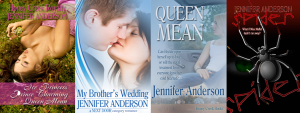
Is this thing on *taps microphone*…*loud feedback* *covers ears*. Good! Hey, I’m Jennifer Anderson, author of the Honey Creek Royalty series, Spider and My Brother’s Wedding. *waves*
Where I Write
 Back when I was a newbie, thinking writing would solve all my problems, I wrote wherever my butt would fit (I don’t actually have a big butt!). Usually, you’d see me plopped between my two children at the kitchen counter while they did their homework.
Then, the best thing ever happened. Ice Princess was picked up by Turquoise Morning Press! Overjoyed and high on writing accomplishment, I was determined to have a place of my very own. So I turned our playroom into a writing room/kid TV room. I cleaned out the toys, added a desk (an old one stored in our basement) and decorated it with all the funny things I could find. I had baskets, cup of pens, my red laptop and an assortment of Angry Birds (my son’s contribution).
Life was good. Great! TMP picked up Prince Charming, Queen Mean and King of the Lake, all from that very special spot.
Then I found out I was pregnant with my third kid (with an eight-year difference with middle kid). And about seven months later, gone was my desk (the curb), my Angry Birds (my son’s room), my baskets (storage) and even my red laptop shot craps. I tried setting up shop in the living room with a TV tray and my baby glider, since I’d be nursing every few hours (she was a pig) but alas, that never felt right either.
Now I’m saddled with a new laptop (plain black) and I’ve returned to the kitchen counter. Instead of my kids flanking my sides, I’m joined by a high chair, baby snacks and a countertop littered with everything imaginable.
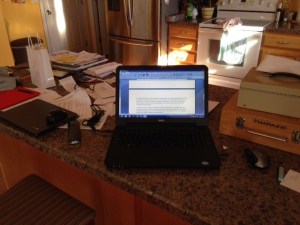
But I don’t let this stop me. I have a submission at Swoon Reads, one waiting to be edited and one in the works.
Where I’m Inspired
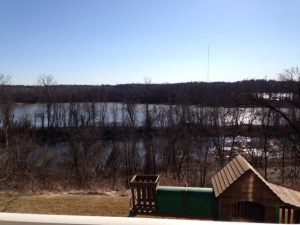
Where do I find my inspiration? Actually, even though I have an amazeballs view, I find the one spot that is sure to conjure up a plot bunny is tightly snug beneath my covers in bed!
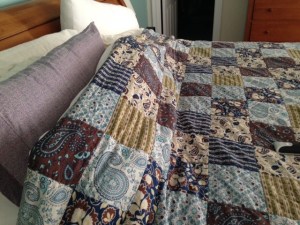
And more often than not, I have to jump from a plot dreaming stupor to find a piece of paper (often an old stray receipt) and jot down my idea.
To Be Read
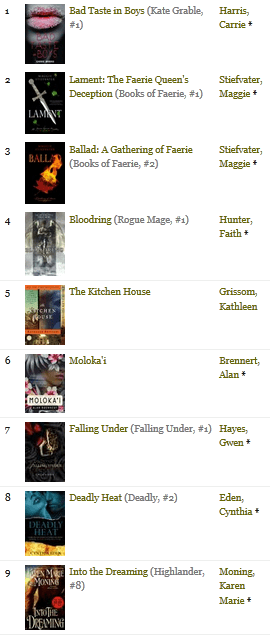 My taste in books run all over the place. But a must is a HEA (Cass: that’s a happily ever after, if you’re not up on your TLAs, or three letter acronyms). I’m in the middle of several series and with 13 books some of them, I’m not in any rush. There are also books that I think I’ve read and forgotten to review! What can I say, mom of three!
You can tell me if I’m successful or not at my countertop writing and check out my latest, My Brother’s Wedding (contemporary romance) or Spider (YA suspense). I’d also love to hear what you think of my Swoon Reads submission, Need To Know. A New Adult fiction that involves a summer hunt, a hot guy on the side of the road and a bestie with an unusual name.
I’m always around to chat on Twitter. Thanks for listening to me ramble and I wish you luck on your writing endeavors!
Author Bio: Mommy, wife, cat owner, review coordinator for Turquoise Morning Press and author. Needless to say, my plate is full. I call the Midwest my home and that’s where I find inspiration. I didn’t grow up wanting to be an author but knew I needed to do something creative. After many years of moving from one job to the next and not finding happiness, I set pen to paper and began work on a young adult novel that will never see the light of day. And that’s okay.
Seeing the world through a writer’s eyes
Posted: February 23, 2014 Filed under: On writing | Tags: inspiration, muses 4 CommentsSomething has happened to me. Something that is both a good thing (from the point of view of my craft) and a little unnerving. Also probably inevitable.
You understand, I’ve always done it. But it’s getting worse.
I’m talking about the part of my brain that views people I meet in terms of their potential to be characters in a book. (Only new people, not ones I’ve known for ages. Friends and family, you are safe. Mostly.)
I write young and new adult, so this phenomenon happens primarily when I’m talking to young people. I suppose I should be grateful it’s not every single human being I encounter.
I first noticed it when I met the girl renting the house next door. I say “girl” but she’d be a NA character — maybe mid-20s. She was tall, fit and blonde, with an elegant Celtic-knot tattoo across both her shoulders and several piercings (that I could see). Polite, tanned and gorgeous. She struck me as someone who’d get on with Melaina, the main character in Lucid Dreaming, like a house on fire.
I don’t go out of my way to eavesdrop on the conversations next door, but let’s just say that if they’re in the yard talking when I’m hanging the washing out, I can’t help but overhear them. And I have a lot of washing.
Does that make me a bad person?
Another example was a week or so ago. I went into a telecommunication shop to buy a dongle (don’t laugh — yes, I know it’s a funny word!). The staff were all in their early 20s. The one who served me had this amazing auburn hair that I assume came straight out of a bottle. The other girl was plump with a very pretty face. The third was a tall guy, broad across the shoulders, with a mop of sandy curls.
They were chatting away, including me in the conversation, and I could feel the “muse” part of my brain taking notes. The auburn-haired girl would be the main character, with the other two her best friends (and the plump girl, like Samwise Gamgee, would be the real hero). The boy would have a secret crush. All I needed was for a brooding vampire to walk in the door and it would’ve been perfect.
Unfortunately all we got was a shaggy fellow asking for directions to a rival telecommunications shop. If he was a brooding vampire, he hid it well.
I do the same thing with songs now too. Which is silly, because most songs have a romantic theme, and I don’t write romance. And when I see a spectacular weather phenomenon or breathtaking view, I start thinking about how to pin it down with words on a page.
For those of you who are writers, do you do the same thing?
This Writer’s Space: a new blog series
Posted: February 19, 2014 Filed under: On writing | Tags: inspiration, this writer's space, writing Leave a comment
Today I’m launching a new weekly blog series, where I ask writers (published or unpublished) to show us photos of three things: where they write, where they are inspired, and their to-be-read pile—with a few words on each, and including an author biography and any links they want to include.
The reason for the idea is simple; I’m a self-confessed stickybeak. And here’s an example—my writer’s space!
Where I Write
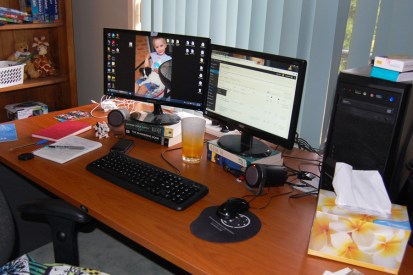
I promised myself that, when I downsized my house last year, the one thing I’d get myself would be a proper study. Our new townhouse is two storeys, which gives me the advantage of being on a different floor to the television! (Yes, I did clean up some old receipts and things before I took the photo.) Having two monitors feels decidedly decadent. Theoretically it’s so I can have a reference page such as wiki up while I’m drafting but, let’s be honest, that right-hand monitor is usually home to Twitter.
The most important things in this photo other than the PC (and photos of my son) are that little red notebook, where I write ideas and sometimes scenes, and the notepad beside it, where I keep track of scheduled blog posts.
Where I’m Inspired

A more honest photo would be of my shower, but ain’t nobody needs to see that! Besides, I love my bathroom. I find the drumming of warm water on my head helps my mind to drift, and tackle any problems at hand. No wonder my water bill is so high… 😉
To Be Read

This photo hasn’t changed much since the last time I took a photo of these shelves. Except now my Kindle is front and centre, because the next few books I plan on reading (Immagica by K.A. Last, The Problem With Crazy by Lauren McKellar and Gifted by Ingrid Alexandra) and my current read (Forget Me Not by Stacey Nash) are all on there. How very 21st century of me!
I haven’t included a bio of me because it feels a little weird given this is my blog… But hopefully you get the idea. It’s not meant to be massively onerous—although if you want to write half a page on each photo, feel free!
If you’re interested in taking part, drop me an email at cassandrapage01[at]gmail[dot]com.
Love at first sight
Posted: February 14, 2014 Filed under: On writing | Tags: romance Leave a commentI hate love at first sight.

Love is a rollercoaster. Also a battlefield. (Thank you, Pat Benatar.)
I don’t mean the emotion. This isn’t one of those bitter Valentine’s Day posts where I insert animated gifs of broken hearts while swilling wine flavoured with my own salty tears.
I’m talking about the use of it in fiction.
It’s a controversial issue, because I know people who say that they experienced love at first sight in their own lives. They vehemently defend it as a thing that can happen to a person. And maybe it can, especially when you’re a teenager and feel emotions in a way that is much more all-consuming than it is for your average adult. I certainly remember developing crushes on people, especially celebrities, with a speed that would leave an Olympic sprinter stunned.
But most of the time, I think what people assume is love at first sight is usually lust at first sight—a fixation on the physicality of a person. Their hair, their eyes, the way their breath smells amazing (hello, Bella, and also ewww). Maybe I’m an old cynic. Maybe that’s why I don’t read pure romance, or most paranormal romance.
However, before you imagine me never enjoying a whirlwind romance, I have seen love at first sight work for me in fiction, and recently—but only when it’s actually a symptom of some other element of the plot.
For example, in Sleeper by S. M. Johnston, Mischa falls madly in love with her university professor the moment she lays eyes on him, an act that causes her to break up with the boyfriend she loved but wasn’t necessarily in love with yet. Her friends tell her that it’s crazy and she even knows it on some level, but she can’t deny how she feels. The revelation of what’s going on there is one of the pivot points of the book.
In Running Home by Julie Hutchings we see a similar instant love between Ellie and the delicious-smelling Nicholas (of whom Bella would no doubt approve), but although she doesn’t really question how she feels, it becomes apparent that he understands the supernatural cause of her strong emotions and is worried about it. She in turn realises he’s holding out on her about something and gets frustrated by that.
To me, love is a connection built between two people, based on mutual understanding and respect. It requires attention. And time.
Your mileage may, of course, vary.
In celebration of Valentine’s Day, check out Tim Minchin’s song “You Grew On Me”. It’s about that creepy uppy kind of love. 😉
Researching your setting
Posted: February 11, 2014 Filed under: On writing | Tags: guest post, research, self-publishing, writing Leave a comment
Today’s guest post is part of the From Australia With Love blog tour, and is by YA urban fantasy and fantasy author, K. A. Last! There’s also a giveaway as part of the tour, which you can enter HERE!
Fall For Me, the first book in the Tate Chronicles, is set in Australia. It’s all fictional, but the places are based on real towns. Writing about them was easy, because I’d been there, and seen what they were like with my own eyes. When it came to writing Sacrifice, I was a little out of my comfort zone. I wanted to tell the story of how Grace and Seth got to where they are in Fall For Me, but to do that I had to go back to England in the 1600s. Yikes! I’ve never been to England, and obviously not in the 1600s.
That is where the research came in.
My knowledge of England was limited to what little I soaked up in school, what I’ve seen on TV, and perhaps what people have told me during social discussions. In short, it didn’t add up to much. So, I devoured everything I could about the English countryside, the people, the castles, events of 1642 and so on. My eyes went blurry from scouring through web article after article, until I was confident I knew enough to sound like I knew what I was talking about. I even learnt a few things along the way.
Nothing can beat visiting a place and seeing it with your own eyes, but just because you haven’t been somewhere doesn’t mean you can’t write about it. Even though I have never been to England, I thought I did a pretty good job of building a convincing setting based on the research I’d done. At the end of the day, I write fiction. My stories are my interpretation of all sorts of factors melded together, and they draw from all different types of resources and research.
A great example of writing about somewhere you’ve never been is Heaven. Things such as religious beliefs, what we’ve seen in movies, or read in books, will influence our own personal depiction of the afterlife. In Sacrifice, my two MCs are angels, so Heaven plays a pretty big role in their lives. My Heaven research consisted mainly of staring at paintings and artworks for a long time. This made me happy, and really excited to write about Heaven. I love art, and I found so many pieces inspirational.
When Sacrifice was close to release, I had someone tell me that my depiction of Heaven was the most ridiculous she’d ever read. I took it with a grain of salt, because who is to say I’m wrong? Then I had three other people tell me it was fresh, and new, and one even said it was “the best description of the great above I’ve ever read”.
Research is an important step in the writing of any book, but we have to remember that some things can’t be researched as thoroughly as others. In the end, when we build the worlds within out stories, we have to go with what we think works best.

SACRIFICE IS FREE AT iBOOKS UNTIL FEBRUARY 19th
Title: Sacrifice – A Fall For Me Prequel (The Tate Chronicles #0.5)
Author: K. A. Last
Genre: Paranormal Romance
Date of Publication: May 24th 2013
Number of pages: Paperback – 114
Word Count: 23,000
Formats available: eBook and paperback
Cover Artist: KILA Designs
Book Trailer: http://youtu.be/jBk-qTPc91c
Purchase Link Amazon eBook: http://amzn.to/11ipsxG
Purchase Link Amazon Paperback: http://amzn.to/13k7QG3
Purchase Link iBooks: https://itunes.apple.com/us/book/sacrifice-fall-for-me-prequel/id694910275?mt=11
Book Blurb:
Seth’s heart is breaking. He knows his decision will hurt the one person he keeps breathing for, but he can’t take it anymore. He can’t be near Grace knowing she will always be just out of reach.
Grace is oblivious to Seth’s turmoil. She loves him unconditionally, but not in the way he wants. They both know that in Heaven physical love is forbidden, and to break the rules is to defy everything they’ve ever been taught.
When Grace and Seth are sent on a mission to save a young mother and her unborn child, Grace must face the fact that Seth won’t be returning home. She doesn’t understand Seth’s decision and hates him for it. But what neither of them realise is how big a part that single decision will play in shaping their entire future.
What would you sacrifice for the one you love?
About the author:
 K. A. Last was born in Subiaco, Western Australia, and moved to Sydney with her parents and older brother when she was eight. Artistic and creative by nature, she studied Graphic Design and graduated with an Advanced Diploma. After marrying her high school sweetheart, she concentrated on her career before settling into family life. Blessed with a vivid imagination, she began writing to let off creative steam, and fell in love with it. K. A. Last is currently studying her Bachelor of Arts at Charles Sturt University, with a major in English, and minors in Children’s Literature, Art History, and Visual Culture. She resides in a peaceful, leafy suburb north of Sydney with her husband, their two children, a rabbit named Twitch, and a guinea pig called Squeak.
You can find her at her website, or on Twitter, Facebook, Goodreads or Amazon.
The (Publishing) Secret
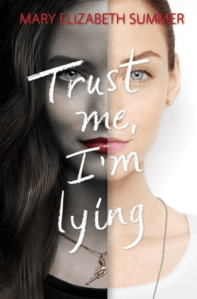
Posted: February 2, 2014 Filed under: On writing | Tags: inspiration, writing 1 CommentThis is a guest post by Mary Elizabeth Summer, YA author.

Meet Mary
As an aspiring writer, I always wanted authors who had battled their way into the temple of traditional publishing and come back out the other side to tell me what the secret formula was, what diamond of creative wisdom they wrenched from the stone jaws of the mummy’s tomb. I wanted a guaranteed, proven path from point A to point Z so that I could unlock the same treasures.
Having now gone in myself and come out knowing that the more I learn, the more I find I don’t know, I can honestly tell you that the secret to unlocking traditional publishing is this:
There is no secret.
It’s not about who you know. It’s not about your age or experience. It’s not about how long you’ve been fighting to get there. It’s not about your platform. It’s not about the market. It’s not about the numbers. It’s not about the words, even. It’s not about any one particular thing. There are as many exceptions as there are rules.
For example, I got my dream agent through a query contest at Cupid’s Literary Connection. I actually hardly queried at all. But my editorial submission process was fairly normal. It took months of anxious nail chewing and several rejections before I got my book deal. On the other hand, one of my friends took many agonizing months getting an agent to turn around and sell her book in less than a month on submission. Another one of my friends got a book deal through an e-book first imprint without any agent help at all. Every story is different.
But even as I write this, I realize I’m lying to you. There is one thing all of us have in common:
 We don’t give up.
Even when we get there and discover that the treasure is going to take an enormous amount of work to haul out. We still get discouraged, we still rejected, we still worry that we’re not good enough, not committed enough, not savvy enough to navigate the capricious market. We get scathing reviews, we get passed up for awards, we get bad news, and we still have to paste on a smile when our well-meaning friends ask us how it’s going.
But we don’t give up. So maybe that’s the secret. Sheer stubborn will power to make the dream come true. Hold onto that, and no matter what your path, you’ll get there.
Author Bio:
Mary Elizabeth Summer contributes to the delinquency of minors by writing books about unruly teenagers with criminal leanings. She has a BA in creative writing from Wells College, and her philosophy on life is “you can never go wrong with sriracha sauce”. She lives in Portland Oregon with her partner, their daughter, and their evil overlor—er, cat. TRUST ME, I’M LYING is her debut novel. Website | Twitter | Facebook | Tumblr
What not to say to your editor
Posted: January 31, 2014 Filed under: On writing | Tags: editing, writing 16 CommentsBefore I start ranting here — because this is a ranty post — yesterday I appeared as a guest at Stacey Nash’s blog as part of the From Australia With Love tour. There’s a (rather tongue-in-cheek) interview with Isla from Isla’s Inheritance and an excerpt too. You know, if you’re curious.
Yesterday when I got in to work a colleague greeted me very loudly. My boss immediately appeared from her office and started making small talk. Then she asked me if I could pop into her office before I read my emails.
Uh oh.
For those of you that aren’t aware, in my day job I edit technical documents. They are often long and very boring, written by subject matter experts whose areas of expertise seldom include more than passing English language skills. Mostly I love it, but sometimes writers are, quite frankly, a pain in the ass. And I say this as a writer who loves writers.
Well, most of them.
My supervisor wanted to warn me out about a passive aggressive email that came in yesterday while I was on leave, before I saw it and started screeching profanities. To paraphrase, the author of a document I edited last week had observed that he’d “gone through the laborious process of going through the enormous number of suggested edits” before going on to tell me he hadn’t done a bunch of them.
This same writer has previously told me that anyone “with an adult level of reading” would understand what he meant by a certain phrase, after I explained that I’d misread it.
Never mind the fact that some of my edits were basic things like turning fragments into full sentences and pointing out missing information, or that some of the missing information would have been damaging to the organisation I work for if it hadn’t been added.
Needless to say, he didn’t say thank you either.

Excuse me while I put my ranty pants on. (And note that when I say “you” below I don’t mean you you … unless you’d also send the above sort of email. In which case I totally mean you.)
At the risk of stating the obvious, taking this tone with your editor is not helpful. It comes across as prima donna-ish, like you think you’re above the editing process. If you do think this, here’s a newsflash: no one is above the editing process. I’m a professional editor who draws a pretty good salary for what I do. I have what I like to think are very high levels of English grammar skills (although now I’ve said that I’m just waiting for someone to spot a typo in this post!), and I am not above the editing process.
This is why I bend over backwards to do what my editor asks me. Because I figure if she’s asking me a question then I haven’t made myself clear enough, and if she misreads something so will readers. The same goes for the questions my beta readers ask.
Not to mention the fact that everyone makes typos, and it’s almost impossible to proofread your own work.
If you get rage-inducing feedback from an editor, agent, crit partner or your mother, WALK AWAY FROM THE KEYBOARD. Take a breath. Think about it. Don’t drive angry, and above all when you reply thank them for their time even if you want to strangle them. (If you have an agent and the editor’s suggestions are unacceptable, let them go back and be the bad guy.)
To do anything else is unprofessional. And, as agent Laura Zats blogged last week, “There’s always another author. There’s always another book.”
Memory in Fiction
Posted: January 30, 2014 Filed under: On writing | Tags: aussie-owned, contests, guest post, small presses, writing, young adult 5 Comments
Today’s guest post is part of the From Australia With Love blog tour, and is by the FANTABULOUS YA sci-fi author, Stacey Nash! There’s also a giveaway as part of the tour, which you can enter HERE!
Memory is an important part of life. It shapes who were are, where we came from, and even where we are headed in life. Losing one’s memory is probably one of the most horrifying things that can happen to a person as it strips them of all sense of identity. Actually it’s probably more horrifying for their loved ones than the actual person in question.
My upcoming YA release FORGET ME NOT centers around memory loss. The theme of memory is one that runs through the whole four-book series; it’s even featured in all of the titles. For me as a writer, memory was a tricky thing to deal with, but I made use of a few writing techniques.
Flashbacks
A flashback is a memory. You know when you’re sitting in class / at work chewing on you pen and staring not at what’s in front of you but at the image in your mind of that cute guy you had a date with last night, while you play over all the details. That’s a flashback.
Flashbacks are a useful tool for writers, whether there are memory loss issues in the story or not. It’s something that can be used to show an event that happened in the past. (Read: backstory.) I think it’s important to be careful though, because flashbacks can turn into info dumps if not written well and, hence, slow the story down. My general rule is keep it short. A 200 word excerpt is enough; otherwise the reader will get bored and the flashback loses its impact. Some flashbacks are written like the character is watching them happen, and other are written as if the character is remembering them.
Here’s an example of a flashback.
The sight of it brings back so many memories. The only time I ever saw my parents fight… Mom shouted so loud I covered my ears, and Dad responded in a low emotionless voice. Young and scared, I hid in the curtains while she screamed. Her last words were punctuated by her yanking the pendant off and tossing it across the room. Dad scooped it up, crossed the room in long strides and pulled her to him. His fingers traced the edge of her face before he kissed her. He lowered the pendant over her head, and the angry lines on her face melted into a smile. It’s not exactly a good memory, but it was her.
(©2014, Stacey Nash, Forget Me Not)
Dreams
I think we all know what dreams are, so I’m just going to jump right in. I used dream sequences on several occasions throughout the books, with the character either having a flashback through a dream or having a dream that had an obvious meaning of something that did happen in the past. They’re a little trickier to use than flashbacks, but boy they read well when they’re done right. I think the big thing to remember is the dream needs to fit the character and the story. If you plop a dream in that is too abstract you’ll wind up confusing readers. It needs to be simple, short, and reflect what’s already happened in the story. Basically, the dream needs to feel like a dream.
Here’s an example of a dream combined with a flashback, so that the dream was like a memory but it wasn’t quite right. That’s because there’s some foreshadowing there too. 😉
A soft rap sounds on my door, but I ignore it. I need to finish Mom’s letter. My gaze burns into the last sheet of paper, but for the life of me I can’t remember what’s happened this past year to tell her.
The rap sounds again, only this time it’s louder, more insistent.
“Not now, Dad.”
He doesn’t stop, just knocks and knocks and knocks.
Dear Mom
My concentration pounds, then shatters. Argh. I can’t do this.
I can’t even think.
My pen, poised over the paper, refuses to move. I push against it, trying to guide the nib into an M, but it’s like the nib is glued to the page.
Knock. Knock. Knock.
Heart pounding, ears ringing, the dampness of sweat cakes my whole body.
Knock.
My eyes spring open. It’s dark.
Knock, knock.
My heart beats in time with the knocks, a rapid, thudding beat.
Knock, knock, knock.
(©2014, Stacey Nash, Forget Me Not)
Other ways of dealing with memory
There are lots of other ways to deal with memory in fiction. Déjàvu is probably the method I used the most. It’s also the most subtle. Then there’s inner dialogue; almost like flashbacks but shorter, just a sentence here, a thought there. Reminiscing through dialogue is another method; multiple characters having a conversation about the past.
No matter which writing technique is used for dealing with memory, I think the trick is not to overuse any one. For me, that was really tricky when there were multiple characters…ah, no. I won’t spoil it – read the book and you’ll see. 😉
About Forget Me Not
 Since her mother vanished nine years ago, Anamae and her father have shared a quiet life. But when Anamae discovers a brooch identical to her mother’s favorite pendant, she unknowingly invites a slew of trouble into their world. When the brooch and the pendant are worn together they’re no longer pretty pieces of jewelry — they’re part of a highly developed technology capable of cloaking the human form. Triggering the jewelry’s power attracts the attention of a secret society determined to confiscate the device — and silence everyone who is aware of its existence. Anamae knows too much, and now she’s Enemy Number One.
She’s forced to leave her father behind when she’s taken in by a group determined to keep her safe. Here Anamae searches for answers about this hidden world. With her father kidnapped and her own life on the line, Anamae must decide if saving her dad is worth risking her new friends’ lives. No matter what she does, somebody is going to get hurt.
Releasing February 17th from Entranced Publishing. Add it to your Goodreads TBR now!
 About Stacey
Stacey Nash writes adventure filled stories for Young Adults in the Science Fiction and Fantasy genres. When her head isn’t stuck in a fictional world, she calls the Hunter Valley of New South Wales home. It is an area nestled between mountains and vineyards, full of history and culture that all comes together to create an abundance of writing inspiration. Stacey loves nothing more than spending her days writing when inspiration strikes.
Her debut novel, Forget Me Not releases 17 February 2014 from Entranced Publishing and its sequel Remember Me releases in August 2014.
Website || Twitter || Facebook Page || Pinterest
If you want to do something right…
Posted: January 26, 2014 Filed under: On the Isla's Inheritance trilogy, On the Lucid Dreaming duology, On writing | Tags: aussie-owned, Australia, blog hop, contests 6 Comments
(Okay, that may not be the most inspirational title for an Australia Day blog post, but I think it sums up what I am about to say pretty well.)
I love urban fantasy. Love it! I’ve felt that way since I didn’t know what the genre was called—back when Interview With the Vampire was filed in the sci-fi and fantasy section of the bookstore and the paranormal shelves didn’t exist. (Say what you will about it, we have Twilight to thank for their creation.) I thoroughly enjoyed Anita Blake’s early adventures, and loved Sookie Stackhouse when she came along too.
When I started thinking about the sort of novel I might write, I toyed with fantasy, but urban fantasy drew me back like a lodestone.
Then I’d think about where to set the book, and come unstuck. Because all the urban fantasy novels I read were set in America or, less usually, England. Wouldn’t Americans (who, lets be honest, are the biggest market of English-speaking readers in the world) prefer to read books set in their own country? The streets of New Orleans, Chicago, New York—those were the places haunted and hunted by the supernatural. Not sunny Australia.
I could’ve tried to write a book set in the States—I did think about it—but I felt like a fraud. I knew my Australian slang would reveal the lie. I’ve never even been to America. How could I pull that off?
So I didn’t write the book. Because “write what you know”, right?
Over the past few years, urban fantasies—and their kissing cousin, the paranormal romance—have started to appear, set in Australia. Maybe they’ve been around for longer and I only just began to notice them through the blanket coverage of foreign authors in Australian chain bookstores.
Okay, I thought, I can do this. Only… those books were all set in Sydney or Melbourne. Could Canberra, with its population of 360,000, be a viable setting for an urban fantasy? It may be the nation’s capital, but almost no one outside Australia has heard of it. Two out of three tourists think Sydney is the capital. (I just made that stat up, but I’d bet it’s true!)
And then it hit me like a boomerang in the face: if someone needs to do it to test the water, to see whether it’s a viable location for an urban fantasy, why shouldn’t that be me? I’ve lived here all my life so it definitely ticks the “write what you know” box. I love this city, with its wide open spaces, bush corridors, national monuments and occasionally dubious public art*.
Of course my books are set here.
*If you want to see what I’m talking about, do a Google image search for “Belconnen owl” and tell me what you think it looks like from behind. Then search for “Skywhale”, because LOL.
This post is part of Aussie Owned and Read’s Australia Day/Blogaversary blog hop. You can find other participating blogs or register your own here. And there is a GIANT GIVEAWAY too, which you can enter here.


 Cassandra Page