Review: ‘Kiya: Mother of a King’ by Katie Hamstead
Posted: June 26, 2014 Filed under: Reviews | Tags: aussie-owned, AWW, reviews 1 Comment
Nefertiti has forced Naomi to flee Amarna with Malachi and the three children. But even under the protection of Naomi’s family in Thebes, Nefertiti still hunts her and Tut. Nefertiti sends assassins to kill them, and while Naomi fights to protect the children, Malachi fights to keep her safe.
With three children in tow, one of which isn’t her own, she is labeled the harlot outcast wife of the pharaoh and is shunned. She isn’t safe among her own people, and flees from being stoned to death. Although her family protects her, she must find a way to survive.
While Naomi struggles to keep herself and Tut alive, old adversaries return as Smenkhkare takes advantage of Akhenaten’s ailing health. Naomi must rely on Horemheb’s promise to protect Tut’s birthright, but her feelings for Malachi could cause more problems with Horemheb than she expects.
By Aussie Author Katie Hamstead, this is the second book in the Kiya series, which follows the life of Naomi—known to the Egyptians as Kiya—after she flees the palace with her children following Queen Nefertiti’s latest assassination attempt.
I’ve quite enjoyed this series so far, although I found this book a little slower in places than the first one—Kiya: Hope of the Pharaoh. I suspect that’s an inevitable result of the relative lack of palace intrigue. Book two spends a lot more time focusing on Naomi’s new life (or return to her old one) as a Hebrew woman. Some of that, such as detailing various pregnancies and births, isn’t as gripping, but it’s also nice to see Naomi get some time living a life that makes her happy.
Then the fabulously sexy Horemheb comes back into her life, Tut gets dragged off to be a boy king, and Naomi’s life gets complicated again. Hooray!
Normally—almost 100% of the time—when I’m reading I find I’m attracted to the good guy in any love triangle. In this series, the good guy is Malachi, and Horemheb is the bad boy. But for some reason, in this I thought Horemheb was way more interesting than Malachi. The latter is strong and caring, but Horemheb is both of those things (to Kiya at least; to others he is cruel) and also very intelligent. I like a hot, smart man.
Or maybe I just go for the underdog. Usually the bad boy gets the girl, after all. 😉
I confess that one thing I really struggled with in Kiya: Mother of a King was a side-effect of the fact it’s historical fiction. Because 3000 years ago, women didn’t have rights. All the Hebrew men buying wives they’ve in some cases never even seen from those girls’ fathers made me cranky. (Of course, the Egyptian alternative of just taking them and raping them was worse.) In each instance in this book, the Hebrew men in question were all good husbands to their wives, but ugh!
At one point Naomi takes Malachi to task when he refers to her as his property, but for the most part even she—the strong-headed one, who used to be queen—is perfectly happy to see herself and other women bought and sold. I realise she simply doesn’t know any better, and maybe I’d be more used to the casual sexism if I read more historical fiction, but I wanted to shake some of the blokes till their teeth rattled.
Still, this is an interesting continuation of Naomi’s story. And if she doesn’t want Horemheb, can I have him?

Review: ‘The Cormorant’ by Chuck Wendig
Posted: June 12, 2014 Filed under: Reviews | Tags: Chuck Wendig, reviews, urban fantasy Leave a comment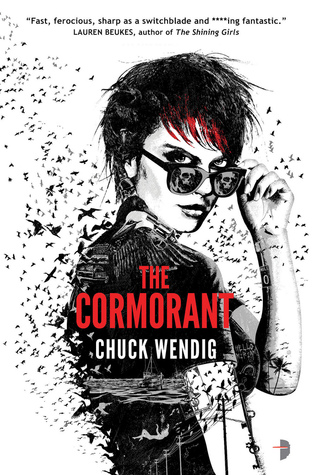
Miriam is on the road again, having transitioned from “thief” to “killer”.
Hired by a wealthy businessman, she heads down to Florida to practice the one thing she’s good at, but in her vision she sees him die by another’s hand and on the wall written in blood is a message just for Miriam.
She’s expected…
The Cormorant is the third book in the Miriam Black series, and if you’ve read the first two you’ve got a pretty good idea of what you’re getting into. If you haven’t, and you like sweary, gory, action-driven urban fantasy, it’s worth going back and starting with Blackbirds, if only because it gives you some context for the events in this book. (For example, although Miriam thinks about Louis a lot in The Cormorant, he doesn’t actually make an appearance—at least, not directly.)
This series is unusual in so many ways. For a start, it’s written in the third person present tense. As a style, it really seems to work for action-based books like The Hunger Games. And this. But I did have to switch mental gears, at least at first, to get into it.
The storytelling is gory enough to make any splatter film director proud. At the start of the series Miriam is already violent—she’s homeless and cursed, so who wouldn’t be? By The Cormorant, as the blurb indicates, she’s turned into a sometime murderer as well. Miriam is not a nice girl. She drinks, chain-smokes and has some of the worst language I’ve ever seen in a work of fiction. (There’s also sex. But that bothers me less than people spitting bloody wads of spit at each other. Because ew!)
In Miriam’s defence, though, she’s been screwed by the nastiest urban fantasy superpower yet: if she touches someone, skin-to-skin, she knows when they’re going to die. We’re not just talking about a polite letter from Fate, either; Miriam sees their death in full surround sound HD, with in-built stink and pain. Miriam doesn’t see death. She experiences it. Over and over again.
I’d swear too. Like a sailor.
She definitely qualifies for a kickass leading lady, though. She knows how to fight, and she’s not afraid to fight back—like a feral cat with a pocket knife and, sometimes, a gun. Or her teeth, or forehead, or elbow. I think she’d fight with her pinkie given half the chance and presented with a deserving target.
Over the course of the series, Miriam learns how to mess with fate to save lives, and the plot of The Cormorant is, in a nutshell, Fate getting angry and hitting back. I won’t go into any more detail than that, because spoilers. However, writing a book that involves visions of the future, some of which are largely immutable, presents certain challenges for an author: challenges that Wendig handles with skill. It’s a joy to read.
Also, the end of the book provides an interesting ray of hope for Miriam. I can’t wait to see what happens next!

Review: ‘Wicked After Midnight’ by Delilah S. Dawson
Posted: June 2, 2014 Filed under: Reviews | Tags: delilah s. dawson, reviews, romance, steampunk 1 Comment
A contortionist and a rakish brigand navigate the cabarets of Paris to rescue a girl taken by slavers in the third steampunk-tinged romance of the Blud series.
Life as a contortionist in Criminy’s Clockwork Caravan should be the height of exotic adventure, but for Demi Ward, it’s total dullsville. Until her best friend, Cherie, is stolen by slavers outside of Paris, and Demi is determined to find her.
On the run from his own past, Vale Hildebrand, a dashing rogue of a highwayman, hides Demi from the slavers…but why? He pledges to help her explore the glittering cabarets of Paris to find her friend, but much to Vale’s frustration, Demi soon attracts a host of wealthy admirers. The pleasures of music, blood, and absinthe could turn anyone’s head, and it would be all too easy to accept Cherie’s disappearance as inevitable—but with Vale’s ferocious will and Demi’s drive to find her friend, they soon have a lead on a depraved society of Parisian notables with a taste for beautiful lost girls. Can Demi wind her way through the seedy underbelly of Paris and save her best friend before she, too, is lost?
Wicked After Midnight is the third and final book in the Blud series, a set of three steampunk fantasy romance novels set in the same world but with each following a different pair of main characters. You could pick up any of the three and read it without having read the other two, and you’d be fine.
I love this series. Love love love. The world, a sort of medieval parallel to modern day Earth, is rich and dark and has clockworks and magic in equal measure. Plus Dawson’s love interests in each book are smoking hot, strong, dangerous to their enemies and respectful of their leading ladies (which is one of the reasons they are smoking hot, in my book!). Wicked After Midnight brought us more of the same in that sense, while telling a different story.
The bulk of this book is set in the Blud equivalent of Paris, populated mostly by daimons — magical creatures that feeds on emotions — and the humans they need to survive. The main character, Demi, is a bludman (basically a vampire but with a bunch of unique aspects that separate them from your typical Dracula or Edward), and — due to her awesome contortionist abilities — quickly becomes a star in the cabaret. I love the movie Moulin Rouge and there were a lot of elements of that in here. I pretty much had the soundtrack stuck in my head the whole time I was reading.
The only fly in the ointment for me is that Demi is a bit of a diva. At the start of the book she basically harrasses her best friend, Cherie, into running away from the caravan to join the cabaret (despite all the warnings she gets about how this isn’t the glamorous life she thinks it is). When Cherie goes missing, Demi decides the best way to find her is to follow through on her original plan and become a star. She then gets so swept up in her new life that at times she completely forgets about her friend. If it wasn’t for Vale, quietly reminding her every so often that he’s still pursuing her friend, Cherie would probably never be found.
Now, in Demi’s defence, a lot of cabaret girls have gone missing, presumably taken by the same people that took Cherie, and her plan to make herself bait and investigate the clientele for hints of her friend isn’t a bad one in and of itself. And she does regret the self-absorption, when she realises what she’s done. But I would’ve liked to see more active searching as well, maybe a couple of scenes early on that involved her actually going out into the city looking for clues, just so I didn’t feel like her decision to join the cabaret was her deluding herself into thinking she was “helping”.
The overall theme of this book is quite pertinent despite its fantasy setting: mysogyny, rape culture and women’s fight against it. And any qualms I had about Demi were blown right out of the water by her defiant reaction to that culture and the things that are expected of her as a dancer and a courtesan. There’s no doubt that if anyone actually tried to force themselves on her, she’d gut them. For example, I love this quote:
My only choices were play nice, get raped or die?
Yeah, no.
The Blud series is a great read, and definitely worth your time if you like stories about carnivals and dancers; hot vampires; steampunk technology (and let’s take a moment to acknowledge the awesomeness that is Coco in this book — she’s only in two scenes and she steals them both); respectful men who are apparently fantastic in bed (*fans self*!); and strong women who know what they want and aren’t afraid to take it.

Review: ‘The Fault in Our Stars’ by John Green
Posted: May 24, 2014 Filed under: Reviews | Tags: reviews, young adult 10 Comments
Despite the tumor-shrinking medical miracle that has bought her a few years, Hazel has never been anything but terminal, her final chapter inscribed upon diagnosis. But when a gorgeous plot twist named Augustus Waters suddenly appears at Cancer Kid Support Group, Hazel’s story is about to be completely rewritten.
Insightful, bold, irreverent, and raw, The Fault in Our Stars is award-winning author John Green’s most ambitious and heartbreaking work yet, brilliantly exploring the funny, thrilling, and tragic business of being alive and in love.
A little while back, one of my Aussie Owned co-bloggers, Emily, reacted with total horror when I told her I hadn’t read The Fault in Our Stars. I told her it was because a) I don’t usually read contemporary, and b) I don’t want to read a book that’s going to break my heart and make me all depressed and mopey.
She promised me this book is just as funny and poignant as it is sad, and bossed me into buying a copy. She has powers like that, you guys. In the meantime, I read The Problem With Crazy by Lauren McKellar, which is both very sad (but also poignant) and also contemporary.
 And since I’d already broken my rule and survived Crazy, although it BROKE MY HEART INTO A THOUSAND MILLION PIECES, I figured I would be able to handle Stars.
I was right. Sort of.
Emily was right too. Some of the moments in Stars are hysterically funny. I love the banter between Hazel, Augustus and Isaac. It’s often classic gallows humour, and although some people may find it shocking, if anyone is entitled to it, it’s those three teens, all with cancer that has cost them big time. When it’s not gallows humour, it’s still clever and wry. The scene where the two boys egg the car was sheer, hilarious genius.
The romance between Hazel and Augustus is very full on very early, and although I usually hate love at first sight, this had just enough kinks in it that it felt real, more like the sort of mad crush a teenager is likely to get. At one point Hazel even acknowledges that if they’d had more time maybe they would’ve grown out of that mad love stage.
I didn’t go totally fangirl over the book though. For example, I didn’t love everything about the characters. Augustus’s thing with the cigarette was totally pretentious, but it was clear how much it meant to him, especially by the end. So I can forgive him that. And the sad bits… well, they made me cry, no doubt about that. But Crazy was sadder. I howled like a baby, reading that. (And loved every minute. I think I want to have Lauren’s babies.)
But here’s what made The Fault in Our Stars special to me. I saw some negative reviews of it that criticised Hazel and Augustus for not talking like normal teengers, as though cancer made them somehow special, “more than”. But I think it goes deeper than that. These two kids would be special even if they were 100% healthy; I mean, Hazel is 16 and already doing university courses. Augustus is also extremely bright, although there’s no doubt his illness made him really look at the world. The fact they both read and analysed a literary novel that (from the description) I’d throw against the wall in the first five minutes is a flashing neon sign that these aren’t normal teenagers. They are precocious.
And that’s a good thing. I’m not saying we shouldn’t read about normal teenagers, but, as anyone who’s argued for diversity in fiction would attest, there are already so many books about the normal out there. The white character, the straight character, the gender normal, average, preppy, pretty, whatever character. The character that holds a mirror to a huge proportion of the reading public.
Hazel and Augustus are super-bright nerds. He and Isaac are gamers. It’s not that John Green failed to write teenagers, it’s that he wrote different teenagers, struggling with awful problems and (for the most part — because they are also realistically portrayed) managing to handle them better than some adults would. They aren’t mirrors that reflect me, because I think literary fiction sucks. But they reflect someone, and that someone no doubt appreciates it.
And that is why I’m giving this book five stars.
Review: ‘Unclean Spirits’ by Chuck Wendig
Posted: May 19, 2014 Filed under: Reviews | Tags: reviews, urban fantasy Leave a comment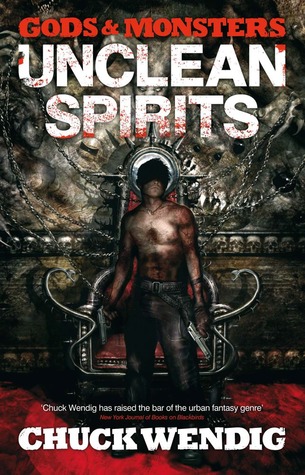
Five years ago, it all went wrong for Cason Cole. He lost his wife and son, lost everything, and was bound into service to a man who chews up human lives and spits them out, a predator who holds nothing dear and respects no law. Now, as the man he both loves and hates lies dying at his feet, the sounds of the explosion still ringing in his ears, Cason is finally free.
The gods and goddesses are real. A polytheistic pantheon—a tangle of divine hierarchies—once kept the world at an arm’s length, warring with one another for mankind’s belief and devotion. It was a grim and bloody balance, but a balance just the same. When one god triumphed, driving all other gods out of Heaven, it was back to the bad old days: cults and sycophants, and the terrible retribution the gods visit on those who spite them.
None of which is going to stop Cason from getting back what’s his…
Anyone who’s read my blog before will know that I’m a fan of Chuck Wendig’s blog, where he dispenses writing advice spiced with profanity and humour. As Chuck’s publishers no doubt hoped I would, I’ve since gone on to read several of his books. Much like his blog, his books — including this one — are peppered with profanity and humour. (I had a genuine laugh at loud moment at one of the lines from Coyote’s perspective in Unclean Spirits.) There’s also violence. Gritty, gory violence, albeit beautifully described. So if that’s not your thing, like the other Wendig books I’ve read, this isn’t the book for you.
However, if it is, and if you like a fast-paced read with a main character you can cheer for as he bulldozes and bashes his way through the obstacles between himself and the path back to his wife and son, you’ll enjoy Unclean Spirits. The premise is somewhat similar to Gaiman’s American Gods (although, as we’ve previously established, I haven’t read it): gods and mythical monsters wander the Earth, exiled from their various heavens and hells 50 years ago. Powers diminished, they are still powerful, manipulative and dangerous.
And, for reasons that become clear as the story progresses, they seem to be distressingly interested in Cason Cole.
The plot is fast-paced, the characters interesting even when they aren’t always sympathetic. The perspective isn’t just limited to Cason’s; we also see bits of the story through the eyes of his wife, Alison, and various gods — from the aforementioned Coyote to Aphrodite, Psyche and other big names I won’t mention here, because spoilers.
The ending was a little abrupt; given Cason’s entire goal was to be reuinited with his wife and son, it might have been nice to see that on the page rather than implied. Maybe there’s going to be a sequel to mess it all up for the poor family, though.
Review: ‘Coraline’ by Neil Gaiman
Posted: May 4, 2014 Filed under: Reviews | Tags: middle grade, reviews 5 Comments
The day after they moved in, Coraline went exploring….
In Coraline’s family’s new flat are twenty-one windows and fourteen doors. Thirteen of the doors open and close.
The fourteenth is locked, and on the other side is only a brick wall, until the day Coraline unlocks the door to find a passage to another flat in another house just like her own.
Only it’s different.
At first, things seem marvelous in the other flat. The food is better. The toy box is filled with wind-up angels that flutter around the bedroom, books whose pictures writhe and crawl and shimmer, little dinosaur skulls that chatter their teeth. But there’s another mother, and another father, and they want Coraline to stay with them and be their little girl. They want to change her and never let her go.
Other children are trapped there as well, lost souls behind the mirrors. Coraline is their only hope of rescue. She will have to fight with all her wits and all the tools she can find if she is to save the lost children, her ordinary life, and herself.
Neil Gaiman is a strange author to me in some ways. I love his scripts, and his Sandman graphic novels, and those of his other books that I’ve read. But I haven’t read that many of them. I don’t exactly know why. So when I saw Coraline at my local second-hand bookstore, I snapped it up. (The cover above is the cover of the version I own. There are prettier covers, but it does capture the weirdness pretty well.)
And no, I haven’t seen the movie either. Although now I kind of want to.
I don’t read a lot of middle grade fiction yet. (My son and I are onto chapter books. If I put all the Geronimo Stilton books I’ve read into my Goodreads account I’d be 50% done on my 2014 challenge already.) But this has got to be one of the best, surely.
I love Neil Gaiman’s wry humour. It’s—dare I say it—terribly British. I love how calm and clever Coraline is, and how even when she’s scared she manages to be brave. As she said, “When you’re scared but you still do it anyway, that’s brave.” Wise little girl.
Apparently Gaiman wrote this book for his five-year-old daughter. So either his daughter is also very brave or he’s trying to give her lots of opportunities to learn, because this is a scary-ass book. At the point where Coraline’s other mother offered to sew button eyes onto her as a mark of her acceptance into their creepy family, my own eyes bugged out a little.
There weren’t any plot twists I didn’t see coming. But this is middle grade fiction, which means the twists tend to be a little more clearly telegraphed than they would be in a book for adults. Nothing wrong with that.
There was one thing lacking from the book. Gaiman didn’t often touch on how Coraline was feeling. When she first discovered her parents were missing, it took her a full 24 hours to cry about it. This is partly because her parents are a little remote and she’s used to fending for herself, but I think it was partly a stylistic choice Gaiman made—not to wallow, or let Coraline wallow, in her emotions. Maybe he did it because the content of the story is nightmare-inducing, and if he’d described the taste of fear in the back of her throat, the shaking of her hands, it suddenly wouldn’t have been middle grade anymore?
Or maybe that’s just his style. Like I said, I haven’t read that many of his books, and those I have read were ages ago.
Either way, although I noticed the lack of emotion, the extra distance that imposed wasn’t enough that I couldn’t follow or enjoy the story.
This is a 4.5 star read for me.

Review: ‘Haze’ (The Rephaim #2) by Paula Weston
Posted: April 27, 2014 Filed under: Reviews | Tags: AWW, reviews, urban fantasy 7 Comments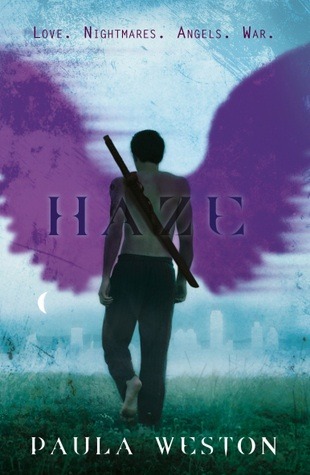
Gaby Winters’ nightmares have stopped but she still can’t remember her old life. Still can’t quite believe she is one of the Rephaim—the wingless half-angels who can shift from place to place, country to country, in the blink of an eye. That she was once the Rephaim’s best fighter. That demons exist. That Rafa has stayed.
But most of all, she can’t quite believe that her twin brother, Jude, might be alive.
And Gaby can’t explain the hesitancy that sidetracks the search for him, infuriates Rafa, and sends them, again, into the darkest danger
I’m struggling with how to review this book, given it’s the second in the series and a lot of people reading this probably won’t have read the first (which is Shadows). I could just write IT’S AWESOME GO BUY IT RIGHT NOW in all caps and then put in some animated gifs of people squeeing all over the place, but that’s not particularly coherent.
At the start of Shadows, Gaby is miserable. She lost her twin brother, Jude, in a car accident a year before. Her sleep is tormented by nightmares of his death and of a strange vision of demons rampaging through a nightclub—and when she has good dreams of their time backpacking together they tear her up just as much, because he’s no longer with her.
Then Rafa shows up, defiant, sexy and disbelieving Gaby’s claim that she doesn’t remember who he is.
Rafa tells Gaby she and Jude are the half-angel offspring of Fallen angels who broke out of hell. A year ago, the pair disappeared together. Gaby woke up in hospital believing she was human. Now, both Rephaim and demons are very interested in finding out what she and Jude did, and will go to all kinds of lengths to get hold of her.
I love Gaby as a main character. She’s sassy and confident. Although Jude’s loss—because regardless of who they really are, he’s still gone—has left her broken, she lifts her chin and soldiers on as best she can.
The chemistry between her and Rafa is volatile. He can be an asshole, but it’s a blustery front to hide his own pain: pain over events from Gaby’s past that she no longer remembers. And when he lets his guard down, showing his compassion and tenderness…woo. *fans self* Haze has the exact right blend of romance and plot that I love in a good urban fantasy. The romance is present, and the slow burn is sexy as anything, but it’s not the main focus of the story.
The two books are set over about a two-week period. That’s how fast the pace is. There were times reading Haze that Weston would throw in a reference to something that happened “this morning”, for example, and I’d be like, WHAT THOSE CHAPTERS WERE ALL ONE DAY? So much was packed into them it seemed impossible—but it really gives you a sense for how exhausted the characters must be, the urgency of the storyline. When they had a chance to pause for food or a sleep I was relieved on their behalf!
I gather there’s at least one more book in the series, maybe two. Like Shadows, Haze has an ending that has equal parts closure and setup for the next book. I MUST HAVE IT NOW!
Paula Weston is an Aussie writer, so that’s another plus—although I gather a deal has been signed for them to come out in the UK and US so you guys don’t have to miss out on this particular slice of awesome. Yay you!
This is a five star read.
Review: ‘Cinder’ by Marissa Meyer
Posted: April 20, 2014 Filed under: Reviews | Tags: reviews, sci-fi, young adult 3 Comments
Humans and androids crowd the raucous streets of New Beijing. A deadly plague ravages the population. From space, a ruthless lunar people watch, waiting to make their move. No one knows that Earth’s fate hinges on one girl.
Cinder, a gifted mechanic, is a cyborg. She’s a second-class citizen with a mysterious past, reviled by her stepmother and blamed for her stepsister’s illness. But when her life becomes intertwined with the handsome Prince Kai’s, she suddenly finds herself at the center of an intergalactic struggle, and a forbidden attraction. Caught between duty and freedom, loyalty and betrayal, she must uncover secrets about her past in order to protect her world’s future
I know I’m coming a little late to the whole Cinder thing and many of you will have already read it, but IF YOU HAVEN’T THIS IS REALLY GOOD YA.
Take Cinderella, stick her in a future Earth and make her a second-class cyborg. Stir in some political intrigue, a terrible plague and a handsome prince, and I’m so there!
One of the things I really enjoyed about Cinder is the richness of the characters. The wicked stepmother is suitably loathsome (but also kind of tragic). The stepsisters are interesting; Pearl is as shallow and cruel as you’d expect — the fairytale required that someone do it, I suppose — but the younger girl, Peony, is lovely and cares for Cinder despite what the rest of the family think of her.
Likewise, Kai isn’t just a two dimensional Prince Charming looking to marry a hot girl with glass shoes. He’s charming, sure, but also funny, kind and terribly conflicted about some of the diplomatic and personal sacrifices he’s asked to make to save his people. I’m not usally one to crush on the typical main character (I was Team Simon, not Team Jace, for example) — but in this case, it’s all about Kai.
Of course, there aren’t really any other alternatives, unless you count the doctor researching the plague cure, and he’s more of a crazy grandfather type. 😉
Cinder‘s plot moves along at a good pace, the story (and Cinder herself) taking the reader from one event to the next without leaving you time to get bored. There is a plot twist but I saw it coming from the first hint in the first two or three chapters — I don’t really think Meyer intended it to be an OMGWTF moment at the end of the book, though, and I never grew frustrated with the characters not figuring it out like I do in some books.
The only thing that was a little unsatisfying is that the ending is a bit of a cliffhanger. My advice would be to buy the second book and have it to hand so you don’t have to wait to dive into it when you finish this one.
Five stars! 🙂
Review: ‘Immagica’ by K. A. Last
Posted: April 10, 2014 Filed under: Reviews | Tags: AWW, reviews, self-publishing, young adult 6 Comments
Immagica surprised me. I read a lot of young adult speculative fiction, but it tends more toward the upper YA to new adult end of the spectrum. With this book’s main character, Rosaline, being fifteen, I thought maybe I’d be a little old for the story.
I should have remembered I loved Harry Potter back when he was a scruffy twelve-year-old. 🙂
I really enjoyed Immagica. It’s a little bit Alice in Wonderland, a little bit The Wizard of Oz, and a little bit The Lion, The Witch and the Wardrobe. Rosa and her brother are sucked through a magical book they discover in their Nana’s attic into a magical world. There they are separated, and Rosa must choose between rushing off to search for her brother and, well, saving the world.
The catch is that if she fails to save the world her brother will die too.
Immagica is populated with all sorts of fairytale creatures: gryphons, unicorns, dragons, wild girls, fairies… it could have very easily been cheesy or saccharine, but the creatures felt real. Especially the dragon, who was magnificently evil.
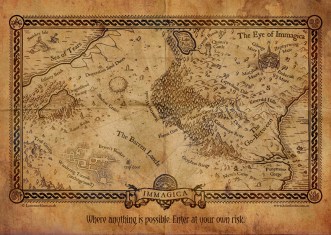
My favourite part of the story, though, is the Eye of Immagica, the centre of the magical world (it’s on the top right corner of the map, below). It’s a little bit Steampunk, with its cogs and hi-tech surveillance. I just loved it.
It probably helps that it had a massive library and a cute boy.
One last thing. This is a very good example of self-publishing done right. It has a professionally designed cover (feast your eyes on that baby!) and professional editing. I’ve read very few self-published novels this well presented.
Immagica is high fantasy adventure with a sense of humour and some poignant moments. I give it four and a half stars.
Review: ‘Twelve Steps’ by Veronica Bartles
Posted: April 4, 2014 Filed under: Reviews | Tags: aussie-owned, reviews, small presses 2 Comments
Twelve Steps
by Veronica Bartles
Release Date: 25 March 2014
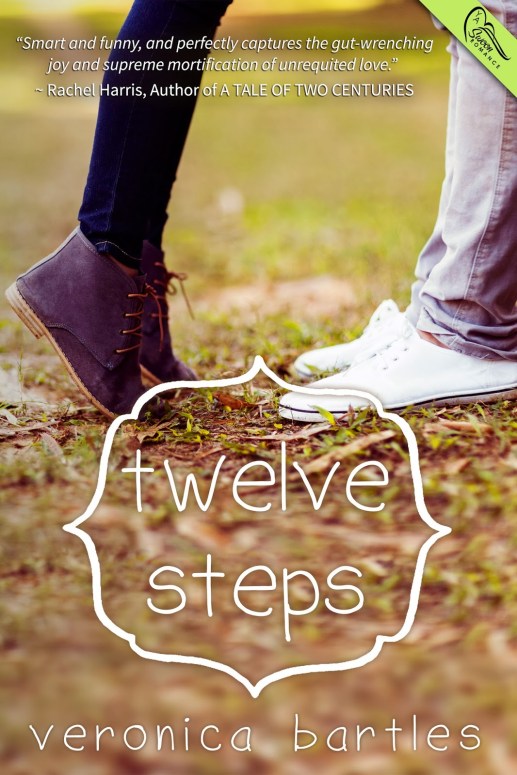
Sixteen-year-old Andi is tired of being a second-class sibling to perfect sister Laina. The only thing Andi’s sure she has going for her is her awesome hair. And even that is eclipsed by Laina’s perfect everything else.
When Andi’s crush asks her to fix him up with Laina, Andi decides enough is enough, and devises a twelve-step program to wrangle the spotlight away from Laina and get the guy.
Step 1: Admit she’s powerless to change her perfect sister, and accept that her life really, really sucks.
Step 4: Make a list of her good qualities. She MUST have more than just great hair, right?
Step 7: Demand attention for more than just the way she screws things up.
When a stolen kiss from her crush ends in disaster, Andi realizes that her twelve-step program isn’t working. Her prince isn’t as charming as she’d hoped, and the spotlight she’s been trying to steal isn’t the one she wants.
As Laina’s flawless façade begins to crumble, the sisters work together to find a spotlight big enough for both to shine.
Last year, Aussie Owned and Read hosted a pitching contest called Pitcharama. Each of us shortlisted our three favourite pitches, and these were then requested by various press editors. Twelve Steps was one of our entries. I originally had it as one of my three, but Sharon guilted me into giving it to her because it was contemp and that’s not my usual genre. (When Lauren said “there were tears, tantrums, stealing, and a little name calling“, this was the book she was referring to.)
Next time I will be hardened to Sharon’s big-eyed Puss in Boots routine. :p
Anyway, needless to say, I’m thrilled beyond measure that Twelve Steps was picked up, and — even though it’s not my usual genre — I leapt at the opportunity to receive a review copy as part of this blog tour.
Twelve Steps tells the story of Andi and Laina, sisters who attend the same high school. Laina’s best friend, Jarod, has had a crush on Laina for about as long as Andi has had a crush on Jarod. And so the sibling rivalry ensues.
This is the sort of story that, if it hadn’t been handled deftly and with humour, could have gone horribly wrong. Both girls are gorgeous and popular, but neither of them fully appreciates how lucky they are. Both, it becomes apparent fairly quickly, view the other sister as the more popular one. And Andi, our leading lady, can be quite sly and manipulative to get what she wants. Only one person sees through her act, and that’s Dave.
Fortunately, Andi has a good heart and instead of turning into the wicked sister she could have become, she (mostly) uses her powers for good rather than evil — especially once she realises there’s more going on than the usual teenage drama. She genuinely wants what’s best for Laina, which completely redeems her and the story.
Also, she has a great sense of humour (once of her defence mechanisms when she’s upset), which I appreciated. 🙂
Twelve Steps is a great story of sibling rivalry, unrequited love and growing to be comfortable with who you are. I give it five stars.
Twelve Steps giveaway
Goodreads | Barnes & Noble | Kobo | iBooks | Amazon
About Veronica
As the second of eight children and the mother of four, Veronica Bartles is no stranger to the ups and downs of sibling relationships. (She was sandwiched between the gorgeous-and-insanely-popular older sister and the too-adorable-for-words younger sister.) She uses this insight to write stories about siblings who mostly love each other, even while they’re driving one another crazy. When she isn’t writing or getting lost in the pages of her newest favorite book, Veronica enjoys knitting fabulous bags and jewelry out of recycled plastic bags and old VHS tapes, sky diving (though she hasn’t actually tried that yet), and inventing the world’s most delectable cookie recipes. TWELVE STEPS is Veronica Bartles’s first novel.
Website | Twitter | Facebook | Authorgraph




 Cassandra Page