Review: ‘Taken by Storm’ by Emmie Mears
Posted: June 11, 2016 Filed under: Reviews | Tags: lgbt, reviews, urban fantasy Leave a comment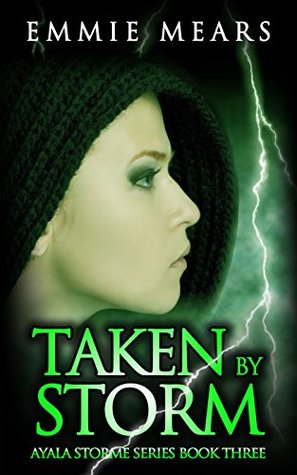
Stripped of her Silver Scale, made a pariah by the Summit, and with a price tag the size of Kentucky on her head, Ayala is on her own. Gregor Gaskin is still missing, and when Ayala discovers he’s far outside the Mediator territory line, she will unravel more about the Summit than she ever thought possible. Finding Gregor will take her far from home, but catching him might hit her right where she lives — and Gregor’s plans may just release hell on earth before she can stop him.
Taken by Storm is the third book in the Ayala Storm series. It doesn’t stand alone, so if you like fast-paced urban fantasy set in an alternate-world USA, I recommend you start with the first book and go from there.
It’s hard to review books this far into a series without spoilers, so please forgive the rather vague review.
Book three continues to deliver on the promises the first two books made: a sassy leading lady who is struggling more and more with who she is and how she fits into her world; an awesome best friend; a hint of romance (but no “love at first sight”); and more fight scenes than you can spray a flamethrower named Lucy at. The story is so fast-paced that it leaves you breathless. Even when you think Ayala might get a bit of downtime, things inevitably go wrong. Poor girl.
Ayala becomes less of a loner, which is great to see (especially after she got schooled in the previous book for complaining she had no friends), and we also discover that she’s bisexual, though it’s not presented as a big deal, just accepted as part of who she is. I really liked that element.
Plot-wise, we get to discover explanations for a few Mediator secrets and about the world more broadly, and there is closure on some story arcs while others — primarily what the demons are up to, which is the primary meta-plot for the series — are elaborated on but not resolved.
As with the previous book, there isn’t any sex. There is situationally appropriate swearing. And I’ve preordered the next (and I believe last?) book in the series, which comes out later this month.
Waiting is hard, you guys.

 In case you missed it, this week over at Aussie Owned and Read, I blogged about five new releases that are coming out to keep you warm this winter!
Review: ‘The Summer I Became a Nerd’ by Leah Rae Miller
Posted: May 26, 2016 Filed under: Reviews | Tags: bookstagram, geekery, reviews Leave a comment
On the outside, seventeen-year-old Madelyne Summers looks like your typical blond cheerleader—perky, popular, and dating the star quarterback. But inside, Maddie spends more time agonizing over what will happen in the next issue of her favorite comic book than planning pep rallies with her squad. That she’s a nerd hiding in a popular girl’s body isn’t just unknown, it’s anti-known. And she needs to keep it that way.
Summer is the only time Maddie lets her real self out to play, but when she slips up and the adorkable guy behind the local comic shop’s counter uncovers her secret, she’s busted. Before she can shake a pom-pom, Maddie’s whisked into Logan’s world of comic conventions, live-action role-playing, and first-person-shooter video games. And she loves it. But the more she denies who she really is, the deeper her lies become … and the more she risks losing Logan forever.
I can’t remember how I stumbled across this book, but I know that I bought it for the title — because obviously! Maddie’s a different variety of geek/nerd than I am; I’ve only got a handful of comics and graphic novels, and those I got as an adult. Logan’s geek experience is a lot closer to mine.
Yes, I have LARPed. I’ve never thrown ping pong balls at anyone, though. :p
This explanation is my way of saying that some parts of Maddie’s experience getting to know Logan and his world are eerily familiar to me. But other parts of her world are very unfamiliar, mostly the “American teenager” thing. Maddie is pretty much pathological about keeping her secret identity as a geek, well, secret, basically because she’s worried about toppling from the top of the popularity tree. Maybe time has fuzzed my memories of high school; maybe in Australia it’s a different social structure; or maybe because I was never popular I never realised how much those girls had to work to stay there. But I found the whole thing a bit baffling. Maddie’s woes are definitely self-inflicted, and at times I lost patience with her because of it.
That being said, I quite liked her voice when she wasn’t having a pity party, and I definitely liked Logan and the fact he and his hilariously brash best friend, Dan, don’t put up with her trying to keep them in the role of dirty secret. Logan is a bit of a teenage dreamboat for the geek set; his parents own a comic book and he’s snagged himself a summer radio show at the local college. I also liked what we saw of Terra, Maddie’s country-music-loving best friend; she’s another one who doesn’t take Maddie’s crap lying down.
I enjoyed spotting the various nerdy references, some of which were made up for the story (I assume; see previous comment about not having read that many comics) but some of which were real-world references. The romance between Logan and Maddie is sweet. The plot is a tiny bit predictable, but The Summer I Became a Nerd was a fun read and easily digestible, with a very clear “be true to yourself” message.


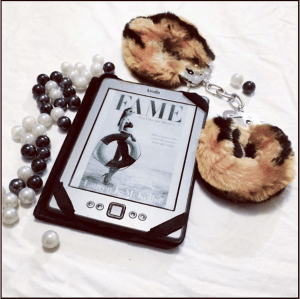
Review: ‘Fame’ by Lauren K. McKellar
Posted: May 20, 2016 Filed under: Reviews | Tags: aussie-owned, AWW, bookstagram, contemporary, reviews, romance 3 Comments
She’s supposed to cover the stories.
Not be one.Madison Winters has life in the bag. Gorgeous fiancé? Check. Promotion to become editor of the country’s hottest fashion magazine? Check. Limited edition pair of Manolo Blahniks? Checkity-check. Catching her fiancé with his pants down isn’t something she expects. In the space of twenty-four hours, Madison loses it all—not even her shoes will be saved. Swapping sass + bide for sweatpants and Dior for the downward dog is going to be hell. The last thing Madison’s broken heart needs is a run-in with America’s newest playboy. Can she ever recover from this?
Tate Masters has it all—Hollywood’s latest golden boy has washboard abs, a killer smile, and a leading role in the next A-list movie. Until a secret from his past is splashed all over the headlines, and that ‘good boy’ image fast-tracks to the gutter. Now the media hunt is on, and they’re baying for Tate’s blood. One night of wild behaviour sees him wake up next to a gorgeous Aussie brunette—and she’s everything Tate’s afraid of.
Keeping secrets has never been this hard.
I’ve said before that Lauren McKellar is one of my very few one-click contemporary authors. She usually writes some young adult and some new adult, and I knew going into Fame that it wasn’t a tragedy like most of her other stories. What I didn’t realise was that this is adult contemporary. Adult-y adult. Now with more adult.
The chemistry — and, let’s be honest, the raw lust — between Madison and Tate sizzles off the page from the first time they meet. And the sex scenes (is that a spoiler?) are scorching. *fans self*
At first I wasn’t sure about Tate. He comes across as a cheat at the start of the book, and no amount of megawatt smiles and ripped muscles made up for that in my mind. Still, it’s not too long before we discover more about Tate — his reasons for doing the things he does — and soon I was swooning and wishing for a Tate in my life too.
It turns out McKellar does sex scenes as well as she does romance. The latter is her bread and butter. It’s not usually my favourite genre, but the relationship here, as embryonic as it is, is well executed. Tate and Madison discover in each other someone who will let them be real, not pushing them to do anything they don’t want to or judging them.
The other thing that’s worth mentioning is that the book is just downright funny. Madison attracts the worst kinds of random luck, but at the same time her approach to handling things is kind of hilarious. While she naturally grieves for her failed relationship with Mike and the consequent struggle with who she is, she’s generally quite resilient and doesn’t take BS from anyone. Her disdain for the trappings of “wellness” (a word I rather dislike myself … mostly because it’s just ugly, tbh) had me giggling on more than one occasion. Her banter with not just Tate but her bestie Courtney was hilarious. And I can’t talk about the humour without mentioning Madison’s parents. They only appear in a handful of scenes, but her father — oh my god, what a scream!
The other touch I liked was the shout-out to How to Save a Life with the cameo of Jase, the tattooed bartender from that book. I wanted to give him a hug, like a long-lost friend.
If you’re looking for a sexy, feel-good story, then I can’t recommend Fame highly enough.
 cas
cas
Review: ‘Winter’ by Marissa Meyer
Posted: May 17, 2016 Filed under: Reviews | Tags: bookstagram, fairy tales, reviews, sci-fi Leave a comment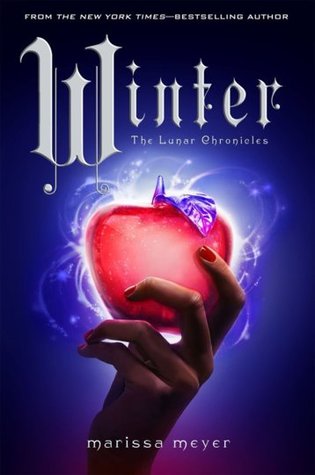
Princess Winter is admired by the Lunar people for her grace and kindness, and despite the scars that mar her face, her beauty is said to be even more breathtaking than that of her stepmother, Queen Levana.
Winter despises her stepmother, and knows Levana won’t approve of her feelings for her childhood friend—the handsome palace guard, Jacin. But Winter isn’t as weak as Levana believes her to be and she’s been undermining her stepmother’s wishes for years. Together with the cyborg mechanic, Cinder, and her allies, Winter might even have the power to launch a revolution and win a war that’s been raging for far too long.
Can Cinder, Scarlet, Cress, and Winter defeat Levana and find their happily ever afters?
This series is the queen of fairy tale retellings. But not the evil queen.
Okay, maybe slightly evil.
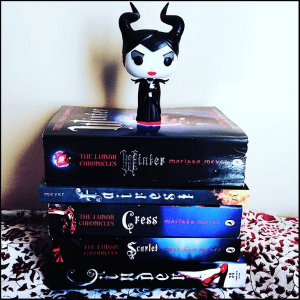
If you haven’t read the rest of the series, then don’t start with Winter, which is the fourth and final (as far as I know) book in the Lunar Chronicles. Instead you want to start with Cinder, which I reviewed here. The entire series is a five-star read for me, so you should do it. Do it now!
Winter is a huge book, at over 800 pages. I noticed because after an afternoon of binge-reading I had a sore wrist, and — despite my best efforts — my copy was the worse for wear by the time I was done. Some of the pages even fell out! Aaah! I didn’t notice how big it was because of the pacing, though; the story ticked along nicely.
As always, the fairy tale references to Snow White were there but didn’t dictate the story. Most of those references related to the titular character, Winter, but occasionally they were used in reference to her cousin Cinder — for example, Levana’s order that someone bring her Cinder’s heart. The seven dwarfs are incredibly subtle, so subtle I missed it at first, but I think they refer to the number of other main characters (excluding Jaicin, who is the “prince”): Cinder, Kai, Scarlet, Wolf, Cress, Thorne and Iko.
As far as the characters go, my favourite relationship is Cinder and Kai’s, far and away. ❤ My other favourite characters are Scarlet, for her sheer, brash defiance of everything and Iko, because Iko! Levana is suitably evil, although doesn’t really muster as much of a defence as I might have liked. But then, in a book with such a big ensemble cast, I’m okay with a little more tragedy-related feels than Winter has. (I’m a fan of Joss Whedon. Enough said.)
Still, if you want a sci-fi series with a fairy tale feel, some kissing and an actual, honest to goodness “they all lived happily ever after” (because it’s a fairy tale retelling and that’s obligatory), I highly recommend this entire series!
Review: ‘The Hero of Ages’ by Brandon Sanderson
Posted: May 10, 2016 Filed under: Reviews | Tags: fantasy, reviews 2 Comments
Tricked into releasing the evil spirit Ruin while attempting to close the Well of Ascension, new emperor Elend Venture and his wife, the assassin Vin, are now hard-pressed to save the world.This adventure brings the Mistborn epic fantasy trilogy to a dramatic and surprising climax as Sanderson’s saga offers complex characters and a compelling plot, asking hard questions about loyalty, faith and responsibility.
To all those people who told me Brandon Sanderson is a man who knows how to write a mind-boggling story: you were right and I owe you a coffee. I don’t think I’ve ever read a trilogy with such intricate world-building, with so many layers and plot twists, and bits of what turned out to be foreshadowing in the first book that are only explained in the third.
The amount of plotting Sanderson must do before he starts writing that first page truly blows my mind.
The Hero of Ages is the third book in the series, and it nicely wraps up the trilogy, giving me explanations for questions I hadn’t even realised I was asking — not really. For example, I remember thinking pretty early on in the series that it was strange that burning tin lets an allomancer see through the Mists. It turns out there’s a reason for that. There’s a reason for everything! There’s even a reason for Sazed’s frustrating naval-gazing and waffling on about dead religions (because, oh my god, I wanted to shake him so badly; those waffle-y bits are actually what made me love this book slightly less than the other two).
Given I’ve been fully immersed in this trilogy in the past month, I had enough depth and currency of understanding to see a lot of the plot twists coming this time around. However, I feel a bit like Vin and Elend must have, fighting an all-powerful god like Ruin: like I thought I knew what Sanderson was going to do, but he only let me feel that way so he could lull me into a false sense of security. Then BAM.
That last plot twist is a doozy. I have an epic book hangover, and a need to buy another Sanderson trilogy ASAP.

Review: ‘The Well of Ascension’ by Brandon Sanderson
Posted: April 27, 2016 Filed under: Reviews | Tags: fantasy, reviews 2 Comments
The impossible has been accomplished. The Lord Ruler – the man who claimed to be god incarnate and brutally ruled the world for a thousand years – has been vanquished. But Kelsier, the hero who masterminded that triumph, is dead too, and now the awesome task of building a new world has been left to his young protégé, Vin, the former street urchin who is now the most powerful Mistborn in the land, and to the idealistic young nobleman she loves.
As Kelsier’s protégé and slayer of the Lord Ruler she is now venerated by a budding new religion, a distinction that makes her intensely uncomfortable. Even more worrying, the mists have begun behaving strangely since the Lord Ruler died, and seem to harbor a strange vaporous entity that haunts her.
Stopping assassins may keep Vin’s Mistborn skills sharp, but it’s the least of her problems. Luthadel, the largest city of the former empire, doesn’t run itself, and Vin and the other members of Kelsier’s crew, who lead the revolution, must learn a whole new set of practical and political skills to help. It certainly won’t get easier with three armies – one of them composed of ferocious giants – now vying to conquer the city, and no sign of the Lord Ruler’s hidden cache of atium, the rarest and most powerful allomantic metal.
As the siege of Luthadel tightens, an ancient legend seems to offer a glimmer of hope. But even if it really exists, no one knows where to find the Well of Ascension or what manner of power it bestows.
The Well of Ascension is book two in Sanderson’s Mistborn trilogy, and I would strongly suggest not trying to read it as a stand-alone novel. I reviewed the first book here if you want to decide whether this series is for you. That review also largely holds true for book two. I’ve given this book 4.5 stars as well, though my niggles are different this time around. (I considered a 4-star rating instead for this one, but the plot twists deserved that extra half star!)
Still, let’s recap.
Things I loved
A little slice of a big world. Despite the fact that almost the entire story is set in or immediately around Luthadel, there is a sense of a much bigger world out there, one that has an impact on Luthadel and the fate of the former empire. Still, I liked the narrower focus — sometimes, fantasy novels that involve army-scale warfare start to read like a book on military tactics. That is never the case here, which is — to me — a good thing.
A cast of characters who aren’t black and white. We gained a sense in the first book that even the Lord Ruler, the tyrant demigod who ruled for 1000 years, might not be 100% evil (maybe 90%? 85%?). On the other side of the coin, Kelsier, the supposed hero of the piece, had grand ideals but was just as brutal in his own way. That trend continues in the second book. Elend is sweet but idealistic to the point of foolishness, while Vin is highly competent but torn and indecisive. We get to see snippets from a much broader range of characters in The Well of Ascension, giving us a greater sense of what motivates them, why they think they are the good guy. My most unexpected favourite is Breeze, the lazy and manipulative soother who somehow turns out to be very sweet, in his own way.
The plot twists and turns (like a twisty turny thing). I thought I had a pretty good idea of where the second book might go, and in some ways I was right, but in others … yeah, there were some massive reveals in The Well of Ascension that I did not see coming. I love it when that happens! 😀
The ending struck a balance between completion and dun-dun-DUN. Writing a series with a meta-plot over three books can be tricky. But there is enough of a resolution in The Well of Ascension to make me happy, while there is also enough left unresolved (and we’re talking big ticket items here) to keep me reading. I expect I’d be less sanguine if I’d found this series back when it was first released, though. Knowing I have the third book sitting here, ready to go, really helps.
Things I was less fond of
I wanted to shake some of the characters. One plot device that sets my teeth on edge is when there’s a disconnect between characters that could easily be resolved if the two of them would just say what they are thinking. I know people aren’t always 100% honest in real life, and I can see how the misunderstandings came about in the book … but at the same time, gah! I wanted to shake both Vin and Elend until their teeth rattled. (But mainly Vin. Though she’d kill me in a messy fashion if I tried.)
I wanted to give some of the characters advice. There were times when I could see potential solutions to problems that the characters didn’t even seem to consider. For example, early on in the book, Vin and Elend discover there’s a potential shape-changing infiltrator in the palace, leaking information to one of their enemies. Vin discovers that said shape-changer is immune to emotional allomancy (magic); she also knows due to circumstance that Breeze, the best emotional allomancer in the city and probably in the world, absolutely cannot be the imposter. Why not tell Breeze about the issue, set him to testing people’s reactions? Even if it wouldn’t have helped in the end, it would have made the characters seem slightly less ineffectual at times. (Of course, maybe the goal was for them to seem ineffectual, in which case, good job, Sanderson!)
Final comments
The fight scenes are truly brutal, but if this were a romance you’d describe the heat level as “sweet”. I gather that could be said of all of Sanderson’s books, so if that’s what you look for in a fantasy novel — as well as an intricate world that focuses on people rather than large-scale politics — then you should definitely read this series.
Review: “Mistborn: The Final Empire” by Brandon Sanderson
Posted: April 16, 2016 Filed under: Reviews | Tags: fantasy, reviews 2 Comments
In a world where ash falls from the sky, and mist dominates the night, an evil cloaks the land and stifles all life. The future of the empire rests on the shoulders of a troublemaker and his young apprentice. Together, can they fill the world with color once more?
In Brandon Sanderson’s intriguing tale of love, loss, despair and hope, a new kind of magic enters the stage — Allomancy, a magic of the metals.
After devouring and enjoying Elantris, I decided to pick up the first book in what may be Brandon Sanderson’s most famous series: Mistborn. And I can see why so many people recommended it to me. Holy wow.
Things I loved
The unique world-building. Instead of traditional wizardly magic, or magic that takes a formless power and shapes it via one mechanism or another, Sanderson based the magic in his world on the idea that some people can consume or “burn” certain metals and alloys to achieve defined effects. I’d love a glimpse into Sanderson’s mind, that he was able to come up with something like this! But I’m not sure you could convince me to swallow a lump of iron, no matter what the supernatural outcome…
A variety of characters that I grew to love. Despite what the blurb suggests, Kelsier and Vin aren’t trying to save the world alone — they are part of a crew of thieves contracted to do a “job”: overthrow the government. Even though some of the crew were crazy-impulsive (Kelsier), others were vain (Breeze), others were surly (Marsh), and some made cynicism an art (Vin), I loved all of the main cast to one degree or another. The fact that these characters — all of these characters — have flaws makes them seem more real.
Of all of them, Vin is the one that experiences the most character growth, probably followed by Kelsier and the nobleman Elend. This are the book’s three main characters (each sharing the POV at one point or another), so that’s to be expected.
The sense of a larger story. Because this is the first book in a trilogy, there are a lot of things left unresolved, most of them in the backstory. It gives the world a sense of depth and makes me eager for the next instalment. For example (note: very light spoilers follow), what happened to the Lord Ruler at the Well of Ascension? What’s the go with the ancient, apparently amorphous bad guy known as “the Deepness”? How is said amorphous, gloomy bad guy connected to the amorphous, gloomy mists that shroud everything come nightfall? Are the ash mounds really volcanoes that will erupt and kill us all?!
The plot twist. It’s one of those ones where you feel like you should have seen it coming afterwards, but that isn’t blindingly obvious beforehand. (At least, it wasn’t to me.) Nuff said.
Things I struggled with a little (especially at first)
The talking. A lot of time, the characters are talking, plotting and scheming. Sometimes they are confiding or manipulating too. This was often levied with humour or with emotion, but early on in the book I found some of the crew’s planning sessions a bit of a slog.
The metal magic. Once Kelsier explained how the metals work to Vin, I was fine. But there’s one scene from his point of view before that, where he’s doing all sorts of things with different metals, and I got really, really lost.
Other observations
There is no sex (there’s barely even a kiss); however, there is quite a bit of violence and some fairly grisly corpses. I wasn’t bothered but YMMV.
Review: ‘Fairest’ by Marissa Meyer
Posted: April 8, 2016 Filed under: Reviews | Tags: reviews, sci-fi Leave a comment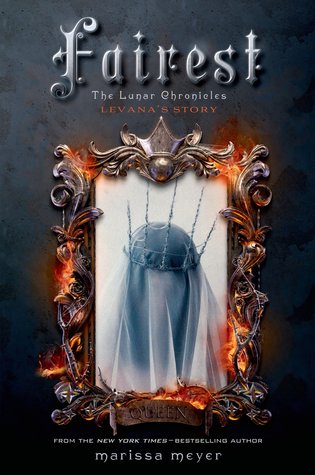
In this stunning bridge book between Cress and Winter in the bestselling Lunar Chronicles, Queen Levana’s story is finally told.
Mirror, mirror on the wall,
Who is the fairest of them all?Fans of the Lunar Chronicles know Queen Levana as a ruler who uses her “glamour” to gain power. But long before she crossed paths with Cinder, Scarlet, and Cress, Levana lived a very different story – a story that has never been told . . . until now.
There aren’t too many authors who are so popular that even their novellas get a traditional paperback release (most bridging novellas are released as ebook only, or maybe POD). Marissa Meyer’s Fairest is one of these rare books and, having devoured it in an evening, I can see why.
Fairest is book 3.5 of the Lunar Chronicles. If you’re not familiar with the premise of this series, it’s basically an alternate Earth sci-fi where each book in the series is inspired by a fairytale. But the books don’t really stand alone; there is an overarching storyline, with the stories of Cinder, Scarlett, Cress and now Levana intertwining. (Winter’s story comes next.)
Levana is the queen of Luna, the moon colony; think the wicked queen from Snow White and you have her basic character concept. Pretty one-dimensional, right? Nope. The beauty of Fairest is that we get to find out how untrue that characterisation is. The story begins when Levana is fifteen and her parents are assassinated, and follows her sister’s coronation, Levana’s “romance” with the guard Evret and pseudo-adoption of Winter, the birth of Selene, and all the horrible things that follow. We get to see through both current events and flashbacks just why Levana starts out a little bit damaged … and why by the end she’s as broken as the the mirror on the wall.
The thing is, despite all the awful things Levana does and who she turns into, you can’t help but feel bad for her. She’s a product of a terrible environment, and one part of her just wants to be loved. Of course, that in no way excuses her behaviour — from murder to what amounts to rape and psychological torture — but you can’t help but think that if someone had taken her away from her family when she was a small child, she could have been a wonderful person. Certainly she’s not as inherently evil as her older sister, Channary, not at first … although that’s setting the bar pretty low.
I mentioned rape and torture. Levana is a Lunar and has the gift to influence others’ minds and control their bodies … and Evret doesn’t want to be anything more than her friend. It’s fair to say there is no romance in this book. There were times I felt physically ill at the things she did to that poor, poor man. Still, what sex there is fades to black — it is a young adult series.
All of this amounts to an amazing five-star read, because you have to admire the talent of a writer who can make you pity and loathe a character all at once. If you’ve read the other books in the series and are wondering whether to dip into the novella: DO. You won’t regret it. And if you haven’t read any of the series, start with Cinder.
Review: ‘Any Port in a Storm’ by Emmie Mears
Posted: April 2, 2016 Filed under: Reviews | Tags: reviews, urban fantasy Leave a comment
After months of training a budding army of human/demon hybrids, Ayala and Carrick have worked out most of their differences.
Who gets to use the bathroom first in the morning. Who’ll feed the bunny before they go out to make mayhem. Who gets to keep the jeeling claw they found in Forest Hills. You know, the important stuff.
But when Gregor sends them out with their battalion of shades and the mission quickly lands on the wrong side of Ayala’s “don’t kill norms” moral line, she quickly discovers that maybe morality wasn’t the motivator behind Gregor’s pet project — or at least not when money’s involved.
And when a trio of shades starts murdering the populace in Nashville again and targeting places and people significant to Ayala, her desire to help her own comrade shades stay on the good side of the Mediators will place her at their mercy again.
With the Summit fracturing and demons closing in on the city, saving the shades and herself may cost Ayala everything.
This is the sequel to Storm in a Teacup, one of my new favourite urban fantasy series. (You can see my review of the first book here.) It’s fun, past-paced and clever, and Emmie Mears’s voice again doesn’t disappoint. The main character, Ayala, could sass for her country!
Sadly for her, she’s instead stuck killing demons, and trying to avoid getting sucked into the sort of intrigue that inevitably pops up when you have a large group of people working together — even if those people are Mediators, people destined from birth to be unpaid monster-hunters. And political intrigue isn’t the only thing she could be sucked into: the demon-infested swamp that is encroaching on Nashville (where the books are set) and the maws of the demons themselves are also ongoing concerns.
Any Port in a Storm doesn’t stand alone, so if you haven’t read the first book, you’ll be very lost with this one. (Go read the first book. We’ll wait.) It continues some of the plot threads from the first book, introduces some new ones, and continues the meta-plot that is the looming threat of the demons’ overall plan — whatever that turns out to be. There is a conclusion of a sort, but as with the first book some threads are left untied to continue in the next one. (Think of it like a season of Buffy: the monster of the week is more or less dealt with, but the season’s Big Bad soldiers on.)
Any Port in a Storm contains some swearing, but there’s no sex or even kissing. The relationships revolve around friendships and family, which I found a refreshing change; urban fantasy, unlike paranormal romance, isn’t all about the love interest. And although I didn’t mind Mason in the first book, I didn’t ship him and Ayala, so him being gone didn’t bother me so much.
I enjoyed this book enough that I one-clicked the third book in the series, Taken by Storm, and can’t wait to get my teeth stuck into it. If you loved Buffy, you should definitely check out Ayala!
Review: ‘Elantris’ by Brandon Sanderson
Posted: March 25, 2016 Filed under: Reviews | Tags: fantasy, reviews 1 Comment
Elantris was the capital of Arelon: gigantic, beautiful, literally radiant, filled with benevolent beings who used their powerful magical abilities for the benefit of all. Yet each of these demigods was once an ordinary person until touched by the mysterious transforming power of the Shaod. Ten years ago, without warning, the magic failed. Elantrians became wizened, leper-like, powerless creatures, and Elantris itself dark, filthy, and crumbling.
Arelon’s new capital, Kae, crouches in the shadow of Elantris. Princess Sarene of Teod arrives for a marriage of state with Crown Prince Raoden, hoping — based on their correspondence — to also find love. She finds instead that Raoden has died and she is considered his widow. Both Teod and Arelon are under threat as the last remaining holdouts against the imperial ambitions of the ruthless religious fanatics of Fjordell. So Sarene decides to use her new status to counter the machinations of Hrathen, a Fjordell high priest who has come to Kae to convert Arelon and claim it for his emperor and his god.
But neither Sarene nor Hrathen suspect the truth about Prince Raoden. Stricken by the same curse that ruined Elantris, Raoden was secretly exiled by his father to the dark city. His struggle to help the wretches trapped there begins a series of events that will bring hope to Arelon, and perhaps reveal the secret of Elantris itself.
My high fantasy audiobook kick continues with Elantris. After I finished Patrick Rothfuss’s two books, I tweeted that I was after something similar: non-political high fantasy that isn’t too grim (ie not Game of Thrones). Pretty much every tweet recommended Brandon Sanderson. The friend who’d gotten me onto Rothfuss in the first place suggested I start with Sanderson’s debut. Since it’s that rare beast — a stand-alone epic fantasy novel — I figured, why not?
And I LOVED Elantris.
It’s a rare example of a split POV book that works — and there aren’t just two but three points of view, those of Raoden, Sarene and Hrathen. The chapters rotate between the three — in that order, something I admired from a craft point of view. Keeping the pacing going and making each thread interesting enough that you always have something to say with each character is hard, and Sanderson did an admirable job. I actually didn’t mind when it switched to a new character, where other multiple-POV books have lost me in the past. I also really liked the way he interwove the various plot threads and foreshadowing, with elements sprinkled through each character’s scenes.
As far as the characters go, Raoden is a sweetheart — a genuinely kind and positive person, something that serves him well when he gets to Elantris. Sarene is a strong-willed diplomat who is just looking for somewhere to belong. And Hrathen is the bad guy. Only actually not. In high fantasy, usually the villain is truly evil, and after Sarene’s introduction you expect Hrathen to be that sort of person. But he’s actually quite sympathetic, and his motivations are (despite the emphasis on world conquest) coming from a good place.
That isn’t to say that there aren’t villains in Elantris, just that Hrathen isn’t necessarily one of them. 😉
I also really enjoyed the magical system, which wasn’t your traditional spellbook memorisation. It’s a bit closer to the Will and the Word that Eddings used (way back when), but the word is written and precision is critical to the process.
I downloaded the tenth-anniversary edition audiobook and there was some extra content, including a deleted storyline and some discussion of the craft. I found Sanderson’s reflections on the book quite interesting. Sanderson commented that his craft has advanced since he wrote Elantris, and I can see the elements of the story that he’d probably fix if he re-did it now (such as Hrathen’s info dumps or some of the repetitive description — I lost track of the number of times we’re told that Sarene’s uncle has a scratchy voice). Still, the craft that went into Elantris is still admirable, and if he gets better in his future works, I’m definitely keen to read them next.


 Cassandra Page