Routine as an aid to writing
Posted: June 28, 2013 Filed under: On writing | Tags: Isla's Inheritance, music, Thursdays Children, writing 10 Comments (This is a Thursday’s Children post, but I’m posting it Friday morning. Hey, it’s still Thursday somewhere in the world!)
The stereotype of a writer at work is often that of a person with a laptop in a coffee shop, observing the clientele and sipping their latte as they tap away at the keyboard. I am not that writer. I am getting better at tuning out background noise—I have a preschooler, after all—but I’m only really able to write under those circumstances when I’m really in the zone. On a normal day it’s a struggle, and I usually only write once my son is in bed and the TV is off.
Until recently, I also had a housemate. His computer was in the same space as mine and he was mad keen on World of Warcraft—so while I prefer to write without music I used to fire up whatever was on the hard drive and put headphones on, to block out the sound of orcs being slain or whatever he was doing at the time. I didn’t usually need to have the music up loud, but just had it on as white noise.
The thing is that for a while there was only one album on my hard drive. I don’t like to use the CD player in the computer because it’s old and sounded like a jet engine preparing for takeoff (even through the headphones). I could have copied some other music onto the hard drive to have it available, but I never got around to it and, after a while, playing that particular album was habit-forming.
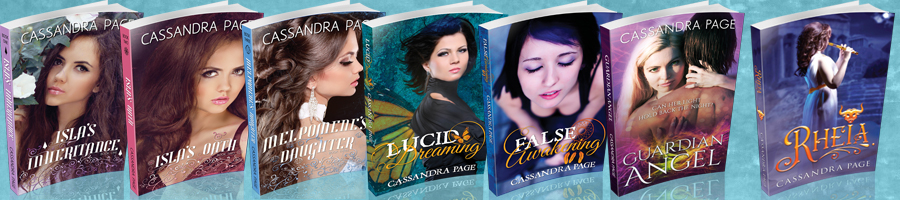
 And that is why I can’t hear the violin at the start of the orchestral version of I’m in a Cage by Tim Minchin (from Tim Minchin and the Heritage Orchestra) without my brain shifting gears into writing mode. I wrote my first two books—Isla’s Inheritance and its sequel—to this music. I’m hesitant to describe the album as the actual soundtrack to those books, because the music isn’t actually related to the story (I didn’t write a comedy, for a start)—but the album was the soundtrack to my writing.
My current work-in-progress is mostly being written to the blissful sounds of a quiet house. I did experiment with some other CDs (played in the CD player—I’m so old-fashioned), but none of them grabbed me. It seems I can only write to silence or Tim Minchin.
Hey, whatever works, right?
Do you have particular music you play to get yourself in the mood to write, or other routines that you always follow? Do you struggle without them?
Click here to see this week’s other Thursday’s Children blog posts.
Why I Write Women’s Fiction
Posted: June 22, 2013 Filed under: On Books, On writing | Tags: book launch, guest post, writing 7 CommentsThis guest post is by another of my fellow authors over at Turquoise Morning Press, Linda Rettstatt.
When I first began to write, I knew very little about creating a novel-length story or of all the mechanics that went into writing. I also knew little about genre. I knew what I enjoyed reading, so it made sense to write that kind of story. My favorite author at the time was Elizabeth Berg. She is brilliant at writing character-driven stories of women—ordinary women—who find themselves in extraordinary circumstances. Her characters are the women who live next door or down the street, or who work in the next cubicle. But Berg takes the reader into the emotional and psychological depths of these women who, as they face life changes and challenges, make us—the readers—feel just a little less alone in our own struggles. She makes us laugh at ourselves.
Some might say that my own background as a psychotherapist who’s done a great deal of counseling with women would lend to writing this genre. And they would probably be right. I set out not to write like Berg, but to write stories about women facing challenges and possessing both vulnerability and strength. I targeted women readers and branded my writing as: Writing for Women—Stories of strength, love, humor and hope. These are the elements I consciously try to incorporate into every book. These are the elements I also find in the books of other writers whose work I admire. Berg, of course, Kris Radish, Elin Hilderbrand, Claire Cook—just to name a few. Kris Radish, a bestselling author in her own right, was kind of enough to give me a quote for Unconditional. Now that’s exciting, when one of the authors you most admire comments (positively) on your work. A true ‘squee’ moment.
Although I also write contemporary romance, when I sit down to write a new women’s fiction novel, it’s like slipping my feet into an old, familiar pair of shoes. They just fit right. Some have asked me, “What’s the difference? Your women’s fiction books often contain romance.” What can I say—I’m a romantic at heart. And romance is largely targeted at a female audience. I don’t think that placing my books under either heading locks them into one or the other sub-genre, but gives readers a hint that women are especially going to identify with the story and the characters. At least, that’s my hope.
Linda Rettstatt is an award-winning author who discovered her passion for writing after years of working in the human services field. When she’s not writing, Linda loves travel, nature photography, and figuring out what makes people tick. Her fantasy is to win the lottery, buy an old Victorian home on the eastern shore and open a writers’ retreat. While she waits for that fantasy to materialise, she continues to live and work in NW Mississippi and to write under the constant observation of her tuxedo cat, Binky.
You can find her at her website, blog or on Facebook or Twitter.
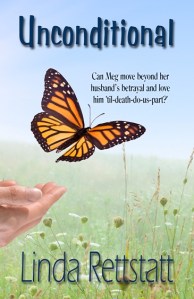
Unconditional (May, 2013, Turquoise Morning Press)
Meg Flores has it all—a loving family, a fulfilling career, and marriage to her best friend, Thomas. She is devastated when her husband announces he wants a divorce so he can pursue a relationship with his secretary—his male secretary. For Meg, the betrayal goes beyond that of a cheating husband. She is losing her best friend and the hopes for adding a child to her life.
Available from Turquoise Morning Press, or at Amazon.com, B&N.com and Smashwords.com.
On chapter titles in fiction
Posted: June 20, 2013 Filed under: On Books, On writing | Tags: chapters, Thursdays Children, writing 15 Comments I love a good chapter title in a book. I really admire writers who manage to come up with a title that summarises the chapter, gives the reader a sense of what’s to come, but without being spoilery. I love chapter titles so much I always thought I’d use them—but when I stopped, partway through drafting Isla’s Inheritance, and thought about it, the idea of crafting the perfect chapter titles seemed as hard as crafting the perfect beginning. I seized up with panic, and decided I’d worry about it later. (That, by the way, is a great way to deal with writer’s block of any sort. Write around the problem and fix it later.)
Then I never actually got around to doing it.
My love of chapter titles started with J.R.R. Tolkien. I was given an illustrated, anniversary edition of The Hobbit when I was in late primary school. I loved that book. I’d alternate between reading about Bilbo’s adventures and staring at the illustrations of Smaug for hours. (As an aside, no one told me about the rest of Tolkien’s books till years later. I remember experiencing that wonder for the first time, the joy of discovering there are more books in a series that I never knew about. It took me a while to warm to Frodo, but he got me in the end.)
A conversation on Twitter about chapter titles the other day got me to thinking, though: do they actually make much difference to my experience as a reader? I looked at a random selection of fantasy and urban fantasy novels from my bookshelves, and the results surprised me. Because if you’d asked me who used chapter titles, I would have said fantasy writers do; urban fantasy writers don’t. I’ve read a lot of both, and that was my impression. But the facts only sort of bear that out—it’s a trend rather than a hard fact.
 On the fantasy (and light sci-fi) side of the shelf, Anne McCaffrey did an assortment of things with her titles. In Dragonflight, the first in the Pern series, she actually used poems instead of chapter titles (the poems written by the harpers in the book). This was like chapter headings on steroids, because if you’ve read the book you’ll know the main character actually has to solve a riddle in one of those songs to save the day. And they foreshadowed the storyline as well. Wow. (In others of her books, though, she used traditional chapter numbers.)
David Eddings uses numbers with some titles for parts. Raymond E. Feist, Kate Forsyth and Jay Kristoff use chapter titles. Mercedes Lackey uses numbers (sometimes with titles to say whose perspective it is, much like George R.R. Martin). Terry Pratchett doesn’t even use chapters!
On the urban fantasy side, Suzanne Collins had part titles. Cassandra Clare uses chapter names. Charles De Lint and Veronica Roth use numbers.
I think the most telling thing for me is how little impression some of the titles made on me. I only read The Hunger Games and City of Bones recently, but the fact there were titles in there didn’t even register—probably because they were both such compelling stories that I was far more interested in continuing on than dwelling on the title and what it might mean. If I was at the point where I’d re-read them lovingly many times, the way I have The Hobbit and Dragonflight, perhaps they would have sunk in as I stopped to marvel.
All of which brings me to my point: what are your feelings on chapter titles in fiction (especially genre fiction)? Do you think they add to your reading experience, detract from it, or make no real difference either way? Do you even notice them?
(I need to caveat this post with the statement that I didn’t look at every book on my shelf by the named authors, just a handful. So maybe all of them do both, and it was just coincidence that the ones I picked up were of a certain style.)
Click here to see this week’s other Thursday’s Children blog posts.
Thoughts on pitching contests
Posted: June 18, 2013 Filed under: On writing | Tags: agents, aussie-owned, contests, queries, small presses, writing Leave a commentI’ve got a new-found respect for agents.
Those of you who’ve been reading my blog for a while know that I highly rate pitching contests. They are a great way to hone your pitch, query or first pages. And, just as great, you can get in touch with what I’ve discovered to be a supportive community of fellow writers, many of whom have great advice to offer or are just happy to be a cheer squad. I wouldn’t be here now if it weren’t for Pitch Wars (if you want to know why, I blogged about it here).
 And if you’ve been reading my blog for only a little while you’ll know that Aussie Owned and Read has been hosting its first pitching contest, where people can submit a 250 word blurb for their young adult or new adult manuscript. In the first round, the eight bloggers at Aussie Owned choose their favourites to progress to the final round. That is where we have eight small presses (nine editors) who will swing by to request the ones they’d like to see more of. (In the second round you can pitch your friends—that starts on 20 June so if you missed the first round it’s not too late!)
The first round closed last night and choosing three pitches from those that entered was SO HARD IT HURT MY BRAIN! Not in a bad way but in an “aaaah, I can’t choose” way! My original shortlist was 50 per cent of the total. I loved them all, and wanted to take them home with me. Like, really. I have a newfound respect for people like Brenda Drake and the writers who help her; she runs Pitch Wars and Pitch Madness. Our humble contest is only in its first year so we didn’t get nearly the number of entries she’d see in one of hers. (Not that I didn’t respect her before, but Oh. My. Gods!)
And that’s why I also have a newfound respect for agents. In a way they have it a bit easier than we did in choosing our pitches, because most of them request at least the first five pages, which gives them an idea of the voice and execution. But in another (much bigger) way, they have to read thousands upon thousands of queries a year. And they don’t even get paid for that part of their business, not until they choose a client and then sell their client’s work.
Wow. Just wow. You seriously have to love books, love stories and tales well told, to dedicate that amount of time to it. Because while all the pitches we saw were good, the same cannot be said for agents’ slush piles (or so I hear).
Agents, I doff my hat to you. Or I would if I was wearing one.
I doff my imaginary hat to you.
One more thing. If you’re reading this and you entered Pitcharama, I also wanted to say that, whether you’re one of my final choices or not, I respect the courage it takes to put yourself and your work out there. I know how stressful it is. Don’t give up.
Dystopian fiction and ‘Runners’
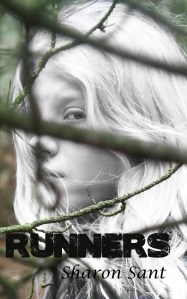
Posted: June 17, 2013 Filed under: On Books | Tags: dystopian, guest post, small presses, writing 1 CommentThis guest post is by Sharon Sant, whose new dystopian novel, Runners, came out on 7 June.
The Oxford dictionary defines dystopia as: ‘an imagined place or state in which everything is unpleasant or bad, typically a totalitarian or environmentally degraded one. The opposite of Utopia.’
That sounds like a perfect place to set a novel. And it seems that I’m not the only one who thinks so. I’ve been reading reports for some time now about how agents and publishers are sick of dystopian novels landing on their desks. According to them, since The Hunger Games, we’ve gone dystopia crazy. I hate to burst that industry bubble, but I don’t think that dystopia is going away any time soon. In fact, I don’t think it was ever really missing from the cultural landscape in one form or another. Thinking back to novels like 1984, even as far back as The Time Machine by H G Wells or Aldous Huxley’s Brave New World, it’s clear that we’ve always been fascinated by the ideas of dystopia.
As a narrative tool, dystopia can hold a mirror up to our own society to make all sorts of political and social statements, or it can be used simply to issue warnings, the latter being closely linked and often overlapping with speculative fiction. For me, however, it also represents a society where the normal rules of our world no longer apply. Like fantasy, dystopia is a setting that you can manipulate; it presents the opportunity to create a world that enables the story you want to tell to unfold how you want. You want kids beating each other to death on a TV show? In a dystopian society you can make this entirely plausible.
When I first had the idea for my dystopian novel, Runners, I knew straight away what the setting would be: a near-future Britain where the current economic hardships and climate change had progressed to their worst possible scenarios. I’m a huge fan of fantasy in realist settings and for me this was just perfect. There are no silver-clad futuristic cities, no radiation-soaked skies full of spacecraft, no mutated humanoid species in Runners—all fantastic settings for dystopian fiction, of course—there’s just a crumbling version of a contemporary Britain and a poverty-stricken population that no longer cares what happens to anyone.
I took a lot of my ideas from periods of austerity in history, so there are Victorian-like features such as child labour and workhouse-type institutions, and then there’s rationing like during the Second World War. These things have already happened in real life and, just because they’ve gone away, it doesn’t mean they can’t come back. Because in real life, just the tiniest false step from the people in charge and we could actually find ourselves living there. It’s a scary prospect for us but a perfect dystopia for a book.
I think that some of the best fictional dystopias are the ones almost close enough for our society to touch, the ones where you can easily imagine yourself living in it. For me, that’s where the weirdness and the fear come from.
About Runners
Elijah is nothing special. He’s just a skinny kid doing his best to stay one step ahead of starvation and the people who would have him locked away in a labour camp—just another Runner. But what he stumbles upon in a forest in Hampshire will show him that the harsh world he knows will become an even more sinister place, unless he can stop it. As past and present and parallel dimensions collide, freedom becomes the last thing on his mind as he is suddenly faced with a battle to save his world from extinction. But before Elijah can find the courage to be the hero the world needs, he must banish his own demons and learn to trust his friends. And all the while, the sinister figure of Maxwell Braithwaite looms, his path inextricably bound to Elijah’s by a long dead physicist, and hellbent on stopping Elijah, whatever the cost.
Find Runners on Goodreads or at Immanion Press.
About Sharon Sant:
Sharon Sant was born in Dorset in England but now lives in Staffordshire. She graduated from Staffordshire University in 2009 with a degree in English and creative writing. She currently works part time as a freelance editor and continues to write her own stories. An avid reader with eclectic tastes across many genres, when not busy trying in vain to be a domestic goddess, she can often be found lurking in local coffee shops with her head in a book. Sometimes she pretends to be clever but really loves nothing more than watching geeky TV and eating Pringles. She is the author of a string of YA novels including the Sky Song trilogy and Runners.
To find out more you can follow her on Twitter or Facebook, or at her website.

Will their world survive? World-building for a series
Posted: June 15, 2013 Filed under: On writing | Tags: guest post, research, writing 3 CommentsThis guest post is by one of my fellow authors over at Turquoise Morning Press, Bobbye Terry. A veteran at writing in created worlds, she’s talking to us today about world-building.
Enter, stage right, head-strong heroine with kick-assitude. Enter, stage left, brooding hero with something to prove. He has a mission. He needs help. She willfully resists helping him. That is, until he woos her through his dry wit and unerringly strong character, winning her heart and enabling him to steal an embrace. But wait! They are fraught with the slings and arrows of outrageous villainy, keeping them from declaring their undying love and destined mating.
You do agree every good book deserves some outrageous villainy—ahem, villains—don’t you? Did I mention your book is set in the future world of Frostos and all those who survive must protect against the ancient followers, known as Ice-ciples, of the Abominable Snow Android, also known as an AS Andro, while staying warm with their revolving bubble-heating spheres? So, where do you begin and how will your idea spawn not one but many books around the central theme of defeating the ice-ciples and the AS Andro, then opening the mechanical clouds to the warmth of the eternal sun?
Before you sit down and busily start to get the first chapter down, stop. Be smart and consider the following list. Know where you want to go so you don’t have to come back and backtrack, and yes, pantsers, this will work for you (so said the queen of all pantsers, me).
Series world-building: things to consider
1. Fantasy in current world or other world? Will your world co-exist with our current world or will it be different, play by new rules? If so, what are those rules?
2. Future, present day, past or time travel?
Is this in the future on our planet Earth? If so, how did we get where we are? Background here…is it a dystopian world, ravaged by war and devastation of a flourishing paradise, or a world now controlled by one sect? How will you best illustrate the change in conditions? Is it in the past? If so, have you done your research about dialect, clothing, customs, conditions, activities and occupations for daily living? Is it a time travel? If so, how will you best contrast the dichotomy?
3. Fantasy beings—in human form with special powers, category beings (vampires, witches, angels, zombies, demons, etc?), or totally new category?
If your characters look like humans but have powers, what are those powers? Is there a limit or an Achilles heel? If they fall into a category of beings, do they act like the stereotype of those in other novels, or do your beings look or act differently? If they do, bring that out early. Are they in a new category? If so, how do you describe them and how do you suspend belief?
4. Items, terrain, locations, special features that remain in all books?
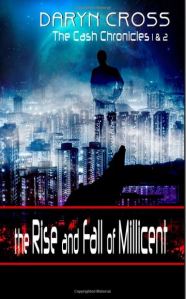
What is the glue that holds this series together, the constants? Think of one or a small number. In my series The Cash Chronicles—which was just released in print this month with The Rise and Fall of Millicent—the story centers around a dystopian word where the U.S. no longer has part of its land mass and has come under the tyrannical rule of the Primera, a woman who was cryogenically frozen and then cloned at a later date in the future. If you use the same locations each time, make sure these locations, their places, etc., stay the same in each book.
5. Do the hero and heroine stay the same in every book or do they change?
If the hero and heroine are the same, how will you ensure that they can hold your readers from book to book? What is suspenseful that continues to propel readers forward? If hero and heroine change, what continuity do you bring over from earlier books?
6. Tone of the books—needs to stay similar.
You can’t have one dark and one light, one funny and one somber, one sweet and one ultra hot. The transition between books need to be smooth like a nice glass of wine or a great piece of jazz music.
7. Keeping all the characters straight—do you have them written down somewhere, including physical and personality details?
This is very hard after you write 80—100,000 words times three or four or five. Write down all your characters, their idiosyncrasies, their traits so you can reference to make sure they stay the same. Even if they’re short-term in the book or the series, you need to keep track of the names and using the same letters, etc. Consider doing some back-story, other things about what make them who they are. You may want to do a companion book like Sherrilyn Kenyon did for the Dark Hunter series.
8. Website—does your world have its own distinct website?
This may be a good idea if the series is long. Always be ready to greet your readers and fans with information to whet their reading appetites.
I hope this has gotten you to start thinking, or maybe a single title sounds real good about now…
Bobbye Terry is the multi-published writer of fantasy, suspense and romantic comedy novels under her own name, her solo pseudonym, Daryn Cross, and her co-authored one, Terry Campbell. She also writes inspirational nonfiction. Her previous works have garnered finalist awards in the Booksellers’ Best and other RWA-sponsored contests. Bobbye’s most recent release is The Rise and Fall of Millicent by Daryn Cross, In the Stillness Publications. Nothing Ever Happens in Briny Bay, a compilation of the novellas in the Briny Bay mystery series by Bobbye Terry, will release this summer through Turquoise Morning Press. Additionally, she has a new inspirational book, The Light Within released in May 2013 and another Joy Glows, which will release mid-July.

Bobbye Terry
Seeking feedback: the importance of critique partners
Posted: June 9, 2013 Filed under: On writing | Tags: beta readers, editing, writing 12 Comments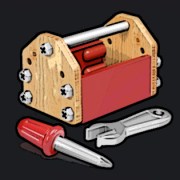
Writer’s toolbox: an artist’s impression. (Original photo from wiki commons.)
Stephen King—who is pretty much the god of writing as far as I’m concerned—said writers should write with the door closed, and edit with the door open. In other words, once you’ve done your first draft, you need to let a few people, people you trust to be honest without being cruel, read it and give you some feedback. These crit partners are often referred to as “beta readers”.
The way you might choose to approach getting that feedback, though, is up to you. There are two basic approaches.
The perfectionist writer lets the drafted manuscript percolate for a month or so, then re-reads it and does a first-round edit on it before letting anyone else lay eyes on it.
Pros: This is a great approach if you want to make sure that your beta readers aren’t going to be distracted by random typos or plot holes you could drive a semitrailer through.
Cons: It’s possible to get stuck in a cycle of editing and re-editing—possibly induced by fear, the mother of procrastination—and never actually let go of your baby enough to give it to someone else.
The sharer is a writer who completes their first draft and then sends it straight out to all their beta readers.
Pros: You can get an idea of where the weaknesses are early, so when you do your first edit you can fix them straight away, rather than tinkering around the edges, working on things that may have bigger problems—the writing equivalent of putting a coat of paint on a car whose engine doesn’t work.
Cons: There will be problems with the first draft—and many of them will be problems you could have fixed if you’d taken the time. That means your beta readers will have a lot more to criticise, which can be a blow to the ego—potentially a fatal one if you’re a new writer struggling with self-doubt.
Both of these approaches work for people, and both have things to offer. But I have writing friends who actually use a middle ground approach, by using an alpha reader.
The alpha reader is the one person you trust to give you the feedback on your raw work. They see it before you edit, and help you shape the direction of your work, but without stomping your heart into the floor. A lot of people use their significant others for this. I know of some that actually give their chapters to their alpha reader as they are completed, before the entire work is finished. This has the benefit of egging them on to write, but you’d want to choose your alpha reader even more carefully in this case, to make sure you don’t get sucked into doing revisions when you should be drafting in the first place.
My boyfriend is my alpha reader. I wouldn’t show him, or anyone, an incomplete manuscript—I’ve feel like I’ve only just become brave enough to share it with others in the first place!—but I do brainstorm with him when I come up against a difficulty in the plot.
For example, I realised recently that my current work in progress was going to run short if I continued to follow my outline. It’s an adult (or possibly new adult) manuscript, and it was looking like tapering out at about 50k words—around 30k shorter than I was aiming for. I explained where the story was up to and what the antagonist’s resources and plans were, and he came up with a few suggestions for things the antagonist could do to throw spanners in the works—even more spanners than I already had. A whole toolbox of spanners.
It helps that my boyfriend is an evil genius, of course.
What is your approach to getting feedback on your writing? Do you fall into any of the camps I’ve described, or is your approach different again? I’d love to hear from you!
The Business of Writing: Reblogged from the Daily Dahlia
Posted: May 30, 2013 Filed under: On writing | Tags: writing Leave a commentThis is a great post about some of the things you need to do if you want to be an author. You should follow Dahlia’s blog if you don’t already, because her posts are insightful and packed full of juicy, useful information.

You know when all of a sudden all these things converge at once and kind of spin your world on its axis a bit with the way they all play into one another to give you some sort of epiphany? That was this past week for me. All of these things happened so close together that made me think about the business of writing. Which doesn’t mean writing as a thing that keeps you busy; it means what it means to decide you want to be a capital-A Author, a person who makes this a full-time, this-is-my-life career.
For a really long time, I didn’t. I refused to show anything I wrote to anyone. The only reason I even queried when I did, after so many years of writing, is because my husband had just started law school and we were broke and I felt like I should try something
View original post 1,091 more words
Imprecise use of pronouns, with Doctor Who!
Posted: May 20, 2013 Filed under: On writing | Tags: editing, pronouns, television, writing 7 CommentsHave you entered my double Amazon giveaway yet, which I’m running to celebrate my book deal and 1000 Twitter followers? The details are here.
One thing I see a lot at work is people using pronouns imprecisely. There was a great example in pop culture over the weekend with the season finale of Doctor Who, where an imprecise pronoun was actually used as a plot device. I’ll explain below what I mean, so please take this as your spoiler alert if you haven’t seen the episode yet! The spoiler material will be at the bottom of the post, beneath the delicious, delicious picture of David Tennant…
First, what is a pronoun? Here’s a dictionary definition.
Pronoun noun
1. one of the major form classes, or parts of speech, comprising words used as substitutes for nouns.
2. any such word, such as I, you, he, she, it, this, who, what, they, us, them.
Basically, it’s a word we use as a substitute for a noun (or a proper noun, like a name), to avoid repeating the noun. Here are a few examples:
Cassandra is writing a post on grammar because she (Cassandra) is a grammar geek.
Cassandra admired the Doctor Who script because it (the script) took advantage of poor grammar.
Where you need to be cautious is where the antecedent (the noun to which the pronoun is referring) is unclear. I find this happens a lot in my writing where there are two people of the same sex acting in a scene. For example:
Leander didn’t like Brad, because he was jealous.
Who is jealous? Brad or Leander? To make it clear, we need to rewrite the sentence.
Jealous, Leander didn’t like Brad.
(Better would be something like “Jealousy drove Leander’s dislike of Brad.”) In this case, the rewrite actually removed the pronoun—which is more elegant than repeating Leander’s name. That won’t always be the case.
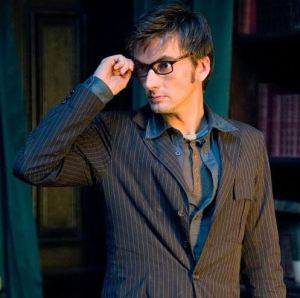
Grammar is cool. (Image belongs to BBC; no copyright infringement intended, although perving definitely is.)
Now, what was the example from Doctor Who? It’s this quote, from a madman:
“The Doctor has a secret he will take to the grave. It is discovered.”
Most of the characters assumed (and the viewer was meant to assume) that the “it” was the secret. It’s logical assumption, because secrets are more traditionally discovered than graves. But in this case, the secret was actually secondary; it was the discovery of the grave that was significant. The Doctor and River both realised this as soon as they heard the quote, but they had the advantage of knowing what Trenzalore (the place mentioned in the context of the madman’s quote) was.
I think as writers we can take a lesson from this example. (Note that I added “example” after the pronoun “this” just then, because otherwise there are a lot of things preceding it to which it could have referred.) And the lesson is this one: avoid unclear antecedents for pronouns … unless you’re using it deliberately, as a plot device. Then go nuts.
Or, to paraphrase the English poet Robert Graves, master the rules of grammar before you attempt to bend or break them. :p
Website design: creating an attractive author image
Posted: May 9, 2013 Filed under: On social media | Tags: blogging, guest post, social-media, websites, writing 2 CommentsToday’s guest post is by Amber A. Bardan, contemporary and paranormal romance writer and winner of North Texas Romance Writers of America‘s 2013 Great Expectations.
I’m so excited to be guest blogging for Cassandra today! I thought I’d blog about something I know a little be about. My day job (as in the job that actually pays me money so I can spend the rest of the time writing) is as a Web and Graphic Designer. Let’s face it the reason you get an author website is so publishers and agents can look you up and see that you appear professional. Obviously you want your website or blog to look pretty, and thereby enhance your professional image.
It’s also the foundation of your one day ‘published author’ platform. I want to stop here a moment and say something; at the end of the day your writing is what is going to sell you – everything else is secondary so don’t stress too much if you have no domain, few blog followers, and only a couple of Twitter followers. These things are only a complement to good writing.
However, the advantage of setting yourself up professionally is that other writers, prospective readers or whomever our blog/website is targeting are far more likely to take you seriously if you look the part. So here are my tips on creating a good looking author website.
Creating Strong Visual Appeal
· Keep it simple
Look at the majority of successful bloggers and aspiring writers; their blogs and websites are usually simple. If not, they usually have professionally designed themes.
Either way they are not generally loaded with photos, images, clip art, hundreds of colors or varying text sizes—it’s simple and consistent.
· Quality graphics
If you are going to use graphics to enrich your website or blog make sure they are good quality, royalty-free images. Nothing looks worse than tacky clipart on a website. Sites like Shutterstock, iStock and Dreamstime have millions of beautiful, professional images available to purchase for a very small fee. You only need one great image to create a website background or blog banner.
· Color Choice
This is the biggest problem with DIY websites and blogs! We all know ‘those’ websites with black background and yellow or magenta text… Apart from not being visually appealing, color choice effects visibility and your website’s or blog’s accessibility.
Chose two colors—with big contrast. You might introduce a third color for enhancement, but only use it with a light hand.
De-saturated colors work well. But always use web-safe colors (no neon yellow or magenta)
When using a color for a background or text I suggest always pairing it with white. For example, with a dusky blue background, use white text. With a white background, use dusky blue text. You can use more than one color against white, such as a white background with a dusky blue text and pale blue embellishments, but never put a colored text on a colored background.
· Templates and Professionals
Another option is to purchase professional services in the form of professional web design or web/blog templates. This option can give you a very professional and individual result—if you choose your source wisely. Of course, custom is the most expensive option but there are more affordable templates available from template stores for a small cost (some are even free). If you do choose this option ensure you do your research; look at portfolios and get a good understanding of what is included, what you need to do yourself, and total costs.
You can find Amber on Twitter or at her blog.


 Cassandra Page