Review: ‘Remember Me’ by Stacey Nash (Collective #2)
Posted: October 11, 2014 Filed under: Reviews | Tags: aussie-owned, AWW, reviews, sci-fi 3 Comments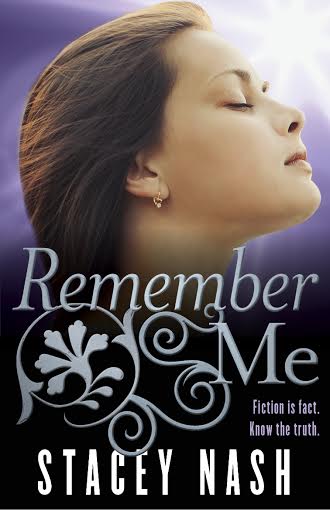
When all is lost, she must remember…
Anamae Gilbert managed to thwart The Collective and rescue her father, even though his mind is now a shell. Determined to stop Councilor Manvyke hurting her family again, she’s training to become an active resistance member and enjoying a growing romance. But things never sail along smoothly – Manvyke wants retribution. And Anamae’s name is high on his list.
After a blow to the head, she awakes in an unfamiliar location. Anamae can’t remember the last few weeks and she can’t believe the fascinating new technology she’s seeing. She’s the new kid at school and weapons training comes with ease, but something feels off. Why does the other new kid’s smile make her heart ache?
And why does she get the feeling these people are deadly?
I have been waiting for this book to come out for the past eight months, since I finished the first book in the series, Forget Me Not. And when it did come out I read it in just over 24 hours — it would’ve been sooner except that I had to work. Pesky work! (Why can’t someone just pay me to read all day?)
Now, I need to start with a disclaimer: Stacey Nash is a very good friend of mine. I adore her and her writing. So in the interests of fairness and an unbiased review, I’ll follow up with this: I did see a handful of typoes throughout Remember Me. THERE, I SAID IT.
Now let me move onto all the things I loved about this book!
In a way I’m regretting giving Forget Me Not a five-star rating, because I feel like Remember Me deserves at least an extra half star. It’s because the first book is the discovery story, whereas in this second book we get to peel back additional layers of this interesting world and see what’s underneath.
You’ll see from reading the blurb that Anamae loses her memory and wakes up somewhere strange. I initially assumed she’d just forgotten all of her resistence friends (with amnesia they would be strange to her), so I was intrigued to discover she’d been taken by the Collective. This meant we got to see their world through a stranger’s eyes — in Forget Me Not they were a faceless, well, collective, but in Remember Me we see that it’s not all black and white after all. There are factions and an interesting, Illuminati-style creation myth.
The other thing we get in the sequel is a dual point of view, split between Anamae and her best friend, Will — who is still with the resistence fighters. He goes a little crazy at the start of Remember Me after Anamae is taken. In the same way that she rushed into danger to try and save her dad in the first book, he doesn’t exactly think through his actions in trying to save Mae. To give him credit, though, he does realise after a while that he’s behaving rashly, and since he loves Mae I forgave him.
My other favourite character in this book is Lilly, daughter of the resistance leader. I love how determined she was not to be over-protected by her father. I think when Mae breaks Will’s heart (which I’m just assuming is going to happen because she’s still all googly-eyed for Jax), Lilly would look after it and nurse it back to health.
Yes, I’m planning the futures of these characters. I told you I love this book!

Review: ‘These Broken Stars’ by Amie Kaufman and Meagan Spooner
Posted: September 22, 2014 Filed under: Reviews | Tags: AWW, reviews, sci-fi 4 Comments
It’s a night like any other on board the Icarus. Then catastrophe strikes: the massive luxury spaceliner is yanked out of hyperspace and plummets into the nearest planet. Lilac LaRoux and Tarver Merendsen survive. And they seem to be alone.
Lilac is the daughter of the richest man in the universe. Tarver comes from nothing, a young war hero who learned long ago that girls like Lilac are more trouble than they’re worth. But with only each other to rely on, Lilac and Tarver must work together, making a tortuous journey across the eerie, deserted terrain to seek help.
Then, against all odds, Lilac and Tarver find a strange blessing in the tragedy that has thrown them into each other’s arms. Without the hope of a future together in their own world, they begin to wonder—would they be better off staying here forever?
Everything changes when they uncover the truth behind the chilling whispers that haunt their every step. Lilac and Tarver may find a way off this planet. But they won’t be the same people who landed on it.
These Broken Stars is my kind of science fiction story; that is, I didn’t need to have a degree in astrophysics or robotic engineering to follow the intricacies of the plot. I’m sure there’s a name for that kind of sci-fi, but I call it “soft”, as opposed to the hard, science-y sort. Another name for it would be “science-magic” — don’t ask how the science works; IT JUST DOES. Wibbly wobbly, timey wimey stuff.
In fact, most of this story actually takes place on the surface of a planet and is relatively low-tech. It’s more of a survival stories. And I love survival stories. LOVE THEM. It’s one of the reasons the first two books in The Hunger Games trilogy were five-star reads for me. I’ve seen some reviewers comment that the slogging-across-the-countryside stuff bored them a little, but not me. There was just enough juicy plot being revealed as the journey took place, and enough obstacles thrown in Lilac and Tarver’s path, to make it interesting.
Lilac and Tarver are great. The alternating point of view in (almost) each chapter gives us some great insights into their personalities, without which I probably would’ve written Lilac off as a spoiled society girl in the first ten seconds. As it is, being able to see how she’s feeling and thinking about things, and those glimpses of technical competence, made her a much more interesting personality. She still grows tremendously during the story, though; the journey gives her a new strength. Tarver is already a more well-rounded person, so his story is less about personal growth and more about the challenges of the situation he’s been thrust into.
The only qualm I had about Lilac and Tarver was their ages. Tarver is a war hero at 18, while Lilac is a 16-year-old princess (figuratively speaking) with a knack for electronics. I get that in this world people are being forced into adulthood younger — Tarver enlisted at 16 — but it still weirded me out every time I was reminded of their age.
On another note, I mentioned that the plot was juicy. There’s a twist in here that made me GOL (that’s “gasp out loud”). Loved it. I also really enjoyed the little interview excerpts with Tarver between each chapter, where he’s being interrogated post-rescue. They do make it clear from the first chapter that he, at least, survives the crash, but the questions they raise in turn piqued my curiosity.
The only thing that makes me sad is that I see the sequel follows another couple. I hope we get to see more of Lilac and Tarver down the track.
Oh, and since Amie Kaufman is from Melbourne (even though Meagan Spooner is an American), this TOTALLY counts for my Australian Women Writers challenge. 😉

Review: ‘Stormcaller’ by R.K. MacPherson
Posted: September 20, 2014 Filed under: Reviews | Tags: GLTB, reviews, urban fantasy 1 Comment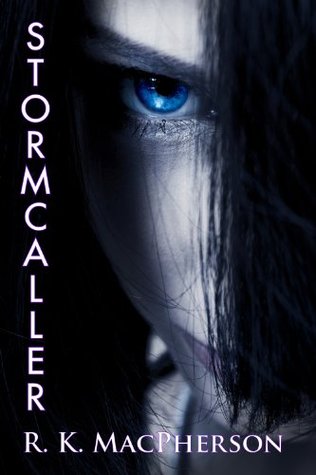
Power always carries a price…
For Isaura Durand, homeless life on the streets of Seattle posed plenty of challenges. She didn’t ask to become a witch. She didn’t understand how it would change her, but when she awakens to her power, Isaura finds herself plunged into a brutal struggle with dark forces.
Thrust into the heart of Seattle’s eldritch world, Isaura uncovers a series of ritual sacrifices designed to unleash magic’s true power upon the world.
Allied with a grumpy Norwegian mage, a Native American shaman on a Harley, and a beautiful medic, Isaura must overcome her own demons and her growing list of enemies. Victory is anything but certain, and to survive, Isaura must embrace her potential and become the…
STORMCALLER
Before I start this review, I should point out that I’m an editor in my day job, which means that I am among the world’s worst grammar nazis. I say this because Stormcaller is a book with so much potential, and you may not be as sensitive to its flaws as I am.
The story is fast-paced; we’re thrown into the action from the start, with Isaura waking up to her new magical powers and immediately nearly having her face eaten off by a demon. The fight scenes, especially the way Marius does his magic, remind me of Final Fantasy, one of my favourite computer game franchises. There’s also a sweet romance between Isaura and Chloe (yay, diversity!), which I loved.
The banter between Isaura, her mentor Coyote (aka Jack), and Marius — the mage who takes her in after her powers awaken — is golden, and often had me in stitches. Isaura causes a lot of her own problems, with her extremely poor lack of self control; at one point Marius describes her as having “the impulse control of a hyperactive chaos demon”. #nailedit
So Stormcaller is a good book. It could have been a mindblowing book with a professional edit. Part of it was a number of copy-editing issues, which is why I mention the grammar nazi thing upfront. The other niggles I had were with things that I’d like to imagine a good editor would’ve pointed out.
One is that the story takes a while to really get flowing, in that there are some kinks in the first few chapters. (Marius takes her in after her initiation, letting her sleep in his shop, but the circumstances were a little confusing to me. Once he gets the flat, it sorts itself out.)
Another issue was the unexpected heat level of the sex scene between Isaura and Chloe. Although both girls are around 18, the book reads like a young adult until you get to this scene, which is, ahem, quite explicit. Not to the point of being outright erotica, but it’s pretty close.
Finally, and I admit this is quite minor, Marius’s brother is named Darius. I regularly got confused about who we were discussing. (I’m easily confused.) :p
This is a regretful 3.5 stars for me — regretful as it’s exactly the sort of story I love: urban fantasy with a strong female lead and a well-developed magic system. The lesbian relationship was something I haven’t read much of, but I loved that too.

Review: ‘The Song of Achilles’ by Madeline Miller
Posted: September 18, 2014 Filed under: Reviews | Tags: GLTB, reviews 1 Comment
Greece in the age of Heroes. Patroclus, an awkward young prince, has been exiled to the kingdom of Phthia. Here he is nobody, just another unwanted boy living in the shadow of King Peleus and his golden son, Achilles.
Achilles, ‘best of all the Greeks’, is everything Patroclus is not — strong, beautiful, the child of a goddess — and by all rights their paths should never cross. Yet one day, Achilles takes the shamed prince under his wing and soon their tentative companionship gives way to a steadfast friendship. As they grow into young men skilled in the arts of war and medicine, their bond blossoms into something far deeper — despite the displeasure of Achilles’s mother Thetis, a cruel and deathly pale sea goddess with a hatred of mortals.
Fate is never far from the heels of Achilles. When word comes that Helen of Sparta has been kidnapped, the men of Greece are called upon to lay siege to Troy in her name. Seduced by the promise of a glorious destiny, Achilles joins their cause. Torn between love and fear for his friend, Patroclus follows Achilles into war, little knowing that the years that follow will test everything they have learned, everything they hold dear. And that, before he is ready, he will be forced to surrender his friend to the hands of Fate.
Profoundly moving and breathtakingly original, this rendering of the epic Trojan War is a dazzling feat of the imagination, a devastating love story, and an almighty battle between gods and kings, peace and glory, immortal fame and the human heart.
Anyone who’s followed my reviews for a while will know this isn’t my normal sort of read. However, since I finished drafting the last book in the Isla’s Inheritance trilogy, I’ve turned my mind — between edits — to my next project, which I want to set in a fantasy version of Ancient Greece. So recently I’ve been reading a bit of historical non-fiction, and some hist fic.
I haven’t reviewed any of that here on the blog, but I loved The Song of Achilles so much I thought it was worth a mention. I actually listened to this as an audiobook that I downloaded as part of an Audible trial, and I’m not sure if the fabulous voice acting of influenced how much I love it. It may have done — I did wonder a couple of times whether I would’ve lost patience with the way the narrator, Patroclus, lingers lovingly over descriptions of Achilles if I was reading it. Listening to it was sometimes like listening to a poetry recital, it was so beautiful.
And beautiful is really the only way to describe this book, even though parts of it are “ugly” in the traditional sense. Miller doesn’t spare us any details of the bloody violence of war, just as she doesn’t spare any details of Achilles’ nimble feet or his golden hair.
If you’ve read the Illiad or studied Ancient Greek legends, you’ll know that the Trojan War didn’t end well for Achilles; the entire story of this novel arises from his best friend and lover Patroclus’s determination that he be remembered not just as a brutal killer but as a talented lyre player, as quick to laugh as he was haughty. (And he was haughty; Patroclus doesn’t have entirely rose-coloured glasses and definitely lets us see Achilles’ arrogance.) Nevertheless, by a third of the way through the story I was in love with Achilles, and by halfway through I loved Patroclus too.
There are sex scenes, but they are more romantic than explicit — it’s entangled limbs and hot kisses rather than…well, you know. (You do know, right?) Also, at the risk of stating the obvious, Patroclus and Achilles are both male, so if that sort of thing bothers you, this may not be your book.
On the other hand, if you want to read a beautiful and tragic story with an eternal romance and an uplifting ending, this may be the book for you. Song of Achilles earned every star!
Review: ‘Unhinged’ by A. G. Howard
Posted: September 13, 2014 Filed under: Reviews | Tags: reviews, urban fantasy, young adult Leave a comment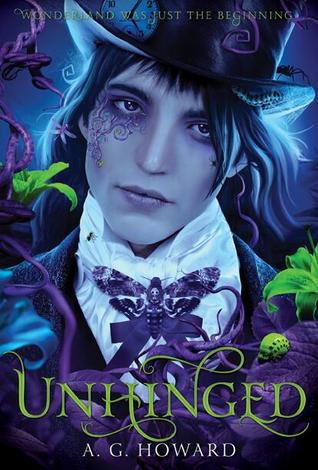
Alyssa Gardner has been down the rabbit hole and faced the bandersnatch. She saved the life of Jeb, the guy she loves, and escaped the machinations of the disturbingly seductive Morpheus and the vindictive Queen Red. Now all she has to do is graduate high school and make it through prom so she can attend the prestigious art school in London she’s always dreamed of.
That would be easier without her mother, freshly released from an asylum, acting overly protective and suspicious. And it would be much simpler if the mysterious Morpheus didn’t show up for school one day to tempt her with another dangerous quest in the dark, challenging Wonderland — where she (partly) belongs.
As prom and graduation creep closer, Alyssa juggles Morpheus’s unsettling presence in her real world with trying to tell Jeb the truth about a past he’s forgotten. Glimpses of Wonderland start to bleed through her art and into her world in very disturbing ways, and Morpheus warns that Queen Red won’t be far behind.
If Alyssa stays in the human realm, she could endanger Jeb, her parents, and everyone she loves. But if she steps through the rabbit hole again, she’ll face a deadly battle that could cost more than just her head.
I commented on a friend’s blog the other day about how it’s so true that when in your life you read a book has a huge impact on how you (well, I) feel about a book. Unhinged may be a good example of that … or maybe it is simply a better book than the first in the series, Splintered. (My review of Splintered is here if you want to compare.)
I read Unhinged in less than 24 hours; I read the first third while I was waiting to have surgery, and the rest of it after I’d had surgery, that night and the next morning. There were a lot of drugs in my system at the time. Maybe that enhanced the experience. I was a little worried that the book would have a lot of trippy Wonderland scenes in it, but it didn’t — which maybe is a good thing, because I didn’t really need a general anaesthetic Wonderland dream scaring the hell out of me!
This preamble is by way of telling you that while I loved the book, I couldn’t give you a blow-by-blow account of the plot if I tried. But that’s ok, because I never summarise the plot when I write a review anyway. (Why do people do that?) 😉
Unhinged is mostly set in the human world. Alyssa is determined to live her normal life and not give in to Morpheus’s demands that she abandon everything and live in Wonderland. I really respected her determination to do so, for a few reasons. One is that she has a family and friends, and a boyfriend, and it would’ve been more than a little crazy if she’d just run off. I also liked that as a lead she had the spine to stand up to the demanding bad boy, Morpheus, and say no. Not that many YA heroines achieve that.
It was a little unfortunate that she didn’t try and integrate both sides of her nature a little better in between the first and second books, but that’s one of the major plot arcs of Unhinged. There was character growth there, and it was very satisfying to see.
I still wasn’t wild about Alyssa’s boyfriend, Jeb. He’s not as physically domineering in book two, but I can’t help but feel that’s because he was off camera (so to speak) for a large part of it, so he never really got the opportunity. He does become a bit of a damsel in distress at one point, and she has to rescue him; I enjoyed the role reversal.
On the other hand, Morpheus, the other player in this love triangle, was very much front and centre, and just as charming, manipulative and obnoxious as he was in the first book. In a love triangle I usually prefer the nicer guy, the boy next door. In this book the choice is between a boy who does happen to live next door (Jeb) but whose attitude I don’t much like, and the bad boy who — while he no doubt has his appeal — is way too deceptive for me to cheer for him wholeheartedly. Instead, I find I’m on Team Alyssa; I want her to choose the guy who mends his ways and ultimately earns her respect and trust.
I am kinda hoping that’s Morpheus, though… 😉
One thing I didn’t notice in Unhinged that bothered me in Splintered was the over-the-top descriptions of clothing and settings. The setting descriptions weren’t as necessary, I guess, because it was mostly set in the human world. I’m not sure if the clothing descriptions weren’t as intense or if I was just less sensitive to it. (See previous comment about lots of drugs in my system.) Either way, it didn’t bother me this time around.
I’m really looking forward to the last book in this trilogy, whose cover is just as gorgeous as the first two. Did Howard hit the cover artist jackpot or what?!
Review: ‘Dancing on Knives’ by Kate Forsyth
Posted: September 4, 2014 Filed under: Reviews | Tags: AWW, reviews 1 Comment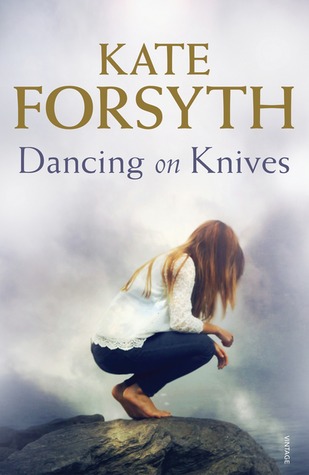
At twenty, Sara is tormented by an inexplicable terror so profound she hasn’t left her home in five years. Like the mermaid in the fairytale her Spanish grandmother once told her, Sara imagines she is Dancing on Knives, unable to speak. She feels suffocated by her family, especially her father – the famous artist Augusto Sanchez – whose volcanic passions dominate their lives.
Then one stormy night, her father does not come home. His body is found dangling from a cliff face. Astonishingly, he is still alive, but the mystery of his fall can only be solved by the revelation of long-held family secrets.
At once a suspenseful murder mystery and a lyrical love story, Dancing on Knives is about how family can constrict and liberate us, how art can be both joyous and destructive, and how strength can be found in the unlikeliest places.
This book was a really hard read, you guys. Really hard.
I went into it not knowing exactly what to expect. I was hoping it might be urban fantasy, given the Little Mermaid reference in the title. Kate Forsyth has written a lot of fantasy and magic realism, and Dancing on Knives could be loosely described as the latter, but it really is closer to straight adult contemporary.
I would’ve picked it up anyway, because I love Kate Forsyth, but I thought you should know, just in case that’s not your thing.
The story, told from Sara’s point of view, covers both a single Easter weekend and her entire lifetime, alternating between the two. I want to say it jumped around between times, but that might make you think it felt disjointed. It didn’t. I never had a problem following with the story, so masterfully did Kate handle the transitions. And her prose is beautiful. Heart-wrenchingly beautiful. (Also, it often made me hungry. Her descriptions of food are to die for.)
So why do I say it was a hard read? Because Sara’s life is awful. This is a girl who has hit rock-bottom, crushed by the huge, passionate and abusive personality of her father, a famous Australian-Italian painter named Augusto Sanchez. I suspect if Augusto hadn’t fallen over that cliff in the first chapter (no spoiler: it’s in the blurb), I might not have been able to finish this, as much as I adored Kate’s writing. Knowing how he ended up gave me the strength to read about how he lived until that point.
Augusto is truly awful — verbally abusive, degrading those he should uplift, womanising, drinking, wasting money while his kids struggle to make ends meet. But at the same time, during some of Sara’s flashbacks, you caught glimpses of why she stuck around, hoping for the good times to come back — in the same way an abused spouse craves the happy moments when they aren’t being thrown against a wall. She blames herself for his behaviour, because she should have known better than to do things that made him angry.
I hated him. A lot. I just wish I’d pushed him off the cliff.
Happily, in the course of figuring out what happened to her father that day, Sara also starts to find the strength to stand up for herself, and to escape her prison for good. The ending is uplifting. But I can still only give the book four stars, because reading it made me melancholy. I was sad about other things in my life, and reading Dancing on Knives to distract myself was maybe the dumbest thing I could have done at the time.
If I’d read this another time, maybe it would’ve been a five-star read. I don’t know. But if you like contemporary novels that look at hard issues with beautiful writing, this may be the one for you.

Review: ‘We Were Liars’ by E. Lockhart
Posted: August 28, 2014 Filed under: Reviews | Tags: reviews, young adult Leave a comment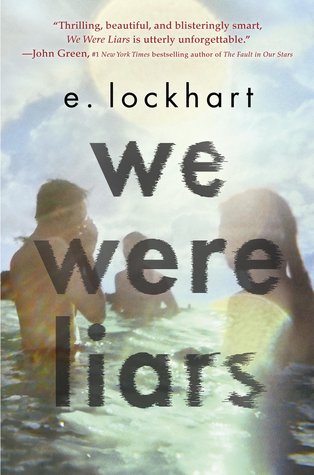
A beautiful and distinguished family.
A private island.
A brilliant, damaged girl; a passionate, political boy.
A group of four friends—the Liars—whose friendship turns destructive.
A revolution. An accident. A secret.
Lies upon lies.
True love.
The truth.We Were Liars is a modern, sophisticated suspense novel from National Book Award finalist and Printz Award honoree E. Lockhart.
Read it.
And if anyone asks you how it ends, just LIE.
A lot of friends have raved about this book. A LOT. I ordered it out of curiosity and then got a little nervous about reading it. I’m a bit of a snob for commercial fiction, if that’s a thing. Literary fiction where nothing much seems to happen bores me. And literary fiction where none of the characters are likeable makes me cross; at university I did a review presentation of a litfic book where I got up in class and said the main character should just stop whining and being an ass to everyone.
I got pretty good marks for that class.
I’m not sure if We Were Liars is literary in the purest sense, but it has some of the trappings of literary fiction.
So. I was nervous. But also intrigued, because the blurb, as you can see, makes a big deal about keeping the plot twist a secret, and my friends were being all cagey. “What is this thing?” I thought to myself. “I must know.”
I read the book yesterday evening.
That’s the first thing. We Were Liars is a short read. In the end, that’s one of the reasons I picked it up when I did; I didn’t want to dive into something huge. In this case, its (lack of) length is a virtue — it meant that the various plot revelations moved at a decent pace, which stopped me from getting bogged down in the occasionally dense prose.
The Prose
We Were Liars is written in a very choppy, fragmented style. The chapters are short — often a single page — and Lockhart makes great use of sentence fragments. I didn’t mind those, but one thing that drove me nuts was the way she
put in line breaks
when the main
character
was felling intense emotion.
Every time I hit one of these little snippets of poetry — usually when Cady, said main character, kissed her love interest, but occasionally at other times — it jarred me right out of the moment and I had to re-read the sentence two or three times to make sense of it. Ick.
On the other hand, interspersed throughout the book are these little fairytales Cady writes about a king and his three beautiful daughters. They are metaphors for Cady’s mother and two aunts, and their rather awful father. I quite enjoyed those.
The characters
The first two things you encounter in this book are a map of the island (largely unecessary but a nice touch), and a family tree. During the first part of the book, I got so confused by all the names that I flicked back to that family tree every other paragraph. I did eventually — more or less — get a handle on who was who, but Lockhart doesn’t take the time to introduce you gently. She throws you in the deep end.
Cady is a somewhat insufferable, priviliged girl who doesn’t really understand how lucky she is until it’s pointed out to her — and even then, she doesn’t really get it. Every summer she and her family go to her grandfather’s private island (as you do). She hangs out with the two other cousins her age, Johnny and Mirren, and Johnny’s best friend, Gat. Gat is American Indian and is the only one that calls the cousins out on just how lucky they are. I quite liked Gat.
On the other hand, I had mixed feelings about Cady. Honestly, I’m not sure we’re meant to like her that much. The way she tells her story is quite detached and often cold. As an example, her offhanded comments about not knowing the names of the long-term household staff was a bit of a shock. (At least by the end she knows their names. She does grow, so she gets points for that.)
For reasons I don’t understand, once Gat starts coming to the island the rest of the family begins calling the gang of four “the Liars”. I wish this had been explained better, because they don’t seem particularly deceptive for the most part. The label didn’t fit, and felt a bit too much like the writer was trying to be clever.
The story
When Cady and the rest of the “Liars” are fifteen, Cady has an accident and winds up with amnesia and crippling migraines. The accident leaves her with a curious lack of telltale scars, which would have rendered her less beautiful, when being a beautiful member of her family was one of her defining characteristics. (Scars would have also tipped the reader off to a certain extent as to the nature of the accident, and undermined the TA-DA moment at the end.)
Two years later, she goes back to the island and starts to unravel the mystery of what happened that summer.
I’m not going to go into details. There’s very little you can say about this plot that isn’t totally spoileriffic. I didn’t guess the plot twist (although I had suspicions heading in that general direction), so that was kind of neat. And I didn’t hate it; it was interesting enough that after I finished the book I flicked back through the pages for half an hour, revisiting certain scenes to admire the foreshadowing. It did feel a tiny bit derivative, but not so much that it bothered me.
One thing the ending didn’t do was make me cry. Maybe that makes me a bit of a robot, or maybe it’s a sign that the book just didn’t pull me in as much as it did others.
I’m giving We Were Liars 3.5 stars. It interested me enough that I stayed up past my bedtime to finish it in one sitting (with a break to watch the new Doctor Who), but I wouldn’t read it again.
Review: ‘Servants of the Storm’ by Delilah S. Dawson
Posted: August 21, 2014 Filed under: Reviews | Tags: delilah s. dawson, horror, reviews, urban fantasy, young adult 2 Comments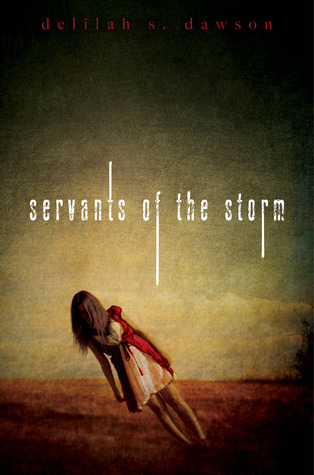
A year ago Hurricane Josephine swept through Savannah, Georgia, leaving behind nothing but death and destruction — and taking the life of Dovey’s best friend, Carly. Since that night, Dovey has been in a medicated haze, numb to everything around her.
But recently she’s started to believe she’s seeing things that can’t be real … including Carly at their favorite cafe. Determined to learn the truth, Dovey stops taking her pills. And the world that opens up to her is unlike anything she could have imagined.
As Dovey slips deeper into the shadowy corners of Savannah — where the dark and horrifying secrets lurk — she learns that the storm that destroyed her city and stole her friend was much more than a force of nature. And now the sinister beings truly responsible are out to finish what they started.
Dovey’s running out of time and torn between two paths. Will she trust her childhood friend Baker, who can’t see the threatening darkness but promises to never give up on Dovey and Carly? Or will she plot with the sexy stranger, Isaac, who offers all the answers — for a price? Soon Dovey realizes that the danger closing in has little to do with Carly … and everything to do with Dovey herself.
This is a book that is going to polarise people. I gave it five stars so clearly I’m in the “I loved it” category, but I can’t think of the last time a book pulled the rug out from under me in the last chapter like this one did. I lay awake half the night thinking about it. If there were a sequel available for me to read RIGHT NOW, that wouldn’t be so bad. But there isn’t. And I want to cry a little from frustration.
I see from perusing other reviews on Goodreads that some people had assumed this was a psychological thriller, and so were disappointed when it took a supernatural turn. Although there are elements of psychological thriller to the story — Dovey spends the first part of the book coming down off heavy medication and her memory is unreliable at best — the story is more a cross between urban fantasy and horror (which I guess is where gothic fiction often sits).
There are supernatural beasties, mostly demons or their various offspring. And the horror elements are a combination of the creeping sense that something was rotten just beneath the shiny surface, and the way the book leaves you gasping, like the freaky scene right at the end of a horror movie where all is revealed. I was reminded of Silent Hill by parts of it, if you’re familiar with those games (and that movie) — the way you’d turn a corner and something that looked shabby but more-or-less normal would peel back and reveal a slice of something deeply disturbing.
Other than the amazing atmosphere, the thing that made this book for me was Dovey. I love how complex a character she is. She is deeply flawed, in that she has a one-track mind (and may or may not have been dangerously insane before the antipsychotics). Her goal, to find out what happened to her friend Carly a year before, is what inspires her to stop taking her medication, and it’s what drives her to do pretty much everything from that point on.
Sometimes her actions are almost daft, the way she dives into trouble after having been warned of the danger. The ease with which she resorts to violence as the drugs go out of her system is both a warning sign and, I have to admit, deeply satisfying (because who doesn’t love a tough main character?). But her clear and enduring love for her friend, and her natural distrust of the gorgeous but suspicious Isaac — the one providing all the warnings of danger in the first place — are the cause of her recklessness. I can respect that.
There is a bit of a love triangle here, in the typical YA way: Baker is the childhood friend with a longstanding crush, and Isaac is a little bit of a bad boy … but not that bad, really, given the other YA bad boys out there. He came across as more of a bookworm who’s fallen in with a bad crowd to me, which made me like him more than I like most bad boys. Either way, the romance is definitely a subplot, a bit of extra spice, which is how I personally like it.
If you like paranormal stories with a serious creep-factor and a dark conspiracy, then this is the book for you. Five stars.
…now, where’s my sequel? 
Review: ‘Splintered’ by A.G. Howard
Posted: August 15, 2014 Filed under: Reviews | Tags: reviews, urban fantasy, young adult Leave a comment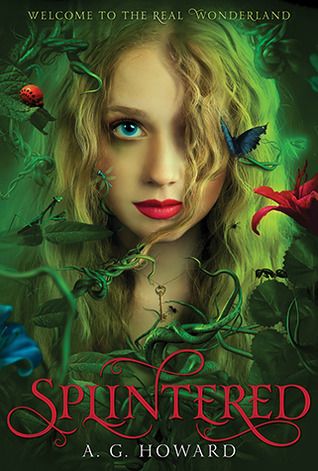
Alyssa Gardner hears the whispers of bugs and flowers—precisely the affliction that landed her mother in a mental hospital years before. This family curse stretches back to her ancestor Alice Liddell, the real-life inspiration for Lewis Carroll’s Alice’s Adventures in Wonderland. Alyssa might be crazy, but she manages to keep it together. For now.
When her mother’s mental health takes a turn for the worse, Alyssa learns that what she thought was fiction is based in terrifying reality. The real Wonderland is a place far darker and more twisted than Lewis Carroll ever let on. There, Alyssa must pass a series of tests, including draining an ocean of Alice’s tears, waking the slumbering tea party, and subduing a vicious bandersnatch, to fix Alice’s mistakes and save her family. She must also decide whom to trust: Jeb, her gorgeous best friend and secret crush, or the sexy but suspicious Morpheus, her guide through Wonderland, who may have dark motives of his own.
This book. I’m really torn about giving it four stars instead of 4.5 or five, because there are parts of it that I really love. But then there are a couple of things that annoyed me, and I deducted half a star for each. (That’s how I rate books, I’ve come to realise; I allocate them full marks and then start taking points off for things that bug me.)
Let’s start with the positive first.
Like anything inspired by Alice in Wonderland — well, anything good — Splintered has atmosphere by the bucketload. Alyssa believes that, like her mother Alison, she is crazy. She hears plants and bugs talk, and is worried that one day she’ll end up in a strait jacket pumped full of sedatives too. Even when she discovers she’s not crazy, she might as well be, because Wonderland’s laws of physics are a few sandwiches short of a picnic, if you know what I mean. Wonderland isn’t cute. It’s bloody, strange and violent. It’s not a sweet, sunlight dream; it’s a nightmare — more Tim Burton than Disney.
Fiery and independent, Alyssa is a little bit punk, a little bit skater and a little bit goth. She keeps her hair long and blond for her father, but then does her damndest to reduce any other resemblance to her mother — whom she loves but doesn’t want to emulate.
And then there’s Morpheus, the childhood “imaginary” friend who taught her everything she needs to know about Wonderland. He’s self-confident, arrogant and presumptuous, but he also trusts Alyssa to be able to handle herself and respects her desire for independence… something you can’t say about Jeb.
Jeb is the first of the negatives. He’s another childhood friend of Alyssa’s, and she’s had a crush on him forever. It’s pretty obvious he’s got a crush on her too, but for reasons that aren’t entirely clear he instead ends up dating the popular blond girl who picks on Alyssa. I suspect his own self-loathing plays a part, as does his completely infuriating desire to treat her like a small child. Maybe he doesn’t want to date her because he still thinks she’s twelve?
Regardless, I wanted to punch him in the nose a few times throughout this book. It wasn’t just that he was protective but that he was physical about it that pissed me off. When Alyssa tries to do something he thinks is dangerous, he doesn’t grab her hand and try to reason with her; he physically restrains her, lifting her off the ground like she’s a toddler. When he sees that she has a knife in her backpack, he appropriates it without even asking. When she’s offered something during the course of the quest, he takes it before she can and puts it in his pocket. WHAT THE HELL, JEB?!
He does redeem himself somewhat throughout the book, which is why it only loses half a point for his bad behaviour.
The other thing I found difficult to contend with at times was Howard’s prose. I didn’t really need a couple of paragraphs to describe each funky new outfit Alyssa wore, or what Morpheus’s hat looked like. I found every time I hit one of these paragraphs I wanted to skip it. Likewise, some of the descriptions of Wonderland itself were a trifle overblown. Not always, mind you — but it was enough that I noticed it and it would pull me out of the story. I realise that something like taste in prose is highly subjective, and others will love it; but this is my review, so nyah! :p
Despite these negatives, I still enjoyed Splintered enough that I’ll read the sequel. (As an aside, if you haven’t already, feast your eyes on that gorgeous cover for a minute. No, two minutes! Isn’t it lovely?)

Review: ‘Shimmer’ (The Rephaim #3) by Paula Weston
Posted: August 9, 2014 Filed under: Reviews | Tags: AWW, reviews, urban fantasy 3 Comments
Gaby thought her life couldn’t get more complicated.
She’s almost used to the idea that she’s not the nineteen-year-old backpacker she thought she was. She can just about cope with being one of the Rephaim—a 140-year-old half-angel—whose memories have been stolen. She’s even coming to grips with the fact that Jude, the brother she’s mourned for a year, didn’t die at all.
But now Rafa—sexy, infuriating Rafa—is being held, and hurt, by Gatekeeper demons. And Gaby has to get the bitterly divided Rephaim to work together, or Rafa has no chance at all.
It’s a race against time—and history. And it may already be too late.
(Two reviews in a row from me? I know, right?! It’s because I’m between writing one novel and the next, and it’s been so busy and stressful at work I’ve been comfort reading at night time. Anyway, enough about that. On with the review!)
Shimmer is book three of four in The Rephaim series, and I usually don’t see much point in reviewing books this far into a series. You’re presumably either reading it because you loved the first two books—and really don’t want to read spoilers—or you haven’t encountered it yet and would probably be better served by a review of the first book.
But the blurb itself contains all the spoilers I’m going to reveal: that Gaby is a Rephaim, Jude is alive and Rafa has been taken by demons. I pinkie swear.
I commented in my review of the previous book, Haze, that the first two books are set over the space of about two weeks, and how the fast pace is one of the breathtaking things about the series. Shimmer continues and accelerates that action-packed trend; the events in it are set over a total of about 24 hours. But that doesn’t mean the story is hollow. In fact, it’s packed with tension and combat, and starts to reveal more of the hidden truth about the Rephaim and others around them. The next and final book, Burn, comes out in 2015 and—if the cliff-hangery, super-exciting end of Haze is anything to go by—promises to be even more jammed full of awesome.
Also, I love these characters like you would not believe. With the exception of the demons themselves, there are very few people to hate in this—even the enigmatic politician of a fallen angel, Nathaniel, is a character I can sympathise with, despite the fact he’s frustrating as anything and blinded by his own goals. One of the interesting thing about the story is how some of the characters I really didn’t like in the first book have grown, and grown on me: Mya, Malachi, Taya and even Daniel are all good examples.
My favourite character, though, is Jude. If I could choose anyone in the world to be my long-lost twin brother, it’d be him. Although since the post of twin is taken by Gaby, I can think of other ways I could use Jude in my life. Phwoar! Just sayin’.
The romantic tension between Gaby and Rafa is, naturally, missing for a large slice of the book, since he’s, well, not in it. But we really get to see how much Gaby cares about him; all her ambivalence over the secrets he’s keeping about their past evaporates, and in turn his ambivalence about her possible reaction when she finds out those secrets falls away. I guess being tortured—or seeing your loved one tortured—by demons gives you a sense of perspective.
This is a great book and a great series. The only bad thing is that now I have to wait, like, a year to see how the story concludes. My plan is to stare at Paula Weston until she’s finished.
That’s not creepy, is it?


 Cassandra Page