Pippa Jay talks about tortured heroes and her new sci-fi release, ‘Gethyon’
Posted: June 26, 2013 Filed under: On Books | Tags: blog hop, book launch, contests, guest post 3 Comments(Note from Cass: As I’m drafting this I’m two-thirds of the way through one of Pippa’s other books, Keir. This lady’s got GAME, my friends!)
I love tortured heroes and heroines. All of mine are tormented in some way, whether mentally or physically, and if I can torture them a little a lot more, then all the better. They carry scars inside and out. Burdens of guilt and regret, for things they could have changed, and those they couldn’t. They not only have to face the fears and terrors from their past, but accept that the people who come into their lives and attempt to win their hearts can see beyond that damage to the soul inside.
As well as loving to write them, I love to read them. So I thought I’d share two of those who helped to shape my own young hero, Gethyon.
The first is a certain farm boy from the desert planet Tatooine. I saw Star Wars: A New Hope televised when I was just eight, and instantly developed a crush, as well as switching from writing fantasy to sci-fi. Poor Luke, orphaned and stuck on a world he describes as ‘if there’s a bright center to the universe, you’re on the planet that it’s farthest from’, desperate to join the rebellion and fight with his friends. A bit bratty? Well, maybe. But in quick succession he loses his home and the only family he’s known to the Empire, gets called short by the princess he wants to rescue, sees his mentor killed, gets sent to a mud-hole of a planet to train and finds out he has to face Vader to complete it. On top of that he learns the second most evil entity in the universe is Daddy! It just gets worse as he finds out his princess is actually his sister, and the Emperor is perfectly willing to sacrifice all Luke’s friends to turn him to the Dark Side. And even as good triumphs, Luke must say goodbye to his father forever. Wow!
The second is Ged from A Wizard of Earthsea, a fantasy story by Ursula Le Guin. This was my assigned English read at school, aged ten, and I’ve reread it so many times since I’ve had to replace the paperback twice! Ged, or Sparrowhawk, also begins as a brat. He’s had a hard start, motherless and used as a slave by his father. He’s arrogant, sullen, and has no friends, but he has a glimmer of power and his witch aunt sets him on the road to mastery. When he saves his entire village from marauding warriors, he’s sent to the Wizard school on Roke. But in his pride and in spite, he unleashes a shadow creature that is bound to him, and could do the greatest evil through him should he become possessed. So, scarred and humbled by his ordeal, Ged seeks out to put it right, almost losing himself in the process.
Both these young heroes had such a huge influence on my reading and my writing, and still remain two of my most memorable. So I can’t deny there isn’t a trace of them in my own tortured heroes, like Gethyon.
To celebrate the release of Gethyon, I’m giving away a pretty piece of crystal, available internationally. To enter, use the rafflecopter form and tell me in the comments who’s your favourite hero, tortured or otherwise. 
GETHYON:
A YA Science Fiction Novel
Released by Champagne Books 3rd June 2013
His father died. His mother abandoned him. In the depths of space, darkness seeks him.
Abandoned by his mother after his father’s death, Gethyon Rees feels at odds with his world and longs to travel the stars. But discovering he has the power to do so leaves him scarred for life. Worse, it alerts the Siah-dhu—a dark entity that seeks his kind for their special abilities—to his existence, and sets a bounty hunter on his trail.
When those same alien powers lead Gethyon to commit a terrible act, they also aid his escape. Marooned on the sea-world of Ulto Marinos, Gethyon and his twin sister must work off their debt to the Seagrafter captain who rescued them while Gethyon puzzles over their transportation. How has he done this? And what more is he capable of?
Before he can learn any answers, the Wardens arrive to arrest him for his crime. Can his powers save him now? And where will he end up next?
Available from Burst, Kobo, Amazon UK, Amazon US or Omnilit.

About Pippa:
A stay-at-home mum of three who spent twelve years working as an Analytical Chemist in a Metals and Minerals laboratory, Pippa Jay bases her stories on a lifetime addiction to science-fiction books and films. Somewhere along the line a touch of romance crept into her work and refused to leave. Between torturing her characters, she spends the odd free moments trying to learn guitar, indulging in freestyle street dance and drinking high-caffeine coffee. Although happily settled in historical Colchester in the UK with her husband of 20 years, she continues to roam the rest of the Universe in her head. Her works have won a SFR Galaxy Award, and finalled in the Readers Favorite Award Contest and the Gulf Coast RWA Chapter Silken Sands Self-Published Star Award.
You can find Pippa at her website or blog, or on Goodreads, Twitter, Facebook or Google+.
Why I Write Women’s Fiction
Posted: June 22, 2013 Filed under: On Books, On writing | Tags: book launch, guest post, writing 7 CommentsThis guest post is by another of my fellow authors over at Turquoise Morning Press, Linda Rettstatt.
When I first began to write, I knew very little about creating a novel-length story or of all the mechanics that went into writing. I also knew little about genre. I knew what I enjoyed reading, so it made sense to write that kind of story. My favorite author at the time was Elizabeth Berg. She is brilliant at writing character-driven stories of women—ordinary women—who find themselves in extraordinary circumstances. Her characters are the women who live next door or down the street, or who work in the next cubicle. But Berg takes the reader into the emotional and psychological depths of these women who, as they face life changes and challenges, make us—the readers—feel just a little less alone in our own struggles. She makes us laugh at ourselves.
Some might say that my own background as a psychotherapist who’s done a great deal of counseling with women would lend to writing this genre. And they would probably be right. I set out not to write like Berg, but to write stories about women facing challenges and possessing both vulnerability and strength. I targeted women readers and branded my writing as: Writing for Women—Stories of strength, love, humor and hope. These are the elements I consciously try to incorporate into every book. These are the elements I also find in the books of other writers whose work I admire. Berg, of course, Kris Radish, Elin Hilderbrand, Claire Cook—just to name a few. Kris Radish, a bestselling author in her own right, was kind of enough to give me a quote for Unconditional. Now that’s exciting, when one of the authors you most admire comments (positively) on your work. A true ‘squee’ moment.
Although I also write contemporary romance, when I sit down to write a new women’s fiction novel, it’s like slipping my feet into an old, familiar pair of shoes. They just fit right. Some have asked me, “What’s the difference? Your women’s fiction books often contain romance.” What can I say—I’m a romantic at heart. And romance is largely targeted at a female audience. I don’t think that placing my books under either heading locks them into one or the other sub-genre, but gives readers a hint that women are especially going to identify with the story and the characters. At least, that’s my hope.
Linda Rettstatt is an award-winning author who discovered her passion for writing after years of working in the human services field. When she’s not writing, Linda loves travel, nature photography, and figuring out what makes people tick. Her fantasy is to win the lottery, buy an old Victorian home on the eastern shore and open a writers’ retreat. While she waits for that fantasy to materialise, she continues to live and work in NW Mississippi and to write under the constant observation of her tuxedo cat, Binky.
You can find her at her website, blog or on Facebook or Twitter.
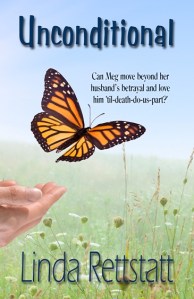
Unconditional (May, 2013, Turquoise Morning Press)
Meg Flores has it all—a loving family, a fulfilling career, and marriage to her best friend, Thomas. She is devastated when her husband announces he wants a divorce so he can pursue a relationship with his secretary—his male secretary. For Meg, the betrayal goes beyond that of a cheating husband. She is losing her best friend and the hopes for adding a child to her life.
Available from Turquoise Morning Press, or at Amazon.com, B&N.com and Smashwords.com.
Dystopian fiction and ‘Runners’
Posted: June 17, 2013 Filed under: On Books | Tags: dystopian, guest post, small presses, writing 1 CommentThis guest post is by Sharon Sant, whose new dystopian novel, Runners, came out on 7 June.
The Oxford dictionary defines dystopia as: ‘an imagined place or state in which everything is unpleasant or bad, typically a totalitarian or environmentally degraded one. The opposite of Utopia.’
That sounds like a perfect place to set a novel. And it seems that I’m not the only one who thinks so. I’ve been reading reports for some time now about how agents and publishers are sick of dystopian novels landing on their desks. According to them, since The Hunger Games, we’ve gone dystopia crazy. I hate to burst that industry bubble, but I don’t think that dystopia is going away any time soon. In fact, I don’t think it was ever really missing from the cultural landscape in one form or another. Thinking back to novels like 1984, even as far back as The Time Machine by H G Wells or Aldous Huxley’s Brave New World, it’s clear that we’ve always been fascinated by the ideas of dystopia.
As a narrative tool, dystopia can hold a mirror up to our own society to make all sorts of political and social statements, or it can be used simply to issue warnings, the latter being closely linked and often overlapping with speculative fiction. For me, however, it also represents a society where the normal rules of our world no longer apply. Like fantasy, dystopia is a setting that you can manipulate; it presents the opportunity to create a world that enables the story you want to tell to unfold how you want. You want kids beating each other to death on a TV show? In a dystopian society you can make this entirely plausible.
When I first had the idea for my dystopian novel, Runners, I knew straight away what the setting would be: a near-future Britain where the current economic hardships and climate change had progressed to their worst possible scenarios. I’m a huge fan of fantasy in realist settings and for me this was just perfect. There are no silver-clad futuristic cities, no radiation-soaked skies full of spacecraft, no mutated humanoid species in Runners—all fantastic settings for dystopian fiction, of course—there’s just a crumbling version of a contemporary Britain and a poverty-stricken population that no longer cares what happens to anyone.
I took a lot of my ideas from periods of austerity in history, so there are Victorian-like features such as child labour and workhouse-type institutions, and then there’s rationing like during the Second World War. These things have already happened in real life and, just because they’ve gone away, it doesn’t mean they can’t come back. Because in real life, just the tiniest false step from the people in charge and we could actually find ourselves living there. It’s a scary prospect for us but a perfect dystopia for a book.
I think that some of the best fictional dystopias are the ones almost close enough for our society to touch, the ones where you can easily imagine yourself living in it. For me, that’s where the weirdness and the fear come from.
About Runners
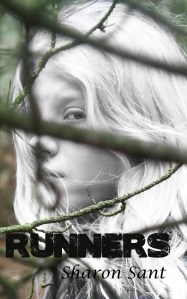
Elijah is nothing special. He’s just a skinny kid doing his best to stay one step ahead of starvation and the people who would have him locked away in a labour camp—just another Runner. But what he stumbles upon in a forest in Hampshire will show him that the harsh world he knows will become an even more sinister place, unless he can stop it. As past and present and parallel dimensions collide, freedom becomes the last thing on his mind as he is suddenly faced with a battle to save his world from extinction. But before Elijah can find the courage to be the hero the world needs, he must banish his own demons and learn to trust his friends. And all the while, the sinister figure of Maxwell Braithwaite looms, his path inextricably bound to Elijah’s by a long dead physicist, and hellbent on stopping Elijah, whatever the cost.
Find Runners on Goodreads or at Immanion Press.
About Sharon Sant:
Sharon Sant was born in Dorset in England but now lives in Staffordshire. She graduated from Staffordshire University in 2009 with a degree in English and creative writing. She currently works part time as a freelance editor and continues to write her own stories. An avid reader with eclectic tastes across many genres, when not busy trying in vain to be a domestic goddess, she can often be found lurking in local coffee shops with her head in a book. Sometimes she pretends to be clever but really loves nothing more than watching geeky TV and eating Pringles. She is the author of a string of YA novels including the Sky Song trilogy and Runners.
To find out more you can follow her on Twitter or Facebook, or at her website.

Will their world survive? World-building for a series
Posted: June 15, 2013 Filed under: On writing | Tags: guest post, research, writing 3 CommentsThis guest post is by one of my fellow authors over at Turquoise Morning Press, Bobbye Terry. A veteran at writing in created worlds, she’s talking to us today about world-building.
Enter, stage right, head-strong heroine with kick-assitude. Enter, stage left, brooding hero with something to prove. He has a mission. He needs help. She willfully resists helping him. That is, until he woos her through his dry wit and unerringly strong character, winning her heart and enabling him to steal an embrace. But wait! They are fraught with the slings and arrows of outrageous villainy, keeping them from declaring their undying love and destined mating.
You do agree every good book deserves some outrageous villainy—ahem, villains—don’t you? Did I mention your book is set in the future world of Frostos and all those who survive must protect against the ancient followers, known as Ice-ciples, of the Abominable Snow Android, also known as an AS Andro, while staying warm with their revolving bubble-heating spheres? So, where do you begin and how will your idea spawn not one but many books around the central theme of defeating the ice-ciples and the AS Andro, then opening the mechanical clouds to the warmth of the eternal sun?
Before you sit down and busily start to get the first chapter down, stop. Be smart and consider the following list. Know where you want to go so you don’t have to come back and backtrack, and yes, pantsers, this will work for you (so said the queen of all pantsers, me).
Series world-building: things to consider
1. Fantasy in current world or other world? Will your world co-exist with our current world or will it be different, play by new rules? If so, what are those rules?
2. Future, present day, past or time travel?
Is this in the future on our planet Earth? If so, how did we get where we are? Background here…is it a dystopian world, ravaged by war and devastation of a flourishing paradise, or a world now controlled by one sect? How will you best illustrate the change in conditions? Is it in the past? If so, have you done your research about dialect, clothing, customs, conditions, activities and occupations for daily living? Is it a time travel? If so, how will you best contrast the dichotomy?
3. Fantasy beings—in human form with special powers, category beings (vampires, witches, angels, zombies, demons, etc?), or totally new category?
If your characters look like humans but have powers, what are those powers? Is there a limit or an Achilles heel? If they fall into a category of beings, do they act like the stereotype of those in other novels, or do your beings look or act differently? If they do, bring that out early. Are they in a new category? If so, how do you describe them and how do you suspend belief?
4. Items, terrain, locations, special features that remain in all books?
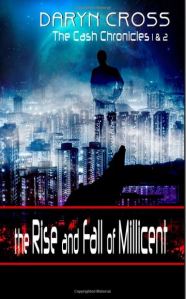
What is the glue that holds this series together, the constants? Think of one or a small number. In my series The Cash Chronicles—which was just released in print this month with The Rise and Fall of Millicent—the story centers around a dystopian word where the U.S. no longer has part of its land mass and has come under the tyrannical rule of the Primera, a woman who was cryogenically frozen and then cloned at a later date in the future. If you use the same locations each time, make sure these locations, their places, etc., stay the same in each book.
5. Do the hero and heroine stay the same in every book or do they change?
If the hero and heroine are the same, how will you ensure that they can hold your readers from book to book? What is suspenseful that continues to propel readers forward? If hero and heroine change, what continuity do you bring over from earlier books?
6. Tone of the books—needs to stay similar.
You can’t have one dark and one light, one funny and one somber, one sweet and one ultra hot. The transition between books need to be smooth like a nice glass of wine or a great piece of jazz music.
7. Keeping all the characters straight—do you have them written down somewhere, including physical and personality details?
This is very hard after you write 80—100,000 words times three or four or five. Write down all your characters, their idiosyncrasies, their traits so you can reference to make sure they stay the same. Even if they’re short-term in the book or the series, you need to keep track of the names and using the same letters, etc. Consider doing some back-story, other things about what make them who they are. You may want to do a companion book like Sherrilyn Kenyon did for the Dark Hunter series.
8. Website—does your world have its own distinct website?
This may be a good idea if the series is long. Always be ready to greet your readers and fans with information to whet their reading appetites.
I hope this has gotten you to start thinking, or maybe a single title sounds real good about now…
Bobbye Terry is the multi-published writer of fantasy, suspense and romantic comedy novels under her own name, her solo pseudonym, Daryn Cross, and her co-authored one, Terry Campbell. She also writes inspirational nonfiction. Her previous works have garnered finalist awards in the Booksellers’ Best and other RWA-sponsored contests. Bobbye’s most recent release is The Rise and Fall of Millicent by Daryn Cross, In the Stillness Publications. Nothing Ever Happens in Briny Bay, a compilation of the novellas in the Briny Bay mystery series by Bobbye Terry, will release this summer through Turquoise Morning Press. Additionally, she has a new inspirational book, The Light Within released in May 2013 and another Joy Glows, which will release mid-July.

Bobbye Terry
Website design: creating an attractive author image
Posted: May 9, 2013 Filed under: On social media | Tags: blogging, guest post, social-media, websites, writing 2 CommentsToday’s guest post is by Amber A. Bardan, contemporary and paranormal romance writer and winner of North Texas Romance Writers of America‘s 2013 Great Expectations.
I’m so excited to be guest blogging for Cassandra today! I thought I’d blog about something I know a little be about. My day job (as in the job that actually pays me money so I can spend the rest of the time writing) is as a Web and Graphic Designer. Let’s face it the reason you get an author website is so publishers and agents can look you up and see that you appear professional. Obviously you want your website or blog to look pretty, and thereby enhance your professional image.
It’s also the foundation of your one day ‘published author’ platform. I want to stop here a moment and say something; at the end of the day your writing is what is going to sell you – everything else is secondary so don’t stress too much if you have no domain, few blog followers, and only a couple of Twitter followers. These things are only a complement to good writing.
However, the advantage of setting yourself up professionally is that other writers, prospective readers or whomever our blog/website is targeting are far more likely to take you seriously if you look the part. So here are my tips on creating a good looking author website.
Creating Strong Visual Appeal
· Keep it simple
Look at the majority of successful bloggers and aspiring writers; their blogs and websites are usually simple. If not, they usually have professionally designed themes.
Either way they are not generally loaded with photos, images, clip art, hundreds of colors or varying text sizes—it’s simple and consistent.
· Quality graphics
If you are going to use graphics to enrich your website or blog make sure they are good quality, royalty-free images. Nothing looks worse than tacky clipart on a website. Sites like Shutterstock, iStock and Dreamstime have millions of beautiful, professional images available to purchase for a very small fee. You only need one great image to create a website background or blog banner.
· Color Choice
This is the biggest problem with DIY websites and blogs! We all know ‘those’ websites with black background and yellow or magenta text… Apart from not being visually appealing, color choice effects visibility and your website’s or blog’s accessibility.
Chose two colors—with big contrast. You might introduce a third color for enhancement, but only use it with a light hand.
De-saturated colors work well. But always use web-safe colors (no neon yellow or magenta)
When using a color for a background or text I suggest always pairing it with white. For example, with a dusky blue background, use white text. With a white background, use dusky blue text. You can use more than one color against white, such as a white background with a dusky blue text and pale blue embellishments, but never put a colored text on a colored background.
· Templates and Professionals
Another option is to purchase professional services in the form of professional web design or web/blog templates. This option can give you a very professional and individual result—if you choose your source wisely. Of course, custom is the most expensive option but there are more affordable templates available from template stores for a small cost (some are even free). If you do choose this option ensure you do your research; look at portfolios and get a good understanding of what is included, what you need to do yourself, and total costs.
You can find Amber on Twitter or at her blog.

What happens after you sign with a small press?
Posted: May 1, 2013 Filed under: On writing | Tags: book launch, editing, guest post, small presses 2 CommentsToday’s guest post is by the amazing Katie, whose book, KIYA: HOPE OF THE PHARAOH, came out yesterday with small press Curiosity Quills. I’m excited to have her here as the first stop on her blog hop to celebrate the book’s launch. You can find out more about that at her blog.
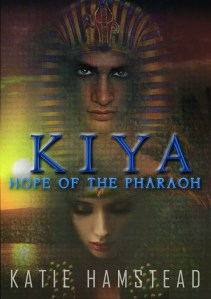
Kiya: Hope of the Pharaoh
Thank you so much Cass for having me on your blog today.
So Cass asked me to talk about my process of publication after I signed with a small press.
For a start, I needed to format my manuscript for their standard requirements. Curiosity Quills has a handy author’s guide to say what they use for font etc. So once I’d gone through and implemented that, I sent my manuscript to my coordinator.
My coordinator manages everything. She picked the release date and assigned me my editor, cover designer, proofreader and so forth, and is my liaison for each of them as well as everyone else working behind the scenes. She does a very good job too.
So once she had my manuscript I filled out a cover outline. It asked what I wanted to see on the cover, and if I had any ideas I could draw them up too.
Then, I waited. For several months.
When my number came up, everything seemed to just jump into action. My editor contacted me and we began my process. I only did two rounds of editing, but some other I know do more. It depends from author to author. Editing was intense. My editor was fantastic though, and walked me through the whole process. She was always just an email away if I found myself stuck, and was my cheerleader on Facebook when I got frustrated.
My CPs were also a great help during this time, as I bounced emails back and forth with them. Their patience with me is astounding!
During my edits, my cover design came through. Let me just say, I loved this cover from the moment I saw it. It was brightened a little, the sun in the background was added, but it still looked awesome. I’m so happy with it.
Finally, my editor told me she sent my final to the proofreader! Hooray! After that, all I needed to do was check the manuscript one last time with the proofreader’s notes, and add my dedication and thank yous.
All in all, I survived. I was a bit stressed through edits while trying to meet deadlines, but it wasn’t a bad experience. I learned a lot from everyone involved and I believe it’s made me a better writer.
About the author:
Katie J Teller (nee Hamstead) was born and raised Aussie, but now live in Arizona with her Navajo husband and their beautiful little girl. You can find her at her blog or on Twitter.
Fiction isn’t just imagination: researching your novel
Posted: April 27, 2013 Filed under: On writing | Tags: guest post, research, writing 9 CommentsToday’s guest post is by the amazing Nicole Evelina, whose dedication to research is awe-inspiring. Don’t believe me? Check out her blog!
I’m a historical fiction writer, so I do a lot of research. But you don’t have to be writing in another time period to find research necessary when writing a novel. Sure, you can make up a lot, but chances are good that unless your characters have the exact same life experiences as you, you’re going to need to do a little fact-finding along the way.

Picture via Wikimedia Commons
Why research is important
Research can be as simple as getting the details of your character’s occupation right or accurately depicting a route through a city. Sometimes it’s providing realistic descriptions of places that your readers may have lived or want to visit after reading your books. Things like that may seem trivial when we’ve got plots bursting from our brains but, trust me, someone out there will know when you’re making things up, and they will call you on it, especially in the age of social media. Of course, no one can get everything right, but it’s up to us as professionals to try.
Research can seem daunting, but I look at it this way: you start broad and then narrow in on the details that will make your book ring true to readers. Usually this means doing background research first. This is the broad information that allows you to feel like you understand the world in which your character lives. For me, this means culture, history, politics, religion, law, dress codes, prejudices, etc. But in other genres, it may just be reading about what a private investigator does or how the myth of vampires evolved over time. Only you will know exactly what you need.
With my basic information in mind, I plot my book. Sometimes I do more detailed research before I write a first draft, focusing on those things I know will play a major role in my characters’ lives. Once I’ve got a draft that makes some semblance of sense, I fact check my details – usually even up to the last minute – because it’s those little things that make fiction feel like reality.
More than just going online
So, how do you go about doing your research, especially if you haven’t done any since college? Well, thanks to the internet, it’s easier than ever. Sometimes all you need to is search Google Maps or Google Earth to get what you need. Other times, you can find the information right on the web. But I recommend verifying anything you find online in some sort of established reference material, just to be certain it’s accurate. There’s a lot of misinformation out there, so it’s better to be safe than sorry.
I’m not a doctor, but I play one in my books
Nothing beats in-person research. Sometimes that means visiting a place in person to get a feel for the area and see its nuances for yourself. Or you could interview an expert or two. If you’re a method writer, you could take a class on your subject or even ask if you can shadow someone who does what you’re curious about. People are amazingly willing to help, especially if they know you’re doing research, so don’t be afraid to be honest with them.
Between the pages
But not everything requires you to go this in-depth. Sometimes good old fashioned book research will do just fine. Amazon’s catalogue and Google Books are great ways to see what books exist on your subject. Some you will want to buy, but don’t worry if you can’t afford or don’t desire to amass an entire collection. Your public library will quickly become your best friend. And even if your city doesn’t have the book you want, they can probably get it through the interlibrary loan system. You’d be surprised what obscure titles will come to you from colleges all around the country (or even the world) if you’re just willing to wait a few weeks.
It’s worth it
Research may seem like a pain, but most of us became writers because we love exploring other worlds, other lives. That’s exactly what research is. If it helps, think of yourself as an actor taking on a role—you’ll have to live your characters’ lives even more in depth and for a longer period of time than you would if you were playing them in a movie. Your readers will be inhabiting their lives for the duration of their time with your book, so you owe it to them to get things right. If you go into research with a positive attitude, you’ll not only come out with a better story, you’ll be a little wiser, too.
Nicole Evelina is a historical fiction writer from the Midwestern United States, represented by Jen Karsbaek of Foreword Literary. She’s currently writing an Arthurian legend trilogy. Her first book, Guinevere of Northgallis, is complete and she’s working on the sequel, Camelot’s Queen.
Knowing When to Follow the Rules and When to Break ’Em
Posted: March 23, 2013 Filed under: On writing | Tags: agents, contests, editing, guest post, writing 3 CommentsI hope you enjoy this guest post by Lori A. Goldstein. I first discovered her novel, BECOMING JINN, when she and I both entered the same competition. Needless to say, she did a little better than I did. So you should listen to her advice. :p
Hi, my name is Lori.
Hi Lori.
I’m a fiction writer, and I’m addicted to starting novels with a character waking up.
Nods, awkward smiles.
For those of you who are unaware, this is a no-no. Maybe the no-no. But I am not alone. Apparently, so many of us have this particular addiction that we’re the ones who’ve made it a no-no. Not necessarily for readers. My small, informal, highly unscientific poll shows that readers have no idea this is a common way of starting a novel, let alone so common that it has become an on-the-books writing “don’t”.
But agents know. And agents care. For many agents, starting with a character waking up is an instant turnoff. Rejection based on that very first yawn, stretch, or tossing off of a blanket.
Sure, The Hunger Games starts with Katniss stretching across the bed for Prim. The Road opens with the protagonist reaching for his sleeping child. Every Day begins with the words “I wake up”.
Again, readers aren’t aware of this. They don’t remember exactly how a novel starts by the time they finish it. Most don’t remember how it starts by the time they hit Chapter 3. All they know is they were sucked in.
As for why other authors “get” to start with their characters waking up and I don’t? The answer is simple.
You are no Suzanne Collins. You are no Cormac McCarthy. You are no David Levithan.
But that’s not the whole answer. Novels need to begin in the right spot. And whether it’s taboo or not, the truth is, sometimes that jackpot moment is the instant a character’s eyelids flutter open.
Yeah, yeah, defend it all you want but don’t expect to win.
When writing my first manuscript, I had no idea that this “rule” existed. The finished novel I queried ultimately did not begin with that character waking up, but not because I discovered the list of novel-opening gaffes. It changed during revision because it should have changed. Waking up was not the right place for that story to start.
I have no excuses for my second novel. I was well aware of the rule. Still, I wrote the opening with my character waking up and looking in a mirror. Double no-no. Before you shake the house with your shuddering, this made sense for my character and her story. Plus, I liked it. And maybe, just maybe, I wanted to defy the odds. I entered two contests and did not get chosen for the next round in either one.
I caved. I rewrote the start. I tried so many versions of my opening page and opening chapter that I had to create a second folder on my computer just to keep some semblance of organization.
Eventually, with a little help from my friends, more than a little patience from my husband, and a concession to myself (my character no longer wakes up on page one, but a mirror still worms its way in on page two), I had a new opening.
With my rule-following page one, I entered several contests. And you know what? My work started gaining traction. It got amazing feedback. It won contests where there were fifty entries and contests were there were five-hundred entries. It was the same character and the same story and the same voice, but it followed the rules. It led to me finding my agent.
So am I converted? Am I law-abiding writer? The answer is a resounding no. Because my rebellious tendencies do not just violate the rules of beginnings but they stomp all over the laws of endings too.
The advice I was given from other writers, websites and craft books was this: novels in a series should be standalone. Do not end with a cliffhanger. This too is a no-no. But apparently, it’s not the no-no. If that’s what’s best for your story, if it completes your character arc, if you have a fantastic rebel of an agent like I do, then breaking that rule can be a big yes-yes!
I guess if someone, reader or agent, has gone on the entire ride with you, ending with a bang can actually be a turn-on.
But to ensure you get there, don’t start with that character waking up. Yawn.
Lori A. Goldstein is a fiction writer whose YA novel BECOMING JINN is currently under representation. She is a freelance copy editor and can be found on Twitter.
Collaboration, not competition
Posted: March 18, 2013 Filed under: On Twitter, On writing | Tags: guest post, social-media, Twitter, writing 4 CommentsA guest post by Sharon Sant on one of the downsides of Twitter. I’d love to hear what you think.
I’ve made a lot of friends through writing. Many of these are in real life, through my university course and local writing networks. Many more have been via social media. It’s been a strange experience in many ways, particularly ‘meeting’ people virtually. Some of my online friends I’ve since met in real life and they’ve been every bit as delightful as they are in the ether. Some, I know I will never meet, and that makes me sad, because they are people I feel I have a strong friendship with, even a deep affection for, despite never having met them face to face.
In today’s writing world, I think there is no stronger tool than collaboration with other writers. In the days of ink and quill, writing was considered a solitary affair, but not anymore. In our rapidly shrinking world, we have so many ways to link up. We’re in constant contact every day, updating each other from across the globe about how many words we’ve done, when we’re taking a break, how our editing is driving us nuts. We participate in blog hops and Nanowrimo and virtual launch parties.
Some of us take these relationships, cherish them and build on them, because we understand that you can’t make it alone. People just like you are the people who will root for you, will retweet you, will send readers to your blog, will beta read for you and critique with the best of intentions, will give you heads-up on news, will egg you on when you flag. And you will do the same for them. In my opinion, that’s how it should be—a community based on mutual respect and collaboration.
But I have also encountered the flip-side of this. Take this example: a friend on twitter chats to a friend of theirs who has exactly the same interests as me, has other mutual friends, even writes the same genre. I follow that person, attempt to chat to them, and I’m ignored. I don’t understand why. Not for a minute am I suggesting that everyone has to follow me because I follow them, or reply to me when I mention them, but I fail to see the logic in not doing these things when we quite clearly have so much in common. We have all the necessary ingredients to make another strong link in the chain; why would you throw that opportunity away? Why would you actively set yourself apart from other writers like you? What does this achieve?
Sometimes, I admit, I feel envious of others I consider vastly more talented, successful or popular than me. But I fight those feelings because I think that life as an indie author is hard enough without negativity taking hold. I’d rather try my best to be happy for others, even when I have a down day and I don’t feel like it, than sit stewing in my juices. The writing journey is a much more fulfilling one when you can share it with people who understand each step.
Sharon Sant holds a BA (Hons) in English and creative writing and is currently researching a PhD in literary studies. She is a freelance editor and is the author of YA novels, “Sky Song” and “The Young Moon”. You can find her blog here.

Indie publishing: pricing your book
Posted: March 11, 2013 Filed under: On writing | Tags: guest post, self-publishing, writing Leave a commentThis guest post is by JC Emery, independent author.
Being an independent author is about more than having the freedom to do as you please, though that is a definite draw. After being underwhelmed by the traditional publishing process, I sought out other, scarier avenues. Being rejected by agents and publishers is one thing, but totally failing at not only writing but publishing was a terrifying prospect.
Now that I’ve released my first novel, Marital Bitch, I’m not any more certain of what I’m doing than I was before the book went live. I first set the book at $.99 so that it would be a no-brainer for readers who were considering taking a chance on an unknown author. I figured I could price future books at or above the $2.99 threshold. I intended to make the book free for a promotion just before Valentine’s Day, but quickly found out that it’s not so easy to make a book free on Amazon. In fact, you have to “trick” the system by reporting a lower price to get it to work and even then it can be difficult to get Amazon to re-price the title to charge when your promotion ends. So there I was, having submitted the price adjustment report to Amazon, thinking the sale would never go into effect.
Weeks passed and I totally forgot about it. Three days after the sale went into effect a friend contacted me and asked if I had meant to make it free. Well, I had, but then I also hadn’t. The first thing I did was to check out my sales. I hadn’t been doing too bad charging for the title and I expected some kind of spike since it had been free for a few days.
Sure enough, in the three days the book had been free, over five times the number of books I had sold in nearly a month had been downloaded. Not only that, but the number of reviews (mostly positive) had doubled on Amazon and Goodreads. I was in heaven and I started stalking my sales page like a madwoman. A few days later I had found Marital Bitch on the Top Free 100 list on Amazon, eventually making it to #1 in Women’s Fiction and #2 in Contemporary Fiction.
With over fifty thousand downloads in just two weeks, I feel Marital Bitch is a success. As a new author, my main goal isn’t to make money, it’s to entertain people by providing an enjoyable reading experience. Sure, it’d be great if the book was making money, but right now it’s generating something far more valuable and in higher numbers—readers. I feel that for now it’s the right choice to keep Marital Bitch free and hope that readers remember me and they’ll take a chance paying for my next book.
Not everyone is going to be comfortable offering their book for free—nor should they! Novels take hundreds of hours from start to finish and, like any other craft, the artist has the right to expect some return on their hard work. One day I hope to see some financial return on the investment of my time, but as an unknown author, reviews and happy readers are the best form of currency. I keep reminding myself that my career as an author is just beginning and that this is a marathon, not a sprint. I’m in it for the long haul.
JC writes adult, new adult, and young adult fiction. She dabbles in many different genres including science fiction, horror, chick lit, and murder mysteries; but she is most enthralled by supernatural stories—and everything has at least a splash of romance. You can download “Marital Bitch” for free here.


 Cassandra Page