Pippa Jay talks about tortured heroes and her new sci-fi release, ‘Gethyon’
Posted: June 26, 2013 Filed under: On Books | Tags: blog hop, book launch, contests, guest post 3 Comments(Note from Cass: As I’m drafting this I’m two-thirds of the way through one of Pippa’s other books, Keir. This lady’s got GAME, my friends!)
I love tortured heroes and heroines. All of mine are tormented in some way, whether mentally or physically, and if I can torture them a little a lot more, then all the better. They carry scars inside and out. Burdens of guilt and regret, for things they could have changed, and those they couldn’t. They not only have to face the fears and terrors from their past, but accept that the people who come into their lives and attempt to win their hearts can see beyond that damage to the soul inside.
As well as loving to write them, I love to read them. So I thought I’d share two of those who helped to shape my own young hero, Gethyon.
The first is a certain farm boy from the desert planet Tatooine. I saw Star Wars: A New Hope televised when I was just eight, and instantly developed a crush, as well as switching from writing fantasy to sci-fi. Poor Luke, orphaned and stuck on a world he describes as ‘if there’s a bright center to the universe, you’re on the planet that it’s farthest from’, desperate to join the rebellion and fight with his friends. A bit bratty? Well, maybe. But in quick succession he loses his home and the only family he’s known to the Empire, gets called short by the princess he wants to rescue, sees his mentor killed, gets sent to a mud-hole of a planet to train and finds out he has to face Vader to complete it. On top of that he learns the second most evil entity in the universe is Daddy! It just gets worse as he finds out his princess is actually his sister, and the Emperor is perfectly willing to sacrifice all Luke’s friends to turn him to the Dark Side. And even as good triumphs, Luke must say goodbye to his father forever. Wow!
The second is Ged from A Wizard of Earthsea, a fantasy story by Ursula Le Guin. This was my assigned English read at school, aged ten, and I’ve reread it so many times since I’ve had to replace the paperback twice! Ged, or Sparrowhawk, also begins as a brat. He’s had a hard start, motherless and used as a slave by his father. He’s arrogant, sullen, and has no friends, but he has a glimmer of power and his witch aunt sets him on the road to mastery. When he saves his entire village from marauding warriors, he’s sent to the Wizard school on Roke. But in his pride and in spite, he unleashes a shadow creature that is bound to him, and could do the greatest evil through him should he become possessed. So, scarred and humbled by his ordeal, Ged seeks out to put it right, almost losing himself in the process.
Both these young heroes had such a huge influence on my reading and my writing, and still remain two of my most memorable. So I can’t deny there isn’t a trace of them in my own tortured heroes, like Gethyon.
To celebrate the release of Gethyon, I’m giving away a pretty piece of crystal, available internationally. To enter, use the rafflecopter form and tell me in the comments who’s your favourite hero, tortured or otherwise. 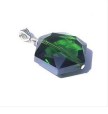
GETHYON:
A YA Science Fiction Novel
Released by Champagne Books 3rd June 2013
His father died. His mother abandoned him. In the depths of space, darkness seeks him.
Abandoned by his mother after his father’s death, Gethyon Rees feels at odds with his world and longs to travel the stars. But discovering he has the power to do so leaves him scarred for life. Worse, it alerts the Siah-dhu—a dark entity that seeks his kind for their special abilities—to his existence, and sets a bounty hunter on his trail.
When those same alien powers lead Gethyon to commit a terrible act, they also aid his escape. Marooned on the sea-world of Ulto Marinos, Gethyon and his twin sister must work off their debt to the Seagrafter captain who rescued them while Gethyon puzzles over their transportation. How has he done this? And what more is he capable of?
Before he can learn any answers, the Wardens arrive to arrest him for his crime. Can his powers save him now? And where will he end up next?
Available from Burst, Kobo, Amazon UK, Amazon US or Omnilit.

About Pippa:
A stay-at-home mum of three who spent twelve years working as an Analytical Chemist in a Metals and Minerals laboratory, Pippa Jay bases her stories on a lifetime addiction to science-fiction books and films. Somewhere along the line a touch of romance crept into her work and refused to leave. Between torturing her characters, she spends the odd free moments trying to learn guitar, indulging in freestyle street dance and drinking high-caffeine coffee. Although happily settled in historical Colchester in the UK with her husband of 20 years, she continues to roam the rest of the Universe in her head. Her works have won a SFR Galaxy Award, and finalled in the Readers Favorite Award Contest and the Gulf Coast RWA Chapter Silken Sands Self-Published Star Award.
You can find Pippa at her website or blog, or on Goodreads, Twitter, Facebook or Google+.
Team Ull
Posted: June 25, 2013 Filed under: On Books | Tags: aussie-owned, contests 3 Comments
Those of you that follow the goings on over at Aussie Owned and Read will know that we’ve been chosen to advocate for Ull in the NA Crush Tourney. Ull is the hero in ST Bende’s NA romantic fantasy, Elsker. Not only is he a Norse God but he’s also a fierce Asgardian Warrior. Despite his violent job, Ull is a sweetheart when it comes to his girl, Kristia.
I confess, I haven’t actually read Elsker yet. My copy of the book is travelling across the seas (probably on some sort of heroic, Nordic adventure) as we speak. But you know how I know I like Ull? Because the author based him off Alexander Skarsgard of True Blood fame. Wooh! *fans self*
Now, because Alexander Skarsgard would quite rightly get tetchy if we started plastering his picture all over everything without permission, we’ve found a very nice looking young man (whose image was purchased legally via a stock website, in case you’re wondering), who will be playing the part of Ull for us here.
Did I mention “wooh”?!
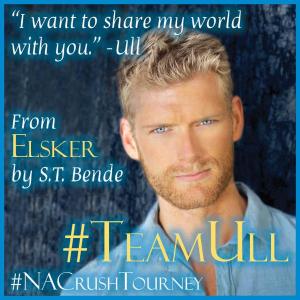
Ull. It rhymes with drool.
(The image, by the way, was done by the amazingly talented K. A. Last.)
You may be wondering what I’m asking of you in exchange for my generous sharing of this serious hotness. Well, on Tuesday 2 July, Ull will be going head-to-head against some wimpy, girly-man named Drew (who I know absolutely nothing about!). The contest will be resolved via voting. I would have preferred some sort of Greco-Roman wrestling, but nobody asked me…
So, uh, yeah. On Tuesday, I’ll be asking you to get your click on. It won’t take long. If you want to see who is participating, click here. Just remember: vote for Ull.
(Also, if you want a chance to win an ebook copy of Elsker, click here.)
Why I Write Women’s Fiction
Posted: June 22, 2013 Filed under: On Books, On writing | Tags: book launch, guest post, writing 7 CommentsThis guest post is by another of my fellow authors over at Turquoise Morning Press, Linda Rettstatt.
When I first began to write, I knew very little about creating a novel-length story or of all the mechanics that went into writing. I also knew little about genre. I knew what I enjoyed reading, so it made sense to write that kind of story. My favorite author at the time was Elizabeth Berg. She is brilliant at writing character-driven stories of women—ordinary women—who find themselves in extraordinary circumstances. Her characters are the women who live next door or down the street, or who work in the next cubicle. But Berg takes the reader into the emotional and psychological depths of these women who, as they face life changes and challenges, make us—the readers—feel just a little less alone in our own struggles. She makes us laugh at ourselves.
Some might say that my own background as a psychotherapist who’s done a great deal of counseling with women would lend to writing this genre. And they would probably be right. I set out not to write like Berg, but to write stories about women facing challenges and possessing both vulnerability and strength. I targeted women readers and branded my writing as: Writing for Women—Stories of strength, love, humor and hope. These are the elements I consciously try to incorporate into every book. These are the elements I also find in the books of other writers whose work I admire. Berg, of course, Kris Radish, Elin Hilderbrand, Claire Cook—just to name a few. Kris Radish, a bestselling author in her own right, was kind of enough to give me a quote for Unconditional. Now that’s exciting, when one of the authors you most admire comments (positively) on your work. A true ‘squee’ moment.
Although I also write contemporary romance, when I sit down to write a new women’s fiction novel, it’s like slipping my feet into an old, familiar pair of shoes. They just fit right. Some have asked me, “What’s the difference? Your women’s fiction books often contain romance.” What can I say—I’m a romantic at heart. And romance is largely targeted at a female audience. I don’t think that placing my books under either heading locks them into one or the other sub-genre, but gives readers a hint that women are especially going to identify with the story and the characters. At least, that’s my hope.
Linda Rettstatt is an award-winning author who discovered her passion for writing after years of working in the human services field. When she’s not writing, Linda loves travel, nature photography, and figuring out what makes people tick. Her fantasy is to win the lottery, buy an old Victorian home on the eastern shore and open a writers’ retreat. While she waits for that fantasy to materialise, she continues to live and work in NW Mississippi and to write under the constant observation of her tuxedo cat, Binky.
You can find her at her website, blog or on Facebook or Twitter.
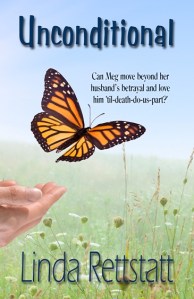
Unconditional (May, 2013, Turquoise Morning Press)
Meg Flores has it all—a loving family, a fulfilling career, and marriage to her best friend, Thomas. She is devastated when her husband announces he wants a divorce so he can pursue a relationship with his secretary—his male secretary. For Meg, the betrayal goes beyond that of a cheating husband. She is losing her best friend and the hopes for adding a child to her life.
Available from Turquoise Morning Press, or at Amazon.com, B&N.com and Smashwords.com.
On chapter titles in fiction
Posted: June 20, 2013 Filed under: On Books, On writing | Tags: chapters, Thursdays Children, writing 15 Comments I love a good chapter title in a book. I really admire writers who manage to come up with a title that summarises the chapter, gives the reader a sense of what’s to come, but without being spoilery. I love chapter titles so much I always thought I’d use them—but when I stopped, partway through drafting Isla’s Inheritance, and thought about it, the idea of crafting the perfect chapter titles seemed as hard as crafting the perfect beginning. I seized up with panic, and decided I’d worry about it later. (That, by the way, is a great way to deal with writer’s block of any sort. Write around the problem and fix it later.)
Then I never actually got around to doing it.
My love of chapter titles started with J.R.R. Tolkien. I was given an illustrated, anniversary edition of The Hobbit when I was in late primary school. I loved that book. I’d alternate between reading about Bilbo’s adventures and staring at the illustrations of Smaug for hours. (As an aside, no one told me about the rest of Tolkien’s books till years later. I remember experiencing that wonder for the first time, the joy of discovering there are more books in a series that I never knew about. It took me a while to warm to Frodo, but he got me in the end.)
A conversation on Twitter about chapter titles the other day got me to thinking, though: do they actually make much difference to my experience as a reader? I looked at a random selection of fantasy and urban fantasy novels from my bookshelves, and the results surprised me. Because if you’d asked me who used chapter titles, I would have said fantasy writers do; urban fantasy writers don’t. I’ve read a lot of both, and that was my impression. But the facts only sort of bear that out—it’s a trend rather than a hard fact.
 On the fantasy (and light sci-fi) side of the shelf, Anne McCaffrey did an assortment of things with her titles. In Dragonflight, the first in the Pern series, she actually used poems instead of chapter titles (the poems written by the harpers in the book). This was like chapter headings on steroids, because if you’ve read the book you’ll know the main character actually has to solve a riddle in one of those songs to save the day. And they foreshadowed the storyline as well. Wow. (In others of her books, though, she used traditional chapter numbers.)
David Eddings uses numbers with some titles for parts. Raymond E. Feist, Kate Forsyth and Jay Kristoff use chapter titles. Mercedes Lackey uses numbers (sometimes with titles to say whose perspective it is, much like George R.R. Martin). Terry Pratchett doesn’t even use chapters!
On the urban fantasy side, Suzanne Collins had part titles. Cassandra Clare uses chapter names. Charles De Lint and Veronica Roth use numbers.
I think the most telling thing for me is how little impression some of the titles made on me. I only read The Hunger Games and City of Bones recently, but the fact there were titles in there didn’t even register—probably because they were both such compelling stories that I was far more interested in continuing on than dwelling on the title and what it might mean. If I was at the point where I’d re-read them lovingly many times, the way I have The Hobbit and Dragonflight, perhaps they would have sunk in as I stopped to marvel.
All of which brings me to my point: what are your feelings on chapter titles in fiction (especially genre fiction)? Do you think they add to your reading experience, detract from it, or make no real difference either way? Do you even notice them?
(I need to caveat this post with the statement that I didn’t look at every book on my shelf by the named authors, just a handful. So maybe all of them do both, and it was just coincidence that the ones I picked up were of a certain style.)
Click here to see this week’s other Thursday’s Children blog posts.
Dystopian fiction and ‘Runners’
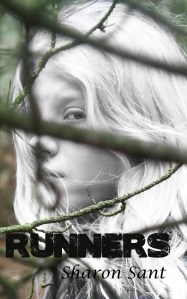
Posted: June 17, 2013 Filed under: On Books | Tags: dystopian, guest post, small presses, writing 1 CommentThis guest post is by Sharon Sant, whose new dystopian novel, Runners, came out on 7 June.
The Oxford dictionary defines dystopia as: ‘an imagined place or state in which everything is unpleasant or bad, typically a totalitarian or environmentally degraded one. The opposite of Utopia.’
That sounds like a perfect place to set a novel. And it seems that I’m not the only one who thinks so. I’ve been reading reports for some time now about how agents and publishers are sick of dystopian novels landing on their desks. According to them, since The Hunger Games, we’ve gone dystopia crazy. I hate to burst that industry bubble, but I don’t think that dystopia is going away any time soon. In fact, I don’t think it was ever really missing from the cultural landscape in one form or another. Thinking back to novels like 1984, even as far back as The Time Machine by H G Wells or Aldous Huxley’s Brave New World, it’s clear that we’ve always been fascinated by the ideas of dystopia.
As a narrative tool, dystopia can hold a mirror up to our own society to make all sorts of political and social statements, or it can be used simply to issue warnings, the latter being closely linked and often overlapping with speculative fiction. For me, however, it also represents a society where the normal rules of our world no longer apply. Like fantasy, dystopia is a setting that you can manipulate; it presents the opportunity to create a world that enables the story you want to tell to unfold how you want. You want kids beating each other to death on a TV show? In a dystopian society you can make this entirely plausible.
When I first had the idea for my dystopian novel, Runners, I knew straight away what the setting would be: a near-future Britain where the current economic hardships and climate change had progressed to their worst possible scenarios. I’m a huge fan of fantasy in realist settings and for me this was just perfect. There are no silver-clad futuristic cities, no radiation-soaked skies full of spacecraft, no mutated humanoid species in Runners—all fantastic settings for dystopian fiction, of course—there’s just a crumbling version of a contemporary Britain and a poverty-stricken population that no longer cares what happens to anyone.
I took a lot of my ideas from periods of austerity in history, so there are Victorian-like features such as child labour and workhouse-type institutions, and then there’s rationing like during the Second World War. These things have already happened in real life and, just because they’ve gone away, it doesn’t mean they can’t come back. Because in real life, just the tiniest false step from the people in charge and we could actually find ourselves living there. It’s a scary prospect for us but a perfect dystopia for a book.
I think that some of the best fictional dystopias are the ones almost close enough for our society to touch, the ones where you can easily imagine yourself living in it. For me, that’s where the weirdness and the fear come from.
About Runners
Elijah is nothing special. He’s just a skinny kid doing his best to stay one step ahead of starvation and the people who would have him locked away in a labour camp—just another Runner. But what he stumbles upon in a forest in Hampshire will show him that the harsh world he knows will become an even more sinister place, unless he can stop it. As past and present and parallel dimensions collide, freedom becomes the last thing on his mind as he is suddenly faced with a battle to save his world from extinction. But before Elijah can find the courage to be the hero the world needs, he must banish his own demons and learn to trust his friends. And all the while, the sinister figure of Maxwell Braithwaite looms, his path inextricably bound to Elijah’s by a long dead physicist, and hellbent on stopping Elijah, whatever the cost.
Find Runners on Goodreads or at Immanion Press.
About Sharon Sant:
Sharon Sant was born in Dorset in England but now lives in Staffordshire. She graduated from Staffordshire University in 2009 with a degree in English and creative writing. She currently works part time as a freelance editor and continues to write her own stories. An avid reader with eclectic tastes across many genres, when not busy trying in vain to be a domestic goddess, she can often be found lurking in local coffee shops with her head in a book. Sometimes she pretends to be clever but really loves nothing more than watching geeky TV and eating Pringles. She is the author of a string of YA novels including the Sky Song trilogy and Runners.
To find out more you can follow her on Twitter or Facebook, or at her website.

Twitter Contest to Win an E-Copy of ‘The Best Man’ by Ana Blaze
Posted: June 7, 2013 Filed under: On Books, On Twitter | Tags: contests, Twitter Leave a commentBeth Chase is too busy planning perfect weddings to worry about the lack of action in her own love life. But if she was looking for a man, she wouldn’t be looking at Colin Pratt. Her boss swears that Best Man Colin is a quiet scholar and science fiction writer who couldn’t possibly cause a fuss at his own brother’s wedding. He’s clearly never met the man in question. Snarky, sexy and more than a little inebriated, Colin is the final obstacle between Beth and the last perfect wedding she needs to make partner. Of course, when she helps him into a taxi at the end of the night she has no idea that he’s only just begun to poke holes in her professional exterior. Colin might have the skills to seduce a romance professional, but can he convince her that he’s the best man to share her happy ever after?

Find The Best Man on Goodreads, or at Amazon, Barnes & Noble, Kobo or Smashwords. The Best Man is also available from Entranced Publishing.
Watch the trailer here.
Contest Details
Entering is easy. Just tweet @ana_blaze and include the hashtag #TheBestMan between midnight EST on 7 June 2013 (NOW!) and 11:59 p.m. EST on 8 June 2013!
For example, you could tweet:
@ana_blaze I married #TheBestMan I know.
@ana_blaze #TheBestMan is on my must read list.
@ana_blaze #TheBestMan made me breakfast in bed.
@ana_blaze I love sexy nerds. #TheBestMan
@ana_blaze I wish Beth would plan my wedding. #TheBestMan
@ana_blaze Being #TheBestMan is tough, but someone’s gotta do it.
or even just:
@ana_blaze I want to read #TheBestMan!
You get the idea. Twitter rules ask that we don’t have too many duplicate tweets, so it’s best (and frankly way more cool) if you come up with your own tweet. Ana is really looking forward to seeing what folks come up with. And hoping for some tweets about how to be #TheBestMan. It’s also best if you are following Ana on Twitter. Apparently that’s the only way to guarantee that your tweet shows up in the search.
You’re welcome to tweet (and enter) more than once, but please not more than once an hour. Let’s not annoy the Twitter-folk too much.
This contest is open internationally.
Void where prohibited. 😦
You can find Ana at her blog, or on Facebook, Twitter, Pinterest or Goodreads.
Goodreads is nagging me
Posted: June 2, 2013 Filed under: On Books | Tags: Goodreads, reading 17 CommentsGoodreads* is nagging me.
I set a rather ambitious goal for the amount of books I’d read in 2013, because last year I didn’t read that many books, and I felt bad, like my brain was a pot plant I’d left on the windowsill to wilt in the sun for lack of water.
My goal is forty books—and okay, that may not be ambitious to a lot of people, but for me that’s a lot more reading than I have time for. One book every week and a bit. Goodreads tells me I’m two books behind. I’m about halfway through two different novels that I’m quite enjoying: Keir by Pippa Jay and Quite Contrary by Richard Roberts. If I spent all of today and tomorrow reading both of them then I’d catch up, but I also want to get some writing done.
Not to mention the fact I’ve got a little boy to keep entertained and housework to do. Sigh. (I know: wah, right?)
I’ve considered getting some audiobooks so at least I can “read” in the car on the commute to and from work. That’s one thing I miss about not being able to use public transport anymore—I loved my reading time on the bus to uni and back. The only thing is that I’ve got a TBR pile that’s about fifty books deep. These are almost all paperbacks I’ve already paid for, and I hate the idea of having to buy the book again to listen to it.
Bring on the day when I can hand my smart phone a novel and it will read it for me. Maybe in David Tennant’s Tenth Doctor accent.
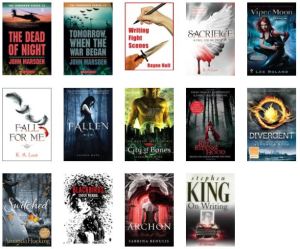
My 2013 reads thus far
How many books do you read in a year? Do you struggle to read as much as you’d like?
* No, I don’t have a Goodreads account linked to this profile. That’s because it’s on my personal account; I haven’t set up an author account yet. I will, when I get around to it. One day. Hey, I have lots of other social media!
Pitcharama: manuscript pitching contest
Posted: June 2, 2013 Filed under: On Books, On writing | Tags: aussie-owned, contests, queries, small presses Leave a commentIf you’re a writer of young adult or new adult fiction, and you have a completed manuscript that’s ready to go, there’s a fantastic opportunity this month over at Aussie Owned and Read!

Eight publishers will be participating – we’ll announce who in the next few days, but they are all open to submissions internationally, so this isn’t just an opportunity for Australians. If I hadn’t just signed with Turquoise Morning Press I’d be really disappointed, because I’m not eligible to enter! :p
The details are on the Aussie Owned blog, so you can start refining your pitch. Make sure you follow the Twitter account as well, so you don’t miss out on any updates.
Book launch and giveaway for ‘Sacrifice: A Fall For Me Prequel’
Posted: May 26, 2013 Filed under: On Books | Tags: book launch, contests, self-publishing Leave a commentIt’s been just over a month since I was part of the crew that helped K. A. Last launch the gorgeous cover of her impending release. Well, guess what? Sacrifice: A Fall for Me Prequel has just hit the virtual shelves. I’ve seen an early version of it and if you read Fall For Me then you should definitely read Sacrifice. (And if you haven’t, why not??) It answers a few questions you may have, about how Grace and Seth got to be where they are. All of the feels.
Here are the deets:
Title: Sacrifice – A Fall For Me Prequel (The Tate Chronicles #0.5)
Author: K. A. Last
Genre: Paranormal Romance
Number of pages: Paperback – 114
Word Count: 23,000
Formats available: eBook (Paperback to come)
Cover Artist: KILA Designs
Purchase Link Amazon: http://amzn.to/11ipsxG
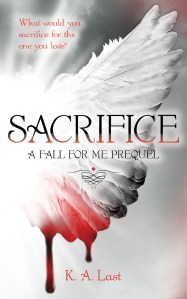
“Sacrifice” by K.A. Last
Seth’s heart is breaking. He knows his decision will hurt the one person he keeps breathing for, but he can’t take it anymore. He can’t be near Grace knowing she will always be just out of reach.
Grace is oblivious to Seth’s turmoil. She loves him unconditionally, but not in the way he wants. They both know that in Heaven physical love is forbidden, and to break the rules is to defy everything they’ve ever been taught.
When Grace and Seth are sent on a mission to save a young mother and her unborn child, Grace must face the fact that Seth won’t be returning home. She doesn’t understand Seth’s decision and hates him for it. But what neither of them realise is how big a part that single decision will play in shaping their entire future.
What would you sacrifice for the one you love?
To celebrate the release, there is a giveaway. You can enter by CLICKING HERE!
About the Author:
K. A. Last was born in Subiaco, Western Australia, and moved to Sydney with her parents and older brother when she was eight. Artistic and creative by nature, she studied Graphic Design and graduated with an Advanced Diploma. After marrying her high school sweetheart, she concentrated on her career before settling into family life. Blessed with a vivid imagination, she began writing to let off creative steam, and fell in love with it. She now resides in a peaceful leafy suburb north of Sydney with her husband, their two children, and a rabbit named Twitch. You can find her at her website, or on Twitter, Facebook, Goodreads or Amazon.

Cover reveal: ‘Sleeper’ by S. M. Johnston
Posted: May 3, 2013 Filed under: On Books | Tags: book covers Leave a commentI’m lucky to have such talented friends. Today I am honoured to be part of the cover reveal for Sleeper by S. M. Johnston. It is a new adult science fiction (with paranormal elements, my favourite kinds!), and will be coming out with Entranced Publishing in December! You can add it to your to-be-read list on Goodreads here.
After a life-saving heart transplant, eighteen-year-old Mishca Richardson is plagued by nightmares and an urgent desire to find her birth parents, which she puts down to post-operation depression. But her new heart seems to bring more than a second chance at life in the form of speed, strength and love at first sight.

“Sleeper” by S. M. Johnston
About the Author:
Sharon is a writer from Mackay in Queensland, Australia who has short stories published in anthologies and was also runner-up in the Australian Literary Review’s Young Adult short story contest with KARMA. By day she is a public relations executive and by night she writes weird fiction and soulful contemporaries while her husband, two sons and cat are fast asleep.
You can find her on Facebook, Twitter or at her blog. She also contributes to Aussie Owned and Read.

Sharon M. Johnston


 Cassandra Page