Pitcharama: what influenced my selections
Posted: June 19, 2013 Filed under: On writing | Tags: agents, aussie-owned, contests, queries, small presses 2 CommentsThe Pitcharama first-round selections were announced today over at Aussie Owned and Read. There are some great pitches there, although I’m sad we couldn’t take everyone through to the final round. (However, as I said yesterday, it’s not too late: the pitch-a-mate round opens tomorrow. Keep an eye on the blog for details.)
My three selections (in the order they were submitted) are:
- No Such Thing by Sarah Glenn Marsh
- Off Campus by AJ Albinak
- Barely Imagined Creatures by Pete Catalano
You’ll see that I chose two young adult manuscripts (both urban fantasy) and one new adult (an m/m romance). There were a few things that influenced my decision.
1. I love urban fantasy.
I write it, I read it—it’s hardly surprising that I would lean toward choosing it. This should give you an idea of how subjective this process really is.
2. Word counts were a big factor.
YA can run from 50k to 80k (or up to 100k for fantasy, but better to keep it lower than that for a debut novel). I chose pitches for manuscripts in that ballpark. If you want to read a great blog post on word lengths, this is the one I use as my rule of thumb.
Some of the digital-only presses may care less about word count, since they don’t have to pay the larger cost of producing a fat novel. I don’t really know much about that, though, so I assumed the normal conventions would apply in this case.
3. I looked at the participating publishers’ preferences.
We have several presses looking for romance (at least one of which publishes m/m—I checked!). We have several that publish paranormal, UF and dark fantasy. So I tried to choose pitches that I thought those presses’ acquiring editors would be interested in, to give “my” three authors the best shot.
This, by the way, is the same process you should go through if you’re pitching to presses or agents directly: look at what they buy or represent. Look at their website to see what they’re after. Most of them are pretty upfront about it, and it saves you from wasting your time and theirs. And, even better, saves you from the heartbreak of a rejection you could have avoided.
Anyway, that’s it. Looking back over the post, it doesn’t seem like rocket science to me, but maybe it’s helpful to someone out there. A big snuggle-y thanks to everyone that has participated thus far!

Thoughts on pitching contests
Posted: June 18, 2013 Filed under: On writing | Tags: agents, aussie-owned, contests, queries, small presses, writing Leave a commentI’ve got a new-found respect for agents.
Those of you who’ve been reading my blog for a while know that I highly rate pitching contests. They are a great way to hone your pitch, query or first pages. And, just as great, you can get in touch with what I’ve discovered to be a supportive community of fellow writers, many of whom have great advice to offer or are just happy to be a cheer squad. I wouldn’t be here now if it weren’t for Pitch Wars (if you want to know why, I blogged about it here).
 And if you’ve been reading my blog for only a little while you’ll know that Aussie Owned and Read has been hosting its first pitching contest, where people can submit a 250 word blurb for their young adult or new adult manuscript. In the first round, the eight bloggers at Aussie Owned choose their favourites to progress to the final round. That is where we have eight small presses (nine editors) who will swing by to request the ones they’d like to see more of. (In the second round you can pitch your friends—that starts on 20 June so if you missed the first round it’s not too late!)
The first round closed last night and choosing three pitches from those that entered was SO HARD IT HURT MY BRAIN! Not in a bad way but in an “aaaah, I can’t choose” way! My original shortlist was 50 per cent of the total. I loved them all, and wanted to take them home with me. Like, really. I have a newfound respect for people like Brenda Drake and the writers who help her; she runs Pitch Wars and Pitch Madness. Our humble contest is only in its first year so we didn’t get nearly the number of entries she’d see in one of hers. (Not that I didn’t respect her before, but Oh. My. Gods!)
And that’s why I also have a newfound respect for agents. In a way they have it a bit easier than we did in choosing our pitches, because most of them request at least the first five pages, which gives them an idea of the voice and execution. But in another (much bigger) way, they have to read thousands upon thousands of queries a year. And they don’t even get paid for that part of their business, not until they choose a client and then sell their client’s work.
Wow. Just wow. You seriously have to love books, love stories and tales well told, to dedicate that amount of time to it. Because while all the pitches we saw were good, the same cannot be said for agents’ slush piles (or so I hear).
Agents, I doff my hat to you. Or I would if I was wearing one.
I doff my imaginary hat to you.
One more thing. If you’re reading this and you entered Pitcharama, I also wanted to say that, whether you’re one of my final choices or not, I respect the courage it takes to put yourself and your work out there. I know how stressful it is. Don’t give up.
Dystopian fiction and ‘Runners’
Posted: June 17, 2013 Filed under: On Books | Tags: dystopian, guest post, small presses, writing 1 CommentThis guest post is by Sharon Sant, whose new dystopian novel, Runners, came out on 7 June.
The Oxford dictionary defines dystopia as: ‘an imagined place or state in which everything is unpleasant or bad, typically a totalitarian or environmentally degraded one. The opposite of Utopia.’
That sounds like a perfect place to set a novel. And it seems that I’m not the only one who thinks so. I’ve been reading reports for some time now about how agents and publishers are sick of dystopian novels landing on their desks. According to them, since The Hunger Games, we’ve gone dystopia crazy. I hate to burst that industry bubble, but I don’t think that dystopia is going away any time soon. In fact, I don’t think it was ever really missing from the cultural landscape in one form or another. Thinking back to novels like 1984, even as far back as The Time Machine by H G Wells or Aldous Huxley’s Brave New World, it’s clear that we’ve always been fascinated by the ideas of dystopia.
As a narrative tool, dystopia can hold a mirror up to our own society to make all sorts of political and social statements, or it can be used simply to issue warnings, the latter being closely linked and often overlapping with speculative fiction. For me, however, it also represents a society where the normal rules of our world no longer apply. Like fantasy, dystopia is a setting that you can manipulate; it presents the opportunity to create a world that enables the story you want to tell to unfold how you want. You want kids beating each other to death on a TV show? In a dystopian society you can make this entirely plausible.
When I first had the idea for my dystopian novel, Runners, I knew straight away what the setting would be: a near-future Britain where the current economic hardships and climate change had progressed to their worst possible scenarios. I’m a huge fan of fantasy in realist settings and for me this was just perfect. There are no silver-clad futuristic cities, no radiation-soaked skies full of spacecraft, no mutated humanoid species in Runners—all fantastic settings for dystopian fiction, of course—there’s just a crumbling version of a contemporary Britain and a poverty-stricken population that no longer cares what happens to anyone.
I took a lot of my ideas from periods of austerity in history, so there are Victorian-like features such as child labour and workhouse-type institutions, and then there’s rationing like during the Second World War. These things have already happened in real life and, just because they’ve gone away, it doesn’t mean they can’t come back. Because in real life, just the tiniest false step from the people in charge and we could actually find ourselves living there. It’s a scary prospect for us but a perfect dystopia for a book.
I think that some of the best fictional dystopias are the ones almost close enough for our society to touch, the ones where you can easily imagine yourself living in it. For me, that’s where the weirdness and the fear come from.
About Runners
Elijah is nothing special. He’s just a skinny kid doing his best to stay one step ahead of starvation and the people who would have him locked away in a labour camp—just another Runner. But what he stumbles upon in a forest in Hampshire will show him that the harsh world he knows will become an even more sinister place, unless he can stop it. As past and present and parallel dimensions collide, freedom becomes the last thing on his mind as he is suddenly faced with a battle to save his world from extinction. But before Elijah can find the courage to be the hero the world needs, he must banish his own demons and learn to trust his friends. And all the while, the sinister figure of Maxwell Braithwaite looms, his path inextricably bound to Elijah’s by a long dead physicist, and hellbent on stopping Elijah, whatever the cost.
Find Runners on Goodreads or at Immanion Press.
About Sharon Sant:
Sharon Sant was born in Dorset in England but now lives in Staffordshire. She graduated from Staffordshire University in 2009 with a degree in English and creative writing. She currently works part time as a freelance editor and continues to write her own stories. An avid reader with eclectic tastes across many genres, when not busy trying in vain to be a domestic goddess, she can often be found lurking in local coffee shops with her head in a book. Sometimes she pretends to be clever but really loves nothing more than watching geeky TV and eating Pringles. She is the author of a string of YA novels including the Sky Song trilogy and Runners.
To find out more you can follow her on Twitter or Facebook, or at her website.

Will their world survive? World-building for a series
Posted: June 15, 2013 Filed under: On writing | Tags: guest post, research, writing 3 CommentsThis guest post is by one of my fellow authors over at Turquoise Morning Press, Bobbye Terry. A veteran at writing in created worlds, she’s talking to us today about world-building.
Enter, stage right, head-strong heroine with kick-assitude. Enter, stage left, brooding hero with something to prove. He has a mission. He needs help. She willfully resists helping him. That is, until he woos her through his dry wit and unerringly strong character, winning her heart and enabling him to steal an embrace. But wait! They are fraught with the slings and arrows of outrageous villainy, keeping them from declaring their undying love and destined mating.
You do agree every good book deserves some outrageous villainy—ahem, villains—don’t you? Did I mention your book is set in the future world of Frostos and all those who survive must protect against the ancient followers, known as Ice-ciples, of the Abominable Snow Android, also known as an AS Andro, while staying warm with their revolving bubble-heating spheres? So, where do you begin and how will your idea spawn not one but many books around the central theme of defeating the ice-ciples and the AS Andro, then opening the mechanical clouds to the warmth of the eternal sun?
Before you sit down and busily start to get the first chapter down, stop. Be smart and consider the following list. Know where you want to go so you don’t have to come back and backtrack, and yes, pantsers, this will work for you (so said the queen of all pantsers, me).
Series world-building: things to consider
1. Fantasy in current world or other world? Will your world co-exist with our current world or will it be different, play by new rules? If so, what are those rules?
2. Future, present day, past or time travel?
Is this in the future on our planet Earth? If so, how did we get where we are? Background here…is it a dystopian world, ravaged by war and devastation of a flourishing paradise, or a world now controlled by one sect? How will you best illustrate the change in conditions? Is it in the past? If so, have you done your research about dialect, clothing, customs, conditions, activities and occupations for daily living? Is it a time travel? If so, how will you best contrast the dichotomy?
3. Fantasy beings—in human form with special powers, category beings (vampires, witches, angels, zombies, demons, etc?), or totally new category?
If your characters look like humans but have powers, what are those powers? Is there a limit or an Achilles heel? If they fall into a category of beings, do they act like the stereotype of those in other novels, or do your beings look or act differently? If they do, bring that out early. Are they in a new category? If so, how do you describe them and how do you suspend belief?
4. Items, terrain, locations, special features that remain in all books?
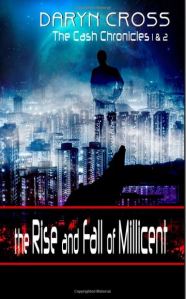
What is the glue that holds this series together, the constants? Think of one or a small number. In my series The Cash Chronicles—which was just released in print this month with The Rise and Fall of Millicent—the story centers around a dystopian word where the U.S. no longer has part of its land mass and has come under the tyrannical rule of the Primera, a woman who was cryogenically frozen and then cloned at a later date in the future. If you use the same locations each time, make sure these locations, their places, etc., stay the same in each book.
5. Do the hero and heroine stay the same in every book or do they change?
If the hero and heroine are the same, how will you ensure that they can hold your readers from book to book? What is suspenseful that continues to propel readers forward? If hero and heroine change, what continuity do you bring over from earlier books?
6. Tone of the books—needs to stay similar.
You can’t have one dark and one light, one funny and one somber, one sweet and one ultra hot. The transition between books need to be smooth like a nice glass of wine or a great piece of jazz music.
7. Keeping all the characters straight—do you have them written down somewhere, including physical and personality details?
This is very hard after you write 80—100,000 words times three or four or five. Write down all your characters, their idiosyncrasies, their traits so you can reference to make sure they stay the same. Even if they’re short-term in the book or the series, you need to keep track of the names and using the same letters, etc. Consider doing some back-story, other things about what make them who they are. You may want to do a companion book like Sherrilyn Kenyon did for the Dark Hunter series.
8. Website—does your world have its own distinct website?
This may be a good idea if the series is long. Always be ready to greet your readers and fans with information to whet their reading appetites.
I hope this has gotten you to start thinking, or maybe a single title sounds real good about now…
Bobbye Terry is the multi-published writer of fantasy, suspense and romantic comedy novels under her own name, her solo pseudonym, Daryn Cross, and her co-authored one, Terry Campbell. She also writes inspirational nonfiction. Her previous works have garnered finalist awards in the Booksellers’ Best and other RWA-sponsored contests. Bobbye’s most recent release is The Rise and Fall of Millicent by Daryn Cross, In the Stillness Publications. Nothing Ever Happens in Briny Bay, a compilation of the novellas in the Briny Bay mystery series by Bobbye Terry, will release this summer through Turquoise Morning Press. Additionally, she has a new inspirational book, The Light Within released in May 2013 and another Joy Glows, which will release mid-July.

Bobbye Terry
Pitcharama: it’s here!
Posted: June 14, 2013 Filed under: On writing | Tags: aussie-owned, contests, queries, small presses, young adult Leave a commentGot a completed manuscript? Want a chance to put your pitch in front of the eyes of eight small press editors? Now is your chance. Go go go! (NOTE: If you don’t have a blog but want to enter anyway, post your pitch here in the comments section of this post on my blog as per the original requirements, and then link it here on the linky list.)

Ladies and gentlemen, it’s the time you’ve all been waiting for… Pitcharama is here! *Insert trumpeting fanfare*
We are so excited to offer you this opportunity to have your manuscript seen by some of the world’s top independent publishing houses. See who they are here.
Sign up your blog with our dear friend Mister Linky Tools below and then post the following information on your blog:
Manuscript Title:
Author:
Age group: (YA/NA)
Genre:
Word count:
250 word blurb:
Quick, do it now! The Aussie Owned and Read team will stop by and select our favourite 24 queries to go through to the publishers round over the next four days and then, AND THEN, we will share them on our blog on the 28th when the big guns stop by. Don’t worry, though; you will know who made the cut on the 19th, when we announce our top 24.
Don’t get…
View original post 58 more words
My boy turned four
Posted: June 13, 2013 Filed under: On parenting, On writing | Tags: motherhood, Thursdays Children 6 Comments
I missed Thursday’s Children last week because it was my son’s birthday. He just turned four, which is weird because I’m pretty sure it was only a few days ago that I was finally being induced at almost 42 weeks gestation. He didn’t want to come out. (I should have realised then how stubborn he was—turns out he really didn’t want to come out and I ended up having an emergency c-section.)
When he was a tiny baby I was wistful about the fact he’d stop being a tiny baby, and terrified of him being a toddler. But it turns out that wasn’t so bad either—suddenly he was cracking jokes and dancing and smothering me with kisses (as well as tantrums), and that was fun too. And words! Seeing him discover words was a joy! Now he’s a pre-schooler and I can see what an inquiring mind he’s going to have. He already has the best vocabulary of any kid in his room at daycare. And I’m really looking forward to him being able to read books, so that together we can (re)discover all my childhood favourites. It seems like every age has its own type of awesome to give a parent, and I’m enjoying the ride.
As for how he’s inspired me, I’ve got two picture book drafts kicking around that I wrote after he was born. I never would have thought I’d be a picture book writer, but reading all those books to him made me want to write for him too. (As an aside, if I entered all the picture books I read into Goodreads then I’d stomp all over my goal for 2013!)
I realise I’ll probably never see them in print, because the PB market is, I understand, even harder to crack than the market for novels. But that’s not really the point. And occasionally I send my favourite of the two off—it’s called Eric Emu to the Rescue—to another publisher, just in case.
Who knows; maybe as he gets to late primary school I’ll dabble in middle grade fiction too.
He also inspires me to write my YA and adult fiction, although I realise that if he grows to be a typical teenage boy my female protagonists aren’t exactly going to be his cup of tea. But I want him to grow up to see that if he has a dream and he works hard enough, he can make it come true: I wanted to be a published author, and next year that dream will come true for me (squee!).
So this blog post is just to say thank you to my son, because he brings me so much happiness. I love you, stinky face.
Do you have children? Do they inspire you to write?

Aww, baby

From baby to … BATMAN!
Click here to see this week’s other Thursday’s Children blog posts.
Seeking feedback: the importance of critique partners
Posted: June 9, 2013 Filed under: On writing | Tags: beta readers, editing, writing 12 Comments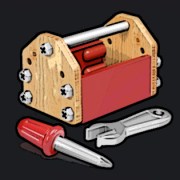
Writer’s toolbox: an artist’s impression. (Original photo from wiki commons.)
Stephen King—who is pretty much the god of writing as far as I’m concerned—said writers should write with the door closed, and edit with the door open. In other words, once you’ve done your first draft, you need to let a few people, people you trust to be honest without being cruel, read it and give you some feedback. These crit partners are often referred to as “beta readers”.
The way you might choose to approach getting that feedback, though, is up to you. There are two basic approaches.
The perfectionist writer lets the drafted manuscript percolate for a month or so, then re-reads it and does a first-round edit on it before letting anyone else lay eyes on it.
Pros: This is a great approach if you want to make sure that your beta readers aren’t going to be distracted by random typos or plot holes you could drive a semitrailer through.
Cons: It’s possible to get stuck in a cycle of editing and re-editing—possibly induced by fear, the mother of procrastination—and never actually let go of your baby enough to give it to someone else.
The sharer is a writer who completes their first draft and then sends it straight out to all their beta readers.
Pros: You can get an idea of where the weaknesses are early, so when you do your first edit you can fix them straight away, rather than tinkering around the edges, working on things that may have bigger problems—the writing equivalent of putting a coat of paint on a car whose engine doesn’t work.
Cons: There will be problems with the first draft—and many of them will be problems you could have fixed if you’d taken the time. That means your beta readers will have a lot more to criticise, which can be a blow to the ego—potentially a fatal one if you’re a new writer struggling with self-doubt.
Both of these approaches work for people, and both have things to offer. But I have writing friends who actually use a middle ground approach, by using an alpha reader.
The alpha reader is the one person you trust to give you the feedback on your raw work. They see it before you edit, and help you shape the direction of your work, but without stomping your heart into the floor. A lot of people use their significant others for this. I know of some that actually give their chapters to their alpha reader as they are completed, before the entire work is finished. This has the benefit of egging them on to write, but you’d want to choose your alpha reader even more carefully in this case, to make sure you don’t get sucked into doing revisions when you should be drafting in the first place.
My boyfriend is my alpha reader. I wouldn’t show him, or anyone, an incomplete manuscript—I’ve feel like I’ve only just become brave enough to share it with others in the first place!—but I do brainstorm with him when I come up against a difficulty in the plot.
For example, I realised recently that my current work in progress was going to run short if I continued to follow my outline. It’s an adult (or possibly new adult) manuscript, and it was looking like tapering out at about 50k words—around 30k shorter than I was aiming for. I explained where the story was up to and what the antagonist’s resources and plans were, and he came up with a few suggestions for things the antagonist could do to throw spanners in the works—even more spanners than I already had. A whole toolbox of spanners.
It helps that my boyfriend is an evil genius, of course.
What is your approach to getting feedback on your writing? Do you fall into any of the camps I’ve described, or is your approach different again? I’d love to hear from you!
Twitter Contest to Win an E-Copy of ‘The Best Man’ by Ana Blaze
Posted: June 7, 2013 Filed under: On Books, On Twitter | Tags: contests, Twitter Leave a commentBeth Chase is too busy planning perfect weddings to worry about the lack of action in her own love life. But if she was looking for a man, she wouldn’t be looking at Colin Pratt. Her boss swears that Best Man Colin is a quiet scholar and science fiction writer who couldn’t possibly cause a fuss at his own brother’s wedding. He’s clearly never met the man in question. Snarky, sexy and more than a little inebriated, Colin is the final obstacle between Beth and the last perfect wedding she needs to make partner. Of course, when she helps him into a taxi at the end of the night she has no idea that he’s only just begun to poke holes in her professional exterior. Colin might have the skills to seduce a romance professional, but can he convince her that he’s the best man to share her happy ever after?

Find The Best Man on Goodreads, or at Amazon, Barnes & Noble, Kobo or Smashwords. The Best Man is also available from Entranced Publishing.
Watch the trailer here.
Contest Details
Entering is easy. Just tweet @ana_blaze and include the hashtag #TheBestMan between midnight EST on 7 June 2013 (NOW!) and 11:59 p.m. EST on 8 June 2013!
For example, you could tweet:
@ana_blaze I married #TheBestMan I know.
@ana_blaze #TheBestMan is on my must read list.
@ana_blaze #TheBestMan made me breakfast in bed.
@ana_blaze I love sexy nerds. #TheBestMan
@ana_blaze I wish Beth would plan my wedding. #TheBestMan
@ana_blaze Being #TheBestMan is tough, but someone’s gotta do it.
or even just:
@ana_blaze I want to read #TheBestMan!
You get the idea. Twitter rules ask that we don’t have too many duplicate tweets, so it’s best (and frankly way more cool) if you come up with your own tweet. Ana is really looking forward to seeing what folks come up with. And hoping for some tweets about how to be #TheBestMan. It’s also best if you are following Ana on Twitter. Apparently that’s the only way to guarantee that your tweet shows up in the search.
You’re welcome to tweet (and enter) more than once, but please not more than once an hour. Let’s not annoy the Twitter-folk too much.
This contest is open internationally.
Void where prohibited. 😦
You can find Ana at her blog, or on Facebook, Twitter, Pinterest or Goodreads.
Goodreads is nagging me
Posted: June 2, 2013 Filed under: On Books | Tags: Goodreads, reading 17 CommentsGoodreads* is nagging me.
I set a rather ambitious goal for the amount of books I’d read in 2013, because last year I didn’t read that many books, and I felt bad, like my brain was a pot plant I’d left on the windowsill to wilt in the sun for lack of water.
My goal is forty books—and okay, that may not be ambitious to a lot of people, but for me that’s a lot more reading than I have time for. One book every week and a bit. Goodreads tells me I’m two books behind. I’m about halfway through two different novels that I’m quite enjoying: Keir by Pippa Jay and Quite Contrary by Richard Roberts. If I spent all of today and tomorrow reading both of them then I’d catch up, but I also want to get some writing done.
Not to mention the fact I’ve got a little boy to keep entertained and housework to do. Sigh. (I know: wah, right?)
I’ve considered getting some audiobooks so at least I can “read” in the car on the commute to and from work. That’s one thing I miss about not being able to use public transport anymore—I loved my reading time on the bus to uni and back. The only thing is that I’ve got a TBR pile that’s about fifty books deep. These are almost all paperbacks I’ve already paid for, and I hate the idea of having to buy the book again to listen to it.
Bring on the day when I can hand my smart phone a novel and it will read it for me. Maybe in David Tennant’s Tenth Doctor accent.
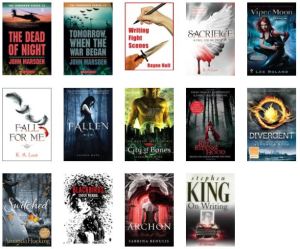
My 2013 reads thus far
How many books do you read in a year? Do you struggle to read as much as you’d like?
* No, I don’t have a Goodreads account linked to this profile. That’s because it’s on my personal account; I haven’t set up an author account yet. I will, when I get around to it. One day. Hey, I have lots of other social media!
Pitcharama: manuscript pitching contest
Posted: June 2, 2013 Filed under: On Books, On writing | Tags: aussie-owned, contests, queries, small presses Leave a commentIf you’re a writer of young adult or new adult fiction, and you have a completed manuscript that’s ready to go, there’s a fantastic opportunity this month over at Aussie Owned and Read!
Eight publishers will be participating – we’ll announce who in the next few days, but they are all open to submissions internationally, so this isn’t just an opportunity for Australians. If I hadn’t just signed with Turquoise Morning Press I’d be really disappointed, because I’m not eligible to enter! :p
The details are on the Aussie Owned blog, so you can start refining your pitch. Make sure you follow the Twitter account as well, so you don’t miss out on any updates.


 Cassandra Page