Why I have an agent
Posted: July 28, 2013 Filed under: On writing | Tags: agents, guest post, traditional publishing, writing 4 CommentsToday’s guest post is by Amy Reichert. I’ve had a few posts on indie publishing and small presses, so I’m really happy that she and Emery (see previous post) have provided us with the other side of the coin. I’m all about “fair and balanced”. 😉
When Cassandra asked me to blog (and a huge thank you for that), she suggested I write about why I chose to go the agented route—I’m represented by the talented Rachel Ekstrom of the Irene Goodman Literary Agency. My initial response was, “Why wouldn’t you?” But with the rise of small publishing houses and self-publishing, many do feel finding an agent isn’t worth the hassle. The queries, the rejections, dear God, the waiting. It can crush your writerly dreams like Snuffaluffagus on a grape. So, dear reader, your path to publishing is your own, but here are few reasons why I wanted an agent.
- Reassurance. You know that kid in school who always wanted the teacher’s approval. Or your co-worker that needs the pat on the head from the boss to feel good about his work? That’s me. I want someone in the publishing industry to read my book and say, “I read a lot of books and this is so good I will convince people to buy it and print it.” I don’t have the confidence or the balls to do that myself. I need the approval.
- Guaranteed Critique Partner. Critique partners are essential to making a manuscript better. If you don’t have some, get them. However, until you establish a solid circle of beta readers, it’s hard to tell if you’re getting the honesty you need. Many people aren’t comfortable telling you your writing sucks. Since my agent has a vested interest in my book being its best, I know she’ll give me high quality, blunt if necessary, feedback.
- Options. With an agent, I have all the options. I’m not limited to small presses or self-publishing. I could get a book deal with a big house, or medium, or still end up self-publishing (though that isn’t my preference—see the following reason). Together, my agent and I will discuss what is best for my book and my writing career, then work as a team to make that happen.
- Publisher. While having an agent leaves me with all the options, I really do want a publisher for my book. One that comes with an editor, a beautiful-cover designer, and people who know about paper, ink, and fonts. And maybe a little marketing on the side would be nice. I don’t want to do it all. I want to focus on writing and interacting with readers. Working with a publishing house gives me a team of experts who are there to help my book into the world. I’m willing to give up some creative control to have all that publishing knowledge.
- Negotiation. Unless I’m at a street market in Mexico (in which case I’m a badass negotiator), I suck at negotiating things. I don’t even like calling the cable company and asking for a refund when service goes out. My agent knows the industry and what would be a fair offer, what rights to give up, which rights to keep. She knows everything is open for negotiation. She will also play bad cop if I’m not happy with my publisher. This is good because I also don’t like conflict. I’m a midwesterner, I like to be agreeable and feed people.
- Knowledge. Legal contracts are complicated, nuanced beasts that even regular lawyers don’t understand completely, but agents eat them for breakfast, lunch and dinner. As boring as they are, it’s what makes the publishing world clunk along. I want someone who will have my back and make sure I don’t give away my left kidney in exchange for an ebook deal.
- Money. I like money and I’d like more of it so I can take fun trips with my kids and maybe pay for their books when they finally go to college. Yes, every dollar I make will have a slice removed for my agent, but I’m more than OK with that. I feel that with her support in selling my book and future books, her knowledge of the industry, her negotiations skills, etc… I’ll make more money in the long run than if I went it alone. Maybe even enough for a fancy treadmill desk.
Have any questions for me? Ask in the comments, I love to share my wisdom. If I don’t know, I’ll just make up an answer.
Amy Reichert is a first-time novelist, mother of two (three if you count the dog—and you should), beloved wife, spectacular procrastinator, die-hard Harry Potter fan, and amateur baker. She earned her MA in English Literature and worked for several years as a technical writer. When she’s not writing or reading, she’s taking the children somewhere, drinking hard cider, or collecting more cookbooks than she could possibly use. Amy is represented by Rachel Ekstrom of the Irene Goodman Literary Agency.
You can find Amy at Twitter or her blog.

What I wish I knew before my book deal
Posted: July 25, 2013 Filed under: On writing | Tags: editing, guest post, queries, traditional publishing 5 CommentsToday’s guest post is by Emery Lord, whose first contemporary YA novel is out with Walker/Bloomsbury next April. I’ve had a few posts on indie publishing and small presses, so I’m really happy that she and Amy (whose post will go live on Sunday) have provided us with the other side of the coin.
Hi y’all, I’m Emery! Cass was kind enough to invite me to talk about what I wish I knew before my book deal.
My biggest Wish-I-Knew? That the querying process was giving me tools I needed for the rest of my publication path.
(Just for clarification, I’m going to be talking about the way I pursued [traditional] publication: wrote a book, revised it a lot, queried agents, signed with one, revised some more, went on submission to houses, sold. Also, add in some rejection, angst and brownie-gobbling during and between every step. 😉 )
I guess I thought of querying as a wall—a tall gatekeeper set up on the road to publication. For some people, it’s a glass wall, easily demolished with a few thrown query-rocks. For others, it’s a brick wall that is chipped away at over years. It can be laborious and time-consuming and sometimes disheartening. I think it’s easy to wish that an agent would magically pick you from on high, before you even struggle through the querying.
But the querying process isn’t just a way to get an agent. It’s a way to get vital practice for what’s waiting down the publication road. If I’d known that at the time, I think querying might have felt a bit easier to handle!
Pitching
When querying, you write up a few-paragraph pitch, maybe a synopsis, and possibly a one-line “elevator pitch.” Learning how to describe your story with brief but distinct details is vital once you sell a book. Plus, your agent may actually pull from your query text to create the submission pitch! So, all that time laboring over my query and synopsis? I now see it as a training ground for a skill I needed to start learning.
Waiting/Radio Silence
It’s so hard. But waiting is a reality of every step of traditional publishing. It’s good to learn your coping mechanisms sooner. (Mine: whipped cream straight from the can, shoe shopping, and diving into a new project.)
Rejection
It happens with editors much the same way it happens with agents: inevitably–some quickly, some slowly. You might get feedback; you might get a generic ‘not for me’.
These are hard messages to receive, but I’m glad I’ve gotten a taste of that. Because writing is so personal … but publishing makes it public consumption. There will always be rejection or disinterest from someone, and that’s okay. It’s still worth it. (Can you tell I’m trying to emotionally prepare myself for the 1-star Goodreads reviews…? 😉 )
Feedback
Sometimes you get feedback from agents you queried; sometimes you don’t. Same goes for editorial submissions. I learned not to judge that feedback from my first week’s reaction to it. Sometimes it rang true once the sting wore off. Some agents (and likewise some editors) will give you an R&R (revise and resubmit). Even if they don’t ultimately sign you, they’ve given you experience in revising with/for someone, which is a huge part of the post-book-deal process!
So, there you have it: the fruitful moments I wish I’d recognized when I was in the querying trenches! Happy writing to all of you, and thanks to Cass for having me!
Emery Lord is a 20-something American girl who writes stories about high school and best friends and weird families and the crushes that make you feel combustibly alive and also more awkward than you thought was possible. If you’re not sure how to pronounce Emery, try slurring the name “Emily,” and that will get you really close. Her first book, OPEN ROAD SUMMER, will be out in Spring 2014 with Walker/Bloomsbury.

Why editing is like streaking
Posted: July 19, 2013 Filed under: On writing | Tags: aussie-owned, editing, guest post, writing 4 CommentsI’ve seen a lot of writing metaphors in my time. But this one is totally new to me. I hope you enjoy this guest post by Lauren McKellar!
If you’re a sports fan you’ve no doubt seen a man naked before. Of course, I’m not referring to the locker room or some more extreme version of sumo wrestling, but more to the one sport that seems to get everybody talking: streaking.
Recently, us Aussies watched a rugby league game where two of our fine states went head-to-head in a battle to win the shield. Or it could have been a plate. Maybe even a trophy. Have I mentioned I’m an editor, not a sports journalist?
So, they battled it out to win. It was the series decider and the question on everyone’s lips was: Will Queensland take it out for the eighth year in a row?
Yet the day after the match the winning state wasn’t the most reported on topic of conversation; instead, it was the guy who streaked.
Which got me to thinking (and I should warn you, this is a stretch): editing is like streaking. Do it well, and you notice it. Fail to have it, and you’re left with a lack of exposure and no chance of going viral.
That’s not where my loose connection ends. When preparing your book for an editor, there are a few leaves you can take out of the streaker’s book to enable your expert to focus on the bigger elements at play. These tips include:
Shedding those outer layers, baby. If there’s one thing a streaker does well, it’s delete excess items of clothing. You need to ask yourself if, as a writer, you have any.
Is every paragraph, every scene, every chapter moving your story forward? Are you telling us some new information we need to know with every sentence you craft?
Because if not, it’s time to make like a streaker and delete, delete, delete! Your editor will thank you for it.
Break the rules. Yes, there are rules of grammar and no, you don’t want to look like an idiot and use ‘there’ when ‘their’ would have been a better choice. Still, there are times in writing when you’re allowed to break the rules.
Technically, you’re not supposed to start a sentence with the word ‘and’,
And I guess you’ve never done that, right?
If there were a naked man at every game we’d quickly get bored and lose attention. But a well-timed streaker can take a rugby match from dull to damned interesting in a heartbeat!
Sometimes, being a literary badass can give your writing character and help get your point across. Go against the grammar grain and run naked across that football field; you deserve it.
Eliminate the backstory. One of the most common editing issues I come across is excessive chunks of backstory just vomited throughout a manuscript.
I have to confess; I am guilty of committing this crime in my own work. I’ll be all ‘What? No! Never!’ and then look at the highlighted paragraph in question: a quick little explanation on my childhood best friend, my family dynamics throughout history and a short snippet on how I used to be a nerd but now I’m a crime-fighting superhero, and realise I’m guilty as the next person.
Search your manuscript for backstory and include it naturally through relevant dialogue, pertinent flash backs or a subtle sentence here and there. Remember, as readers, we’d like to think we’re pretty smart. We get it, already.
And how is this like streaking? Well, just like you don’t want to have too much backstory on the record in your manuscript, a streaker doesn’t want to have too much of a streaking history on his criminal record. After all, get caught streaking once, face a hefty fine. Get caught for streaking twice…now you’re a crazy man who thinks he’s the emperor wearing a new suit.
Lauren McKellar is a freelance editor currently taking on new clients for late August and beyond. With over six years publishing experience, she is currently a Senior Editor for digital romance house Entranced Publishing. For more information on her services, visit her website here.
Why self-publish? And ‘The Last Knight’
Posted: July 4, 2013 Filed under: On Books, On writing | Tags: blog hop, book launch, guest post, self-publishing, young adult Leave a commentA little while ago I posted my four reasons why I chose not to self-publish. I made the point, though, that I don’t jude self-publishing or those that do it, just that it wasn’t the right decision for me at the time. So, in the interests of balance, my guest post today is by Nicola S. Dorrington, about why she chose to self-publish her debut novel, THE LAST KNIGHT.

Nicola S. Dorrington
I never planned on self-publishing. Like most writers I dreamed of the ideal. Securing an incredible agent, then getting a fantastic book deal with one of the big publishers. After that is was all fame and fortune and ‘the next J.K Rowling’.
Funny how dreams don’t work out the way you expect them to.
When I tell people I’m self-publishing the first question I get asked is why.
The fact is, my reasons for self-publishing are mine alone. It’s not the right path for everyone, but it is the right path for me.
Let me break my reasons down for you.
The first reason is that the publishing industry is first and foremost a money-making business. I get that and I respect it. But it does mean that publishers are not risk-takers. I don’t blame them. Why risk large sums of money on an untried and untested new author – or a new idea?
The problem with that is that the market is sadly dominated by a lot of similar books – I could count on one hand the number of YA books I’ve read recently that have broken out of the mould.
And The Last Knight doesn’t really fit that mold. So I’m taking the risk that publishers won’t take. The joy of self-publishing my ebooks is that the risk is only to my reputation – not to my pocket.
Which brings me to my second reason. I’m not in this for the money. I’m not going to make my millions self-publishing. And I’m OK with that. For me it’s all about just getting my book out there. If I sell ten copies or I sell ten thousand – I don’t mind. If just one person reads and enjoys The Last Knight I’m happy.
And then we come to my third reason – control. Maybe I am a little bit of a control freak but the best part of self-publishing is that I have final say – on everything.
The cover is my choice. The book blurb says what I want it to say. I decide the price I sell it for and how I market it. And I decide what content stays and what goes.
Admittedly it means I am missing out on a professional editor (and don’t get me wrong, there have been times – about the 30th edit when I was still finding typos – when I regretted that), but it also means that I don’t have someone trying to change my idea of what the story should be. I am almost certain that had this book gone through an editor at a publishing house they would have wanted more romance. I don’t. I like it the way it is.
This book is my baby, my creation – and succeed or fail it will be down to me.
So those are my reasons. That sometimes it’s worth taking a risk, that it’s about the readers not the money, and that ultimately it’s my book, and my vision.
Don’t get me wrong, there are still moments when I wonder if I’ve made the right choice: when I look at the stigma still attached to self-publishing, or when I wonder if the book could have been improved by a professional eye. But at the end of the day I’ve taken my future, and my career, into my own hands. Succeed or fail, no one can say I didn’t try.
About The Last Knight
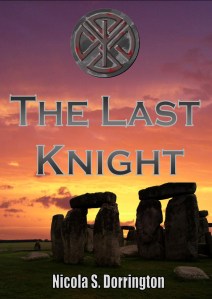 Seventeen-year-old Cara Page Knows what mark she’s going to get on her English test next week. She knows in three days her history teacher is going to be late because his car broke down. She knows she’s going to give the new boy a nose bleed on his first day.
She knows because every night she dreams of the future, and every day those dreams come true.
Now she’s dreaming of a boy, and a future that can’t be real. Because if it is, then everything she thought was myth and legend is actually true, and there is an evil coming that will tear the country apart.
Lance Filwer is a boy with secrets of his own, and a past full of mistakes he can’t undo. Cara is his second chance, his chance to succeed where he failed before – if only she’ll trust him enough to let him help her.
Cara needs to know what’s happening, but the answer lies in a long-forgotten past, and an ancient legend. To find it Cara will have to travel into the depths of Wales, and the heart of ancient Britain.
With Wraiths, creatures from the darkest of myths, dogging her every move, Cara knows it’s only a matter of time before they catch up with her. And, myth or not, they will kill her.
Her only hope is Lance, and the birthright she must claim, if she is to prevent the future she has foreseen.
You can buy The Last Knight on Amazon, or add it to your to-be-read shelf on Goodreads.
Finding inspiration, and ‘In Stone’
Posted: July 3, 2013 Filed under: On Books, On writing | Tags: book launch, guest post, inspiration, writing, young adult 3 Comments
Today’s post is by one of my mates from Twitter, the gorgeous Louise D. Gornall. Her debut novel, IN STONE, was released on Monday, so the first thing I wanted to say was HAPPY BOOK BIRTHDAY!
Massive thanks for having me on your blog today, Cass!
So, I’m here to tell you guys the inspiration behind In Stone. Of course there was music, various breath-taking landscapes and thousands of hours spent searching through pictures on Pinterest. Then there were the emails between me and my CP, as well as the countless 4am brainstorming session with my twin sister. All of these things were inspirational, and the book would have undoubtedly sunk without them. However, if I HAD to single out three things that were inspirational in the pre-writing stages of In Stone, they would be:
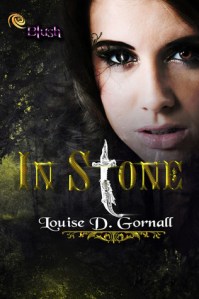 1. This quote from Friedrich Nietzsche: “And if you gaze for long into an abyss, the abyss gazes also into you.”
2. Then there was a conversation I saw between two agents on Twitter that amounted to ‘stakes in a story are significantly lowered when immortals are involved because immortals, after all, can’t die.’
3. And then there was the plot of The Lord of the Rings.
I’m not going to go into too much detail because I will undoubtedly—however inadvertently—end up giving away the plot of In Stone. It wouldn’t be the first time I’ve done that. I just wanted to tell you a little bit about how these things wormed their way into my imagination and helped me cook up a story.
So, I think the first point is pretty standard. Who doesn’t find inspiration in a good quote? This one spoke volumes to me. I’ve read a couple of academic articles that all ponder its meaning, but I took it at face value when I applied it to my plot. To me this quote says that if you’re going to hang around with bad guys, eventually some of that badness is going to rub off on you…
The second point was something I’d been thinking long and hard about for a while. I knew I wanted my MC to be an immortal, but I didn’t want my stakes to be significantly lower because of it. This conversation really got me thinking about how I could avoid compromising my stakes, and that in turn helped me to develop a huge element in my plot.
Finally, The Lord of the Rings is my favourite film of all time. I love everything about it. I would have loved to have had the balls to attempt a retelling of Tolkien’s epic tale…but I don’t. So instead I borrowed some aspects of LOTR. Location, for example. One of my favourite things about LOTR is that it is as much a physical journey as it is a mental one. Plus, you know, I’m a writer. I like to add to my characters hell whenever I can, and dumping them in unfamiliar landscapes while they had this epic task to undertake was just too perfect. And then of course, there was the idea that this one tiny thing (a ring) could cause so much trouble and make even the most loyal of people turn rogue.
…and I’m going to stop now because my spoiler senses are tingling. I’m a bit of a sponge when it comes to inspiration. I find a little bit of something in everything, but these three things were definitely responsible for shaping In Stone.
BOOK BLURB
Beau Bailey is suffering from a post-break-up meltdown when she happens across a knife in her local park and takes it home. Less than a week later, the new boy in school has her trapped in an alley; he’s sprouted horns and is going to kill Beau unless she hands over the knife.
Until Eighteenth-century gargoyle, Jack, shows up to save her.
Jack has woken from a century-long slumber to tell Beau that she’s unwittingly been drafted into a power struggle between two immortal races: Demons and Gargoyles. The knife is the only one in existence capable of killing immortals and they’ll tear the world apart to get it back. To draw the warring immortals away from her home, Beau goes with Jack in search of the mind-bending realm known as the Underworld, a place where they’ll hopefully be able to destroy the knife and prevent all hell from breaking loose. That is, provided they can outrun the demons chasing them
In Stone is available from Amazon, Barnes & Noble and Kobo. You can also add it to your Goodreads list here.
EXCERPT

Louise. I told you she was gorgeous.
As a general rule, nobody walks the Switch on account of the overgrown nettle bushes, a pungent aroma of foot infection, and a collective fear of encountering something feral. However, the Switch shaves at least ten minutes off my journey, and lately I don’t trust the dark. I blame my encounter with the almost-corpse, two nights ago. Before then the dark was just a natural progression: something to be slept in, a different color in the sky. Now, shadows make me jump, and the dark carries a silence that makes me think of funerals. It breathes life into creatures that had always been safely contained behind a TV screen. I make my way down the Switch, striding over vicious flora and trying to ignore the occasional nip that sinks straight through my jeans.
“Hey, Beau!” A voice from behind startles me. When I turn, Gray is jogging in my direction, thwarting thorn bushes with his bare hands. “I was looking for you.”
The hairs on the back of my neck bristle. My hand is in my pocket, and my fingers are wrapped around a slender cylinder of pepper spray as he reaches me.
“Well you found me. What’s up?”
“There’s something I need to ask you,” he says sheepishly. He hammers his toe against the ground, grinding it nervously into the dirt and crushing several stems of dandelion into gold dust. He giggles; it’s a soft, sweet sound that suffocates my hostility. He reminds me of Mark moments before he’d asked me out on our first date. Maybe this guy could be the one to liberate me from my social network sabbatical. Maybe my slightly-too-heavy eyeliner and my reputation as the mortician’s daughter hasn’t freaked him out.
“Really?” Surprise raises my pitch. “What’s that?” The pepper spray is abandoned in my pocket.
“Where’s the knife?” he replies, snatching my throat and slamming my back up against the concrete wall. It’s so forceful, so hard, that my spine ripples. Red flashes across my vision. The muscles in my neck go slack, and my head flops forward. He stabs his thumb up under my chin, forcing me to look him in the eye. His eyes are like the moon; cold, giant circles of icy-silver. But a change in his eye color is nothing in comparison to the change happening on either side of his head. I don’t understand it. It makes me wonder, briefly, if what I’m seeing is a side effect of the migraine pills Leah slipped me at lunch. Gray is growing horns. Giant grey horns that slide out of the side of his skull and then curl like springs around his ears. They’re animal.
Brake and accelerate: writing advice from Chuck Wendig
Posted: June 30, 2013 Filed under: On writing | Tags: Chuck Wendig, editing, pacing, writing Leave a commentOne of the things I struggle with as a writer is pacing. My first book needed major editorial surgery—after pointy-edged feedback from various folks, whom I owe for their insight and honesty—before I was able to get it right. It was less a problem of exposition in my case but of description. I was describing a lot of things, but many of them were the wrong things. What a room looked like, rather than what the character was feeling. Boring stuff, not the juicy stuff a reader really wants to know. Yawn.
So when Chuck Wendig posted his latest advice blog post, 50 Rantypants Snidbits Of Random Writing & Storytelling Advice, this one particularly struck me.
Know what speeds your story up and what slows it down. Dialogue is lubricant: frictionless. Description is grit: friction-filled. Action is a coked-up jackrabbit; exposition is a tired sloth. Short chapters are a bottle rocket; long chapters are a big boat. A story is the slowness of alcohol with the swiftness of meth; sometimes a story needs oxygen to breathe. Sometimes a story needs oxygen to light things on fire. Tension/recoil. Momentum/restriction. Green light. Red light.
Because I love writing dialogue, now I suspect I’ll need to guard against going too far the other way—too fast instead of too slow. (Of course, this is a problem to deal with when you’re editing, not drafting. When you draft, just get it down any way it falls out of your hands or mouth.)
Anyway, follow Chuck Wendig’s blog. Even if profanity offends you (and, believe me, he doles that out like Halloween sweets), follow his blog. He’s cussing you out for your own good. :p
Routine as an aid to writing
Posted: June 28, 2013 Filed under: On writing | Tags: Isla's Inheritance, music, Thursdays Children, writing 10 Comments (This is a Thursday’s Children post, but I’m posting it Friday morning. Hey, it’s still Thursday somewhere in the world!)
The stereotype of a writer at work is often that of a person with a laptop in a coffee shop, observing the clientele and sipping their latte as they tap away at the keyboard. I am not that writer. I am getting better at tuning out background noise—I have a preschooler, after all—but I’m only really able to write under those circumstances when I’m really in the zone. On a normal day it’s a struggle, and I usually only write once my son is in bed and the TV is off.
Until recently, I also had a housemate. His computer was in the same space as mine and he was mad keen on World of Warcraft—so while I prefer to write without music I used to fire up whatever was on the hard drive and put headphones on, to block out the sound of orcs being slain or whatever he was doing at the time. I didn’t usually need to have the music up loud, but just had it on as white noise.
The thing is that for a while there was only one album on my hard drive. I don’t like to use the CD player in the computer because it’s old and sounded like a jet engine preparing for takeoff (even through the headphones). I could have copied some other music onto the hard drive to have it available, but I never got around to it and, after a while, playing that particular album was habit-forming.
 And that is why I can’t hear the violin at the start of the orchestral version of I’m in a Cage by Tim Minchin (from Tim Minchin and the Heritage Orchestra) without my brain shifting gears into writing mode. I wrote my first two books—Isla’s Inheritance and its sequel—to this music. I’m hesitant to describe the album as the actual soundtrack to those books, because the music isn’t actually related to the story (I didn’t write a comedy, for a start)—but the album was the soundtrack to my writing.
My current work-in-progress is mostly being written to the blissful sounds of a quiet house. I did experiment with some other CDs (played in the CD player—I’m so old-fashioned), but none of them grabbed me. It seems I can only write to silence or Tim Minchin.
Hey, whatever works, right?
Do you have particular music you play to get yourself in the mood to write, or other routines that you always follow? Do you struggle without them?
Click here to see this week’s other Thursday’s Children blog posts.
Why I Write Women’s Fiction
Posted: June 22, 2013 Filed under: On Books, On writing | Tags: book launch, guest post, writing 7 CommentsThis guest post is by another of my fellow authors over at Turquoise Morning Press, Linda Rettstatt.
When I first began to write, I knew very little about creating a novel-length story or of all the mechanics that went into writing. I also knew little about genre. I knew what I enjoyed reading, so it made sense to write that kind of story. My favorite author at the time was Elizabeth Berg. She is brilliant at writing character-driven stories of women—ordinary women—who find themselves in extraordinary circumstances. Her characters are the women who live next door or down the street, or who work in the next cubicle. But Berg takes the reader into the emotional and psychological depths of these women who, as they face life changes and challenges, make us—the readers—feel just a little less alone in our own struggles. She makes us laugh at ourselves.
Some might say that my own background as a psychotherapist who’s done a great deal of counseling with women would lend to writing this genre. And they would probably be right. I set out not to write like Berg, but to write stories about women facing challenges and possessing both vulnerability and strength. I targeted women readers and branded my writing as: Writing for Women—Stories of strength, love, humor and hope. These are the elements I consciously try to incorporate into every book. These are the elements I also find in the books of other writers whose work I admire. Berg, of course, Kris Radish, Elin Hilderbrand, Claire Cook—just to name a few. Kris Radish, a bestselling author in her own right, was kind of enough to give me a quote for Unconditional. Now that’s exciting, when one of the authors you most admire comments (positively) on your work. A true ‘squee’ moment.
Although I also write contemporary romance, when I sit down to write a new women’s fiction novel, it’s like slipping my feet into an old, familiar pair of shoes. They just fit right. Some have asked me, “What’s the difference? Your women’s fiction books often contain romance.” What can I say—I’m a romantic at heart. And romance is largely targeted at a female audience. I don’t think that placing my books under either heading locks them into one or the other sub-genre, but gives readers a hint that women are especially going to identify with the story and the characters. At least, that’s my hope.
Linda Rettstatt is an award-winning author who discovered her passion for writing after years of working in the human services field. When she’s not writing, Linda loves travel, nature photography, and figuring out what makes people tick. Her fantasy is to win the lottery, buy an old Victorian home on the eastern shore and open a writers’ retreat. While she waits for that fantasy to materialise, she continues to live and work in NW Mississippi and to write under the constant observation of her tuxedo cat, Binky.
You can find her at her website, blog or on Facebook or Twitter.
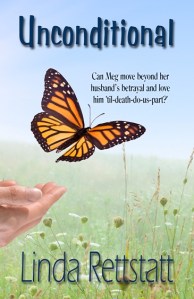
Unconditional (May, 2013, Turquoise Morning Press)
Meg Flores has it all—a loving family, a fulfilling career, and marriage to her best friend, Thomas. She is devastated when her husband announces he wants a divorce so he can pursue a relationship with his secretary—his male secretary. For Meg, the betrayal goes beyond that of a cheating husband. She is losing her best friend and the hopes for adding a child to her life.
Available from Turquoise Morning Press, or at Amazon.com, B&N.com and Smashwords.com.
On chapter titles in fiction
Posted: June 20, 2013 Filed under: On Books, On writing | Tags: chapters, Thursdays Children, writing 15 Comments I love a good chapter title in a book. I really admire writers who manage to come up with a title that summarises the chapter, gives the reader a sense of what’s to come, but without being spoilery. I love chapter titles so much I always thought I’d use them—but when I stopped, partway through drafting Isla’s Inheritance, and thought about it, the idea of crafting the perfect chapter titles seemed as hard as crafting the perfect beginning. I seized up with panic, and decided I’d worry about it later. (That, by the way, is a great way to deal with writer’s block of any sort. Write around the problem and fix it later.)
Then I never actually got around to doing it.
My love of chapter titles started with J.R.R. Tolkien. I was given an illustrated, anniversary edition of The Hobbit when I was in late primary school. I loved that book. I’d alternate between reading about Bilbo’s adventures and staring at the illustrations of Smaug for hours. (As an aside, no one told me about the rest of Tolkien’s books till years later. I remember experiencing that wonder for the first time, the joy of discovering there are more books in a series that I never knew about. It took me a while to warm to Frodo, but he got me in the end.)
A conversation on Twitter about chapter titles the other day got me to thinking, though: do they actually make much difference to my experience as a reader? I looked at a random selection of fantasy and urban fantasy novels from my bookshelves, and the results surprised me. Because if you’d asked me who used chapter titles, I would have said fantasy writers do; urban fantasy writers don’t. I’ve read a lot of both, and that was my impression. But the facts only sort of bear that out—it’s a trend rather than a hard fact.
 On the fantasy (and light sci-fi) side of the shelf, Anne McCaffrey did an assortment of things with her titles. In Dragonflight, the first in the Pern series, she actually used poems instead of chapter titles (the poems written by the harpers in the book). This was like chapter headings on steroids, because if you’ve read the book you’ll know the main character actually has to solve a riddle in one of those songs to save the day. And they foreshadowed the storyline as well. Wow. (In others of her books, though, she used traditional chapter numbers.)
David Eddings uses numbers with some titles for parts. Raymond E. Feist, Kate Forsyth and Jay Kristoff use chapter titles. Mercedes Lackey uses numbers (sometimes with titles to say whose perspective it is, much like George R.R. Martin). Terry Pratchett doesn’t even use chapters!
On the urban fantasy side, Suzanne Collins had part titles. Cassandra Clare uses chapter names. Charles De Lint and Veronica Roth use numbers.
I think the most telling thing for me is how little impression some of the titles made on me. I only read The Hunger Games and City of Bones recently, but the fact there were titles in there didn’t even register—probably because they were both such compelling stories that I was far more interested in continuing on than dwelling on the title and what it might mean. If I was at the point where I’d re-read them lovingly many times, the way I have The Hobbit and Dragonflight, perhaps they would have sunk in as I stopped to marvel.
All of which brings me to my point: what are your feelings on chapter titles in fiction (especially genre fiction)? Do you think they add to your reading experience, detract from it, or make no real difference either way? Do you even notice them?
(I need to caveat this post with the statement that I didn’t look at every book on my shelf by the named authors, just a handful. So maybe all of them do both, and it was just coincidence that the ones I picked up were of a certain style.)
Click here to see this week’s other Thursday’s Children blog posts.
Pitcharama: what influenced my selections
Posted: June 19, 2013 Filed under: On writing | Tags: agents, aussie-owned, contests, queries, small presses 2 CommentsThe Pitcharama first-round selections were announced today over at Aussie Owned and Read. There are some great pitches there, although I’m sad we couldn’t take everyone through to the final round. (However, as I said yesterday, it’s not too late: the pitch-a-mate round opens tomorrow. Keep an eye on the blog for details.)
My three selections (in the order they were submitted) are:
- No Such Thing by Sarah Glenn Marsh
- Off Campus by AJ Albinak
- Barely Imagined Creatures by Pete Catalano
You’ll see that I chose two young adult manuscripts (both urban fantasy) and one new adult (an m/m romance). There were a few things that influenced my decision.
1. I love urban fantasy.
I write it, I read it—it’s hardly surprising that I would lean toward choosing it. This should give you an idea of how subjective this process really is.
2. Word counts were a big factor.
YA can run from 50k to 80k (or up to 100k for fantasy, but better to keep it lower than that for a debut novel). I chose pitches for manuscripts in that ballpark. If you want to read a great blog post on word lengths, this is the one I use as my rule of thumb.
Some of the digital-only presses may care less about word count, since they don’t have to pay the larger cost of producing a fat novel. I don’t really know much about that, though, so I assumed the normal conventions would apply in this case.
3. I looked at the participating publishers’ preferences.
We have several presses looking for romance (at least one of which publishes m/m—I checked!). We have several that publish paranormal, UF and dark fantasy. So I tried to choose pitches that I thought those presses’ acquiring editors would be interested in, to give “my” three authors the best shot.
This, by the way, is the same process you should go through if you’re pitching to presses or agents directly: look at what they buy or represent. Look at their website to see what they’re after. Most of them are pretty upfront about it, and it saves you from wasting your time and theirs. And, even better, saves you from the heartbreak of a rejection you could have avoided.
Anyway, that’s it. Looking back over the post, it doesn’t seem like rocket science to me, but maybe it’s helpful to someone out there. A big snuggle-y thanks to everyone that has participated thus far!


 Cassandra Page